

[Decoding Gen Alpha: A Deep Dive into Modern Slang and Linguistic Evolution]-[445. New English vocabulary? Learn Gen Alpha Slang with an 8-year-old expert!]
📋 Summary
Decoding Gen Alpha: A Deep Dive into Modern Slang and Linguistic Evolution
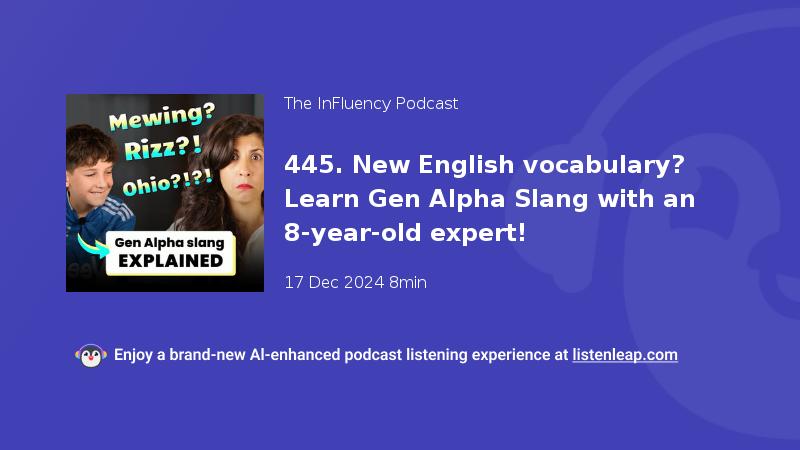
In a recent episode of the Influency Podcast, host Hadar sits down with a multilingual guest, Asaf, to navigate the rapidly evolving and often confusing world of Gen Alpha slang. As a parent of two tween girls, Hadar seeks to demystify terms that have become ubiquitous in youth culture, while simultaneously discussing the broader implications of language learning and the reality of being a non-native speaker.
The Gen Alpha Slang Lexicon
The conversation begins by addressing the elephant in the room: should adults actually use these terms? Asaf offers a pragmatic warning, suggesting that non-Gen Alpha speakers are likely to use these terms incorrectly, ultimately rendering them "Ohio"—a term used to describe something "cringe" or the polar opposite of having "Riz."
Here is a breakdown of the key vocabulary discussed:
- Riz: Derived from charisma, this term describes someone who is a charmer. One who possesses this quality is known as a "Rizler."
- Gjat: A direct, albeit blunt, slang term used to refer to a person's "butt."
- Mewing: A practice involving specific tongue and jaw positioning intended to improve one’s jawline, often performed for aesthetic purposes in photos.
- Ohio: A derogatory descriptor for something "cringe" or undesirable. If something is "Ohio," it lacks the appeal associated with being cool.
- Mid: Used to describe something average. However, as Asaf points out, for the current generation, being "mid" is synonymous with being "really bad," as the standard for excellence has shifted.
- Aura: A metric of "coolness." Individuals accumulate "aura points" based on their behavior and persona.
- Sigma: A label for someone who possesses high "aura." It represents an elite, cool individual.
The Reality of Multilingualism and Mistakes
Beyond the slang, the podcast touches upon the cognitive experience of a multilingual child. Asaf, who speaks multiple languages including English, Spanish, Hebrew, Catalan, and French, notes that he thinks primarily in English. This leads to a poignant discussion about the fear of making mistakes in a non-native language.
Hadar emphasizes that making mistakes is an inherent and necessary part of the language-learning journey. She reframes the experience, noting that "the fact that you make mistakes means that you know another language." They conclude that the ability to navigate multiple languages—and the courage to stumble while learning—is truly "Sigma" or, in more traditional terms, a powerful and impressive skill.
Conclusion: Fluency and Freedom
The episode serves as a bridge between generations. While Hadar jokes about her struggle to adopt Gen Alpha terminology—often using it incorrectly to the amusement of her guest—the underlying message is one of confidence. Whether one is learning a new language or trying to keep up with the shifting tides of internet slang, the focus should remain on clear communication and the freedom to express oneself.
Asaf and Hadar close the episode with a lighthearted reminder to the audience: don't be "mid," keep learning, and, as the kids say, "peace out."
Deep Learning with ListenLeap


