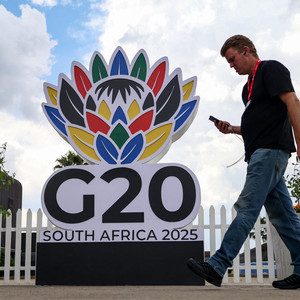
The G20 minus one.
The United States is not participating in official talks at the G20 in South Africa.
Those that are in Johannesburg today are those that want to see progress.
Those that are not here are those that do not want to see progress.
It's World Business Report from the BBC World Service.
This is Andrew Peach.
On the way, we'll hear what business leaders are discussing and we'll focus on farming.
Also today how aid agencies are responding to huge cuts in their funding and why the Eurovision Song Contest is trying to stop governments from promoting their entries on social media.
First global leaders arriving in South Africa for the G20.
Hey!
Hey!
Now this gathering brings together those from the richest and developing countries to try to reach consensus on global issues.
It's the first time it's being held on the African continent, so a big moment for South Africa's president, Cyril Ramaphosa.
We therefore need to use the G20 to advance our agenda.
South Africa correctly felt that we need to put the interests of our continent on the global platforms.
But the US government isn't there.
President Trump blasted the meeting in a social media post, repeating his claims that white South Africans are being persecuted.
Our correspondent at the talks is Mayani Jones.
She told me why hosting the event is so important to South Africa.
A lot of people expressing lots of excitement at being in what is essentially the first G20 in Africa.
And they see this particularly lots of the African participants as an opportunity to push forward an agenda that is important or that centres African countries, that centres the issues that matter to them, like debt and the price of debt for developing countries, issues to do with climate change financing.
They may also see this as an opportunity to show that Africa can host these kind of venues.
Right, we're going to hear from the Chamber of Commerce in South Africa in a second on the programme.
Let me ask you to set out for us, what is the G20?
We're going to hear it in the news day after day.
But what exactly is it?
What's it trying to do?
So the G20 is basically a gathering of 20 of the world's biggest economies, and it was set up in order to bring developing nations and more developed nations together to try and come up with some sort of economic policies or some economic consensus around the main economic issues of the day.
So some of the things they're looking at this year, for example, as I mentioned, is their financing.
They also talk about technological advances like artificial intelligence, how to help developing nations recover from debt.
So they have these meetings all throughout the year where different ministers, different diplomats discuss these issues.
And this weekend all the leaders of this country are going to come together and hopefully issue a leaders' declaration which will lay out what's been negotiated over the year, what they've decided on, what their areas of focus are.
Now, similar kind of conversation that we had about the COP climate talks in Brazil.
If Donald Trump doesn't go, if the US is not there and other countries as well, for that matter does that make the whole thing a bit meaningless in terms of its outcomes having any meaning?
That's why the absence of certain countries has been central to the conversation, because there is a recognition that, as the world's biggest economy, the US needs to be in these kind of forums.
President Cyril Ramaphosa said it himself on Thursday.
But on the flip side, Pretoria has wanted to push this message that only the countries that are present can come to some sort of consensus and that they shouldn't allow themselves to be frozen by a country that's absent.
Our correspondent Mayani Jones at the G20.
So why is Donald Trump not there?
Here's what White House Press Secretary Caroline Levitt had to say on Thursday.
The United States is not participating in official talks at the G20 in South Africa.
I saw the South African president running his mouth a little bit against the United States and the president of the United States earlier today.
And that language is not appreciated by the president or his team.
Business leaders have been gathering ahead of the politicians.
Mpho Zulu is president of the South African Chamber of Commerce and Industry.
I asked him if it matters that Donald Trump won't be there.
From a business point of view, we just view it as an unfortunate development in history, because the G20 is such an important event for the world and the fact that it was a bit tainted it was unfortunate.
But fortunately, we also had a lot of success from the B20 point of view.
It was not a lot of influence from the politics because from day one in our precedence in the business segment the American companies were very active.
They were part of our planning, they were part of our negotiations and they accepted our recommendations.
And that's why it was such a seamless handover that we were able to do this week in the business point of view, and we believe that it will spill over into the government and leaders summit.
Give me a sense of the impact, the actual impact of tariffs on south africa, on other african nations, because what's played out perhaps is slightly different to how everyone expected things to happen.
So what's the actual impact of us tariffs been In Africa?
Obviously, as you know, different African countries had different tariff structures and arrangements set on a bilateral level.
But in South Africa, the NOC.
Obviously we are going to fill it in the areas of our agriculture products that usually go to the US, as well as our automotive industry.
So those two main sectors have been obviously slapped the tariffs and it has created jitters throughout the value chain.
So you still have the business confidence being damped by the prospect that we are still yet to feel the full impact on tariffs.
And we have to make sure that we are able to keep the American account turn the tide in terms of reducing those tariffs, while we also obviously create other opportunities for ourselves through the Africa continental free trade area.
So it's putting a strain on business confidence and business outlook, because we do consider the US as a strategic partner.
The numbers have not really flown through every sector, but it's had its hit in the automotive industry and agriculture.
And finally, give me a sense of what you want the outcome of these projects, discussions at the B20, the G20, to be.
What would be most helpful?
We would like an element of continuity.
We understand and respect that every country will have their own theme under their own presidency.
And I think we must not squander the amount of work and the hours that we put in under the South African presidency.
Well, as Nthozulu was explaining there, there's still plenty to talk about with or without the US.
Next, I spoke to Ndidi Silobo, who's a member of South Africa's Advisory Council on Agriculture.
The key thing for South Africa, and indeed the African continent, is thinking about how do we share technology to boost agricultural productivity in the African continent, but also thinking about climate change and its disproportionate impact on Africa's farming.
About what lessons can we take out of Europe and other parts of the world.
Another area that is important in agriculture is, of course, the aspect of trade.
We have a saying in South Africa of talking about achieving food security through trade, which basically means then that, in the near term, let's open up the borders.
Let's make sure that those that can produce can export without much tariffs or anything.
That increases food prices for importing countries and also blocks farmers and other agribusinesses in exporting countries, so that in the near term all countries can have a bit of access to food.
A few things to pick up on there.
Let's talk about tariffs first.
I hear you make the case against them, but they are.
Although you might campaign against tariffs, they're there.
They are right there.
And I mean, South Africa is one of the countries that is filling them directly.
If you think about our auto industry, which has a much greater exposure in the US, is experiencing those difficulties.
And, if you think about the agricultural sector, is one of those that are experiencing those difficulties, although not to a large extent, because the province that is experiencing in South Africa is the Western Cape.
That's the southwestern region around Cape Town, while the greater part of the country, which accounts for 96 of the agricultural exports, go to other parts of the world.
And I think that the world leaders in Johannesburg, one of the important things that they have to underscore is their support for the World Trade Organization, so that these multinational institutions that ensure that there is some policing of the rules but also fairness in the global trading system, are in order.
And Wandili, do you agree with Mpho Zulu from the South African Chamber of Commerce that, despite all the political noise around this G20 meeting, which everyone regrets, that actually there's some quite productive discussion going on?
Good things might emerge from it all the same?
I mean, I think good things will emerge, because those that are in Johannesburg today are those that want to see progress.
And then that makes the meeting to be much more meaningful.
Those that are not here are those that do not want to see progress.
Therefore, if they are outside the room and the people that are in the room are those that aspire to see a better world, then we will get somewhere.
That's Wendy Lisi-Lobo from South Africa's Advisory Council on Agriculture.
Let's get a US perspective now from New York.
Chris Lowe, Chief Economist at FHN Financial.
What do you think of the G20 taking place without the US represented, Chris?
Well, thank you, Andrew.
I guess it's a mixed bag, right?
Because, on the one hand, having Donald Trump not in the room is an opportunity for others to get a word in, which is probably welcome.
But the other and I think seriously the more important piece is that Trump has demonstrated since the beginning of the year he wants to negotiate bilaterally, country by country.
And that's what the US has done.
So this is an opportunity for the rest of the international community to sort of circle back, talk about what's changed in the last 11 months and, you know, strategize how to move forward from here.
And I think in that sense, it's quite useful to have this meeting even without the US.
Let's talk about Bitcoin.
We're used to discussing the rising value of Bitcoin, but actually it's fallen quite a lot.
Astonishing drop.
Yeah, from the peak on October 6th.
At one point today, Bitcoin was down 365, so lost more than a third of its value.
I think the really important thing to understand with the Bitcoin trade is the reason it's such a violent correction is because a lot of traders are –.
Younger, less experienced, and willing to use leverage.
And so when the value drops, they start getting margin calls.
That is, they have to raise cash to pay back the money they borrowed to buy the asset that's no longer worth what they borrowed in the first place.
And to do that, they're selling other assets.
And that's what's putting huge downward pressure on U.S. equities at the moment.
It's the selling to meet those margin calls.
It's an absolute roller coaster.
Let's talk about Eli Lilly, the first trillion-dollar pharmaceutical company.
Yeah, and that's all about weight loss.
You know, you have a popular weight loss drug that becomes –
Well, in a city like New York, where I live, you would think it's an absolute essential, considering how many people I know who are using it.
It is extraordinarily profitable.
And what's interesting is, while it is technically a diabetes drug, it's not only being prescribed, but the US government is coming around saying to supporting weight loss drugs because the medical problems associated with obesity in the US are so expensive and honestly make people so miserable that a solution is very welcome.
Chris, thank you.
Chris Lowe from FHN Financial in New York.
This is Andrew Peach.
You're listening to World Business Report from the BBC World Service.
Red Cross is one of the best-known international aid organisations.
In the last five years, we've witnessed violence in Syria, South Sudan Ukraine, Central African Republic, Yemen and a score of other nations.
A few of more than the 80 countries we've worked in without fear or favour for more than 150 years.
That's one of its promo videos.
Now the International Committee of the Red Cross says it's slashing its budget for next year by about a fifth.
That means...
3,000 full-time positions being cut, 15% of its global workforce.
The ICRC said these difficult decisions were necessary so it could continue delivering critical humanitarian aid.
The backdrop for all this, of course, is the big cut to global aid programmes like USAID, which had its funding cut by the Trump administration.
Among many projects thrown into uncertainty by that, the work of the Helen Keller International Foundation in Nepal.
Its country director is Pooja Pandey.
So the USAID-funded project, because it was designed at scale, we covered almost 60% of the country.
One of our primary job was to really identify where are the most vulnerable areas that have high risk of malnutrition.
And their job was to really truly implement a community-focused program.
And so what I mean by that?
We would sort of employ local women that would go to communities after communities, screen children if they're malnourished.
If they find a malnourished child, they would then refer them to the closest treatment centre.
Now you can hear more of that interview and other stories about the impact of the USAID cuts if you search Business Daily, wherever you get your BBC podcasts from.
But as donors shift their global aid budgets largely to defence spending, I asked Freddie Carver from the global affairs think tank ODI Global for his reaction to today's announcement of those cuts by the ICRC.
It isn't surprising news.
This is part of a trend that has been obviously accelerated this year, particularly since the closure of USAID early in the year, but actually we've been seeing these trends for the last two or three years across a whole range of donors.
In fact, the ICRC itself made a massively significant cut a couple of years ago.
I think they went from a budget of around £2.8 billion to £2.1 billion about 18, 24 months ago.
Give me a sense of the impact that these reductions have already had and what this cut might mean in terms of the delivery of aid across the world.
It's really difficult to capture the depth of the impact.
There's a huge amount of anecdotal stories out there of aid programs being stopped, delivery stopping, health centres having to shut their doors for lack of fuel, people not being able to access support, deaths.
I mean, there are real human impacts across a very wide range of countries.
Beyond that, the best estimates are potentially that in the middle of next year we could be looking at a 50 overall cut in humanitarian assistance from where things stood a couple of years ago.
So just in terms of the sheer number of losses of jobs across closures of programmes, halting of programmes that in some cases have actually been running for quite considerable time across a very large range of countries,
I get the subject matter is so vast, it's hard to know where to start.
But give me some examples of countries that are affected and maybe specific things that those countries need that are affected.
Accepting it's not the full picture.
Some of the stories that have really kind of hit home to me are of the immediacy, of responses, of needs for pregnant women who are unable to receive the medical care that they need to give birth safely and subsequently dying.
I mean, I've seen stories like that in Sudan.
I've seen stories like that in Yemen.
I'm certain there are thousands of stories of that type in different countries.
Beyond that, I think where some of the real concerns are is actually a lot of the cuts that we're seeing are trying to protect the most challenging, the most high profile responses.
So the Gazas, the Sedans, the Ukraines.
I think there's a subset of responses below those places.
South Sudan Somalia Yemen, Afghanistan that in many cases have had long-standing humanitarian responses, that are keeping communities going over many years and those are facing some of the most challenging cuts, and that really has an effect on health services, on education services and on access to basic needs for a very large group of people.
And I mean, I suppose people might be wondering about charities.
Charities are involved in delivering this aid, but it might be a surprise to some people listening to World Business Report that so much of the funding for charities was coming from governments, which is now being cut, as opposed to sourcing charitable donations or bequests or other ways in which charities get hold of money.
Absolutely.
I mean governments have been the backbone of the internationally led humanitarian system over the last 40, 50 years.
And really, it's fair to say that the US government has been the backbone of that system as well.
So I think this is why the closure of USAID and the ending of that funding has had such a profound impact on the sector.
Freddie Carver from the global affairs think tank ODI Global.
Politics and pop collide with money at the Eurovision Song Contest, the big TV event that's been around since 1956 and keeps getting bigger, with a TV audience this year of 166 million people and hundreds of millions of views on YouTube, TikTok and Instagram.
They've announced they're going to change the Eurovision voting system, which decides the result, because of the controversy that followed Israel's entry.
The suggestion is that the Israeli government paid for the promotion of its entry on social media...
And that might have helped it come top in the public vote and second overall.
Lisa Bird is deputy editor of the Eurovision fan site ESC Extra.
There's going to be sort of stricter sort of controls on how broadcasters can promote and campaign for their artists and songs, just to try and stop a little bit of tension that was going on.
You know, not every broadcaster has the same amount of funding to do those sorts of campaigns.
So it's important just to put a bit more regulatory sort of control on that.
So there can still be campaigns and things, but the artists themselves...
And broadcasters, they're not allowed to be a part of that now.
Because this has become a bigger and bigger part of the thing, as it has indeed with music.
Just to use an example, remember Monday, the UK act from this year.
It didn't do all that well in the contest in the end.
They travelled to not quite every country taking part in Eurovision, but they travelled to a phenomenal number of countries in a very short space of time.
There's an enormous social media presence.
And then there's been particular criticism of Israel doing this, funded by the government, campaigning on social media.
Yeah, there has.
And I think a lot of pushback has been in terms of, as you say, it's okay to sort of go out and promote your artist and go on little mini tours and to try and build a televote score for them.
That way get them promoted in other countries.
But the problem has been, as you say, government backed campaigns like what Israel did last year and these voting changes they kind of touch on accepting okay, things have happened, we need to make changes going forward.
But these changes, it doesn't stop say, a record label, a government going and funding money into a record label, who then does a lot of promotion and campaigning without the artist being aware that that's happening on their behalf.
So there's changes, but there's still question marks around them.
Politics and economics have dogged Eurovision since it was founded in the 1950s.
And it's part of why you and I love the whole thing.
It's part of the story, of course.
Will this go any way to quieten down the critics?
I mean there's quite an active campaign from people who want Israel to be excluded from Eurovision worldwide altogether.
How much impact do you think the rule changes that have been announced will have on the various countries and broadcasters who've been expressing strong views about it all?
I think there've been changes that have been coming for a few years anyway.
There's been a lot of broadcasters that struggle to get a televote saying, we want the juries back.
You get ones that struggle in a jury vote saying we want more of a televote.
And so there was always going to be some changes to try and placate broadcasters in the last couple of years, outside of the Israel situation.
Eurovision fan Lisa Bird with me.
Now nearly 13 million Mexicans are holding on to 50 peso banknotes.
This is a banknote that's become far more than everyday currency.
It's stylish, it's purple, it's got Gorda the Axolotl on it and it won Banknote of the Year when it came out in 2021.
Four years on, the Bank of Mexico says people are hoarding these and they're effectively worth far more than the 50 pesos they claim to be.
Valeria Moy is an economist and general director at Mexican Institute for Competitiveness, and live with me on World Business Report.
Valeria, there are very few stories where I would consider that radio may not be the best medium, but you're going to have to describe and paint a picture of this banknote so that people outside Mexico can understand why everyone's keeping them.
Yes, okay.
I will try my best.
Well, it's kind of a purple-pink note.
It has a little circle that is transparent that has a security brand.
That's important.
And then you have this Xochimilco like that.
Maybe you have heard of it, but it's a very important part of Mexico City where you have water and agriculture and it's a very traditional part of the country.
And then you have a very small design of an axolotl, which you described perfectly.
And the axolotl, it's a very cute and very rare and very traditional animal in Mexico.
And it's actually... originally from Xochimilco.
So you have the axolotl there in Xochimilco swimming.
That's the image that you can have.
And on the other side of the note, you have the traditional Mexican eagle.
So it's a very nice note.
And since it's a very recent bill, you can have them very new.
So you can have very new bills and that's something that's very likable for people.
And suddenly in Mexico, for the past I don't know, maybe 10 years the axolotl has become kind of a traditional icon.
It wasn't before, let me tell you.
It's kind of new.
We weren't, it wasn't always the case.
We weren't, I mean, when I was a kid, nobody talked about the axolotl.
We knew it existed, but of course it wasn't an issue.
And now it is an issue.
You can find the axolotl printed in t-shirts and in bags, in supermarkets and small plush toys everywhere.
So the axolotl has become a very iconic figure.
It sounds like a very well-designed banknote.
We get the idea it's really good.
But in order for it to be collectible, for people to want to keep them, surely there has to be some kind of shortage.
And that's absurd, because when you design from the monetary policy perspective, when you design a bill or a coin, its value, its intrinsic value, shouldn't be more than the value of the things that you can acquire with it, that you can purchase with it.
So when people hoard these bills, they are not being used as money.
And, of course, when Banco de Mexico, or the Bank of Mexico, put out these bills, it wasn't its intention.
I mean, its intention was just to put a nice bill that you know circulated in the economy and it's the second lowest denomination bill.
So it was supposed to be very usable, but it hasn't been the case.
People are keeping it.
Actually, I keep one of those.
And when I received the call from the BBC, I was like well, I'm kind of embarrassed because I actually keep one of them.
But I would say I keep one of them.
The other day the guy I usually buy my coffee from says he collects all of them that he receives and that he has a huge stash at his home of this 50 pesos, that is around two pounds bills.
So it's becoming.
I mean, I won't say it's a problem, but it could become a problem, because when you issue money, it should be used as money.
Not as a pressure, you know.
Yeah, exactly, because otherwise its whole meaning is being changed.
It actually violates one of the economic laws.
You need to get out right now and get yourself some more of these things.
Thank you very much indeed.
Very much appreciate your analysis and your picture painting as well.
We really got a sense of the purple note with the axolotl on.
There's more about today's money stories on our webpages at bbc.com slash news slash business.
And from me, Andrew Peach and the World Business Report team, thank you for being with us.