Ted Audio Collective.
You're listening to Ted Talks Daily, where we bring you new ideas to spark your curiosity every day.
I'm your host, Elise Hugh.
Today, something special, a new original series called Ted Intersections, featuring speakers taking on subjects at the intersection of their expertise.
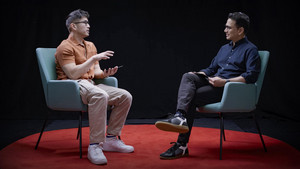
Chef John Kong sits down with cardiologist Uma Velletti to talk through their culinary journeys, how they found food to be healing, and the way thinking more deeply about food has helped them find purpose.
That's after the break.
And now our Ted Talk of the Day.
The connection with food, it always goes back to childhood for me.
And I grew up in the kitchen, so to speak, with my mom, trying to cook everything she did, I used to watch her, try to help her chop vegetables or go to the Sunday market with my dad and bring back meat and slice meat and kind of wanted to cook from day one.
But I realized some of my skills weren't great.
So I went to school in India, and there was this hawker who was right outside our school.
And I was fascinated with his work because he used to sell the fast foods of India called bhaji and things like that, but the way he chopped onions, just I was hooked onto it because he would slice them up like he'll take an onion and in 10 seconds the whole thing will be sliced and diced like finally.
I'm like, I'm going to master that.
So I became the master slicer dicer of onions in my house.
And later on in food, obviously, look, it's the most creative expression of anything you can do in a daily life and I love to cook with my wife and kids and it just becomes part of my life.
And I feel like it's also a way to fiercely express your creativity or independence and what you want the creation to be.
So yeah, it's just deeply, deeply connected to food.
What about yours? What's your personal connection to food?
My personal connection to food, as you had said, it is an expression of my creativity, but it is also a way that we express our culture and the way that we pass down our cultures.
So growing up in Hong Kong as well as Toronto, food was very much a way that I was attached to the things that my parents loved as well as my grandparents.
My own grasp on Cantonese language is very, very weak because of all the traveling that we did when I was younger.
So I felt like relearning cultural dishes was a way that I would easily get in contact with my roots without having to learn a language.
But yeah, yeah. What did food mean to you when you were growing up in Hong Kong?
I mean, food, I was very, very blessed.
Hong Kong, as is India, has a very rich culinary history and actually it shares a little similar ones in terms of, I would guess - Is it the spices or - Imperialism.
Yeah, there is, yes.
But yeah, our appreciation for spices and flavor.
There's an internationality that was brought into there.
So I was very spoiled for choice in terms of what good food is.
And I used that memory to kind of like craft my entire skill sets, because I'm self -taught and I had nothing to go off of except my earlier experiences with food.
So luckily, Hong Kong taught me how to eat and by that I taught myself how to cook.
So was that experience one of those formative ones that made you say, I want to cook in America?
Yeah, that was the biggest reason was because where I was living, where I do live now, Detroit, at the time didn't have a lot of options for traditional Cantonese food that I missed.
So out of necessity, which as I think is a very common thread among a lot of students from Asia is like, they teach themselves how to cook because where they end up for school doesn't offer the food that they miss from home.
That's right. And yeah, that was pretty much the basis of it.
It just so happened that it turned into my career as opposed to just a hobby.
What made you want to be a cardiologist then?
Oh, I grew up watching my grandfather who had been taken care of patients all his life.
He was a doctor as well.
He was a physician.
And I loved it when he would take care of people and there would be this expression of, I think gratitude.
And my grandfather would not expect anything in return.
He never charged a dollar for anyone.
He was in the Gandhian movement and the freedom movement for India.
And I just grew up adoring him.
I'm like, ah, that would be cool.
And then as I started learning more about medicine, I went to one of the medical schools in India and realized very quickly that cardiology is one thing where you would get to save patients' lives, literally resuscitate patients who were dead in the field, resuscitate them and bring them back to life.
And I found nothing more gratifying than being able to save someone's life.
And then that relationship continues afterwards because then there's a bond between you and the patient who now is not a patient anymore back to living his own life or her own life.
And then this bond with that person and their family kind of continues on.
So I was really like, this is what I want to be in my life.
Would you say that intersectionality of being able to tend and care for people is what crossed you over into this food space then?
I didn't know back in 2015, 16, when I was thinking of quitting cardiology and starting off on this crazy journey that I'm on right now, but looking back and reflecting on it, there is a lot of common threads where both are bound by a deep sense of purpose and a deep sense of building relationships
and defying some of the things where people keep telling you it's impossible to do this.
It's impossible to save someone's life.
They're already dead in the field.
You can't resuscitate them back.
And here we are looking at a impending food crisis, climate crisis of such large proportions and people keep saying it's impossible to do this.
We cannot do this. We'll not do this.
People will not change.
Countries won't change.
And I think this is a much bigger fight than saving an individual patient's life.
But I think those common threads of saying, yes, these are possible by putting one foot in front of the other and starting to slowly make these things go away.
And you climb one mountain, celebrate the victory for a moment, and then the next mountain is in front of you.
So that was your kind of inspiration to start Upside?
Yes. Yeah, Upside Foods is a company that I've started in late 2015.
And the idea is the most delicious product in the world that we've known as humans is meat.
Yeah, I will agree with you.
No disrespect to salads or greens or beans, but meat is the center of plate for almost every tradition in the world.
And a lot of our memories growing up and also with our families now are tied to cooking meat.
And while it's the most beloved food, there's also this incredible challenge where we ignore how it comes to the plate.
And we all know there's a troubling story of how meat comes to the plate, but we love it so much.
We love the product so much, not the process so much.
And there hasn't been a real solution for it until now.
So we've continued our journey as being conflicted carnivores, let's say.
And I thought it would be really cool if we can actually try to work on a solution where we can bring meat grown from animal cells directly to the plate.
So we're not asking people to give up animal -based products, but incorporate that in the future so that traditions can continue, the culture can continue.
It's a big, tense solution where nearly people from all stripes can come together.
And I've thought it will be a win -win, but this was at the time of an ideal stage.
It was really, really hard to do it.
And now, back to the episode.
What's been the biggest challenge so far in getting people to accept this new way of...
It's not even a product in a way, but it's a new way of accepting what meat is and what meat could be.
Like, yeah, there have been challenges along the way, but this is unfolding in multiple chapters.
So the challenges in the first chapter were people loved the idea, but did not believe that the science would work.
So the first chapter was all about proof of science, showing that the science can work and that we can take cells from an egg or a chicken or a cow and grow meat directly from those cells.
And once we started doing it, we started showing these products and cooking it in front of people and having hardcore meat eaters and chefs come and cook it.
And it just melt the disbelief, melts into like, wow, this is possible.
And then when they taste it, it just demystifies a lot of things because all the neurons have been programmed to kind of recognize as meat or start firing in your brain.
Which I think is so interesting because a lot of people that would probably be your greatest distractors are the same type of person that would be uncomfortable eating chicken wings with bones in it still.
Our perceptions of like from animal to meat have been so far removed from what it actually is or where it actually comes from, that this does not seem like that much of a leap considering how much we process the meat that we eat already.
Like it is unrecognizable once it comes to your grocery store anyway, compared to what it was when it was on the farm.
So like, what's the difference here?
Or like, why is this such a stretch?
Well, yeah, I mean, I think I'd say this.
I think nearly all major or transformative innovations that have happened in the world eventually triumphed despite formidable opposition.
And the opposition here is, I think the fear of the unknown is actually higher than all the risks we are taking right now with the amount of animals we are raising in intense confined places that can increase the risk of pandemics or zoonatics or things just like food poisoning or draining ecosystems
to feed the crops with animals or even simply just like, what about animal welfare?
Things of that nature.
So that's the part that has been really interesting for us to learn that the fear of the unknown is more than the fear of what we are actually living with every second in our lives.
And part of this is communicating better, demystifying it.
And I think demystification should be very simple.
Tasting the product, magical experience, touring the place where it's made in clean production facilities, where you can just go around and walk around and say, hey, here's animal cells growing.
And then the last thing is just meeting the people that are making it.
They're just people in your neighborhood, working, farming.
The people that are working behind it, there's Gen Z's and millennials and people of all generations that are part of our team.
Just talking to them.
These are real people working on making real products and solutions.
I feel like if you demystify the traditional way of processing meat, they would help come flocking to this as well.
I think so much of people's acceptance of traditional meat is rooted in what they don't know about the process of not just the cost of cruelty to animals or the environmental cost, but the human cost of it as well.
These processing facilities are extremely harsh on the body.
And I guess the wages are probably not very good as well.
Yeah, but coming back to you, you have been known to be creating a revolution in Detroit as a third -culture cook.
I mean, my perspective here about your philosophy.
What is that? What's your philosophy?
So when it comes to third -culture cooking or being a person of third culture is, actually, you have the exact lived experience, is growing up with a predominant culture in your household, but your household just happens to be in a completely different culture altogether.
So in my case, growing up Chinese in a North American household, crossing the cultural threshold every time you step out the door, I've been pushing this idea that access to daily nuance in two different cultures gives you kind of an in -depth knowledge on both in a way that somebody who just studies
one or just is lived in one, doesn't really have.
And you see examples of this all over the country.
It was like Koreatown in Los Angeles or Queens out here in New York.
Just places where people are used to complete immersion in more than one culture on their day -to -day life.
And that produces creatively speaking, like a completely different kind of output.
In my case, it's food.
And it is like people will say, well, isn't that just fusion?
Which I don't believe should be considered a dirty word in culinary anymore.
But yes, I think if you look back far enough, all food and all cultural foods is fusion.
It is the melding of cultures as the communities grow and become more diverse.
So it's a beautiful expression.
Yes, and I was like, it's either rooted in creativity or cultural exchange or even just adaptation, necessity.
One of the biggest things that I'm tackling right now is trying to get people to accept electricity into their home kitchens in lieu of gas ranges.
And I've been having a lot of pushback from a lot of Chinese community because of the way that we cook with woks.
I see. They want that high BTU, high powered thing, high powered output to come up through the wok cooking.
And I've been trying to explain it's like, it's just energy.
Like you can get that in a way without having all these toxic fumes and using all this fuel.
You can get that with induction now and it's just a focused energy into the same pan that you've always been using.
And in that, I do believe that's the adaptation element where it's like, we have to do better for not just, you know, the planet, but ourselves and our own personal health.
And I think that's where a lot of our missions intersect.
Yeah, I mean, I'm curious, what's your favorite food to cook?
Oh, me? This type of...
Oh. Chef -y -chef answer is like, I like to cook eggs in it because like eggs give you such an immediate response and a visual cue in like their level of doneness.
And that kind of allows you to match because with flame you have a visual cue.
With induction, it's just numbers and it's hard to quantify that.
So an egg can give you that like immediate visual feedback on like what that energy is doing.
And by that, it's pretty much how I learned to cook traditional Chinese food in a wok without the help of a flame.
I see, okay. What's your take on how our cooking can evolve and our choice of foods can evolve to meet the crisis of climate?
I mean, if your project goes off the ground and gets into everyone's homes, I feel like that would be a big one, but I think ultimately we have to meet humans at where their desires are.
We've tried very hard since our generations were very young to appeal to like, this is what we have to do.
We have to be stewards of the plant and stuff.
And yes, that is very much true, but on an individual level, humans are beings of desire for better or for worse.
And I think that is one of the problems that you are tackling is meeting them at their desires and at their wants and at their comforts.
We've tried with alternatives already.
And I think like this is probably the best way to do it if we're going to tackle the climate crisis together is just like meet them where their wants are.
Yeah, I keep describing this as a catch -22 where we would want to have the solutions that preserve our choice.
And we also do not want to have downsides to the choices we make.
But there is a fair amount of wishful or magical thinking on our part as just humanity that if we ignore the downsides, they'll go away.
But the debt is building up enormously.
And it is striking at unexpected, you know, in unexpected ways.
And I mean, look at how we're coming out of the pandemic.
A hundred year pandemic.
And we still do not know exactly how that took off like it.
And millions of people died.
Millions of people.
My father died. A healthy man running around, happy veterinarian in two weeks.
And I think all of us are having more and more of this experience.
I think that is part of the debt that we're building up.
And I'm hoping that the catch -22 will get resolved by a lot more innovators and the incumbent industry coming together.
A lot more people crossing party lines.
Lots of businesses saying this is relevant for us and just letting these conversations like this happen and showing people what's possible.
And I'm really, you know, I'm an optimist.
And I think in order for us to be able to solve this immense challenges ahead of us, it's going to require the worldview of optimism but a very pragmatic view of solutions.
Yes. And going at it over and over again because what might not have worked a month ago or a week or even a year ago or a decade ago would work now.
I think that optimism is very, very important because it seems like with the younger generations, at least like what I see on TikTok and Shorts and all and Reels, is that the fatalistic doom and gloom messaging has been very, very effective to the point where young people almost feel, not almost, they
do feel helpless. And there was not enough of a focus to like the good things that we were doing, not in the sense that we need to like pat ourselves on the back, but like, you know, progress is happening.
Technology is advancing and people are doing work to prevent disaster or further disaster from happening.
And we need to focus on those stories just so that we can encourage people to like continue like doing what they can, voting in the way that benefits the planet and humanity.
And yeah, a focus on the optimism is I think what we need for like younger generations.
And I do think like your work is one of those examples of good things.
Yeah, we are at an intersection of enormous amount of support, but also enormous amount of resistance.
Places like Florida and Alabama and Italy have banned and criminalized making cultivated meat.
And it's all fresh in the last few weeks.
But I do think cultivated meat offers a really big win for people and businesses and communities in these places and also across the world, because it is the one single thing that can bring people of multiple stripes under the big tent.
You know, people who prize innovation, people who prize tradition, people who love eating meat, and those who object to animal slaughter, and basically to simplify people who love choice and people who love life.
I think it's one of those things where we can bring people together.
And hopefully, eventually, I think we'll overcome these bans.
Yeah, about to say like hopefully through like acceptance in other states and like through examples and popularity that other places will show that this is a good product, this is a delicious product, that those bans would ultimately be lifted.
Because they do seem like they were enacted out of ignorance and fear and let's face it, protectionism.
Yeah, there is a fair amount of that.
And I think part of our work is to reach out as opposed to, you know, picking up and trying to just create more polarization.
Our goal is to reach out and let those communities and the people who wanted us to on our right see how we're going to on our right by bringing people together.
So that's part of my personal goal.
So we'll be doing more work in Florida, Alabama, and if needed to be in Italy.
Yeah, well, if I can help in any way, I'd be happy to.
Well, thank you, John.
I really appreciate it.
Well, John, it's really been fun to talk to you, and a cool fact was I got my start in Detroit.
And I think of the Motor City as the one that got my motor going on innovation.
And I'm so glad that we intersect on the fact that we both have connections to Detroit.
So I'd love to come and visit your restaurant.
I would love for you to come.
Detroit really has always been a city of innovation whether it comes to entrepreneurship or creativity.
I think it's been an underdog for far too long and really deserve this flowers, but the fact that it managed to produce both of us, we ended up here.
I mean. Look, Detroit has been the heart of the automotive transformation.
It was. And I keep telling there's a food transformation happening, and I'm happy to draw my roots from having an experience in Detroit that kind of influenced me to keep going on in search of cardiology and then going on in search of trying to say, can we make meat better and bring cultivated meat into
the world? So I love Detroit.
So I'm gonna come and visit your restaurant.
We will be happy to have you back.
Thank you, John. Thank you.
All right. Great to talk to you.
Yeah. You are listening to chef John Kung and cardiologist Uma Valetti in conversation for TED intersections.
If you're curious about Ted's curation, find out more at ted .com slash curation guidelines.
And that's it for today.
Ted Talks Daily is part of the TED Audio Collective.
This episode was produced and edited by our team.
Martha Estefanos, Oliver Friedman, Brian Green, Autumn Thompson, and Alejandra Salazar.
It was mixed by Christopher Faizi -Bogan.
Additional support from Emma Toppner and Daniela Vallerezo.
I'm Elise Hugh. I'll be back tomorrow with a fresh idea for your feed.
Thanks for listening.
P -R -X.