Did you know you can opt out of winter?
With Vrbo, save up to $1,500 for booking a month-long stay.
With thousands of sunny homes, why subject yourself to the cold?
Just filter your search by monthly stays and save up to $1,500.
Book now at Vrbo.com.
Welcome to Spotlight Advanced.
I'm Andrew Devis.
And I'm Megan Nolet.
Spotlight uses a special English method of broadcasting.
It is easier for people to understand, no matter where in the world they live.
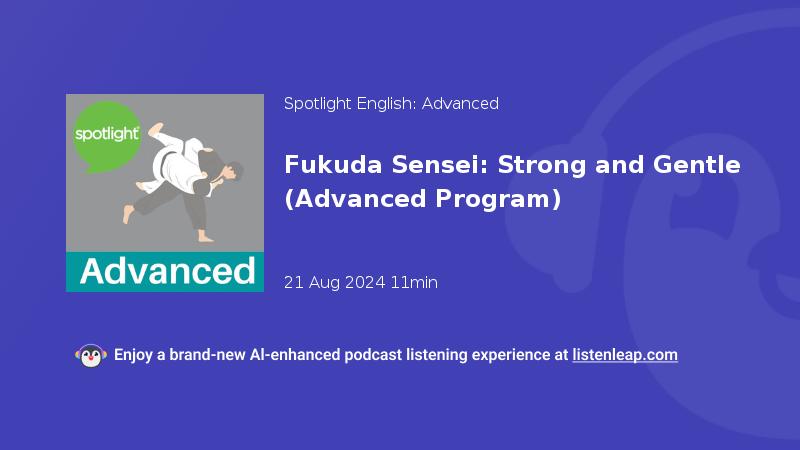
A small woman bows.
She stands opposite a man.
He is much larger than she is.
They both stand on a large square mat.
The woman wears a white shirt and white trousers.
She has a red belt around her waist.
The man steps towards her and holds her wrist.
The small woman moves her body quickly.
The man lands on the mat on his back.
He stands up.
Again, the woman flips him over onto the floor.
How can such a small woman do this?
This woman is an expert in Judo.
Judo is a martial art.
It is a structured kind of fighting.
People practice these styles of fighting as an art form.
This little woman is one of the most famous Judo experts.
She is a sensei, a master teacher.
Today's Spotlight is on Sensei Kaiko Fukuda.
Judo began in Japan.
It is a combat sport.
In these sports, two people usually compete against each other.
They take turns attacking and defending.
But in Judo, people do not use violence to win.
Judo is based on using an attacker's violence against themselves.
Experts in Judo train for many years to learn to do this.
They use special moves to throw opponents to the ground.
And they also have to learn how to fall without getting hurt.
Keiko Fukuda's family was very important in martial arts.
Her grandfather taught a different sport called Jujutsu.
One of his students was a man named Jigoro Kano.
In 1882, Kano created a new form of martial art from Jujutsu.
He named it Judo.
This means the gentle way in Japanese.
The main idea of Judo was that gentleness can control strength.
Judo teaches that people can use less effort to get a greater result.
Jigoro Kano wrote a book about Judo.
In it, he describes Judo this way.
Using force against a more powerful opponent will result in your defeat.
But moving and avoiding your opponent's attack will cause him to lose his balance.
Then his power will be reduced and you will defeat him.
This can apply even with differences in power.
So, it is possible for weaker people to beat much stronger ones.
Kano's ideas were not just about combat.
He believed practicing Judo would focus a person's mind and body.
A person could become skilled practicing Judo, but they would also become a better person through its discipline.
Judo's final goal is to improve society by improving its people.
Being good at Judo depends on skill and training.
A person's size is not important.
This was very good for Kiko Fukuda.
She was only 125 centimeters tall and she only weighed about 45 kilograms, but she became the most famous female judo expert in the world.
Fukuda began her judo training in 1934.
At that time, Jigoro Kano started a new judo school for women.
Fukuda explained what happened in the documentary film Mrs. Judo.
I was 21 years old at this time.
Master Kano said to me, We have a new women judo section.
So, therefore, please come.
When I heard that, there was nothing left to question.
Judo soon became the most important part of Fukuda's life.
She practiced judo through many difficulties.
At the time, Japan was fighting in World War II.
Tokyo was very dangerous.
Bombs often fell throughout the city.
But Fukuda was determined to learn.
She traveled across Tokyo every day to practice and teach Judo.
Fukuda gave up many things to do Judo.
She even chose not to have a husband and family.
Fukuda knew that without a husband, people would not give her as much respect.
But she also knew that she could not do Judo if she had a husband.
So, she made a very difficult choice.
She said in an interview on judoinfo.com, Judo is my lifetime partner.
Judo is my family anywhere I go.
Students are very nice to me.
I have family all over the world.
There were also other difficulties for women in Judo.
For many years, women could not move up to the higher levels of Judo.
Judo levels are called Dans.
Students wear different colored cloth belts around their waists.
Each color represents for a different level of ability.
The highest level belt color is black.
There are 10 degrees or Dans in the black belt.
Very few people reach the 10th level.
Less than 40 people have achieved this rank.
To be a 10th dan, a person must do more than be good in Judo skills.
They must give something to the art form of Judo.
This could be teaching students or writing a book.
When Fukuda was training, the Judo Institute had some different rules for women.
Women could not go higher than the fifth dan.
By this time, Hiko Fukuda was one of the greatest experts in Judo.
She knew it was not fair that she could not move to a higher dan.
But Fukuda continued to practice Judo.
She became a sensei, a master teacher.
She wrote books and taught around the world.
In 1966, Fukuda was in California in the United States.
People at Mills College saw her judo demonstration, and they quickly offered her a teaching job.
Fukuda took this position and moved to the U.S.
Later, she opened her own judo school in California.
Fukuda taught there for over 40 years.
She encouraged people who did judo She especially inspired young women.
Fukuda also continued to travel around the world.
She did this even when she grew older.
In the film Mrs. Judo, Fukuda told this story.
I went to France to teach Judo.
People gathered from all over the country.
But I heard they were not sure about what an 80-year-old woman could offer.
They became sure when I showed them all 40 throwing techniques.
Fukuda Sensei also led a movement for women in Judo.
They wanted to be able to reach the higher Dans.
In 1974, the Judo Institute changed the rules.
Now women had no limits in Judo.
Over time, Fukuda moved up to the 9th Dan.
Then, in 2011, Fukuda's dream came true.
USA Judo awarded her the 10th dan.
She was 98 years old.
For many years she continued to teach judo three times each week, host an annual judo competition and teach at the Joshi Judo Camp until her death at age 99.
She lived with her personal motto well, be strong, be gentle, be beautiful in mind, body and spirit.
Do you practice martial arts?
Have you seen people practice judo?
You can leave a comment on our website at www.spotlightenglish.com.
You can also find us on YouTube Facebook, Instagram and Twitter and X.
The writers of this program were Rina Dam and Dan Chrisman.
The producer was Michio Ozaki.
The voices you heard were from the United Kingdom and the United States.
All quotes were adapted for this program and voiced by Spotlight.
This program is called Fukuda Sensei, Strong and Gentle.
You can also get our programs delivered directly to your Android or Apple device through our free official Spotlight English app.
We hope you can join us again for the next Spotlight program.
Goodbye.