Hey there, grownups.
We want to learn more about you and why you listen to Circle Round.
Take our short, 10 -minute survey and get a special bonus story from me, Rebecca Shear.
Find a link in the show notes of this episode or visit WBUR .org .survey.
WBUR Podcasts, Boston Have you ever heard the phrase planning for posterity?
Posterity is another word for future generations.
So planning for posterity means taking actions and making choices that will benefit the generations to come.
We're about to meet a wise old woman who doesn't just plan for posterity, she plants for it.
I'm Rebecca Shear, and welcome to Circle Round, where storytime happens all the time.
Today, our story is called The Fruits of Labor.
It's inspired by Jewish tales written in the Middle East more than one thousand years ago.
Some really great people came together to bring you our adaptation of this story, including Jeffrey Donovan, whom you grownups may recognize from TV shows like Burn Notice, Law & Order, Invincible and Fargo.
His recent films include Surrounded and Wrath of Man.
So circle around everyone, for the fruits of labor.
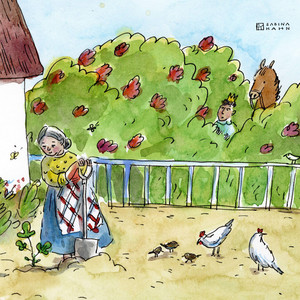
Early one morning, a prince was riding his horse through the countryside.
It was just after sunrise, and the world was quiet and still as the prince galloped across meadows and fields.
He didn't see any other people up and about until he approached a village in a valley.
For it was there, outside a crumbly brick cottage, that he spied a woman.
Just one woman, hard at work in her garden.
And she looks to be ancient.
Her hair is white, her back is stooped, and her hands are as gnarled as the apple tree in her garden.
Yet in those hands she's holding a shovel and planting a tree.
I must investigate." The woman didn't seem to hear the approaching hoof beats until they shuffled to a stop on the road.
When she looked up and saw the prince, she wiped the dirt off her wrinkly hands and gave a slow and creaky bow.
Good morning, your Royal Highness!
Oh, fancy seeing the Prince in my very own village!
Good morning, madam.
It's a fine day for planting, isn't it?
Indeed. It is a fine day for planting, even if, at my age, it'll take me hours to get this sampling in the ground.
The prince glanced at the sapling.
It was a fig tree. So young and small, it stood no higher than his horse's hoof.
Madam, you mentioned your age.
If I may be so bold, how old are you?
A crinkly smile stretched across the woman's face.
As of last week, I am officially 100 years old.
It took all 5 of my children, all 10 of my grandchildren, and all 20 of my great grandchildren to help me blow out the candles on my birthday cake.
Well, happy belated birthday, madam.
But if I may be so bold yet again, why would you plant this young fig tree at your age?
Do you expect to enjoy its fruit?
After all, it will be years before their sapling produces figs.
And you already have one hundred years to your name.
That is a fair point, sir.
But, the truth is, I'm not planting this tree for me.
You're not? Then who are you planting it for?
For my five children, and my ten grandchildren, and my twenty great -grandchildren, and however many generations come after that!
Tell me, sir. Do you see that apple tree over there?
I do. Well, that apple tree is even older than I am.
My ancestors planted it long before I walked, or even crawled this earth.
Thanks to their hard work, I have been enjoying that tree's fruit my entire life.
And thanks to my hard work, I hope my children, grandchildren, great grandchildren and all generations to come will enjoy this tree's fruit their entire lives.
The woman's wise, thoughtful words brought a grin to the Prince's lips.
Madame you have a good and generous heart.
Your children, grandchildren and great -grandchildren are lucky to have you.
I wonder if, perchance, you are able to enjoy this tree's fruit someday, and I certainly hope you are.
Will you let me know?
Of course I will. I promise I'll bring you a basket of the very first crop.
And I shall hold you to that promise.
Farewell. Within a month of this curious encounter, the prince's father passed away.
And next thing the young man knew, he was the new king.
Suddenly, he was too busy for early morning horse rides through the countryside.
He had his hands full, writing decrees, hosting banquets, and working with neighboring kingdoms to ensure peace and order.
And as the years went by, thoughts of the old woman and her fig tree all but faded away.
One day, the king was sitting in his throne room when his head guard came rushing in.
Your majesty, you have a most remarkable visitor.
Unbelievable, really.
Is that so? Well, bring them in.
I must see who this remarkable visitor is.
The guard hurried out.
When she returned, she had a steadying arm around the frail shoulders of an old woman.
A very familiar old woman.
My, my, my, if it isn't my favourite fig tree planter.
Good madam, if memory serves, last time we met I believe you had just celebrated your 100th birthday.
Oh, you remember correctly, your majesty.
You may also recall that I made you a promise during our encounter, and I'm here to make good on it.
The woman held up a wicker basket.
She removed the cloth cover, and the king's eyes lit up with recognition.
Figs. Oh. You brought me a basket of your first crop of figs.
The figs were beautiful.
Round and ripe, and a brilliant purple streaked with crimson stripes.
The king plucked one from the basket and took a bite.
Oh, my. Mm, this fig is exquisite.
And the purple and red coloring is gorgeous, like nothing I've ever seen.
I'm glad it's to your liking, sir.
Liking? I am loving it.
Madam, it is clear that fortune has smiled on you.
No doubt rewarding you for your kind, generous and selfless heart.
And I would like to reward you too.
Guard. Yes, sir? Please take this basket of figs to the kitchen, so I may enjoy them later.
After that, here is what I want you to do." The king leaned over and whispered in the guard's ear.
She nodded, then grabbed the basket and left the room.
When she returned, she had the basket in hand.
But when the old woman saw it, she let out a gasp, because it was filled with the most surprising thing the old woman had ever laid eyes on in all of her 100 plus years.
What do you think is in the woman's basket?
We'll find out what it is after a quick break.
Support for Circle Round comes from indeed.
You just realized that your business needed to hire someone yesterday.
How can you find amazing candidates fast?
Easy. Just use Indeed.
There's no need to wait.
You can speed up your hiring with Indeed.
And circle round listeners will get a $75 sponsored job credit to get your jobs more visibility at indeed .com slash circle round.
Just go to indeed .com slash circle round right now and support the show by saying you heard about indeed on this podcast, indeed .com slash Circle Round.
Terms and conditions apply, hiring indeed is all you need.
Before we return to our story, a quick reminder and request to take our short survey so we can learn how to make your Circle Round experience even more fun.
It takes ten minutes and all survey takers get a bonus story from me, Rebecca Shear.
Click the link in the show notes or visit I'm Rebecca Shear, welcome back to Circle Round.
Today, our story is called The Fruits of Labor.
Before the break, an aged woman fulfilled a promise by bringing the king a basket of figs from her fig tree.
She had planted the tree when she was one hundred years old, so that future generations could enjoy its fruits.
The king wished to honor the woman's generosity and foresight, so he had his guard empty out the basket, and fill it with a reward. When the old woman saw what it was, her snowy white eyebrows shot all the way up to her snowy white hairline.
Sir, my basket of figs is now brimming with gold coins.
What can an old white hare like me do with such wealth?
The same thing you're doing with your fig tree, Madam.
You can share it with your children, your grandchildren, your great -grandchildren, and the generations to come.
You are an inspiration now and forever.
As you can imagine, the woman's sudden wealth became the talk of her village, and everyone was happy for her.
Well, almost everyone.
Next door to the woman lived a conniving, lazy fellow who was always seeking ways to make a quick buck.
So when he learned of the woman's newfound riches, he seethed with envy.
Good Golly! Apparently, the king is crazy about figs, or just plain crazy.
No matter. If that old geezer can get a basket of gold in exchange for a basket of figs, Then so can I." The neighbor didn't have a fig tree.
Nor did he have any figs.
He considered buying some but the village was nestled so deep in the valley.
Reaching the nearest marketplace would take forever.
Well, if I can't buy figs, I'll have to get my hands on them some other way.
And I know just how I'll do it.
Later that night, under a full silvery moon, the neighbor tiptoed outside.
He crept to the old woman's yard, then made a beeline for her fig tree.
Wow. This tree has so many figs on it.
Its branches are bending under the weight.
There's no way that geezer will notice if a few pieces of fruit are missing.
He darted around the tree, yanking purple and crimson figs from the branches, and tossing them into a basket.
Hee -hee -hee! Ho! Ho!
This is going to be great!
The next morning he covered the basket with a cloth and carried it to the palace.
When he entered the king's throne room, he dropped to his knees.
Bowing so low, his nose squished against the floor.
Your Excellency, your Eminence.
I come bearing a special gift, one I am certain you will appreciate.
He sprang to his feet and held out the basket.
Then with a grand flourish, ta -da, he removed the cloth, revealing the round ripe purple and crimson figs within.
I've heard how much you adore figs, my liege.
In fact, I've heard you adore them so much that you'll offer a very rich reward for them.
The king stared at the neighbor, noting the eager, shifty look in his eyes.
Then the king stared at the figs, noting how oddly familiar they seemed.
My dear man, I appreciate this gift. But tell me, who told you that I offer rich rewards for figs?" Everyone in my village, they're all talking about how my dotty old neighbor—I'm sorry, my delightful old neighbor brought you some figs.
And even though she's like a million years old, you sent her home with gold coins.
The king's heart lurched, so this fawning fellow was the old woman's neighbor.
Clearly, he had plotted to swipe figs from her tree, then come to the palace and get rich. So the king began hatching a plot of his own.
He gave the neighbor a solemn, serious nod.
You are correct, sir.
I did send your neighbor home with gold coins.
And do you know why?
The neighbor sighed and rolled his eyes.
You sent her home with gold coins because you love figs so much. I thought we already covered that.
So, your grace, how about you give me my reward and I'll be off?
The King fixed the neighbor with a hard stare.
Then he signaled to his guard and whispered something in her ear.
Right away she took the neighbor's basket and left the room.
The neighbor's stomach filled with butterflies as he eagerly awaited her return.
But when she came back, His stomach dropped down to his toes, because sitting in his basket was not a pile of gold coins.
Instead, it was a parchment scroll carefully tied closed with a ribbon.
Here you go, sir. Your reward for your figs.
The neighbor gaped at the scroll.
Then he gaped at the king.
Um, my lord. What? With all due respect, where is my gold?
The king didn't say a word. Instead, he looked at his guard who lifted the scroll, untied it, and thrust it into the neighbor's hands.
Here, read it! The neighbor swallowed hard, cleared his throat, then began to read.
This document officially declares that one basket of gold shall hereby be rewarded to My great grandchildren?
He looked at the king in shock.
Your majesty, tell me that isn't right.
Oh, but it is right.
One basket of gold shall officially be rewarded to your great grandchildren.
But... what about me?
What about you? Sir, it is painfully apparent that you haven't a clue about the real reason I gave a basket of gold coins to your neighbor.
You see, ten years ago she planted a fig tree, the same fig tree, by the way, from which you stole." The king took a breath, then carried on.
�At the ripe old age of one hundred, your neighbor planted a fig tree because she was planning for the future, hoping to leave a reward for her children, her grandchildren, her great -grandchildren.
Therefore it's only fitting that your reward should be for your great -grandchildren.
They and only they may come to the palace to claim their gold.
But I don't have any great -grandchildren.
I don't even have children.
I'm sorry, sir. This reward is for posterity, not for you.
Good day. As the neighbor turned and stomped off in a huff, the king made a decision.
He would ask his royal gardeners to acquire as many young fruit trees as possible then plant them around the palace grounds not for his enjoyment but for the enjoyment of generations to come.
Because thanks to the old woman's noble example, the king now understood that if you want to set up a brighter future?
There's no time like the present to do it.
Now it's your turn.
What are some simple things you can do to plan for posterity?
Perhaps, like the old woman, you could plant a tree or a garden.
You could reduce waste by recycling.
You could take part in a town clean -up or gather up stuff you don't use anymore and donate it.
You could also make a point to practice acts of kindness.
Because one kind act today could have a ripple effect that lasts for years.
This week's episode, The Fruits of Labor, was adapted by me, Rebecca Shear.
It was edited by Dean Russell.
Our original music and sound design is by Eric Shimolonis.
Eric's featured instrument this week was the clarinet, played by a musician you know and love from the Circle Round theme song Ben Redwine.
To learn more about the clarinet and about Ben, and to see a photo of him playing this member of the Woodwind family, visit our website wbur .org circle round.
Circle Round's artist is Sabina Han.
Sabina has created a black and white coloring page for all of our Circle Round stories, and you can print them out and color them in.
Grownups, you can find them all at wbor .org slash circle round.
Special thanks to this week's actors, Evan Casey, Susannah Mars, Dawn Ursula, and Jeffrey Donovan.
Grownups, you can enjoy Jeffrey Donovan in a bunch of television shows including Burn Notice, Law & Order, Invincible, and Fargo.
His recent films include Surrounded and Wrath of Man.
If you're looking for even more ways to circle round with us, I invite you to join the Circle Round Club.
As a member, you'll get special club swag, ad -free episodes, bonus bedtime stories, early access to live events.
You can even order a personalized birthday message from me, Rebecca Shear.
Join our community of superfans and show your love and support for public media by visiting wbur .org slash circle around.
Grown ups, once this episode is over, please leave us a five -star rating or review on whatever podcast app you're using right now.
It helps other listeners find the show so we can make the CircleRound circle even bigger!
CircleRound is a production of WBUR, Boston's NPR.
I'm Rebecca Shear. Thanks for circling round with us!
Now that you've made it to the end of this CircleRound episode, we want to know what's your favorite CircleRound story?
Thousands of fans just like you have been telling us about the circle round stories they like best. Take a listen.
Maybe one of their favorites is one of yours too.
Hi, my name is Eve and I'm from Ontario, Canada.
My favorite circle round story is the bright yellow hat because it allows her to hear the place.
My name is Ruby and I live in Boston and my favorite story is the blizzard wizard and my favorite part is where the gold Melts.
Melts. Melts the blizzard wizard. My name is Iza.
I live in Manhattan Massachusetts.
My favorite episode is this spotted gold because I like the phone when the little fellow raised his hand.
My name is Trye and I'm from Minnesota and my favorite circle and story is Ketchuator.
And I like the part when the ghost makes that funny sound.
My name is Annabelle.
I live in Washougal, Washington, and my favorite stories are Anansi and the forest folk.
And the forest folk I like when the screws cool and fall into her basket.
And Anansi, my favorite part is when he gets the crystal box of stories.
My name is Jack. I live in Charlottesville.
My favorite circle around the store is the Elephant and theENDORANT.
I like the part when the man in blue says he stole from the grocery shop.
My name is Halle and I live in Seattle, Washington.
And my favorite circle around the store is a horse of a different color because I like the part when they throw the apple into the King's lap.
My name is Woody and I live in Botherham, Montana.
My favorite circle round story is the little blue pebble, and I like the part when the socialist chases Otto.
Did someone mention a story you've missed?
Not to worry! Grownups, you can find all of our circle round stories, plus links to the Circle Round Club, picture books, coloring pages, and oh so much more, on our website ,ibr .org.
Circle round.