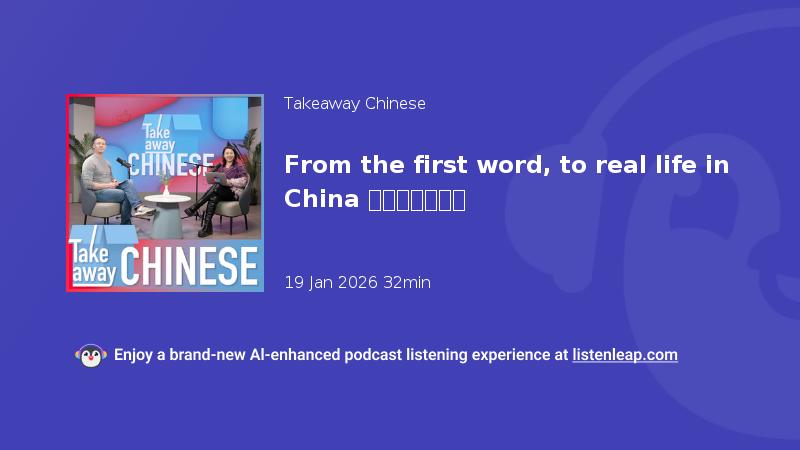
Takeaway Chinese, where you can take some Chinese away and experience progress day by day.
Takeaway Chinese, we will promise you a difference.
你好,欢迎收听随行汉语。 Welcome to Takeaway Chinese.
I'm Niu Honglin with Steve Hatherly here in the studio.
Hello, Steve.
Hello to you.
Hello to our audience.
Hello, everybody.
This is very exciting.
It is very exciting.
Usually, when we do Takeaway Chinese which we've been doing together for more than a year now we're usually in a pretty small studio that is not nearly as pretty as this one.
Yeah, it's a special occasion.
It's the occasion we have once a while, once a year, where we get to interact with you guys.
It's not that directly, but we leave posts on our social media account and we gather your answers and we talk about them and compare notes.
Actually, we help you compare notes And that is quite, a very exciting thing to do, because my feeling is that in life, when you get older, you stop making new friends as much.
Yeah, I think that's probably true.
Is it just a natural part of life?
Life you kind of get satisfied with the people that you know.
I think maybe you get a little bit lazy as well.
And another thing is for those who really want to do it, because their life experience, their life circle is kind of relatively fixed with the current friend, with the work, with the environment.
So one way to do that is to find a hobby club, the kind of club that you can meet new friends.
And I feel like learning a language can be a really good choice when it comes to a new hobby, something that you do in your free time, no matter if you're doing it in the physical world and face-to-face, or in a group chat on Facebook or YouTube.
And that's the cool thing about technology now is that it allows us to be sitting here in a studio in Beijing but also interact with fans of Takeaway Chinese from all around the world.
So this is a special treat for our audience today, but it's also a special treat for us, I feel like.
Definitely a special treat for us.
And again, we talked about this once a while.
We would start asking questions, because we welcome a lot of new friends to our Takeaway Chinese or Learn Chinese family.
Some of them have already got a really good command of language.
And they are looking for new things, which is something we're doing on Takeaway Chinese.
We try to include more Chinese idioms and complicated expressions and fun ways of saying things that are not that useful per se, but fun.
Totally fun.
And back to the point of, you know, everybody has different language level abilities.
I remember the last time we did I think it was maybe about seven or eight months ago.
I know you remember we had an episode of Takeaway Chinese where we had a live interaction with our audience.
And again, it was with people from all around the world.
Niu Niu said, hey, Steve, join the show.
You know, we're going to meet some people from around the world.
And I thought, OK, we'll be learning like the basic levels.
Now I was completely blown away by how fluent so many people were and are when it comes to learning Chinese, but aren't even here physically in the country.
That's a really cool thing.
Yes, and they're able to tell stories, ancient Chinese stories or the stories about their favorite cartoon characters in Chinese.
And I can tell you were nodding, but you were... Not comprehending.
Yeah, but I still really enjoyed the experience though because, with your help, you were translating, of course.
But I enjoyed the experience because it allowed me to see people's perspectives more on what they knew about China, what they wanted to know about China, what they wanted to know about Chinese language.
And for me being here physically in the country and working with you in this context.
It was a cool experience at the time.
And we're going to do that again today.
We've asked some more questions to you, our audience, various questions, and we're going to get some various answers.
Yes.
And one thing I want to ask you about is Because you mentioned that it's that show was around seven, eight months ago.
And at that time, you were still not able to understand the stories quite well.
But you are already a little bit accustomed or used to listening to a longer paragraph of Chinese because you've been here for a while.
And the intonation, the tones and everything can be not as intimidating as Chinese.
From the very beginning and and i think this is true for any language when you start hearing it for the first time, you don't know where one word stops and the next word begins, or when one sentence stops and the next sentence begins.
Then you start to pick up a few words here and there, you get to pick up a few sentences here and there and you don't really realize that you've learned something.
And this is the really cool part.
You don't realize you've learned it until you find yourself in the context of a situation or you're listening to other speakers and your brain goes.
I understood that.
I knew I got that.
Then you give your brain a little pat on the back and you move on to the next learning phase.
Yes.
So the starting stage of learning is usually very much fun.
It can start with A TV drama that you've been watching, with subtitles, with translations, but you started to have that passion of learning the language.
It can be because that you like the country, you want to travel there.
It can also be because a faraway friend that you for some reason started to know and wanted to you know, interact and communicate with their culture, or at least showing that you are interested in their culture.
Everybody has their own reason.
What was yours?
Well, I moved here.
Yeah.
And I can't think of a better reason.
It's a very practical one.
To start learning Chinese.
But you know, saying that living in a metropolitan city such as Beijing, I would say, if you speak English well, or if you have a pretty good command of English, you can live in Beijing quite comfortably because, But that being said, it's always better to be able to expand your language skills of the country that you're living in.
Because number one, I just think it shows a sign of respect.
Number two, it satisfies that curiosity of, oh, what are people talking about all the time?
And it's just nice to be able to interact with people when you go out on a daily basis.
And after a while, when you do have a good level of Chinese, you can still pretend that you don't know, and then know exactly what people are talking listening to your conversation.
Yes, yes, yes.
And I would give that as a travel tip to anyone traveling anywhere in the world, really.
Be careful because you never know who speaks what language these days.
And I really appreciate when you say that it's a good experience living here as a foreign expat, because now we know that here in China, This country has started the visa-free policy for a lot of countries, so it's very convenient to come over.
And besides that, recently I think within the last couple of months, or even just recently, Very much recently we see that there is the construction of Hainan Free Trade Port, which is the largest free trade port in the world in terms of area.
And there.
Ever since 2020, more than 9600 foreign-funded enterprises have been newly established in Hainan and by investors from more than 170 countries and regions.
Now, it's even easier to go to that area because the entire island is now a free trade zone.
You can start business there.
And for those who are interested, if you're only just interested, you can have a one month visa free period to go investigate and talk about the kind of business you want to do there.
You want to cooperate with the local people and also invest to the market, the policies.
And it's quite nice and it's I think it's a good opportunity to get to know China.
Yeah, 100 agree, and they're making it so easy and so friendly as well.
The policy changes that came for that particular part of China came at the same time as the China International Travel Mart.
It happened at the end of last year.
It was a three-day event and it was in Haikou, in Hainan.
And the level of participation was really impressive.
It was a record, as a matter of fact.
They had a thousand operators and representatives from 101 countries and regions.
And that reflects the growing international interest.
I mean, I think we can just put it that simply in Hainan, and that's driven by the favorable policies.
And I think that's enough reason for those who are not starting learning Chinese to start learning, or at least, you know, go visit Hainan or something.
But now the time is for you, for those of you who have already sent in your answers.
So the first question we asked was, why did you start learning Chinese?
And we've got so many cool answers.
I'm curious to find out people's answers because mine was kind of obvious.
Right.
You know, I moved here.
Yes.
But I'd love to know what other people said.
Well, there are more general ones.
We have friends saying from, from Cambodia, whose name I apologize for not knowing how to pronounce your name.
I should be start learning your language.
And you said about jobs, opportunity and culture, including philosophy.
That's a very sophisticated answer.
Do you know how to say philosophy in Chinese?
Tell me.
哲学 学 is kind of a subject or a school of thought or an area or aspect.
So what's the 哲?
哲 carries the meaning word here in this word.
哲学 here means philosophy, the kind of subject that is related to a relatively more abstract and life-thinking kind of method.
I was about to say, for example, 数学, 数学 is math.
So 数 is digit or number.
So 数学 is like the study of math.
And there's also 科学, science, science-related subject.
And 哲学 is philosophy.
So 学 is the subject of whatever comes in front of it.
Yes, yes.
So here, job opportunity, that is something 就业 yes, job opportunity, that is something relatively more practical, whereas psychology, whereas philosophy, it's something more abstract and romantic in a way.
Yeah, i totally agree with that.
And when we think about the philosophy of ancient china, a lot of people who aren't from here Find that as an entry point, I think, into the culture, into the language.
Wow, really?
I think so because it's kind of mysterious and it's kind of something that everybody knows about at least a little tiny bit.
And I think the easiest example would be Confucius.
Yes.
Yes.
And obviously there are other examples, too.
But that's a name that's known worldwide.
So if you have interest in that type of, OK, what were the teachings like?
What were people thinking about?
What was he thinking about?
You know, and then, oh, that's an introduction to the country.
That's an introduction to the culture at that time, even now.
And that's an introduction to the language.
Yes, and more often than ever you see that ancient people, even thousands of years ago, they kind of have similar reasons and similar perspective.
We see the world and they have the kind of wisdom that can even help us dealing with problems in our own lives these days.
So yeah, 哲学 quite a good way to understand the culture, understand people's mentality of that culture.
And not only that, but, you know, that was a long time ago.
But those things are still very, very well represented in Chinese culture today.
That's true.
That's true.
And also we have buried Chris saying for personal reasons and for work, it came in useful when I traveled in China.
That's for sure.
So personal reasons might have something to do with your personal interest and work.
Oh, yeah.
Many people now have work, chinese clients or business related to chinese market.
That also makes a lot of sense.
Could be romantic relationships too.
Yeah, i said a few minutes ago that if you live in beijing, or if you live in shanghai or shenzhen or guangzhou or one of the big cities, then you'll find it to be very, very international, i think.
But if you travel into the countryside a little bit, then you're obviously going to find it to be less international, and that's true for any country that you travel to.
And what I mean by saying that is that your other language, your second language, your English, might not come in as handy as it would in the bigger cities.
So traveling with a little bit of Chinese language ability is never going to be a bad idea.
That's true.
And also we have from Joel saying 因为我要学习外语和要新的就业机会 in Chinese.
So really good Chinese level already, saying that I just wanted to learn a new language.
And also I hope I can get a new opportunity or job opportunity for it.
It's the same answer with Boge Man or Boge Man saying for business, sure.
And this is a cute one.
We have Liv saying I have loved Chinese culture since I was a kid.
I am 21 now.
So most of my life I've been liking it.
Chinese and my dream job is to teach English in China.
I have always wanted to learn the language and now I am making my dream come true.
Lovely.
And I think if you have a plan to come to China and that's in your future, then getting ahead of the game and learning before you come, I mean, that's going to be such a great advantage for you.
And that's very impressive because on our Learn Chinese little online club, our little community here, as well as the show that you mentioned around seven, eight months ago, we did with a lot of Chinese learners out there.
They were interacting with us.
A very high percentage of those people are younger people.
Some of them are even kids and they're already learning Chinese very, very well.
And we also see that today, Chinese is taught in the national education systems for 86 countries and more than 200 million people worldwide are learning Chinese, learning it or using it as a second language.
Sure.
I mean.
In Canada too, there are hundreds of Chinese language institutions, and It goes beyond language institutions, though.
I mean, it could be at university level studies as well.
There's lots of places and lots of opportunities to do so.
Can I share one of my favorite answers here?
This is from Hushka Atsa, because I work at a Chinese restaurant in New York and I had to.
Don't know how to read, but I can speak fluently.
Well, that's very cool.
Yeah, that is cool.
And that's the thing about the Chinese language.
You need to know that Chinese is the kind of language.
If your first language is English, for example, then reading it and being able to speak it can be a little bit of like two things you need to learn separately, especially at the beginning, because the characters have nothing to do with the pronunciation at the beginning.
It's not like in English you learn the alphabet and you kind of have an idea of how to pronounce the words in chinese.
It's harder than that yeah, because you're learning the characters as opposed to letters and the sounds of letters in a word, but at the same time, it also means if you are the kind of people who are really good at recognizing characters and just remembering them I know people who are able to read much better than they can speak.
No way.
Yeah.
I thought that was impossible, actually.
Of course, more people would be the other way around, that they know how to speak it, but they don't know how to read newspapers or books.
And that's fine.
So for our friend here saying that I do not know how to read, but I can speak fluently, it's possible.
Yeah, absolutely.
And you know, in the context of how or why you need to learn to speak Chinese.
Learning in a restaurant would be cool, because the language would get repeated a lot of the time, right?
So it would be easier to remember the phrases or the words that you needed to.
Anyway, Hachka, thanks for your answer.
Thank you.
And, at the same time, we have many, many answers related to traveling to the country, communicating with local people.
We have Claudia saying I started to learn Chinese because I love Chinese culture and I wish to be able to communicate with Chinese people when I travel to China.
That is a lovely one.
And as long as you make the effort, I'm pretty sure local people would be able to appreciate it and they will welcome you even more.
We got a message from Alex that said I started to learn Chinese because I want to be able to enhance my communication skills.
And the message also says, How are you, teacher?
Yes.
Oh, that's another thing for those who are learning to speak and trying to be fluent.
It's not easy to use characters, but you can definitely use pinyin.
The pinyin system is to help you to know how to speak.
And if you can even speak longer sentences, the hurdle of different tones would be, you know, A challenge.
It will be a challenge, but if it's longer sentences, it'll be better.
Even though you're not always that accurate with the tones, people would still be able to understand you.
I remember one of the first chats that we had on Takeaway Chinese over a year ago and you were asking me about what are some of the challenges for you and my answer was I needed to remember that pinyin is not English.
Oh, yes.
It looks like English, and you might be tempted.
No, your brain will be tempted.
If you're an English speaker, your brain will be tempted to try to read it out phonetically in English, but you're learning something completely different.
But it's there to help you, and it is a huge help once you figure it out.
Yes, and the reason that you need to remember it's not English is that certain letters would be pronounced very, very much different.
The opposite almost from what you would expect.
Here's another one.
This is on the topic of Chinese dramas and movies.
Rovineth says, I want to get rid of the English subtitles when I'm watching Chinese drama.
That's ambitious.
I want to ask, what is your favorite Chinese drama?
And please give your answers in the comment area.
Let us know what are the kind of cool C drama that give you the the edge to learn a language that is
So challenging for some people.
Yeah.
I mean, that's pretty advanced.
If you can watch a drama without the subtitles, I would say you are nearing a level of fluency that's pretty impressive.
You know, in Chinese, we have... One more time.
生 means raw.
肉 is meat.
And 生肉 is raw meat, and 熟 is cooked.
So 熟肉 is cooked meat.
Raw meat, cooked meat.
Yes, and that was referring to... Is that a drama title?
It's a drama-related thing.
It's saying that if you're watching a drama or a TV show or anything that is outside of your culture and you do not know the language, 生肉 would be the drama itself, whereas 熟肉 would be drama with subtitles and translation.
So it's like raw meat there.
And if you are good enough, you can cook it yourself.
But if you're not that great, you can wait for the shuzhou, the cooked meat, to be able to appreciate it.
So now you're trying to move from the shuzhou to the shenzhou area.
That's awesome.
Yeah.
Yeah.
Lots of people actually answered about Chinese dramas.
Anna said, I always watch Chinese dramas.
Laden said, because I like Chinese dramas and that's how it started.
And It has an incredible history and culture and customs and landscapes.
And that just goes back to the point, doesn't it, that it really your interests?
Wherever your interests lie, then that can be your entry into learning Chinese.
And I totally, totally understand the drive, because in Chinese we would also give the kind of shows that we watch, a lot of different types of nicknames, and even for nicknames are sometimes not for the show themselves but for the kinds.
And we have a way of addressing those shows.
We call them xia fan ju.
Xia fan ju.
So xia is to help something go down.
And fan is food or meal.
Ju is drama.
So xia fan ju is the kind of show you would watch while you're eating.
Ah.
It helps you eat more because you're just very much intrigued and you enjoy the process.
Okay, so what types of shows would those be then?
The type of show that I do not have to stare at the subtitles all the time because I have to occasionally look at my food.
That's what I'm saying.
So I would love to know that many of you are able to at least understand part of the conversation without staring at the subtitle.
So you'll be able to treat your favorite C drama as Xia Fan Ju as well.
Cool.
I'll give you a tip.
Maybe you do this already or maybe you don't.
I was watching a Chinese drama on television last night.
If I'm flipping through the channels, I'll stop for like 10 or 15 minutes maybe, and that's kind of all you need to do.
I mean, you don't need to be.
You can be a dedicated fan of that drama, but you don't necessarily have to be if learning Chinese is your goal.
And what I'll do is I'll watch without the subtitles and I'll just hear a sentence spoken.
Usually it's maybe, I don't know, a four character or eight character, whatever my brain happens to catch.
Then what I'll do is I'll go to the internet.
Or I'll go to AI and I'll type it out in English and I'll say, is this Chinese?
I heard this on TV.
And I'll talk to the AI and say, oh, yes, I think this is this sentence.
And it's amazing.
So you can use an AI tool.
You don't even know if you're writing it out correctly.
Well, you're probably not because you're not using pinion.
But even still, it'll be able to teach you the sentence.
That's very cool.
Isn't that really cool?
And also when you actually engage with the sentence instead of just listening to it, it helps you understand and remember even better.
Yeah, 100%.
Yeah.
And, of course, besides dramas and movies, we also have reasons that are related to culture and history, which is even more sophisticated.
Rain says, I've always been fascinated by Chinese culture and history and philosophy and arts.
It's one of the oldest civilizations.
Learning the language will make it much easier to understand.
Definitely, definitely.
And especially if it comes to culture-related history and philosophy-related stuff.
Here in China, we say things in our daily lives for sure with Mandarin, but we also have 古文.
Gu Wen is ancient Chinese.
Ancient Chinese can be quite different from modern day Chinese.
Would you still recognize it or would it be like a completely different language?
It would be relatively different in the way that in middle school you would have to study it.
So, in general, you need to understand different ways of using the same characters in different scenarios.
And sometimes there would be different, relatively more ancient characters.
So it can be quite different.
But for those who are learning the Chinese culture and history and wanted to know more about it, definitely it's something that they would need to learn.
And also, I love this answer.
We have Fastina saying, because of 3,000 years of civilization.
And you know what?
It's 5,000 years of civilization.
It's even longer than that.
I remember after I moved, it was such a stupid thing for me to think.
It was kind of ignorant.
But I just had the assumption that all Chinese people know everything about Chinese history.
And all Chinese people know everything about Chinese language.
And of course that's not true, because you know.
No matter where you're from in the world, you don't know everything about your country's history.
And you haven't been to every town and every village and every city within the country.
But that's true.
When I read that comment from Fistina, you know three, five thousand years of history.
It's fun to chat with my coworkers, like you know, and my other coworkers as well, just asking questions about Chinese philosophy or Chinese history or events that have happened, because sometimes the answer is I don't know.
I don't know.
We kind of learn about it together, which is really cool.
Yes.
And also knowing what is the exact point that interests you from a perspective of an expert is also quite cool.
And besides that, we also have a lot of personal reasons like to exercise my aging brain.
Pretty sure you're not aged, but yes, Doing it as a brain gymnastics is also quite fun.
Yeah, that's like I mean.
If you're learning Chinese just for brain exercise, that's like saying I'm going to start exercising.
I think I'll run a marathon.
You're going to the hardest thing for gymnastics.
Yeah, yeah.
And also we have this is a lovely reason because my kids study at a Chinese school.
It's kind of like I want to communicate with them with the kind of language that they prefer or they want.
They are learning.
Yeah, of course.
And when there are all these interesting, interesting reasons, you kind of want to ask them.
Oh, it must be because, or it must be that you are learning Chinese already.
So what was the very first Chinese word that you learned?
So what's yours?
Well, for me, I think maybe Ni Hao, of course.
Ni Hao Ma was the first that I learned.
But after I arrived, I think the first thing that stuck with me was Bing Kua.
Ah, ice.
Ice cube.
Cube.
Yes.
And the reason for that is because I guess as a Canadian or maybe it's a North American thing we want ice in everything.
We want our drinks to be super, super cold.
And if you go to Beijing restaurants and I'm not sure if this is or I'm not sure if this is true around the country, but you don't find a lot of ice cubes just given to you.
If you ask for them, they often have them.
But yeah, I remember going to restaurants and like searching.
Okay, I want ice.
How do I say?
Okay, so I would ask and say, okay, sure.
Remember the very important tip we talked about when it comes to asking whether or not they have ice.
The very important thing is to say, do you have ice cube?
Instead of saying, do you have ice?
Yeah, because I tried that.
And it's not going to work because 你有冰吗? which sounds a bit closer to 你有冰吗? which is not very polite.
You taught me what that means too.
It's like you're... What's your matter?
What's your problem?
Right.
So that's the difference between 冰 which is ice and 冰块 which is ice cubes always say 冰块.
Yes.
When it comes to the answers we received, it's quite...
Romantic.
Romantic.
Because I love you is one of the answers.
A lot of people texted that in as the first Chinese words.
I do that too when I try to learn a new language or when I travel to different places.
I don't know about you, but I also do find it quite useful.
That is, you learn to say I love you.
And you learn to say hello.
But once you're traveling there and saying I love you to local people in their local language would definitely give them a laugh, sometimes a blush, and they would appreciate your effort.
Yeah, just be careful with it, you know, depending on the context of the situation.
But a lot of people say well, i need um.
A lot of people said numbers numbers, the first ones.
They learn hard.
But it makes sense, because when i was teaching my kid when he was two, one and a half, i teach him numbers.
Yeah, er sansu yeah, those are kind of those the first things that people tend to come across when they learn a language.
Yeah and, And there are a lot of 儿歌 with numbers in.
So 儿歌 would be children's songs.
And learning a language through a simple song would be a good way to do.
Oh, do you know why or how I suddenly realized, oh, I have to learn the numbers.
Because I got a phone number here in China.
And I realized I have to tell people what that telephone number is.
And by people, I mean the delivery people.
When they bring your food or your package and you meet them, they want to know the last four digits.
And that's true when you get a taxi or you order a taxi.
Yes.
I was wondering have you ever returned anything or get refund in China when you're doing e-shopping?
Well, the answer is no.
But it's really easy to do, you know?
Yeah.
Yeah.
Within seven days, almost all of the package, all of the things and the commodity that you bought.
You're able to return them.
And once you return them, there's even the kind of service that having the delivery guy to come to your doorstep and collect the goods and you do not need to worry about where to send it, because you've already decided to send it back and the address would automatically appear on their phone.
But what you need to do is give them the password so that they know it is your package and you're sending it back, yeah.
So yes, knowing numbers are very important, super useful.
Yeah, and also we have oh, we have some lovely answers as well.
How come mall cat would be the first thing that you learn?
You must love cats.
I love cats too, And also 小兔子, little rabbit bunnies.
Nobody said 谢谢.
Oh, thank you.
Yes.
Yeah.
Do we have 谢谢?
Or 谢谢你.
谢谢你.
Oh, we have 帮帮我, please help me.
帮帮我.
That's also very important.
Okay.
But yes, 谢谢你 can be important.
So if the answer of yours is 谢谢, please let us know in the comment area.
Maybe you didn't have the chance to answer just yet, but here is another opportunity to engage with us.
And of course, we also have a lot of people here answer related to money how much is it?
So that's also a good one.
Yes, and when you ask that question, then you know they're going to answer with numbers.
That's why you should also learn numbers.
Yeah, exactly.
Yeah, 多少钱 means how much is this?
Yes.
And I just realized we only talked about two questions and answers and it's already enough time for our one episode.
So, yeah.
Again, thank you so much for being with us for this lovely half an hour.
And we prepared another fun episode with all the answers and, of course, cool questions, so that you're able to participate a bit later.
So if you're interested in this one, I'm pretty sure you should not miss the second episode we have about.
You know this way of interacting with our lovely, lovely Chinese friends learners out there.
Thank you so much for being with us.
I'm Niu Honglin with Steve here in the studio and we'll see you next time.
Bye bye.
Bye.