Hello, hello, hello, and welcome to English Learning for Curious Mines by Leonardo English,
the show where you can listen to fascinating stories and learn weird and wonderful things
about the world at the same time as improving your English.
I'm Alistair Bunch and today it is the start of another mini-series, this time on the
theme of Scotland.
In part one, in this episode we are going to have some fun talking about unusual Scottish
traditions and facts.
In part two, we are going to talk about the time that Donald Trump tried to build a golf
course in the north of Scotland and, well, it didn't quite go to plan.
In part three, we are going to talk about the quest for Scottish independence and ask
ourselves whether Scotland will ever break free from the United Kingdom.
And in part four, yes, lucky you, this is going to be our first four part mini-series.
We are going to look at one of the bloodiest events in Scottish history, the Glencoe
Massacre.
Parts two and four are going to be bonus member only episodes, so this is my opportunity
to very quickly remind you that if you would like to become a member of Leonardo English,
unlock all of our bonus episodes and all of our learning materials, likely study packs,
interactive transcripts and subtitles, the place for that is LeonardoEnglish.com.
OK, then let's not waste a minute and get talking about some unusual Scottish traditions.
There was a famous survey done several years ago of American tourists considering making
a trip to Scotland.
The survey asked the reason for the trip, and a reported 23% said that they had come in
the belief that they could hunt and catch something called a haggis.
When asked to describe this haggis, one tourist said it was a wild beast of the Highlands,
no bigger than a grouse which only came out at night.
One or another said that it was a creature that sometimes ventured into the cities and
was similar to a fox.
You may know that haggis is a popular Scottish dish, it's eaten during special occasions.
The problem is haggis isn't an animal.
It is a collection of sheep organs mixed together with oats and other spices.
It might sound disgusting, but if you ask me it's delicious.
Now this survey was created by an American tour company and a haggis producer, so perhaps
we should take the results with a pinch of salt.
But even today, if you go to Google and start typing is haggis.
The first option that pops up is healthy, and the second is an animal.
So clearly there are plenty of people who still believe this quintessential Scottish dish
is in fact a cute furry little animal.
We will talk more about haggis in a moment, but the reason to start with this little story
was to underline this strange mythology that Scotland and Scottish customs have in many
people's minds, especially in those of Americans.
Scotland is a small country.
Only five and a half million people, but it has an outside global impact.
It has produced great inventors, scientists and philosophers.
Scottish people are rightfully proud to call themselves Scottish, and the hundreds of millions
of people with some kind of Scottish heritage, Scottish ancestors, often embrace it and
feel a strong connection with this country that in many cases they will never step foot
on and no nobody from.
One of those people with Scottish ancestry is, in fact, me.
If you've been paying attention, you will know that my name is Alistair, which is a Scottish
name.
My grandfather was Scottish.
I still have a lot of family in Scotland, and I partially grew up in Scotland from when
I was seven until when I was 13.
I might not sound Scottish to you.
That's what lots of moving around and then living in England does to your accent.
But I am more Scottish than several players on the Scottish rugby team, and I can actually
play the bagpipes.
So I am more Scottish than you might have realised.
So here we are, someone who is at least partially Scottish, talking to you about some unusual
Scottish traditions.
People are first one, we are going to return to the haggis.
You might know that there are some days on which haggis is traditionally eaten.
The most famous of these is Burns Night, which is a celebration of the life of the famous
Scottish poet Robert Burns, and falls on January 25th every year.
But what you might not know, and is certainly an unusual Scottish tradition, is what is done
before the haggis is eaten.
The haggis is prepared, of course, which really only means boiling it in water.
It is brought to the table, ideally to the sound of bagpipes.
I have piked in many a haggis I should add.
But before the haggis can be eaten, it is tradition to read a poem to celebrate the haggis.
It was written by Robert Burns himself, and is called Address to a haggis.
It is written in Scots, so it is hard to understand even for a native English speaker.
But it starts like this.
Fair far your honest, Sonsi face, great chieftain of a pudding that is.
I imagine you might not have understood any of that.
Fair far is a way of wishing someone well, and Sonsi means happy or cheerful.
And then he is calling the haggis a chieftain, a great leader of the race of puddings.
So to translate it into normal English, it will be something like, hello, honest and
happy haggis, you wonderful leader of all puddings.
Anyway, I won't go through the entire poem.
It's quite long and complicated.
But about a third of the way through the poem, the person reading it needs to ceremoniously
stab the haggis with a knife, cutting it open and spilling all the contents of the pudding.
It is a lot of fun, and if you ever find yourself in Scotland on Burns Night and
see an animated person reading a poem out loud and holding a large knife, do not worry,
this is what is going on.
Now for our second unusual tradition, we are going to talk about something called the
Highland Games, and you will be pleased to hear that haggis's feature here as well.
The Highlands, as you may know, are the northern half of Scotland.
If you have seen pictures of wonderful mountains and forests, you are probably imagining the
Highlands.
And during the summer months, all throughout the Highlands, different towns and villages
put on Highland Games, which are a sort of day of sporting activities and competitions,
as well as music and celebrations.
Some of the events will be familiar to you.
There are normally running races and weight lifting, but some of the activities will probably
be less familiar.
There is something called tossing the caver, which involves picking up a large telegraph
pole, a huge pole of wood, typically 5 to 6 meters tall, and throwing it so that it
lands on one end and then flips over on the other.
There is the hammer throw, which involves someone trying to launch a heavy ball attached to
a rope as far as they can.
It's quite scary and impressive to watch, as the person needs to spin around and around,
and then let go of the rope just at the right time, so that it doesn't fly into the crowd
and smash into some unsuspecting spectator.
And then there is also something called hurling the haggis.
To hurl is another word for to throw, it means to throw with great force or effort.
And haggis hurling is exactly that.
It requires someone to throw a haggis as far as they possibly can.
But there are some nuances, some rules to be aware of.
A real cooked haggis must be used, and the haggis cannot break.
If it splits in midair or when it lands, the throw is disqualified.
And this happens quite a lot.
After all, a haggis is only held together with a thin lining.
So there is real skill in throwing it a long distance, but so that the landing is relatively
gentle.
And if you are wondering what the world record for haggis hurling is, it is 66 meters,
which is quite impressive if you ask me.
Now we are going to move away from haggis-based traditions, but we are going to keep on the
subject of food.
As you may know, if you are looking to visit somewhere that prides itself on healthy,
nutritious food, fresh vegetables and fruit, then Scotland probably isn't your best bet.
Our first unusual Scottish tradition is one that you might have heard of, and that is
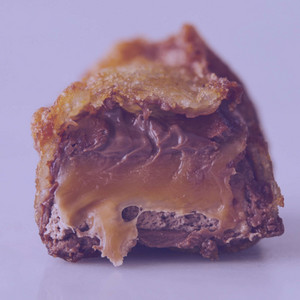
something called a deep fried Mars bar.
You probably know what a Mars bar is.
It is a chocolate bar filled with newgar and caramel.
And you probably know what to deep fry means.
It means to submerge something in hot oil.
It is what you do with chips, or fried chicken, or the fish in fish and chips.
But a deep fried Mars bar is exactly what you probably think it is.
The Mars bar is chilled, put in a fridge, before being covered in batter, and then deep fried.
If you like fried food and you like Mars bars, it will be delicious, but it should come
with a health warning.
Each one contains a reported 1,200 calories, almost half the daily recommended allowance
for a man.
So it is a treat best enjoyed infrequently, unless you also enjoy visiting the hospital.
Now moving on, you probably know that Scotland is the home of whiskey, but you might not
know a less famous and less alcoholic Scottish drink.
It's called iron brew, and you can recognise it by its bright orange colour.
And if you are thinking mmmm, delicious, a kind of orange tasting soda.
Nope, it doesn't taste like oranges at all.
I actually quite like it, and I used to drink it a lot as a child.
But as such a strange taste, that it took me quite a while to figure out how to describe
it to you.
I looked through various forums to see how other people described it, and one of the most
popular comments was that it tastes kind of like rust and battery acid, and it's magic.
It tastes a little bit like bubble gum, a little bit of lemon, but looks highly radioactive
and tastes like nothing else I've tasted anywhere outside Scotland.
And in Scotland, it is exceptionally popular.
It is the best selling drink in the entire country, outselling coke and Pepsi.
And its recipe, according to folklore, is an incredibly, closely guarded secret.
Only three people in the company know the exact recipe, and they are never allowed to travel
together, in case there's an accident, and the recipe is lost forever.
So if you happen to be travelling to Scotland, and you see people drinking what looks like
it could be radioactive fluid, that's what's going on.
And I would certainly recommend that you try it yourself, as it is pretty hard to come
by anywhere outside the Scottish borders.
Right, for our last tradition, I am going to tell you some unusual facts about the National
Instrument of Scotland, the bagpipes.
As I said at the start of the episode, I can actually play the bagpipes.
So this is something I can tell you about from first-hand experience.
In case you don't know what I'm talking about, the bagpipes are a musical instrument
made up of a bag with several tubes coming out of it.
To be precise, one tube where you blow air in, three tubes that sit over your shoulder,
called drums, and another tube that you hold with both hands and play tune with.
It's not an easy instrument to play.
You need to properly manage blowing into the bag and squeezing it with your left arm.
But when you do it properly, it sounds like this.
So to finish up this episode, here are five unusual facts about the bagpipes.
Firstly, the bagpipes can never be silent.
Unlike almost any other instrument, you can't stop making noise when you're playing.
There is always the background noise, the drone, and the noise of the chanta, the one that
makes the tune.
Secondly, bagpipes were traditionally made from the skin of an entire animal.
With the pipes attached to where the neck and head would have been.
Thirdly, as you may know, forms of bagpipes exist in many different countries.
France, Spain, Italy, Poland, they all have different forms of bagpipes,
and there are similar kinds of instruments all over the world.
Fourth, and this in fact came as news to me.
Alongside myself, the famous and not particularly pleasant Roman Emperor Nero was said to have
been a skilled bagpiper, and played a form of bagpipes not so dissimilar to the Scottish
Great Highland bagpipe.
And for number five, I'm going to give you a fact that you won't find anywhere else
online.
There is a kind of whiskey called Glen Morangie.
It's a very famous high-quality whiskey, made just outside a town called Tain in the north
of Scotland.
You can visit the desilary and see how the whiskey is made.
The desilary employs many people in the area, including a man called Jimmy, who was also
my bagpipe teacher.
Jimmy was the night watchman, so it was his job to monitor everything in the desilary
during the night, to make sure that nothing went wrong overnight.
And Jimmy would spend his evenings walking up and down the desilary floor, playing the
bagpipes to pass the time.
And given that Glen Morangie whiskey is ten years old or more, if you have drunk Glen
Morangie at any point in the last twenty years or so, in all probability that whiskey has
been aged to the sound of a man called Jimmy McLeod playing the bagpipes.
Okay, then that is it for today's episode on Weird Scotland, the first in our mini-series
on this wonderful country.
As a reminder, next up we'll be Donald Trump's battle to build a golf course, and how he
realised that the locals were going to put up more of a fight than he expected.
Part three will be on Scotland's quest for independence.
Part four will be on one of the bloodiest events in Scottish history, the Glencoe massacre.
And as a final reminder, if you enjoyed this episode and you are wondering where to get
all of our bonus episodes, like Part Two and Part Four of this mini-series, plus the
interactive transcripts, subtitles and Cuba capri, then the place to go for that is
Leonardo English.com.
And if you aren't yet ready to become a member, but you would like to do something to support
the show, then I would love for you to think about leaving a review or a star rating on
your favourite podcast app.
It takes less than 30 seconds to do, but they are super helpful, and each one brings a
smile to my face.
You've been listening to English Learning for Curious Mines by Leonardo English.
I'm Alistair Bunch, you stay safe, and I'll catch you in the next episode.