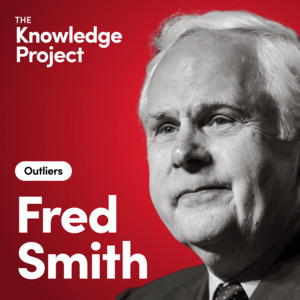
It's July, 1974.
Fred Smith is sitting at a blackjack table in Las Vegas at 3 a.m.
He's playing with the last $5,000 his company has left, literally the entire bank account of FedEx.
Back in Memphis, 14 jets sit on the tarmac.
They need $24,000 worth of fuel by Monday morning or Federal Express dies.
Smith's already been turned down by every investor.
He's personally guaranteed millions in loans.
His house, his inheritance, everything he owns is on the line.
General Dynamics, an early investor in FedEx, just told him no for the third time.
Sorry, Fred, we can't invest anymore in FedEx.
The company is burning a million dollars a month with no plan to profitability.
Most founders would have given up, but Fred Smith isn't most founders.
He went to Vegas instead.
By sunrise, he's turned that $5,000 into $27,000, just enough to fuel the planes for two more weeks.
That bought him the time to raise $11 million and save the company.
Five decades later, that desperate gamble has become an 88 billion empire that moves 17 million packages a day.
But here's what matters.
Fred Smith didn't build FedEx because he got lucky at Blackjack.
He built it because when everyone else said overnight delivery was impossible, he saw that impossible was just another word for opportunity.
Welcome to The Knowledge Project.
I'm your host, Shane Parish.
In a world where knowledge is power, this podcast is your toolkit for mastering the best of what other people have already figured out.
Fred Smith built FedEx from a college term paper that got a C. The professor said it wouldn't work.
Today, that idea moves trillions of dollars a year in packages.
This is about how Fred Smith solved a problem everyone else accepted as unsolvable.
Before FedEx, shipping something across the country meant waiting days or weeks with no idea when it would arrive.
Smith refused to accept that.
What he built changed more than shipping.
He changed our relationship with time before FedEx waiting was inevitable.
After FedEx waiting became optional.
That shift created everything from just-in-time manufacturing to same-day delivery.
Smith had every excuse to fail.
His father died when he was four, leaving him to grow up in leg braces from a bone disease.
He came back to Vietnam to build his company during the worst recession since the Depression.
At one point with only $5,000 left in the company bank account, he flew to Vegas and won.
Yet he built one of only four companies to ever hit 1 billion in revenue within 10 years without acquisitions.
At the time, anyway.
Three lessons from this episode stand out.
First, the best businesses solve coordination problems, not product problems.
FedEx wasn't really about moving packages.
It was about trust.
Second, align incentives with outcomes.
When FedEx couldn't get packages sorted fast enough, they switched from paying by the hour to paying by the shift.
And the problem solved itself overnight.
Third, loyalty can't be bought, only earned.
When FedEx nearly died, employees worked without pay and used personal credit cards for jet fuel.
Not because they had to, but because they wanted to.
Let's see how he did it.
It's time to listen and learn.
Fred Smith's story begins with transportation running through his family.
His grandfather commanded steamboats on the Mississippi River.
His father, James Frederick Smith, built that inheritance into something even bigger.
He created Dixie Greyhound lines connecting small southern towns that national carriers ignored.
Then he co-founded Tottle House restaurant chain, placing diners along his bus roads.
By the time Fred was born in 1944, his father had built an empire worth millions.
But Fred barely knew him.
James Frederick died in 1948 when Fred was four years old.
The death left behind an unusual arrangement.
Fred's father had locked the family fortune in trust funds that wouldn't be open until his children turned 21.
He built his wealth from nothing and understood how easily money could destroy character.
So Fred's mother, Sally Wallace-Smith, raised her children in a unique situation.
They were technically wealthy, but practically middle class.
They lived comfortably in Memphis, but not lavishly.
Fred would later credit this with teaching him that money was a tool, not a goal.
And that lesson would prove critical when he'd risk his entire inheritance on an idea everyone called impossible.
But first came a different challenge.
Fred developed a rare childhood disease, a condition that cuts off all blood supply to the hip joints.
The bones didn't develop properly.
Doctors said it would be years before he could walk normally, and he would never play sports.
For most of his childhood, Fred lived with crutches and leg braces.
The physical therapy sessions were painful and seemed pointless.
While other kids ran around playing, Fred watched from the sidelines.
He became an observer, learning to read people and spot patterns that others missed.
His mother refused to let him give up or feel sorry for himself.
Sally Smith was determined her son wouldn't be defined by his disability.
She drove him to specialists across the South, pushed him through therapy even when it hurt, and never accepted his disability as an excuse for anything.
Fred responded with determination rather than self-pity.
Therapy was excruciating, but he kept at it.
Around age nine, something shifted.
The calcium deposits that had been destroying his hip joints began to recede.
By age 10, through thousands of hours of therapy, he'd overcome the disease completely.
He didn't just walk normally again.
He became his high school star athlete at Memphis University School, earning varsity letters in basketball and football.
Consider what that took.
A kid who couldn't walk properly for years became a varsity athlete.
As Fred would later say, fear of failure must never be a reason for not trying something.
The lesson here matters for everything that came after.
Fred learned early that accepting a diagnosis isn't the same thing as accepting defeat.
When everyone said overnight delivery was impossible, he'd remember the doctors who said he'd never play sports.
Flying came next.
At 15, Fred earned his pilot's license, the youngest age legally allowed.
While his classmates were getting driver's license, Fred was learning to fly.
He'd spend hours and hours at Memphis airport watching cargo planes load and unload, already noticing how inefficient the whole process seemed.
If you're wondering, Who does this at 15?
Here's how his sister described him as a 15 year old.
If you met Fred, then you would have been dazzled by him.
The man was charming, articulate and just winning.
You would follow him anywhere as a leader.
He would start waving his hands around and conjure up these images and your checkbook would just bounce in your head and you are ready to follow him over the next hill and wherever.
He was a terrific salesman who made fantasies come alive.
He also started his first real business in high school.
Fred and two friends launched Ardent Record Company from a garage recording local Memphis musicians.
It began as a hobby but quickly became a legitimate business.
They broke even on their first release.
The studio would survive for decades.
Led Zeppelin would eventually record there.
At Yale from 1962 to 1966, Fred wasn't much of a student.
I was a crummy student, he'd later admit.
But he wasn't wasting his time either.
He failed to make a football team and threw himself into flying.
He discovered that Yale's flying club was defunct.
Smith didn't just restart it, he turned it into a business operation.
He convinced Piper Aircraft to lease planes, negotiated with New Haven Airways for instructors and recruited a legendary professor as a sponsor.
His classmate, Mike Waterman, remembered Fred was looking for a less expensive way to fly.
He also saw there was a real need on campus for people to learn to fly.
So he put the deal together.
It was like financing a startup company, and Fred was good at that.
Then came the term paper that would change everything.
In Economics 43A, Professor Chalice Hall asked students to identify a problem in the modern economy and propose a real solution.
Fred identified something everyone else simply accepted.
The shipping system was fundamentally broken.
Packages traveled as afterthoughts on passenger planes competing for space with luggage.
Ship something from New York to Los Angeles and it might sit in three different airports over five different days.
Nobody could guarantee when anything would arrive.
Businesses, of course, had learned to cope with this uncertainty.
Fred's solution was radical but simple.
Create a dedicated airline just for packages.
Route everything through a central hub in middle America, guarantee overnight delivery anywhere in America and you only need flights from each city to the hub and back, not between every city pair.
The math kind of worked.
Package going from New York to LA would first be flown to say, the Memphis hub, where it would be sorted and rerouted out on the plane that had just brought in the shipments from Los Angeles.
He calculated the market size by analyzing what companies spent on emergency shipments, the urgent things, the things they absolutely had to get there.
He identified the target customers businesses needing guaranteed delivery for critical parts and documents.
He even outlined the technology required, including a tracking system that would tell customers exactly where their packages were.
This was the idea, the seed of the idea for what would eventually become FedEx.
The professor gave it a C.
One of his friends, Bob Frame, recalls I remember reading his term paper.
When he got back, Fred joked about the grade.
The idea always seemed to be in the back of his mind.
You knew he was going to do something with aviation.
He was going to devote his life to some aspect of it.
In some of our bull sessions, all of us were talking about life and things in general.
Several times he brought up the concept of Federal Express.
I think it was germinating.
It was in his mind.
I think Fred had a charisma about him, a sort of self-confidence.
And he had those entrepreneurial instincts like getting the flying club going and being president of our fraternity.
He had an aura about him that was very impressive to people and legitimately so.
I think his leadership and his entrepreneurial instincts and seeing what ought to be done was right there at Yale.
And people recognize that.
The fraternity he was president of was Delta Kappa Epsilon, alongside future President George W Bush and Senator John Kerry.
He was tapped for Skull and Bones, one of only 15 seniors selected.
Those relationships would prove critical when FedEx later needed political support for deregulation.
In August 1963, while home from Yale, Fred was in a serious car accident.
He was driving his new Corvette with his close friend, Mike Gadbury, when a car full of children made a sudden turn in front of them.
Fred had a split second to decide, hit the car with the kids or leave the road.
A spectator would describe the crash as the car was flipping and and over.
It was bouncing high in the air.
It would hit once and flip completely over and then hit the ground again and then flip again.
At once, I could see the boy still in the car was badly hurt.
He was lying on his back, struggling to breathe.
If he'd had immediate care, he might have made it.
Mike died at the scene.
Fred survived and was treated for a concussion.
His mother later recalled it made an old man out of him overnight.
A close friend who visited Fred in the hospital would later say I still think that experience had a great influence on Fred and his life in terms of what he did.
I think he felt very badly and I think he pushed himself to the limit in everything he did.
He probably would say no, that didn't have anything to do with it, but I always thought it might have.
The accident fundamentally changed Fred's relationship with risk and failure.
When you've survived something like that, when you've watched a friend die, business setbacks don't scare you in the same way.
This would influence every major decision he made afterward, from volunteering for Vietnam to betting everything on FedEx.
Fred could have easily avoided Vietnam.
His childhood disability qualified him for medical deferment.
Instead, at 23, he volunteered for the Marines and chose active combat duty.
Some fellow Marines thought he had a death wish after losing his friend in that car accident.
And whether that was true or not, he was a remarkably good soldier.
As second lieutenant, he led a 94-man mortar platoon on search and destroy missions.
The close calls came regularly.
Once a bullet severed his helmet's chinstrap without giving him a scratch.
On another patrol, the men immediately in front, beside, and behind him were all killed.
He was the only one left standing.
Smith served two tours from 1966 to 1970, earning the Silver Star, the Bronze Star and two Purple Hearts.
But the metals weren't what mattered.
Vietnam taught him the principles that would define FedEx.
First, he watched military logistics fail spectacularly.
The hub and spoke system moving supplies through bases like Da Nang was brilliant in theory but catastrophic in practice.
Critical medical supplies sat for weeks while non-essential items moved quickly.
Supply sergeants hoarded because they couldn't trust the system.
Smith saw the problem wasn't the model, it was the execution.
With better tracking and guaranteed reliability, the hub and spoke could work perfectly.
More importantly, he learned about leadership from Staff Sergeant Richard Jackson, a platoon sergeant from Philadelphia with 11 years in the Marines.
Sergeant Jack, you would say was not very well educated, but he was probably the wisest guy I ever met.
He had a wisdom about what people who weren't officers think and want.
And that has stood me in great stead since I was a manager.
When Jackson was killed in Operation Swift a battle so fierce the Marines couldn't even retrieve their dead for two and a half days.
It drove the lesson home.
Soldiers don't fight for abstract ideals.
They fight for the person next to them in the foxhole.
Lieutenant Colonel Donald Rexroad saw Smith live this philosophy.
Fred had the best company in my battalion.
They function better as an entity.
After one firefight, Rex Road remembered Smith returning in tears.
The sergeant had just been killed.
And that loss hit Fred hard, very hard.
When Smith's first tour ended in 1968, America was falling apart.
Martin Luther King and Robert Kennedy had been assassinated.
It would have been easy to stay home.
Smith decided to return for a second tour.
When asked why by a local newspaper, reporter Smith replied there are 500000 Americans over there and I've had a year's experience and I know I can do it better than any new officer they might send over to replace me.
Smith returned home on July 21, 1969, the same day that Neil Armstrong walked on the moon.
He was 25, carrying medals, shrapnel still in his back, and a complete operating philosophy.
Take care of your people and they'll accomplish the impossible.
I wanted to do something productive after blowing up so many things, he said.
The lesson he took away from his time is that loyalty is earned through shared sacrifice, not money.
Years later, when FedEx nearly died, employees would work without pay to save it.
They'd use personal credit cards to fuel planes, not because they had to, but because Fred Smith had learned from Sergeant Jack how to earn that kind of loyalty.
Fred Smith had transformed himself again.
Each transformation taught him that impossible was just another word for opportunity.
Now he was ready to build a company that would transform how the world moved.
But first...
He'd have to convince everyone that overnight delivery wasn't a fantasy.
It was the future.
And he'd risk every dollar to prove it.
We were made to easily bundle your trip.
Expedia made to travel flight inclusive packages are at all protected Savings and cash back.
And you can get it too.
Stack sales on top of cash back and feel what it's like to know you're maximizing savings.
It's easy to use, and you get cash back sent to you through PayPal or Check.
The idea is simple.
Download the free Rakuten app or go to Rakuten.com to start saving today.
It's the most rewarding way to shop.
That's R-A-K-U-T-E-N.
Rakuten.com.
When Fred Smith returned from Vietnam in July of 1969, he didn't go straight into building FedEx.
First, he went to Little Rock to clean up his stepfather's mess.
His stepfather had bought into Arkansas aviation sales, a failing airplane service station.
The books were cooked.
What looked like profits were losses.
Hook discovered this the hard way.
The confrontation with his business partner ended in a fistfight.
Fred could have walked away.
His inheritance was secure.
But he'd already assigned his mother $100,000 a year from his trust for the next decade.
Now she was about to pour all that money into savings from her current husband's disaster.
So Fred took control.
Within a year, he transformed Arkansas Aviation from a gas and repair shop into a corporate jets parts broker.
Sales jumped 1,500% to $9 million.
Profit this time was $250,000.
But Smith discovered something more important than money.
When Arkansas Aviation ordered rush aircraft parts, they might arrive in two days or two weeks.
Nobody knew.
We can't count on getting any air freight shipment reliably, he told his stepfather.
Somebody ought to do something about this.
The lesson was clear.
In business, reliability beats everything else.
Speed without predictability is useless.
This observation would become the foundation of FedEx.
It wasn't just fast delivery, but guaranteed delivery.
Smith's first attempt at fixing shipping started with an unexpected target, checks, not packages.
In 1970, a check from New York to Los Angeles took 10 days to clear.
Physical checks had to be trucked between federal reserve banks, and this created billions of dollars in unusable float.
His solution was to apply the hub and spoke concept to banking.
Small jets would collect checks nightly, fly them to a central hub, sort them and return them by dawn.
One day, instead of 10, Smith incorporated Federal Express Corporation on June 18, 1971.
The name was strategic.
Federal would resonate with the Federal Reserve System.
He bought two Falcon jets from Pan Am for $2.6 million, a bargain during the aviation depression.
The Federal Reserve loved the idea, then said no.
It depended on the Fed at Kansas City working with the Fed at St.
Louis, as Comptroller Irby Tedder explained.
They were so politically oriented that people weren't willing to change their work schedule.
So now Smith, at this point, he owns two jets.
He's got about $4 million in debt and he has no business.
Most people would sell the planes and walk away, take the loss.
Smith chose to see the rejection as an opportunity because it freed him to pursue something even bigger.
So with banking off the table, he returned to the original idea.
Air freight was broken.
The major airlines had all tried cargo, and by 1970, they were all failing.
United alone had lost $20 million that year.
The problem was fundamental.
Airlines were optimized for passengers and not packages.
They flew during the day and eliminated most flights at night and treated cargo as an afterthought.
I think I remember reading a statistic that 95% of flights are during the day.
A package might sit for days waiting for space.
Smith's vision was radical.
An airline designed exclusively just for packages flying at night, when airports were empty.
Everything through one central hub, guaranteed overnight delivery anywhere in America.
So he commissioned two consulting firms, and neither of which was aware of the other, to study the feasibility of the idea.
And both confirmed massive demand.
Businesses spent billions on inventory because they couldn't trust shipping.
One missing park could shut down an assembly line costing hundreds of thousands daily.
So armed with this data, Smith orchestrated something unprecedented.
By late 1972, he'd raised $91 million in venture capital.
More than any startup had ever raised at that point.
Big players like General Dynamics, Citicorp, and Prudential all bought in.
How did a 28-year-old with no track record pull this off?
Well, I think his sister's comments earlier in the episode point to something.
But he wasn't selling delivery.
He was selling trucks.
We're building the freight equivalent of the telephone network he pitched.
And he'd already bet everything, his inheritance, his family's trust.
Everything was on the line.
This wasn't business.
It was pure conviction.
I was very sure what we were doing was destined to be successful, Smith said.
That's the definition of an insane person or a zealot.
Everyone thought he was crazy for choosing Memphis.
Why not Chicago?
Why not Atlanta?
But Smith saw what other people meant.
Everyone thought Smith was crazy for choosing Memphis as a hub.
Why not Chicago?
Why not Atlanta?
But Smith saw something that other people missed.
Memphis International was desperate for business and would give him almost anything.
Also, two other key benefits here that are really important.
First, the weather almost never closed it, just a couple hours annually.
And second, and perhaps most importantly, Memphis sat within overnight truck range of most of America's population.
But the real innovation was hub and spoke itself.
Instead of flights between every city pair, he only needed flights from each city to Memphis and back.
So there was fewer routes, fuller planes, and lower costs.
It's interesting how the best business solutions often seem obvious in retrospect.
The hub and spoke wasn't complex.
It was super simple.
But simple doesn't mean easy.
Execution would be everything, as he learned in Vietnam.
So on April 17th, 1973, after two years of preparation, Federal Express was finally ready to launch.
So Smith assembled 14 Falcon jets, hired almost 400 employees.
He'd spent millions on advertising, promising overnight delivery to 25 cities across America.
And that first night, the company delivered exactly 186 packages.
Total.
I could have sorted everything in my station wagon.
Smith would later joke, but nobody was laughing then.
They were burning through a million dollars a month with virtually no revenue coming in.
Some executives wanted to shut down immediately, but Smith remembered a lesson from Vietnam.
In combat, the plan falls apart in the first five minutes.
What matters is how fast you adapt.
The problem wasn't the concept.
It was education.
Businesses didn't understand what overnight delivery meant because nothing like it had ever existed.
So Smith sent sales teams to visit companies directly, demonstrating how this service worked.
Package volumes began climbing slowly.
Six months later, a bigger crisis arrived the Arab oil embargo and aviation fuel prices tripled overnight.
Federal Express was now losing money on every single flight, even as package volume grew.
By 1974 the company had exactly 5000 left in its bank account, not enough to fuel the planes for the upcoming week.
I want to just pause here and put things in perspective. they were so up to their eyeballs in debt.
It was so bad.
They had somebody monitoring airports for when creditors would show up and they would tell the planes not to land Because they might get seized.
And there was one quote in the book which says In Detroit the airport parked a fire truck in front of the Federal Express Falcon, so it couldn't take off without paying an overdue bill for fuel and landing fees.
Employees got a memo from Fred directly asking them not to cash their paychecks.
And so what happened next became legend.
Smith flew to Las Vegas with the company's last $5,000.
And by Monday morning he'd won 27000 at Blackjack enough for fuel and payroll for another few weeks.
Roger Frock, an early executive, confirmed The Las Vegas thing really happened at the close of Business Friday.
We were out of money.
And Fred brought back the money and we got our fuel.
The $27,000 wasn't really what saved FedEx, though.
But when Smith told investors, they saw something crucial a leader who would do literally anything to survive.
And within two weeks, he'd raised $11 million more.
The $27,000 wasn't decisive, Smith reflected later, but it was an omen that things would get better.
As Federal Express grew and grew, the Memphis hub became the company's biggest operational headache.
Every night, planes from all over America had to land unload, get sorted and reload in just a few hours.
If the sort ran late, even a little late, the entire system failed.
Smith tried everything to speed it up.
Pep talks, bonuses, threats, nothing worked.
The night shift dragged on, the planes left late, and overnight delivery became somewhat of a joke.
And then someone noticed something obvious.
They were paying the night shift by the hour.
Think about that.
The longer the work took, the more money workers made.
They'd accidentally incentivize being slow.
Federal Express changed one thing.
They started paying by the shift, not the hour.
Get done faster, go home earlier, exact same pay.
Up until that point, the sort had been a nightly disaster, and suddenly it ran like clockwork.
Workers raced to beat their previous times and planes left on time or even early.
Charlie Munger loved this story.
And you know his comment on this was never, ever.
Think about something else when you should be thinking about the power of incentives.
The lesson here hits hard.
People don't follow mission statements.
They follow their personal incentives.
If your incentives point the wrong way, that's where people are going to go.
Federal Express succeeded because every incentive pointed toward the same goal.
Get the packages there overnight.
Through every crisis, Smith stuck to what Sergeant Jack had taught him in Vietnam take care of your people first.
But personal loyalty wouldn't scale to thousands of employees.
So Smith created the Federal Express.
Credo People Service, Profit.
We consider the effects on our people first, recognizing that if we take care of our employees, they will deliver superior service.
Only by making a profit can we ensure our continued existence.
The order mattered.
People first, not profit.
When Federal Express finally turned a profit in July 1975 just 55000 after years of losses and hundreds of millions invested Smith's first move was paying bonuses to everyone who'd stuck around.
When times got tough, executives took pay cuts before touching frontline workers.
Federal Express created a no-layoff policy and promoted from within.
They started an employee stock program, loaning workers money to buy shares.
Courier drivers who joined early became millionaires when the company went public.
The loyalty this created was remarkable.
When cash ran out, employees worked without pay.
Pilots used personal credit cards for fuel.
Managers mortgaged houses so they could make payroll.
Not because they had to, but because they wanted to.
By March 1974, before they were turning a consistent profit.
The investors on the board had seen enough.
Federal Express needed another check or it would die.
And they wanted Fred Smith out.
They hired a new CEO with the help of a headhunting firm, General Howell S, a retired Air Force general.
Smith was to be demoted to president at half the salary.
The board meeting to finalize the change ran late into the night.
And while they deliberated, something extraordinary happened.
Every senior officer gathered and drafted a letter.
And the letter said this.
The following senior management people do hereby tender their resignations effective immediately upon the resignation or termination of Frederick W Smith.
Everyone signed it.
The board offered the presidency to one of the revolt leaders, and he refused.
He wouldn't take the job without Smith.
After hours of closed-door negotiations, they emerged with a decision.
S was out.
Smith would remain chairman.
This is what genuine loyalty looks like in practice, not words but action.
When your team is willing to walk into unemployment rather than work without you.
You've built something incredibly special.
This doesn't happen by accident, it happens when you've earned it.
Federal Express would turn its first profit in July 1975, $55,000.
After years of losses totaling nearly 30 million, they were finally in the black.
The transformation came from three particular decisions.
First, Smith fought for deregulation.
The government had limited cargo planes to 7500 pounds and Smith convinced both parties, the Republican and Democrat Party, to support change.
In 1977, Congress passed the Federal Express Bill, deregulating air cargo completely.
Second, he institutionalized his Vietnam philosophy.
People serve as profit in that order.
When cash ran out, employees worked without pay.
Pilots used personal credit cards for fuel. managers mortgaged houses.
They weren't forced to, they chose to.
Third, he built systems that scaled.
At the Memphis hub, planes landed every 90 seconds.
Workers wore colored vats, red for loaders, blue for sorters, and yellow for supervisors.
A massive countdown clock showed minutes until sort completion.
Visual systems borrowed from combat.
When speed matters, seeing beats talking.
By 1979 Federal Express hit 1 billion in revenue, the first American company to reach that milestone in under 10 years at that point, without any acquisitions.
But Smith wasn't celebrating.
The information about the package is important as the package itself, he kept saying over and over.
And most thought he meant tracking.
But he saw something bigger a future where data about the package mattered as much as delivery of the package.
The overnight delivery industry he'd created was just the beginning.
What matters isn't winning once.
It's building systems that keep winning.
And Smith had proved the impossible was possible.
And now he had to prove that it could last.
By 1983, Fred Smith should have been satisfied, but he wasn't.
Success made him restless, and restlessness made him dangerous.
While his competitors focused on perfecting overnight delivery, he was already living in the future.
He developed a habit that would drive every major decision good and bad for the next decade.
He read for about four hours a day, every day newspapers magazines, books on management, journals on technology and histories of American commerce.
Particularly information about change, he explained, because from change comes opportunity.
Reading is such a cheat code for outliers.
Charlie Munger put it best when he said, None.
Zero.
Smith took this further.
He didn't just read, he synthesized the ideas.
The common trait of people who supposedly have vision is that they spend a lot of time reading and gathering information, and then they synthesize it until they come up with an idea.
This constant intake of information convinced Smith that Federal Express needed to evolve or die.
The information about the package is important as the package itself, he kept saying.
His executives thought he meant better tracking, but he meant something bigger.
Not only was he a reader, but he was a master at time management, because he was constantly reading and working.
He was in the weeds of everything.
He knew all the details, and this allowed him to process information almost immediately.
You never had to wait around for him to decide.
The lesson here is powerful.
Always be learning.
Always be in the details.
What you knew yesterday might've gotten you here, but it's not going to get you where you wanna go.
Be a student by mastering the best of what other people have figured out.
And that's what you're doing with this podcast.
Smith's reading convinced him that paper documents would eventually disappear.
So in 1984, and that year is important to remember, 1984, he launched ZapMail.
So this was FedEx's attempt to eliminate document delivery altogether.
And the concept was incredibly logical.
Fax machines at the time cost $30,000.
Most businesses couldn't afford them.
FedEx would build its fax network.
So basically, you would bring your document to a FedEx office and they'd transmit it via satellite to another FedEx office near the recipient.
Two-hour delivery of documents anywhere in America.
Smith was so confident that he ignored all the warning signs.
When executives used voting to gauge enthusiasm, the results were lukewarm.
Smith interpreted them as unanimous support.
ZapMail burned through hundreds of millions before Smith would admit defeat.
While FedEx built its satellite network, fax machine prices crashed to $300.
Suddenly, everyone could afford one.
Why pay FedEx to fax something when you could do it yourself cheaper?
We got our heads handed to us, Smith later admitted.
The failure is strong, but he didn't stop experimenting.
At one point, he seriously investigated using giant cargo blimps.
His executives thought he was joking, but he commissioned actual studies.
The economics kind of made sense.
They could carry 250 tons at about 100 miles an hour using cheap natural gas.
They never flew, but this showed something important about Smith.
He'd consider any idea if he thought it might work.
By 1988, Federal Express owned 45% of the U.S. overnight market.
But Smith saw a threat nobody else did.
UPS was coming.
Reading the industry reports late into the night, he understood that domestic growth was slowing.
International expansion wasn't optional, it was survival.
And the fastest way to go global was to buy Flying Tigers, the legendary cargo airline.
Flying Tigers had what money couldn't buy, the landing rights in 21 different countries.
These rights, negotiated just after World War II, were virtually impossible to attain today.
As Smith's analyst explained, you essentially can't duplicate these by just applying for them.
It would take you 50 years to get that stuff.
But there was another reason Smith wanted tigers and one that kept him up at night, fear.
Fred was afraid somebody like UPS was going to come in and buy it.
And if UPS got those international routes, FedEx would be boxed into America forever.
So in November of 1988, he made his move.
He offered $20.88 a share, $880 million total, $6 above the market price.
Take it or leave it.
They took it.
Wall Street loved the deal, at least initially.
FedEx stock jumped 10 points.
Smith had just bought a global network overnight.
And then reality hits.
The Tigers fleet was a disaster.
Many of the 747s barely met FAA requirements.
So FedEx would go on to spend another $100 million just making them airworthy.
But the planes were fixable and the pilots weren't.
Tiger pilots were unionized with strict seniority rights.
FedEx pilots weren't.
Smith had promised his pilots that nothing would disturb their seniority system, and now he had to merge two pilot groups.
Someone had to lose.
And Smith chose to protect the Tiger's pilots' seniority.
His pilots the one who'd build FedEx, who'd use their personal credit cards to buy fuel during the dark days felt betrayed.
They called it treachery.
The family culture that Smith had cultivated for 15 years was shattered overnight.
FedEx pilots immediately began organizing to unionize.
Trust, once broken, is almost impossible to rebuild.
The one thing that stands out here is that every company has a soul.
And FedEx's soul was the loyalty between Smith and his people.
And the Tigers put a crack in that soul.
The company would recover financially, but something irreplaceable was lost.
While struggling with the Tigers' integration, Smith opened another front, Europe.
The plan seemed obvious, replicate the Memphis model in Brussels.
Hubbin spoke across the continent, overnight delivery for European businesses.
Smith had made a fatal assumption.
Europeans were just like Americans.
They weren't.
Europeans didn't care about overnight delivery.
Their countries were small.
Truck networks worked fine.
A package from Paris to Berlin moved reliably by truck or train.
Why pay premium prices for air delivery?
The Brussels hub hemorrhaged money.
Planes flew mostly empty.
By 1991, FedEx posted its first quarterly loss since going public, $105 million.
International operations lost $629 million over three years.
Senior executives started fleeing.
The CFO quit.
The COO resigned.
They claimed better opportunities.
Everyone knew the truth.
The ship was sinking.
By early 1992, Smith faced reality.
FedEx couldn't make Europe work.
The retreat was brutal.
FedEx sold its European ground operations, fired 6600 employees and took a 254 million charge.
For a company with a no-layoff philosophy, firing thousands of employees was agonizing.
Smith explained the failure with unusual candor.
Translation, But Smith had learned something from all that reading.
Great leaders knew when to retreat.
He'd studied military history.
Sometimes the smartest strategy is walking away.
Sure, it hurts the ego, but it saves the company.
Federal Express pulled back to what it knew moving packages between America and the world, not within Europe.
Let local companies handle local delivery.
FedEx would be the bridge.
The lesson matters.
Admitting failure isn't weakness, it's intelligence.
Smith could have thrown more and more and more money at Europe trying to prove that he was right.
Instead, he admitted that he was wrong and saved the company.
As 1992 ended, Federal Express looked wounded.
The stock price was battered.
International dreams scaled back.
The founder who built an industry was being questioned.
But Fred Smith had survived worse.
The bone disease that should have crippled him.
The car accident that killed his friend.
Vietnam.
The Vegas gamble.
Each crisis taught him the same lesson.
Adapt or die.
Federal Express wasn't really about planes or packages.
It was about trust.
And trust, unlike flying tigers or European hubs, couldn't be bought.
It had to be earned, package by package, night by night, promise by promise.
The boy who couldn't walk had built a company that moved in the world.
He'd made mistakes, expensive ones, sure.
But he'd also done something more important.
He'd proved that impossible was just another problem to solve.
And he wasn't done solving problems yet.
At Capella University, learning online doesn't mean learning alone.
You'll get support from people who care about your success, like your enrollment specialist, who gets to know you and the goals you'd like to achieve.
You'll also get a designated academic coach who's with you throughout your entire program.
Plus, career coaches are available to help you navigate your professional goals.
A different future is closer than you think with Capella University.
Learn more at capella.edu.
Hey guys, have you heard of Gold Belly?
It's this amazing site where they ship the most iconic famous foods from restaurants across the country anywhere nationwide.
I've never found a more perfect gift than food.
Goldbelly ships, Chicago deep dish pizza, New York bagels, Maine lobster rolls and even Ina Gardens famous cakes.
So if you're looking for a gift for the food lover in your life, head to goldbellycom and get 20 off your first order with promo code gift.
That's goldbelly.com promo code gift.
The biography this episode is largely based on ended in 1993, but Fred Smith's story continued for another 32 years.
After the European disaster, Smith did something brilliant.
He'd stop trying to own everything.
FedEx would be the bridge between markets and not the owner of every truck.
He built partnerships instead of empires, using technology to connect different networks.
The internet boom proved Smith had been right all along.
Every .com needed FedEx.
As people began buying more goods online, those purple planes became essential infrastructure.
Revenue exploded from $7.8 billion in 1992 to nearly $30 billion by 2005.
The 2009 recession brought another crisis.
Package volume crashed.
Smith had to cut thousands of jobs, a layoff for only the second time in the company's history.
But while competitors retreated, FedEx invested in technology and efficiency.
They emerged stronger with industry-leading margins.
When COVID hit in 2020, FedEx became humanity's lifeline, delivering vaccines worldwide and medical supplies to overwhelmed hospitals.
Revenue hit $84 billion.
The Marine who'd wanted to do something productive after blowing things up certainly had done so.
Smith stepped down as CEO in March 2022 at age 77, but remained executive chairman, still reading four hours a day and still unable to let go fully.
Under new leadership, FedEx finally merged express and ground operations, something that Smith had resisted for decades.
Even visionaries sometimes hold their original vision a little too tightly.
Fred Smith died on June 21st, 2025 at the age of 80.
By then, FedEx operated in over 220 countries, employed half a million people and moved 17 million packages daily.
But Smith's real legacy was psychological.
He changed our relationship with time and distance.
Before FedEx, waiting was inevitable.
And after FedEx, waiting became intolerable.
At his funeral, streets were lined with FedEx trucks and purple-uniformed employees.
Jets flew overhead in formation.
But the most fitting tribute came at midnight.
The Memphis hub operated exactly as it had for 50 years.
Packages arrived, they got sorted, and they departed worldwide.
The machine that Fred Smith built kept running without him, which was the greatest success of all.
Smith transformed from a boy who couldn't walk into a man who changed how the world moves.
He proved that our limitations are usually just starting points.
That impossible is just another word for opportunity but only if you're willing to pay the price.
Okay, I want to cover a few important things that didn't make it into the episode, before we get into the lessons that I took away from reading and researching about Smith.
The first thing that didn't make it into the episode.
We talked about how Federal Express got its name, because it was originally for the Federal Reserve System, although that didn't work out, but that was the intent.
So there's the secret arrow that's hiding in plain sight in the FedEx logo.
So have you ever really looked at the FedEx logo?
There's an arrow hidden between the E and the X, and most people never notice it.
But once you see it, you can't unsee it.
Designer Lyndon Leder created it in 1994, not Fred Smith.
But Smith loved it immediately.
That hidden arrow works on your brain without you knowing it.
It implies forward movement, precision, purpose.
Every FedEx truck is carrying a subliminal message about what the company does.
Two, why the money back guarantee actually worked.
FedEx promised overnight delivery or your money back.
And it sounds like marketing and it kind of is, but it's Fred's sneakiest management tool ever.
Every late package meant lost money.
No excuses, no blaming other departments, no hiding behind weather or traffic.
If you're late, you pay.
This one policy created more accountability inside FedEx than a thousand meetings ever could.
It turned every employee into an owner because failure hit the bottom line immediately.
It also signaled to companies that you could trust us to get your package there.
Okay, and finally, when UPS went on strike in 1997, FedEx employees voluntarily worked 16 hours a day to handle nearly 800000 extra packages a day.
No overtime demands, no complaints, nothing.
Just people protecting their company.
Smith thanked them with full-page newspaper ads listing every single name.
When UPS came back, FedEx kept 15% of those emergency customers permanently.
Turns out when your employees fight for you, customers notice.
OK, and one more.
There's a couple of comments about Fred Smith that explain how he did it that I think are really important to work in.
So Charlotte Curtis, recalling her days with him between 1972 and 1976, said he was so preoccupied.
He was in such deep thought all the time.
He was constantly thinking.
Such late hours, sheer determination.
There was no doubt in that man's mind where he and the company were going.
Think about that.
This force of will, this personality, always thinking, always working, determined.
Nothing would set him back.
Another person, Jay Tucker Moore, said he was intrigued by his enormous powers of concentration.
You could walk in and he'd be thinking about something and literally wouldn't know you were in the room.
This is one sign of a great mind is the ability to concentrate.
How do we sum this up right now?
So he read a lot.
He was in the details.
He didn't skip over anything.
He worked a lot.
He was determined.
He was driven.
He was constantly thinking.
And he knew how to harness his mind to get the most out of it with focus.
Okay, I want to get into some of the lessons that I took away from this episode and the research that I did on Fred Smith.
So one, your diagnosis isn't destiny.
So Fred spent his childhood in leg braces.
A rare bone disease cut off the blood supply to his hip joints.
Doctors said he'd never walk normally.
Through thousands of hours of excruciating therapy.
He didn't just walk, he became a varsity athlete.
Fear of failure must never be a reason not to try something, he'd later say.
When everyone said overnight delivery was impossible, he remembered the doctors who said he'd never play sports.
Most people accept their limitations.
The exceptional see them as data, not a verdict.
Two, and this one is incredibly important, incentives matter.
The Memphis hub was a nightly disaster.
Planes had to land unload, sort and reload in a matter of hours and nothing worked until someone noticed the obvious.
They paid people by the hour.
The longer it took, the more they earned.
FedEx switched to paying by the shift.
Same pay, go home whenever you're done.
The sort suddenly ran like clockwork.
Charlie Munger loved this story.
Never ever think about something else when you should be thinking about the power of incentives.
Your mission statement doesn't matter.
Your incentives do.
Three, loyalty comes from the trenches.
In Vietnam, Fred learned from Staff Sergeant Jack, an enlisted man from Philadelphia.
Sergeant Jack, he said, wasn't well-educated, but he was probably the wisest guy I ever met.
When Jackson died in combat, it crystallized the lesson that soldiers don't fight for politicians, they fight for the person next to them.
Years later, when FedEx ran out of money and employees worked without pay, pilots used personal credit cards for fuel.
Not because they had to, but because of loyalty.
Most leaders demand it, but the best earn it through shared sacrifice.
Four, always be learning.
Fred read for four hours a day every day.
And he had this quote that I loved.
People who supposedly have vision spend a lot of time reading and gathering information and then synthesize it until they come up with an idea.
This reading convinced him that information about the package was as important as the package itself, years before tracking existed.
While competitors perfected overnight delivery, he was already building for the data age.
Most executives wait for insights to come to them, but visionaries go out and find them.
Five, people first isn't a slogan.
When investors tried to fire Fred in 1974, every senior officer signed the same letter.
They'd resign immediately if he was removed.
The board offered the presidency to one of them.
He refused instantly.
This was people, service, profit in action.
The order was important.
Take care of your people first.
They'll deliver superior service.
Service creates profit.
Most companies save people first, but at FedEx, people proved it by risking unemployment for their leader.
Six, reliability beats everything.
At Arkansas Aviation, Fred ordered rush aircraft parts and they might arrive in two days or two weeks.
Nobody knew.
We can't count on getting any shipment reliably, he realized.
Speed without predictability is useless.
FedEx guaranteed overnight delivery or your money back, a feat that seemed impossible at the time.
The money guarantee created trust with customers and accountability internally.
There were no excuses.
Most companies compete on price.
The best ones compete on trust.
Number seven, all in.
It's July 1974.
FedEx has $5,000 left, not enough to fuel Monday's flights.
Fred flew to Vegas and turned it into $27,000 at the blackjack table.
But the real gamble was even bigger.
He'd already bet his entire inheritance, his house, everything he had, everything was on the line.
When he told investors about Vegas, they didn't see desperation.
They saw someone who would do anything to survive.
And within two weeks, he raised $11 million.
Most people hedge.
The ones who change the world burn the boats.
8.
One betrayal breaks everything.
When Fred bought Flying Tigers, he had to merge two pilot groups with different seniority systems.
He protected the Tigers pilots over his own.
The FedEx pilots who'd built the company, who'd used their personal credit cards for fuel, felt betrayed.
They called it treachery.
15 years of family culture shattered overnight.
Warren Buffett said, 15 years of family culture were shattered overnight.
Warren Buffett says it takes 20 years to build a reputation and five minutes to ruin it.
And Fred learned it the hard way.
The company recovered financially, but it lost something irreplaceable in its soul.
Number nine, outcome over ego.
FedEx lost $629 million trying to crack Europe.
Fred assumed Europeans would want overnight delivery like Americans, but they didn't.
Their countries were small.
Trucks worked fine.
Smith could have thrown more money at it to save face.
Instead, he retreated, sold operations, and laid off 6,000 people and took the laws.
Sometimes the smartest strategy is walking away, he'd learned from military history.
Most leaders double down on proving themselves right.
The best never stop focusing on the outcome.
And finally, balance don't break.
A childhood disease that should have crippled him.
A car accident that killed his friend.
Two tours in Vietnam.
The Vegas gamble.
The coup attempt.
The European disaster.
Each crisis taught Fred the same lesson.
Adapt or die.
He didn't just survive.
He built an $88 billion empire that moves...
Over 17 million packages a day.
Most people are destroyed by their worst moments.
The exceptional are forged by them.
I hope you loved this episode with Fred Smith as much as I did.
Thanks for listening and learning with me and we'll see you next week.
Thanks for listening and learning with us.
Be sure to sign up for my free weekly newsletter at fs.blog slash newsletter.
The Farnham Street website is also where you can get more info on our membership program, which includes access to episode transcripts, my repository, ad-free episodes and more.
Follow myself and Farnam Street on X, Instagram and LinkedIn to stay in the loop.
If you like what we're doing here, leaving a rating and review would mean the world.
And if you really like us, sharing with a friend is the best way to grow this community.
Until next time.