N -P -R. This is The Indicator from Planet Money, I'm Darian Woods, here with Weilim Wang.
Howdy! And Adrian Ma.
Hey! And you know there is a lot of economic news we're expecting this week, so we wanted to give you an idea of what we're watching.
This is the part I guess where we ask questions like, what's happening with the economy now?
How does the past inform the present?
Where will the future take us?
Or, you know, at the very least, where will the next several business days take us?
Today on the show we look ahead to the week's economic news, like countries coughing up money for climate change.
How confident are homebuilders right now?
And we ask whether US manufacturing really is in decline.
That's all after the break.
Okay, we're looking at what's coming up this week in economic indicators, Weilim Wang, take us away.
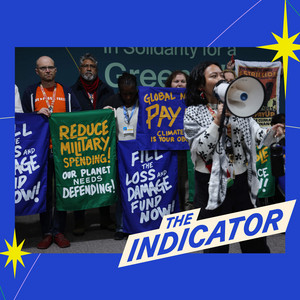
What I'm watching this week is COP29.
This is the United Nations Annual Climate Change Conference.
It's being held in Azerbaijan, and we are headed into the second and final week.
And I will say this COP has been a little fraught.
I mean, maybe it's always a little fraught, but we just had the election in the US, and Donald Trump has said he's going to pull out of the Paris agreement.
Yeah, for the second time.
Yeah, I mean we have seen this film before.
This time around, Argentina might do the same though.
President Javier Mallet pulled the Argentine negotiators from COP29 after just three days, and then he flew to Mar -a -Lago for a conservative summit.
So the countries that are still at COP29, like, what are going to be the hot topics they're talking about this year?
Well, this is a perennial hot topic, but climate finance.
Basically, how much money should rich countries pony up to help lower -income countries reduce their emissions and adapt to climate change?
Back in 2009, wealthy countries said they would provide $100 billion a year by 2020.
And that didn't happen in time, right?
Right, they miss their timeline.
So they're expected to come up with a new goal now, and as you might expect, there's a lot of disagreement over what the new number should be.
I mean, it could be higher, but how much higher?
Who knows? And, of course, where is the money going to come from?
Now, one buzzword from this year's COP29 is solidarity levies.
Have you guys heard of this?
Time for me. Yeah, what is that?
A solidarity levy is a tax that raises money for a particular cause that a government wants to fund.
These are actually already in use in dozens of countries.
One example is France.
It has a special tax on airline tickets that goes towards public health.
So in the case of climate, the solidarity levy crowd wants to tax industries like shipping or fossil fuels and then channel that money to these lower -income countries.
Isn't that the basic job of government to tax some things and pay for others?
You put a name on it called solidarity levy, and then you earmark it for special costs.
A rose would be just as sweet by any other name, Waylon.
Well, I think you should just be happy you learned some new vocab today.
It sounds like a levy, but they're giving it a nice new name.
Yeah, it's just a tax.
So what are we expecting is going to happen with the US -Paris agreement?
I mean, will we find out this week?
Who knows? I mean, interestingly enough, the CEO of Exxon said publicly last week that the US should not pull out.
He said it would create too much uncertainty.
Well... Plot twist.
Plot twist. Okay, so my indicator that I'm watching actually has to do with uncertainty.
Uh, slash certainty?
Anyway, it's called the Home Builders Confidence Index.
It's this index which actually comes out this morning, and it's a measure put together each month by the National Association of Home Builders.
And the way they calculate this index is they survey a bunch of companies that build single -family homes, and they ask them things like, how are sales going?
How do you think they're going to be going in the near future?
And the index itself is on a scale from 0 to 100, and the closer you get to 100, the more positive the feelings are, right?
So for example, back in 2020, the Home Builder Confidence Index actually reached 90.
Oh, so they're feeling great.
Yeah, like I remember in 2020, there was a lot of demand for single -family homes because of lower interest rates and work from home, among other things.
Absolutely. But over the next few years, that confidence was eroded by a number of factors.
Supply chain issues, inflation, rising borrowing costs, all these things made the costs of building homes more expensive, which made it unaffordable for many would -be buyers.
This year, the index fell into the 40s.
However, the last couple of months, we have seen a bit of an uptick in builder confidence, and that could be because of the Federal Reserve, which has gotten inflation down to almost its 2 % target.
It's also begun cutting interest rates, which should result in cheaper mortgages in time.
So this week, I'll be watching to see if that trend continues.
And what's your Spidey sense telling you, Adrian?
My Spidey sense is telling me that maybe we could expect to see like a slight uptick in the confidence of builders, and that could be because of the presidential election, right?
President -elect Donald Trump has promised to cut regulations that he says make it harder to build housing.
And so I think it's possible, if not this month, maybe next month, we could see that factor in.
From building homes to building everything else, I'm going to be looking at manufacturing, specifically the Philadelphia Fed's manufacturing survey, which comes out this Thursday.
Right. So this is like a big theme for the election.
Democrats, Republicans, are always talking about the health of U .S.
manufacturing. Yeah.
And in the short term, there's actually been some recent upticks in manufacturing activity after a fairly lackluster last two and a half years.
We'll see if that continued in November.
Longer term, though, I mean, I feel like the bigger story is the decline of American manufacturing and whether it's possible to reverse that.
Yeah, a lot of talk, but the reality is much more interesting.
It's true that as a share of jobs, manufacturing is a lot less now than it was several decades ago.
So in 1947, one in three jobs were manufacturing, and now it's about one in 10.
Not many of those one in three jobs in 1947 was podcasters.
I don't think we count as manufacturing, even though we do manufacture beautiful smiles.
We manufacture many listeners.
We manufacture smiles.
Anyway, going back to manufacturing.
Actual manufacturing.
Yes, on the actual output produced, there's stories murkier in the U .S.
Over the last 20 years, the country has produced more or less as much as it ever has, and that's thanks to automation and doing things better.
Fewer manufacturing jobs, same output, and what about that output as a share of the economy?
Yeah, as a share of the economy, it's also fallen.
Manufacturing was about 20 % or 25 % of economic output in the U .S.
in the 1950s, and now it's about 10%.
That's so interesting.
So it's like if you took the number of cars and pianos and computer chips being made in, I don't know, like the year 2000, we still produce roughly the same amount of stuff with fewer workers, and also we've produced so much more of other things, services like, I don't know, brewing coffee, making websites,
teaching people how to skydive.
That's important. Where did that come from?
I don't know. Skydiving lessons, a big part of my personal basket.
Skewing the numbers here.
Darren's just jumping out of planes constantly.
But all the skydiving that Darren's doing means that manufacturing has become less and less important relatively.
Yes, and there is, of course, this human toll to those job losses, which can economically hollow entire towns.
So over the last 70 years or so, the U .S.
went through a manufacturing jobs decline.
It has gone through a relative manufacturing stuff decline, but it's also worth keeping in mind we're still producing roughly as much stuff as we always have.
Okay, we will wait to see whether that stays true in November.
Yeah, my eyes will be glued to the Philadelphia Fed's website.
And while I wait, I'm actually going to jump out of this airplane now.
See you guys later.
Well, Darian, don't forget your parachute.
What? Darian, are you okay?
I'm okay. That was not a soft landing.
This episode was produced by Angel Correras with engineering by Valentina Rodriguez Sanchez.
It was fact checked by Sierra Juarez.
KK Cannon edits the show and The Indicator is a production of NPR.