Has this ever happened to you?
You learn many new words, and when you see them, you know what they mean.
But when you want to speak, you can't use them.
Of course, and... This is a very common problem among learners.
In this video, I will help you understand why it happens and how to fix it.
Understanding the problem.
Let me give you a very simple example.
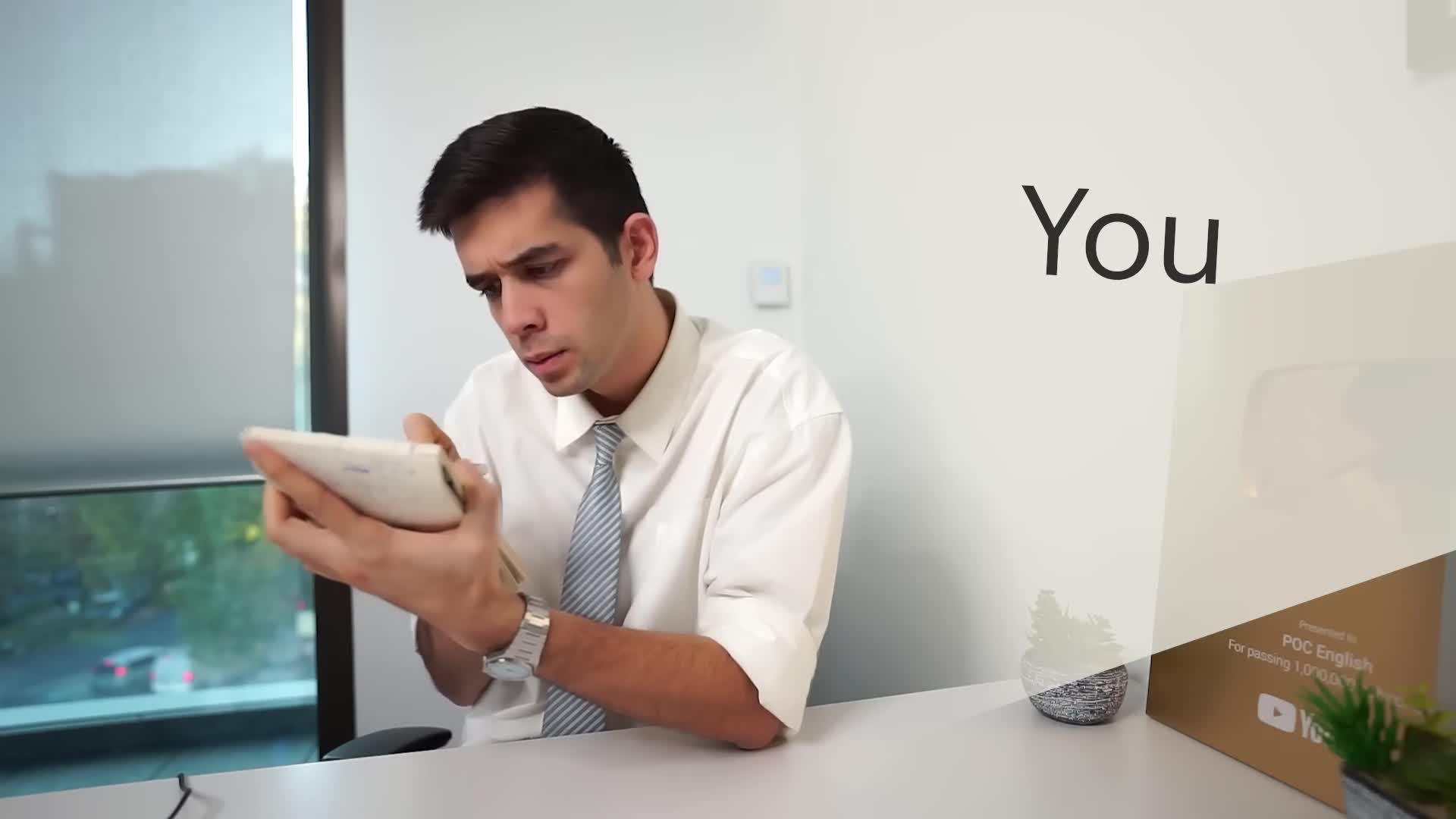
Look at this guy.
His name is Jack.
He helps everyone and everybody likes him.
So let's describe Jack with a few adjectives.
He is a guy.
Mm-hmm, mm-hmm.
Did you say good or nice or kind?
All of these words are correct and they're good.
You thought about these words, because these words are active in your brain and you can use them when you want to speak.
But instead of these words you could have said respectful reliable trustworthy wholesome, well-mannered.
Now I'm pretty sure you know the meaning of at least most of these words, but when you wanted to describe Jack, you didn't use any of them.
So you know what they mean, but you do not actively use them.
That means these words in your head are passive.
So words in your head are either active that means you can use them when you want to speak Or passive, which means if you see them somewhere for example, you're reading a book and you see these words, you know what they mean.
But when you want to speak, you cannot use them.
But why does this happen?
Why are the words passive in your head?
Think about how you learn new words.
Most students learn words randomly.
Let's watch a movie and learn a few random words.
Or let's read this book.
And learn 20 words today.
But the thing is, learning random words doesn't help at all.
In fact, it's very bad for you.
Let's say today you learn four random words.
Balance.
Visa.
Office.
Recycle.
Tomorrow, you add four new words.
Exercise.
Skill.
Map.
Waste.
And you keep adding more random words every day.
Shift. wildlife, ticket, wrist.
Do you see what is happening in your brain?
Because all these words are random, your brain is not able to create meaningful connections between these words.
It is not able to group them or to categorize them.
And eventually, your brain is not able to make sense of all these random words you've learned.
That is why all these words are passive.
If you see them in a book, or if you're watching a movie and you hear one of these words, you know what they mean because they are in your head.
But when you want to speak, the random words are all over the place.
You cannot just choose them and say anything you want.
That's why you know the meaning of respectful or wholesome or well-mannered, but instead you say good or nice.
So what's the solution?
It's very easy.
You just have to turn the passive words into active words.
Here are five things you need to do.
Step one, learn topic vocabulary.
This is very important.
Instead of learning random words, you need to have a topic-based approach.
What does it mean?
Let's say you choose four topics.
Environment.
Health and fitness. business English, and traveling.
Then for each topic, you learn some words related to that topic.
For example, for the environment, you can say recycle, waste, wildlife.
For health and fitness, you can write balance, exercise, and rest.
For business English, you can say office, skill, and shift.
And for traveling, you can say visa, map, and ticket.
Did you see what happened?
In your mind.
Instead of having a mess with all those random words you have learned over the years, you now have clear folders, clear categories of vocabulary.
So the next time there is a conversation about the environment, your brain automatically goes to the category of the environment and all the words are already there.
Your brain is able to make sense of all the relationships between these words.
Or if somebody asks you about your health or fitness or sport activities, your brain automatically goes to health and fitness.
This is the first and probably one of the most important steps towards speaking English fluently.
And that's exactly what we do at PUC English Academy.
We focus strongly on your fluency and speaking skill to make sure you learn English the right way, so that you can speak and not just understand.
We have a topic-based approach to grammar and vocabulary in our four English courses of General English, IELTS Pronunciation and English for Leisure.
We have AI tools to practice and ask for feedback in writing and speaking.
We offer daily live lessons on Zoom with our teachers and other classmates of yours, so you can turn on your camera and you can actually speak with other people.
And also we have a student community with students from all around the world where you can make international friends, practice on your own time and find speaking partners.
And in our Black Friday sale, the biggest sale of the year, you can register with a 60% discount.
This is the first and the last time we're offering this huge discount.
If you are really serious about improving your English and speaking fluently, this is your chance.
Go ahead, click on the link above this video.
And on my website, you can register during this period with a 60% discount.
Step two, see the words in context.
Here's the thing, learning single words never helps.
For example, look at the word change and look at these two sentences.
I need to change my lifestyle.
Do you have any change so I can buy a bus ticket?
In the first sentence, change means to do something differently.
And in the second one, it is a unit of currency.
It's like asking for a smaller unit of money.
Same words, but two different meanings.
And technically, two different parts of speech.
One of them is a verb and the other one is a noun.
Or here's another example.
Think about the word shift and look at these three sentences.
Can you shift the table to the other side of the room?
He shifted to gear four and drove faster.
She was on a night shift.
In the first sentence, shift means move.
In the second one, it means change.
And in the third one, it's a period of work.
Again, same word, three meanings.
You see what I'm trying to say?
It's very important to see the word in context, to understand it's part of speech, whether it's a noun or a verb, and to really understand the meaning and how it is used.
So, learn words in sentences, never alone.
Step three, write a paragraph.
Now, with all the words you have learned, you're going to write one paragraph.
And in this one paragraph, you will try to use as many of these words as you can.
Let's say I have learned a few words about the topic environment.
These are the words that I've learned.
Waste.
But remember, you are not learning the words alone.
You need to see the words in context.
So we need a sentence.
We should reduce waste to protect the planet.
The second word is recycle.
I always recycle my plastic bottles.
Pollution.
Air pollution is getting worse in many big cities.
Energy we can save energy by turning off the lights.
And finally, wildlife.
Many types of wildlife are in danger because of humans.
See, there is a clear topic and there are some words in context.
We have a topic-based approach, step one, and we're seeing the words in sentences.
Step two.
Now, in step three, we're going to write a paragraph about this topic using as many of these words as we can.
I want to help the earth.
I try to make less waste and I recycle plastic, glass and paper.
This helps reduce pollution.
I also save energy when I turn off the lights.
When I do these small things, I help protect wildlife. not use AI to write this paragraph.
This is very important.
That paragraph needs to be produced by your brain.
You need to do it yourself.
We need this.
After you write the paragraph, go to ChatGPT, paste that paragraph and use this prompt to make sure it's grammatically accurate.
But only after writing the paragraph.
Here's the prompt check this sentence for grammar or vocabulary mistakes.
Highlight mistakes very important.
Suggest corrections and explain why they are wrong.
Use the prompt after you have written the text yourself, not before.
So there you have it.
You have one topic the environment.
You have five words related to that topic.
Each word comes with at least one sentence so we can see that word in context and finally, we have written a paragraph in which we have used all those words.
Step four review the words by reading your paragraph.
Learning words is one thing, Reviewing them is another thing.
How can you review the words?
One of the options you have is just to review the single words, but that's not going to help.
What's the best way to review these words?
You can read the words alone.
You can read the sentences that you wrote for every word.
But the best way to review the words is to read your own paragraph.
Remember the paragraph you wrote about each topic?
Go ahead. read that paragraph again and again, and review the words using that one.
But why does this help?
That paragraph was produced by your brain.
Remember I said do not use AI?
And it has to come from you?
That paragraph was produced by your brain.
So when you read it again, it sounds familiar.
It is no longer a new context.
It's the context you created yourself.
And you're seeing the new words in your own context.
That is why it's extremely effective. to read that paragraph and review the words.
Again, if you are serious about speaking English fluently and you really want to focus on being able to use all the words and grammar points that you have learned in spoken English, you need to register at PUC English Academy.
And during the Black Friday offer, we have a 60% discount.
That means you will get all the four courses, our AI tools for writing and speaking daily, live lessons every day with our teachers on Zoom and the student community to make international friends and find a study partner.
Go ahead, register now before the discount is over.
See you soon.
Bye.