Ted Audio Collective You're listening to Ted Talks Daily where we bring you new ideas to spark your curiosity every day.
I'm your host, Elise Hugh.
Okay, here's a wild stat.
A third of the world's food production goes to waste, which is a big contributor to climate change.
In his 2024 talk, climate champion Gonzalo Munoz sheds light on negotiating international pledges to make food supply part of a climate solution rather than its cause.
That's coming up after a break.
And now our Ted Talk of the Day.
So when we speak about climate negotiations, intergovernmental processes, we always think that the people working there are, of course, diplomats, ministers, politicians, right?
Well, last year I was asked by the United Arab Emirates, the country that was in charge of the climate negotiations, to help deliver a significant progress in the connection between food and climate.
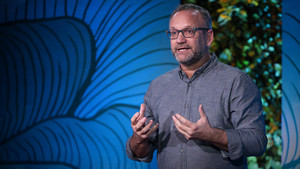
My name is Gonzalo Munoz.
I'm a farmer from Chile, and definitely it's a pleasure to be with all of you here today.
So back in the farm, I've been dealing with water scarcity for the last 15 years.
We've seen firsthand how much climate change is affecting and reducing our capacity to produce, as well as how much our conventional practices are contributing to the problem.
That of course inspired us to innovate.
So for example, producing the best 2023 trillion zerat with only 1 liter of water instead of an average of 240 liters as a normal practice in the region where we are.
I also got very much involved in the global promotion of circular economy as well as with certification standards for companies that meet the highest performance in social and environmental practices, so -called B Corps.
Probably because of that, in 2019, the Chilean government invited me to serve as the United Nations High -Level Climate Action Champion.
And in that role, I had to mobilize all non -state actors, of course, companies like mine, but as well as cities, some national governments, financial institutions, civil society, anyone that can deliver concrete action in the ground.
And through that, push for governments for them also to take bolder action on climate.
But there I noticed that there was something missing, the broader food system.
From the way we produce, distribute, consume, even the way we're wasting our food has a huge impact in the climate crisis.
As you all probably know, food and agriculture are really complex topics.
I bet we won't find two people in this room that have exactly the same understanding and relationship with food, whether it's because of health reasons or it can be because of ideology or religion or culture or even because of taste.
Well, same thing happens with countries.
For some countries, the number one priority is food security, whereas some communities, they deeply rely on agricultural commodities like cotton or beef or soy.
So part of the problem as well is that the food system nowadays is not fit for purpose.
At this precise moment in history, there are 800 million people around that number of people hungry.
And at the same time, we're wasting and losing about one third of the food production.
Our food system is both causing climate change and being severely affected by the climate crisis.
Of course, it's also a system that is confronting many different challenges like the pandemic or conflict or disrupted supply chains or droughts, all types of shocks and stresses.
So at this point, you can imagine that food and agriculture are really political topics.
And of course, we can no longer delay.
So I have some news to share with all of you.
In 2023, led by the United Arab Emirates and with the help of so many brilliant people, we tried a new approach.
And that means that we worked with the UAE Food and Agriculture Declaration to ensure the highest political recognition that food must move from being a source of pollution and degradation to become one of the most important tools for climate action benefiting both people and the planet.
And now back to the episode.
Well, have you any of you tried ever to agree with your neighbors on something like whatever, paint the communal walls and decide the color?
Hard, right? Well, try to agree on food and agriculture with 200 countries.
Yeah, wish you luck.
When we started this plan, we set ourselves a goal of, let's try to put together triple digits, 100 heads of state signed in the UAE Declaration.
At the end, we not have only 100, but 159 heads of state signed in the UAE Declaration of Food and Agriculture.
That and counting. That is absolutely, thank you.
That is massive and honestly absolutely unprecedented.
How we did it and most importantly, how can we accelerate progress?
First, focus on people, building the resilience of food producers, farmers, fisher folks, anyone that is producing our food for those people to thrive despite of the climate crisis and become real effective stewards of nature.
Second, set a goal but not prescribe how to get there.
Every country is facing different circumstances.
We have to respect that and allow every country to design the pathway and of course, ask them to set precise goals and targets.
Third, we need of course to reflect on the diversity and complexity of food systems.
Every region has a different starting point.
On the other side, during this process, real economy actors started to discuss what a food system non -state actor called to action could look like.
So with the leadership of the high level champions and building on the experience of several experiences that happened before, we started a very careful consultation process with many, many stakeholders from all around the world, from small holder farmers to big multinational corporations on food, from indigenous
communities to commercial banks to concretely have a common vision and a set of 10 priority goals to ensure climate action.
Amazingly, more than 10 hundred groups of non -state actors endorse the call to action and with more and more endorsing every day as we continue rallying them towards the next cycle of negotiations.
So suddenly, we were in front of what we can call potentially an ambition loop.
It's a positive virtuous loop between states and non -state actors where countries strongly agree on something, they send the message to the real economy where some non -state actors immediately react by raising the bar with concrete examples.
That act of leadership, proving that it can be done, immediately sends back the message to the politician encouraging them for also raising the bar through policy making.
That's what we trigger in the run -up and during the negotiations in Dubai.
So now we have these two pledges.
It's great, but it's not enough.
We know that. And many of us, many here in the room and myself, have a mission to continue to mobilizing action as we ambition this next cycle of negotiations towards 2025 in Brazil and beyond.
There will be many, many things that are needed, right?
But let me refer to a few of them that come to my mind as critical.
First, we have to stop damaging nature.
Our food system depends and relies on functional and healthy ecosystems and resources.
Second, we need to scale all forms of finance for the transition towards sustainable food system, but at the same time for innovating, changing the incentives, and at the same time for securing just transition for everyone.
We also need to develop all types of metrics, goals, and targets for countries to own them so we can also hold governments to account when we measure progress.
Of course, we would need much more than that.
But just with that, we can start envisioning the start of this new ambition loop just like we had in the previous decades with renewable energy.
And of course, I have my ambition loop in my farm too, right?
We will continue working on innovating on practices for reducing the need of water.
We will continue working on regeneration with endangered species.
We will continue using renewable energy.
And let's imagine what happens when those practices are packed and therefore scaled up to the size of a country like Chile and you have more and more farmers, more and more businesses, more and more value chains adopting those practices.
All of a sudden we can have a global food system that is fit for purpose, nourishing everyone while restoring the earth.
That's the ambition loop I want to see.
Muchas gracias. That was Gonzalo Munoz recorded for TED's Countdown Dilemma series on the Future of Food in 2024.
If you're curious about TED's curation, find out more at TED .com slash curation guidelines.
And that's it for today.
TED Talks Daily is part of the TED Audio Collective.
This episode was produced and edited by our team.
Martha Estefanos, Oliver Friedman, Brian Green, Autumn Thompson and Alejandra Salazar.
It was mixed by Christopher Faizi Bogan.
Additional support from Emma Toppner and Daniella Valarezzo.
I'm Elise Hugh. I'll be back tomorrow with a fresh idea for your feed.
Thanks for listening.