This is the Global News Podcast from the BBC World Service.
I'm Nick Miles and it's 16 Hours GMT.
On Monday 1 December, these are our main stories.
Rescue workers in Indonesia are trying to reach the survivors of devastating floods which have submerged parts of the island of Sumatra.
And more evidence has emerged about young African men who are being recruited to fight for Russia in the Ukraine conflict, also in this podcast.
Relatives of those two men tell the BBC how a moment of existential danger was averted.
And...
So it's height, width and circumference.
So my width and my height I wasn't really worried about, but my circumference I was concerned about because I do at-home trims.
It turns out she needn't have worried.
But what world title has she just won?
As we record this podcast.
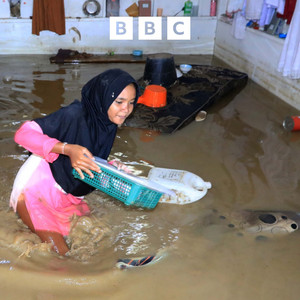
It is known that more than 600 people have been killed in floods and landslides caused by days of rain and an intense tropical storm.
That is the sound of rescue workers arriving in a small motorboat, fighting against the raging brown floodwaters.
They reach a terrified-looking man clinging to the trunk of a palm tree and pluck him to safety.
Another person lucky to be alive is a woman called Rosmina, who lives in northern Sumatra.
Reporters found her wading through knee-deep mud to try to see if she could salvage anything from her house.
She told them about her escape.
Suddenly, someone ran from the garden.
Come on, run, run, the big water's coming, he said.
So I immediately ran to save my child.
I had to get out of the house and save my child.
The water from the house was already up to their knees.
Many people who survived in the province of Aceh say they haven't eaten for two or three days and many are having trouble accessing clean water.
Niki Wedadio from BBC Indonesian has just arrived in West Sumatra and told us what she's seen.
Before the flash floods happened, there were some houses, residential houses in the streets, but now they are all gone and i can also see like the hills like has cut off to two.
So before, like the hills are really green, like there were trees right there and but now, after the flash floods comes like, i can see like big stones, like and it's like the hills is cut off to now.
The rescue teams are still working and they even had to use rope to cross the river because that's the only possible way for them to evacuate the victims.
Have you managed to speak to people and gather how they survived and their stories?
We talked to the family of the missing victim who waited here for days.
They are waiting for news from their loved one.
They already feel like the change for their family to be save a life is getting even smaller.
So they told us that they're really sad about this.
What about conditions for those people who have survived?
We're hearing the possibility of food shortages.
You mentioned that houses have been swept away.
What are conditions like there for people?
Some of the areas like in North Sumatra and Aceh are now still isolated.
So the military has given aid through the air, hoping that it will reach the victims, because many roads are still closed, are still inaccessible.
So that's the only way.
Here in West Sumatra, where I am now, we also talk to some people who initiate some relay system to deliver aid from person to person, from village to village, because that's the only possible way.
Almost every conflict at some point involves foreign fighters or mercenaries, and the Russia-Ukraine war is no different.
There are reports that young African men are being lured to Russia on the promise of well-paying jobs like security or driving.
But when they get there, they find themselves forced to join the army and are sent to fight.
According to Ukraine's foreign minister, more than 1400 men from at least 30 African countries are believed to have been deployed.
One of them is Kenyan recruit David Kuloba.
His mother, Susan, later got a message to say he'd been killed.
Anne Soy has been speaking to her.
As of how David left, honestly, I don't know.
I can't lie to you.
So I asked him again, which country are you going to, David?
He showed me his phone and said, look, it's Russia.
Eh?
Russia?
No.
Don't you see the kinds of things they show on TV about Russia?
They're never good.
But he insisted, mom, I have to go.
The pay is very good.
We've been told that when we arrive, we'll be paid over 7,000 U.S. dollars.
We argued and argued.
I didn't even know when he left.
He sent me a photo.
It's here.
I was shocked.
He was dressed in a combat uniform.
I asked him, Are you sure this is the job you went to do?
He told me, Mom, what could I have done?
The job we were told we came to do has been changed.
After a few days, he told me they had been ambushed.
I told him, David, please leave that place.
Leave that country.
It is not good.
He said, Mum, how can I leave?
I signed a contract.
Give me at least one year.
October 4th is a day I will never forget.
He said, Mum, I want to tell you something.
But before I do, let me send you some documents.
The documents were in Russian.
Shortly afterwards, he sent a voice note.
Those documents I've sent you, it's because tomorrow I'm going on a mission.
And in case anything happens, they will call you and tell you whether I'm dead or alive.
If I'm gone, take those documents to the immigration or to the embassy.
If you take them to the embassy, you will claim compensation.
Tell them I am your child.
Give them everything, including the pictures.
I wrote your name as my next of kin.
I love you so much.
And from there, what have you been following up?
I asked his friend, how do you know he's dead?
How have you confirmed it?
He said, let me give you the number of the agent who received us in Russia.
I texted him.
Hello?
He replied in Russian.
I said, this is David Kuloba's mum.
I want to know how he is.
That's when he said...
I'm sorry to tell you this about your son.
I don't even want to read these messages.
Have you contacted the Russian embassy?
Then you said not yet.
Then keep scrolling.
Okay, thank you for the information.
You'll go to the embassy on Tuesday.
Did you go?
Yeah.
And he says, hello, do you have the opportunity to come to Russia?
And you say no, I'm just a student, stay at home mom, I can't get that much money.
And unfortunately he says we won't be able to do anything remotely.
And he says he's really sorry.
He says I understand your emotional state and we'll do everything possible.
Do you have a foreign passport?
And he said no.
And he said please do it.
You're entitled to payment and compensation for the death of your child.
I can't say for sure, but it's around 100000.
When I read these messages, my heart breaks so much.
Susan Kuloba talking to Ann Soy.
They've been found in homes, food and drinking water and have even been linked to serious harms like cancer and infertility.
A group of chemicals known as PFAS, also referred to as forever chemicals, are in many of our family household items.
As part of a new BBC Panorama investigation, journalist Katrin Nye took a test for the chemicals with worrying results.
Teflon silverstone, the tough non-stick surface with a heart of stone.
Their discovery 60 years ago led to a revolutionary new product.
Teflon used to make non-stick pans.
But these days, PFAS, or forever chemicals, are not just found in kitchenware.
They're used to make things durable, waterproof and greaseproof, and can be found in clothes and electronics, medical equipment and solar panels.
Despite most being legal, once they make it into the human body, the chemicals can stay for a long time and have been linked to serious health consequences.
These chemicals can make their way into our food and drink.
They've been found in fish, fruit and tap water.
I decided to take a test to find out if I've been affected by forever chemicals.
Having recently had two children, I wanted to know if they may have been affected too.
There we go.
We've checked your PFAS levels in your blood and in your urine.
So have we found PFAS?
Yes.
The safe level would be less than two nanograms per milliliter.
Okay.
Your level is 9.8 nanograms per milliliter.
Okay, so we definitely do find PFAS there.
So what we need to identify... And it's so much higher than I expected.
But it also makes me worry that I have passed on a lot to my kids.
You will have passed on, for sure.
To try to lower my levels.
I'm advised to limit my exposure to products that may contain forever chemicals, like hair colouring and makeup.
I'm told eating more fibre can also help.
The European Commission is currently consulting on a blanket ban of forever chemicals.
The Chemical Industries Association says regulators and industry need to work together in setting transition periods for bringing alternatives to market.
Well, Katrin was advised that she can lower her PFAS levels.
We asked her what others can do to avoid forever chemicals.
The realistic answer is that you cannot avoid PFAS chemicals. completely you can try and limit your exposure you can do things like changing your non-stick scratch non-stick pans to stainless steel or ceramic versions looking at products looking in detail at products so cosmetics and cleaning products and trying to buy ones that are pfas free if you do your research if you go online if you research companies you can find companies that that advertise themselves as PFAS-free, but you are a lot less likely to find a product that says very clearly on it that it does contain PFAS.
It's the other way around.
The BBC World Service has launched a new podcast today.
It's the latest series of The Bomb and has been delving deeply into how the nuclear bomb shaped the world.
This time it's the story of the Cuban Missile Crisis, told by the relatives of the leaders negotiating that tricky landscape at the time.
In October 1962, the then US President, John F Kennedy, made a televised address about the crisis beginning.
We will not prematurely or unnecessarily risk the course of worldwide nuclear war, in which even the fruits of victory would be ashes in our mouth.
But neither will we shrink from that risk at any time it must be faced.
Well, Anna Foster spoke to the hosts of the series JFK's nephew, Max Kennedy, and Nina Khrushcheva, the great-granddaughter of the former Soviet leader, Nikita Khrushchev, about how they came to learn of that story and their family links to it when they were growing up.
Nikita Khrushchev was ousted from power in 1964.
And when I was growing up, they really didn't talk about politics that much.
But you did know about the Cuban Missile Crisis, about mistakes that Khrushchev made because he withdrew weapons from Cuba and he gave in to American imperialism.
And that's how we learn about it at school.
And so at home, I was told that it was a great thing because, as Khrushchev himself used to say, what do you want me to do to back off what you wanted me to start World War III?
So I was in this very dual position. relationship with history.
That's really interesting, that contrast between the two narratives that you were hearing.
What about you, Max?
The first time I really spent any time thinking about it was when they filmed a television program called The Missiles of October.
And I just remember sitting around with my mother and older siblings and they gave a running commentary of how inaccurate every scene was that had my father or my uncle in it.
The central issue for me growing up was that we didn't really understand how incredibly close the two countries really came to nuclear war and to the kind of war that would have annihilated the world.
Because we didn't understand until this very late meeting in around 1988 that Khrushchev had succeeded in putting shorter-range weapons, tactical nuclear weapons, in Cuba.
And at the very beginning of the crisis, almost everyone in the White House wanted to bomb the missile sites and to attack Cuba with our naval forces.
Had we done that, the United States 6th Fleet would have been completely annihilated.
And if that had happened, we would have launched a full-scale attack on Russia immediately.
And the world would have been obliterated.
And, given Nina, how close the world came to that actually happening?
How much do you think the relationship between these two men related to you and Max?
How important do you think that was in eventually neutralizing that threat?
It's a fascinating question because I always thought that When I learned more and more about it, I thought it was really very close.
But the more I've learned in this program, I realized that actually we weren't that close.
And the reason we weren't that close because of these two leaders that made those decisions, because either of them absolutely at no circumstances were ready to start the war.
And so I actually got out of this program with a feeling that I wish our leaders today would have been as responsible as John F Kennedy and Nikita Khrushchev were in 1962.
Well, I had the same conclusion that I wish today's leaders were more similar to President Kennedy and Chairman Khrushchev.
But I had a very different reaction to the threat.
I think we were very, very close to nuclear war.
And the scariest part to me was that you could tell that Chairman Khrushchev wanted to do everything to avoid war and that President Kennedy wanted to do everything to avoid war.
And they were both determined to explore every avenue to peace before going to war.
But there is an inexorable difference. nature of conflict that was bringing them closer and closer.
The armed forces, the military industrial complex were all moving us closer and closer to doom.
And that was very scary to me.
Episode one of The Bomb, Kennedy and Khrushchev is available wherever you get your BBC podcasts.
Coming up later in this podcast, her again.
Because it was so wide, like all the way around, the circumference was so big.
First he had one person come help him.
Still, the ruler was too big, so he had another person come.
Any of the whys are about her record yet?
To coincide with World AIDS Day, a new HIV prevention injection is being rolled out in southern Africa, the region with the world's highest HIV burden.
Researchers overseeing the operation in South Africa, Eswatini and Zambia have described the injection as groundbreaking.
Clinical trials show that Lenacapavir, taken twice a year, is almost 100 effective at preventing HIV infection.
But this comes against a squeeze in global funding.
It includes cuts by the Trump administration to the US Agency for International Development, or USAID, as well as the American president's emergency plans for AIDS relief, known as PEPFAR.
Glenda Gray is a paediatrician based in Johannesburg who specialises in HIV vaccination research.
Rebecca Kesby asked her how those US cuts had affected her work.
They've affected it quite badly in two ways, both in care and in research.
I had USAID funding to invest in HIV vaccine research and development in Africa.
And this has been completely cut.
It was 46 million US dollars to cost many countries in Africa.
And that has been stopped and we are unable to continue on this program.
In terms of treatment, although South Africa funds 80 of the treatment, 20 that USAID PEPFAR funds was very critical because it funded the areas in our country which are mostly affected by HIV and also funded the managing of stock and the movement of both antiretrovirals and testing to the clinics.
So it has affected the quality of our program.
I mean, I suppose supporters of Mr Trump and Mr Trump himself would say well look, you know, these are problems for the South African government and other governments affected by HIV AIDS to look into.
And it's up to them to put together more sustainable funding for such programs.
What would you say to that criticism?
Well, South Africa has funded all its antiretroviral treatment and so has contributed significantly many years to ensuring that we can increase survival and impact on pediatric HIV.
So we have funded the majority of the program.
The funding that came from the USAID and PEPFAR was to improve the quality of our program to make sure that we had support procuring drugs, sending them out to the clinics, making sure that diagnostics went to the clinics so we could do HIV testing.
So it was more around improving the quality of the program rather than overall funding of South African paediatrician Glenda Gray.
The ousting last year of Bangladesh's Prime Minister, Sheikh Hasina, came after hundreds of people had been killed in anti-government demonstrations.
The fallout from that political turmoil has embroiled countless people close to her, and now it's even affected a Member of Parliament from Britain's governing Labour Party.
Tulip Sadiq, a former British minister, has been found guilty of corruption charges in Bangladesh and sentenced to two years in prison.
I spoke to our correspondent Arunajoy Mukherjee to find out the latest.
Well, this is one particular case that Tulip Sadiq was being investigated for.
She was a co-accused with her mother.
She happens to be the niece of the former and deposed Prime Minister Sheikh Hasina.
Essentially, the allegation was that she had used her influence to pressure her aunt, who was Prime Minister then, to get a plot of land allotted at a very lucrative suburb on the outskirts of the capital city of Dhaka.
So that was the particular case which she has been found guilty of, sentenced to two years in prison.
It's a case that she has repeatedly rejected.
She has questioned the credibility of the investigation, rejected the trial and essentially maintained that she has not been contacted by the rightful authorities through the right channels, even when the Anti-Corruption Commission team was in the UK.
She feels and she has said this by way of her lawyers that they didn't make any efforts to contact her.
So that's been the consistent response from Tulip Siddique.
But the authorities here have been very clear and, as you rightly pointed out, this has all been part of a wider anti-corruption investigation that has been going on since the outset of Sheikh Hasina, and authorities have been sort of investigating her and her family members.
And as I've been saying, this is not... the only case.
There are others as well which are in the pipeline, which are in various stages of investigation.
Haroldo, to what extent do some people, particularly people who supported Sheikh Hasina, see this as just a reckoning, a political witch hunt, if you like?
Well, that's been, you know, the main sort of response and counter-argument from all her supporters, including Tulip Siddique as well, who has said this in the past that this trial is a political conspiracy as well.
So her supporters still see this.
And, you know, this is common in Bangladesh politics, which we've seen in the past as well.
Whoever is in power goes after who was, who's in the opposition, and who comes back to power goes after those supporters who were part of the previous regime.
So we've seen this kind of seesaw play out in the past in Bangladesh politics as well.
But I think the big question will be whether this sentencing will be executed or not.
This trial was held in absentia.
The UK government and Bangladesh do not have an extradition treaty, so I think that's where the big legal roadblock will now be for Bangladesh authorities.
South Korea's largest online retailer has formally apologised after customer data was stolen in the country's largest ever data breach.
Coupang says the names, phone numbers, addresses and order histories of some 34 million customers have been stolen since June.
Though passwords and credit card details remain were not reported to have been stolen.
Jake Kwon, our Seoul correspondent, told us about the extent of the country's largest ever data breach.
About half of all the online sales in South Korea happens on their platform.
And almost everyone I know here have used it at least once in their life.
I use it at least once a week.
So yesterday I got the same text as many of them saying you know, giving the apology for leaking the personal data.
And the scale of this leak is really astounding, and it is unprecedented.
Some 34 million accounts.
If those are all individual people, that is more than three quarters of all adults in South Korea.
It is really shocking how many accounts were accessed by this attacker.
Now the company said that credit card information or the passwords are safe, but this gives little comfort to the customers whose now home address, work address or their phone number email address that are all out there in the hands of the hackers.
And it really gives very intimate details of what their lifestyle may be like, what they might have in their house.
And a lot of people were concerned that scammers might try to use this information to defraud them of money later.
Now the police have said that they are now investigating an individual, an ex-employee who is a Chinese national, who had already left the company and left the country, as the prime suspect.
And the authorities are also investigating Kupang to see whether the company had taken enough steps to protect the customer data.
And this will have a big implication on the possible fine on the company, as well as the class action lawsuit that many of the customers have already launched.
Jake Kwan.
Now to a new world record that took three people to measure.
New Yorker, Jess Martino, has been handed the title for the largest afro.
Her impressive head of hair is more than six feet in circumference.
Julianne Warwicker has been finding out what inspired her to go after the title.
The record was brought to my attention via social media.
And I said, okay, yeah, that sounds cool, but there's no way I would actually break the record.
And I slept on the idea for about a year.
And then I finally started the process October of 2024.
So once I applied, from start to finish, it took me a whole year. what's going on in that year?
I mean to those of us who aren't experts in the world of hair and hair records what are you doing after October 2024 to make this possible?
So I was trying to prep my hair and in order to break the record, you have to break it in three categories.
If you don't break one of the three, you don't hold the new title.
So it's height, width, and circumference.
So my width and my height I wasn't really worried about, but my circumference I was concerned about because I do at-home trims and the way my hair is styled.
It's not styled to add extra shape in the back.
Now the circumference is taken by where the hair comes out the furthest point.
So I wanted to get my hair shaped a bit.
And so in February of 2025, I went and I got a haircut.
The stylist ended up cutting a little bit more than I was comfortable with off, but the shape that we needed was there.
So in the next eight months or so, I focused on just trusting the process around, that my hair was going to grow in on its own, how it always does, and that it was going to be still record-breaking hair.
I've got the figures in front of me here.
The circumference six feet two inches.
There's somebody standing there with a great long tape.
Is there going around that?
Yeah, we did have an official guinness world record adjudicator that measured my hair and he usually can do these things on his own, but because it was so wide, like all the way around, the circumference was so big.
First he had one person come help him.
Still, the ruler was too big, so he had another person come and that's why everyone is like three people to measure, like wow.
But yes, they use measure tape and everyone had two hands on each side of their corners that they were on to make sure that we could get an accurate depiction of how wide the hair was.
Jess Martinez, the woman with the largest afro in the world.
And that's all from us for now, but there will be a new edition of the Global News Podcast later.
If you want to comment on this podcast or the topics covered in it, you can send us an email.
The address is globalpodcast at bbc.co.uk.
You can also find us on X at BBC World Service.
Use the hashtag Global News Pod.
This edition was mixed by Jonathan Greer and the producer was Stephen Yensen.
The editor is Karen Martin.
I'm Nick Miles and until next time, goodbye.