This is Planet Money, from NPR.
The year is 2000. The world has just survived Y2K, parents are lining up to buy Sony's new PlayStation 2, and the hottest songs on the radio are from Destiny's Child and Christina Aguilera.
And nobody knows this yet, but it is the end of an era, for the U .S. economy and for the U .S. government.
Because between 2000 and 2001, this will be the last time that the federal government ever runs a budget surplus.
The last time the government ever collects more money in a year than it spends.
Ever since then, for the last 25 years, the U .S. has been adding to the national debt.
Borrowing money to pay for the wars in Iraq and Afghanistan.
To bail out the banks and other industries during the global financial crisis.
Then, borrowing even more money to pay for more tax cuts, to pay for the rising costs of Social Security and Medicare, and more recently, to pay for more economic stimulus during COVID.
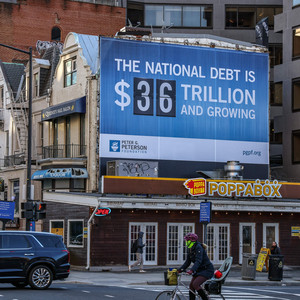
That is how, over these past 25 years, the amount of money the federal government has borrowed from the public, the national debt, went from about $3 trillion to almost $30 trillion.
dollars. And right now, Congress is wrestling over a new budget that's expected to add another two to three trillion dollars to that debt over the next decade.
Now, there's no hard or fast rule for how much debt is too much debt.
But at this point, most economists say that we could be entering dangerous territory.
Used to be that the cost of borrowing all that money was pretty low because interest rates were low.
But now that interest rates have gone up, more and more of the federal budget has to go to just paying the interest on all that debt.
The government is now spending more on interest payments than on national defense.
Economists fear that if we don't get a handle on the debt, we could run the risk of spiraling into a sort of fiscal crisis, which is why we are now hearing a lot of people saying the government needs to start getting back to a balanced budget by raising taxes or cutting spending or both.
But, OK, maybe there is another thing we could do.
You see, the last time the national debt was this big relative to the size of the economy, it was the 1940s.
The U .S. was just coming out of World War II, had just borrowed tons of money to finance the war, and all that debt added up to more than the entire output of the U .S. economy in a single year, more than our annual GDP.
But after the war, the government didn't dramatically raise taxes or slash spending to pay off the debt.
Instead, we just kind of kept calm and carried on.
We built up what President Dwight D.
Eisenhower called our military -industrial complex. We have been compelled to create a permanent armaments industry of vast proportions.
We expanded Social Security and invested in massive infrastructure projects like the National Highway System.
This is the greatest construction program in the entire history of the nation.
And we could afford all that because the economy was growing.
between the 1950s and the 1980s, the size of the economy quadrupled.
It grew much faster than we were adding to our pile of debt.
And so within a few decades, the debt wasn't really a problem anymore.
Recently, some very serious economists from across the political spectrum have been toying around with a thought experiment.
What if growth could be a solution to our current debt debt problem?
What if we just made the economy bigger?
What if we could just outgrow the debt?
Hello and welcome to Planet Money.
I'm Jeff Guo. And I'm Alexi Horowitz -Ghazi.
The debate over the national debt can often get bogged down in partisan politics.
But what happens when you look at government spending through the very particular lens of growth?
Today on the show, we talk to three economists who've been running the numbers, trying to figure out what the government could do to make the economy grow faster.
Fast enough to maybe even help us outrun our national debt.
For everyday business travel and upgrade, book your next business trip at Holiday Inn by IHG.
Visit HolidayInn .com to book your stay.
There are some economists who study monopoly power, some who study game theory, and then there is a special type of economist who's just really, really obsessed with the federal budget and the ballooning federal debt.
The honest answer is I've been worried about it for so long, people think I probably am out to lunch because I've been worried about it for decades.
That said, I got really worried several years ago.
Yes, economist Glenn Hubbard has been worrying about the debt since before it was cool.
Glenn is kind of this legendary budget geek.
He was the top economic advisor to President George W.
Bush. And about a year ago, Glenn was chatting with these other renowned economists who are also low -key freaking out about the debt.
People like Doug Elmendorf.
I'm an economist and budget analyst, probably best known for having been director of the Congressional Budget Office from 2009 to 2015.
Is it fair to call you a budget geek?
Yes, I'm a budget geek and proud of it.
And the third economist they were chatting with used to be the chief economist of the Office of Management and Budget under President Joe Biden.
His name is Zach Lisko.
Help us understand what is the type of person that gets really, really into the U .S. budget.
Well, I think you said it.
Geek. I mean, yeah, geek.
Last year, Glenn and Doug and Zach decided to form a kind of budget geek squad, like a group of highly specialized Best Buy employees uniting not to troubleshoot a malfunctioning modem, but to find new solutions to the national debt problem.
And they knew that the idea of economic growth as this catch -all solution to our debt woes can sound too good to be true.
Okay, but just a little bit of economic growth could, in theory, solve our budgetary problems. A bigger economy would mean more taxes coming in, which would help balance the budget and start paying down the debt.
And a bigger economy in general just means that we can borrow more without it becoming a problem.
According to the Congressional Budget Office, even if we keep spending like we're spending, we could stop the national debt from snowballing over the next few decades if productivity in the economy grew just like 0 .5 percentage points faster a year.
Now, Glenn, Doug and Zach are budget geek squad.
They've been through a lot of congressional budget battles in the course of their careers.
And one thing you sometimes hear in these budget battles is that whatever party that's in power, whatever party that's trying to add expensive stuff to the budget, they will say, well, all this spending will be worth it because it'll boost our economy.
It'll supercharge growth.
Our budget geeks wanted to get away from the usual partisan talking points.
Now, Glenn does lean more to the right and Doug and Zach tend to lean a bit more to the left, but they were going to set aside politics, come up with a dispassionate analysis of what the evidence actually says.
You see, how to get an economy to grow, that is still kind of the biggest mystery in economics.
Yes, it involves innovation and productivity and other stuff, but exactly how to trigger any of that has been unclear.
clear. Until the last decade or so, when economists have been starting to get a better idea of what a government can do to boost economic growth, and by how much. So what we're going to do for the rest of the show is to dive into the paper they ended up writing together, to hear what they found when they went looking for possible ways the government can stimulate growth.
And we're going to start with Glenn Hubbard. His specialty is taxes.
Over the years, he's done a lot of research on how how taxes affect the economy.
And he says the evidence is pretty clear.
Cutting certain taxes is one way to grow the economy, though it's not the silver bullet that some politicians make it out to be.
Do tax cuts pay for themselves?
Almost never. But in general, that's not the right question to ask.
The right question to ask is what's the bang for the buck if I want to increase the capital stock or if I want to increase how many businesses get formed, whatever the policy question is, how effective is the tax change in some of that?
Yeah. If the goal is to stimulate economic growth, what taxes should you cut?
Should you cut taxes for individuals or should you cut taxes for businesses?
And Glenn says both kinds of tax cuts might lead to economic growth, but in different ways.
When you cut taxes for individuals, you might encourage some people to work more and to spend more money, which can cause some economic growth in the short term.
But Glenn says when you cut taxes for corporations, that can lead to more innovation and productivity, which can accelerate growth in the longer term.
Because companies might end up building more factories, buying more high -tech equipment and investing in more cutting -edge research. If we have tax policy that's more favorable to business investment decisions that corporations or small businesses make about the goods that they buy to produce other goods, That can increase the size of capital, increase the output of businesses and increase wages.
So that's a very favorable dynamic.
Glenn says over the past 10 -15 years, economists have gotten pretty confident that certain tax cuts do lead to more economic growth.
For instance, one paper that looked at taxes in the U .S. since World War II found that a one percentage point cut in the corporate income tax rate increased GDP by 0 .6 percent after one year.
So tax cuts can be a powerful tool for stimulating growth.
But Glenn points out, as a nation, we've already done a lot of tax cuts, so it probably isn't the most fruitful place to look for future growth.
Largely because we've done a lot of business tax reforms. We brought corporate taxes down.
So at the margin, I'm not sure that's where I'd be looking.
Right now, Republicans are trying to extend the temporary tax cuts that they passed during the first Trump administration.
It is by far the most expensive part of their sweeping domestic policy bill, the one that they're calling the one big beautiful bill.
The CBO estimates that these tax cuts, which are mostly for individuals, will add almost four trillion dollars to the debt over the next decade.
And these tax cuts will definitely not pay for themselves.
Okay, so the next economist in our budget geek squad is Doug Elmendorf.
In the paper, For instance, one way to grow the economy is for the government to help people be more productive workers in the future.
That's been one argument for social programs like Medicaid and food stamps and early childhood education.
It's an investment in the next generation of workers.
For a long time, people have understood that providing benefits to poor families in terms of food or health care or housing or other things would raise the standard of living of those families while they were receiving the benefits.
That's the direct effect.
Doug says for decades, policymakers argued about this sort of indirect effects, the long -term consequences of government benefits.
offense. Some politicians argued that those programs would just create a culture of dependency on the government.
Others argued that if children could grow up healthier, they would become more productive workers in the future.
And for a while, we didn't know which answer was true.
But recent research has started to shed some light on that question.
Many pieces of that research show that there are positive, long -run effects of safety net programs. programs that children who grow up in families that receive at least certain kinds of benefits that have been analyzed will have higher earnings later in their lives than children in comparable families who did not receive those benefits.
Doug says that according to the latest research, some government benefits programs might actually pay for themselves.
For instance, expanding Medicaid so more low -income children can get health care.
One study found that for every Every additional dollar the U .S. government spent on Medicaid for low -income children, the federal budget got back $1 .78 in the long run from things like higher tax revenues and lower health care costs in the future.
Right now, Republicans in the House and the Senate are trying to make large cuts to Medicaid and also to food stamps.
The CBO estimates that, if passed, almost 12 million people could lose their health care over the next decade.
Most of these proposed cuts would fall on adults, not children, but the final terms of the budget are still being debated.
Yeah. Doug says it's important to remember that government policies are not just about growth.
They have consequences for people's lives.
But in this thought experiment, he and his colleagues were focused on the evidence for economic growth.
And next, Doug says, they decided to look at government -funded research and development.
Because another way to boost the economy is for the government to fund programs that increase innovation.
You know, invent new technologies that create whole new industries.
One way the government does that is by spending money on scientific research. So federal research and development funding has been a key source of economic growth in this country since the Second World War, when the federal commitment to R &D really stepped up.
You can think of government R &D spending as a way for the government to make bets on technologies that are too expensive or would take too long for the private sector.
GPS, the internet, there are a lot of examples of things that have been unbelievably important to economic growth that started as a research grant from DARPA or the NIH or the NSF or somebody else.
Doug says economists have recently started to understand just how much the economy benefits from government -funded research. One study that looked at U .S. research spending since World War II found that for every dollar the government invested in non -defense R &D, it got back about $1 .50 to $2.
Now, the current versions of the Republican domestic policy bill don't appear to say much about cutting R &D spending.
But in recent months, President Trump has called for cutting back on research grants to universities and downsizing the National Institutes of Health.
And the last big policy area Doug looked at is immigration.
immigration doug says immigration can boost the economy in two ways first you're bringing in more workers and an economy with more workers can make more stuff but more importantly immigration can bring in workers with advanced skills in engineering and science workers who can invent whole new technologies economists can see this in the data immigrants in the united states are way more likely to file patents between 1990 and 2016 almost a quarter of patents in the u .s were filed by immigrants.
And those patents mean technological advances that then boost productivity.
So admitting immigrants who bring the kinds of skills that can boost productivity has a special positive effect beyond simply the hours of labor that it can provide.
Doug and his fellow budget geeks did a sort of back of the envelope calculation to figure out how tweaking immigration policy might affect growth.
And while the evidence is still thin, they found that if the U .S. government accelerated high -skilled immigration, it could help boost productivity growth by up to 0 .05 percentage points after a couple decades, which is technically not nothing.
And we say in the paper that if you admitted 100 ,000 additional immigrants over the coming decade, that you would reduce deficits by $16 billion cumulatively.
That's real money, even for the U .S. government.
It doesn't change the fundamental trajectory of debt by itself, but it matters.
At the moment, Republicans in Congress are trying to crack down on immigration.
Both the House and Senate versions of the bill include about $45 billion for immigration detention facilities, $45 billion for the border wall, and $30 billion for ICE and Border Patrol staff.
Okay. So far, we've heard about how things like tax policy, social safety net spending, and immigration can look pretty different when you zoom out from the annual budget debate and start to think about them based on the way they might affect growth.
But the budget geek squad says there is one more policy area that could offer the biggest bang of all.
That's coming up after the break.
Okay, so for the final chapter in our thought experiment about how we might be able to To outgrow our looming national debt, we turn to the third member of the budget geek squad, Zach Lisko.
I'm an economist and a lawyer, and I work on why it costs so much and takes so long to build infrastructure in the U .S. Zach, who was the chief economist for the Office of Management and Budget, says that one big potential strategy for boosting economic growth would be for Congress to make it easier to build things in this country.
There's recently been a whole discourse around this kind of policy under the label abundance.
Zach's work is actually heavily cited by the abundance crowd.
And a lot of it focuses on the importance of building public infrastructure.
Zach says one of the best things the U .S. did for its economy was to build a highway system so people and products could travel more quickly across the country.
These days, one big opportunity for growth has to do with updating and building out the nation's electrical grid.
At the moment, the grid is basically divided into regional clusters.
It can be hard to move electricity from where it's generated to where people need it.
And Zach says this has made electricity more expensive.
For example, in Texas, you've got solar panels generating huge amounts of cheap electricity.
But there's no easy way to get that electricity to, like, a power -hungry data center in a nearby state.
The Department of Energy estimates that for every dollar we invested in building out the electric grid, customers could end up saving up to $1 .80 in lower electricity costs.
So what is holding things back at the moment and what can the government do?
Zach says it largely comes down to permitting and regulation.
Let me give you one example.
it's the National Environmental Policy Act, and it requires that the federal government does environmental review for each large infrastructure project.
Right now, one reason it's very hard to build stuff is because federal projects require a detailed environmental impact analysis, which on average takes almost five years.
And the review process empowers NIMBYs, God in My Backyard folks.
The law allows individuals to sue to stop projects, which can take years to resolve.
Zach says that is an example of how some government regulations stand in the way of building more infrastructure.
But he says there are also times when the government should get more involved, like when it comes to building out a national electric grid.
A bigger obstacle is having to coordinate between dozens of different states and counties and utility companies who might not agree on how to build the grid or who should pay pay for it.
Zack says that logjam is something the federal government could help streamline.
He says there's precedent for this.
In recent years, the government has stepped in to clear the way for companies to build natural gas pipelines across the country, which supercharged that industry.
And he says the government could do the same for electricity.
Just like we have unleashed natural gas and fracking through the natural gas pipelines, we need the transmission to unleash the wind and solar renewables generation generation to help reduce electricity.
How do you explain to people who might be concerned about the environmental problems that arise from this type of infrastructure?
Yeah, so I think that's a reasonable concern.
We do not want the federal government to ignore impacts on the environment or impacts on local communities.
So you would want to reform this in a way that selectively reduce the ability of NIMBYs, of small groups of people who are not representative of the overall rural community to stand in the way while still empowering local communities.
Zach and his co -authors don't want to get rid of environmental regulations.
They just point out there are trade -offs to the way we currently vet and permit and build infrastructure.
And they say this is a way we could unlock potential economic growth.
But as monumental a change as upgrading our nation's infrastructure may be, there is one final policy area that Zach thinks could hold the most potential when it comes to boosting economic growth.
And that is housing, especially housing in cities.
Cities are engines of economic growth, where ideas and know -how can quickly spread and cross -pollinate.
For example, a huge chunk of U .S. economic growth has been driven by the companies that grew up in Silicon Valley.
So the idea is that if we could just get more people into that kind of city, we could unleash a lot of growth.
And recently, economists have calculated how much growth it could actually unleash.
The existing research says that over the 30 -year period up to 2010, if you had made it much easier to build in the seven most congested parts of the country, over that 30 -year period, GDP would be 8 % higher.
8 % So 8 % is a lot. That is a lot of GDP.
Meaning in 2010, there would have been a trillion dollars more in economic activity.
Now, one of the big reasons that housing supply remains so low are local zoning laws that slow new construction.
But when it comes to addressing this problem, Zach points out that right now there isn't actually that much the federal government can do directly.
Most cities and counties are in charge of their own zoning.
But he does think Congress could incentivize cities to loosen their zoning around new housing construction.
Like it could offer a city more transportation funding or tax credits if it agreed to reform its zoning laws.
Right now, drafts of the Republican bill have proposed trying to expedite the environmental review process, though it's unclear what will end up in the final version.
But the economists think that this is a place where both the left and the right might eventually be able to agree.
Now, Zach and Glenn and Doug of the Budget Geek Squad, they are clear eyed about the limits of all these possible policy changes.
They say that even if Congress were able to pass policies aimed at defanging the deficit by boosting growth, We almost certainly won't be able to just outgrow the debt at the end of the day.
Sooner or later, we will have to make some hard choices in order to stabilize the budget.
But Doug says that at the very least, thinking about the national deficit through the lens of growth is a reminder about the bigger picture of what the government is supposed to do for its citizens, no matter where you fall on the political spectrum.
And so as we think about ways to raise taxes and cut spending to put the budget on a better path, we need to be conscious of the effects those changes can have on economic growth and presumably try to make changes in spending and taxes that would have hopefully a positive effect on economic growth over time.
Is it kind of like if someone is in debt, they have tons of credit card bills, probably one of the last things they should do is sell their car because then they can't get to work to pay off the credit cards that they owe money on?
Yes, exactly. Another way to put this is that when we talk about the burden of the federal debt, we're talking about what we're leaving to our children or grandchildren to pay for.
But what we leave to future generations is not just a federal debt.
We also leave a better or worse highway system.
We leave more or less research in science and technology.
And so to improve the debt outlook in ways that hurt the future through these other channels is undoing a lot of the good that we're trying to do by putting the debt on a sustainable path.
Doug says the work that he and the rest of the Budget Geek Squad have done so far is just the very beginning of their efforts in figuring out what policies might help address the deficit it while keeping the bigger economic picture in mind.
The point is that as we think about balancing the budget, we can be smart.
Make sure not to lose the macroeconomic forest for the budgetary trees.
Planet Money Summer School returns next week.
It's our summer tradition where we choose one big theoretical idea in economics, and dive in each week.
This year, it's political economy, the role of government in the economy and the relationship between government and business.
And this year, we are giving Planet Money Plus supporters early access to new episodes.
You get to hear it before everyone else, sponsor free.
So if you're not signed up for Planet Money Plus, now is a very good time.
By joining, you also get regular bonus episodes, and it's just a great way to support our work.
Go to plus .npr .org for details.
This episode of Planet Money was produced by Emma Peasley with help from Sam Yellowhorse -Kessler.
It was edited by Jess Jang and fact -checked by Sierra Juarez and engineered by Ko Takasugi Chernewin.
Alex Goldmark is Planet Money's executive producer.
I'm Jeff Guo. I'm Alexi Horowitz -Gazi.
This is NPR. Thanks for listening.