
[The Academic Crisis of Sheldon Cooper: When Genius Hits a Wall]-[The First Time Sheldon Blanked on a Test | Young Sheldon]
📋 Summary
The Illusion of Academic Invincibility
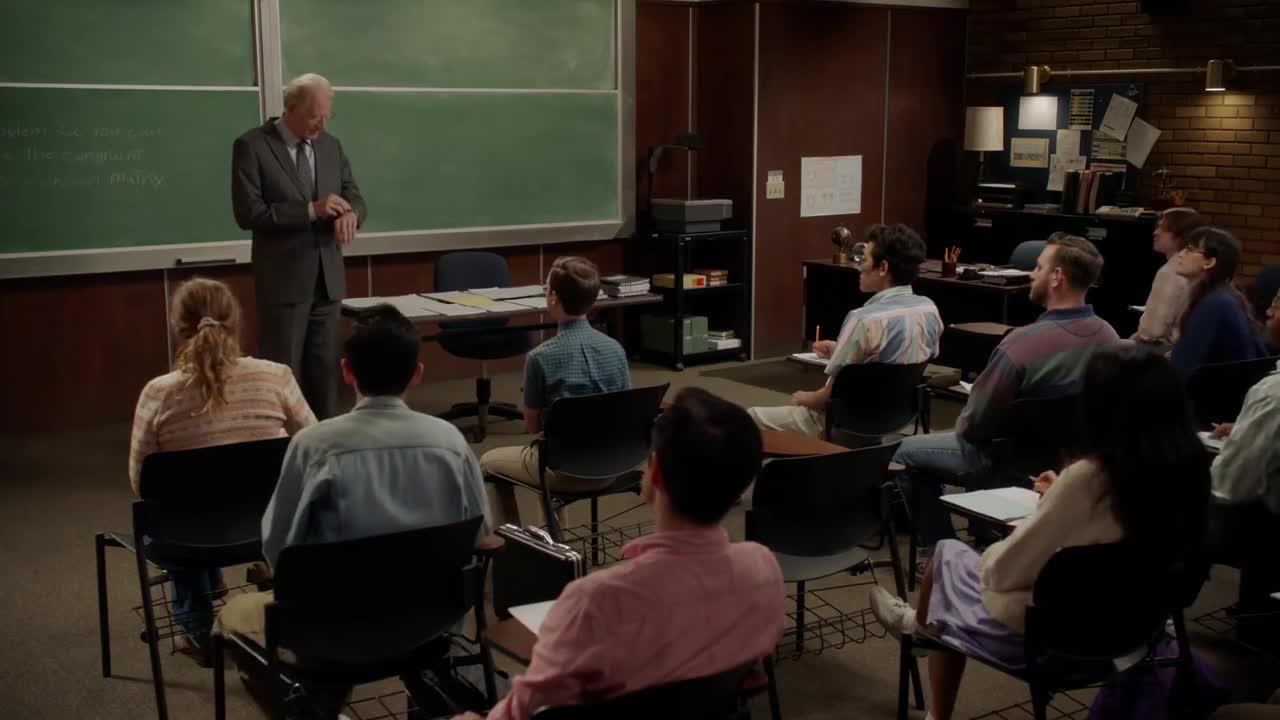
In this brief but revealing narrative, the young prodigy Sheldon Cooper finds himself in a rare state of vulnerability during a high-stakes physics examination. Sheldon, who typically approaches academic challenges with supreme confidence, describes his progress through the test with hyperbolic flair, stating, "I flew through wave functions" and "I dominated harmonic oscillators." His narrative voice highlights a personality defined by intellectual arrogance and a rigid, almost ritualistic attention to detail, evidenced by his internal conflict between the "desire to finish quickly" and the "urge to stop and smell my freshly sharpened pencil."
The Encounter with the 'Bessel Function' Block
The central tension of the story emerges when Sheldon reaches the final question, which requires him to "solve Schrödinger's equation in a cylindrical well by employing the zeros of the Bessel function." Despite his immense preparation and past experience, he encounters a sudden, debilitating mental block. He describes this moment of cognitive failure with a sense of disbelief, questioning his own memory: "You've done it a million times. Oh dear." This moment serves as a stark contrast to his usual self-assuredness, revealing that even a mind as mathematically gifted as Sheldon’s is susceptible to the pressures of performance.
The Conflict of Perfectionism
Sheldon’s reaction to the ticking clock is not one of a typical student worried about a passing grade, but rather one of an perfectionist facing a personal failure. When instructed to turn in his test, he refuses, arguing, "I just need a few more minutes on this problem." His insistence highlights his obsession with academic excellence; when the examiner reminds him that he will "still pass," Sheldon retorts with a defining statement of his character: "Sheldon Cooper doesn't just pass." This illustrates his internal pressure to maintain an image of flawlessness, where anything less than total mastery is perceived as an intolerable defeat.
The Vulnerability of the Genius
Even when attempting to recall the specific date of his memorization—"October 7th, 1988"—he finds himself "blanking." This moment of human fallibility is profound. It strips away the myth of the infallible child genius, showing that his knowledge, while vast, is not immune to the chaotic nature of human memory. The narrative concludes with a shift in power dynamics. Sheldon, desperate to solve the problem, is tricked by the examiner into handing over his paper. His final realization—"Sheldon Cooper isn't always that gullible. He was today"—marks a humbling conclusion to his ordeal. The story serves as a poignant reminder that even those who view themselves as intellectual titans are subject to the same anxieties, lapses, and social manipulations as any other student.

Deep Learning with ListenLeap


