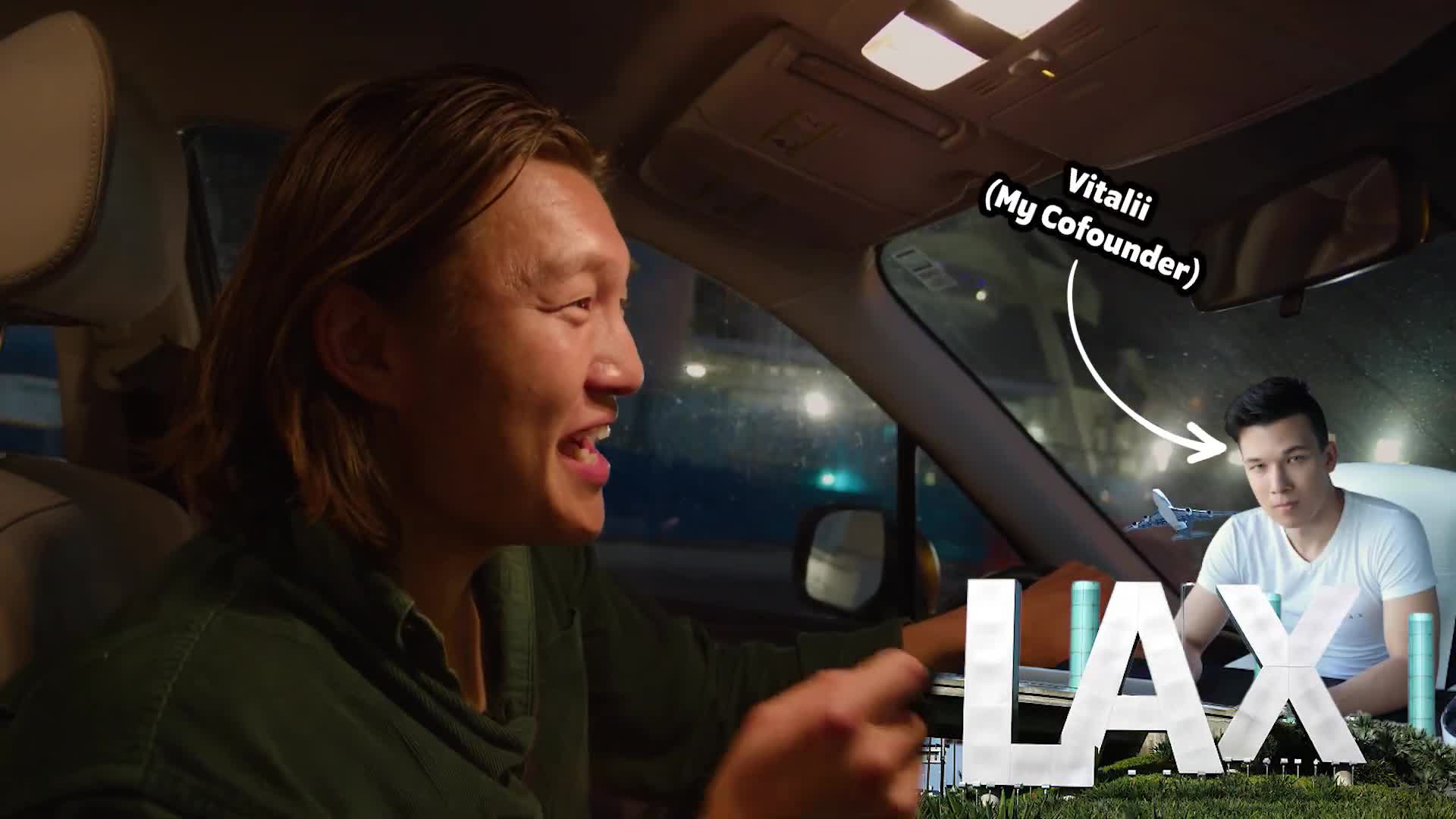
So we are at LAX about to pick up my co-founder.
I am really excited to see him because he is a rock to this company.
He is my business partner and everything and I couldn't do it without him.
And so him and I are actually going to teach you guys how to find your co-founder, so y'all can start crushing it together.
So now that we've picked you up, we have to teach them how to find a co-founder.
So I figured the step one of all of that is actually figure out what kind of co-founder you need.
So figure out who is the right co-founder for you.
And so my advice on that is to figure out who is your compliment.
So figure out who is a complimentary skill set from you, which I think you and I do really well, where I'm on the business side and I'm more of the kind of emotional, intuition-based kind of visionary person and you're more the kind of execution-based technical co-founder.
You actually make sure stuff gets done, whereas I'm kind of like busy dreaming up the big ideas.
Yeah, and my style is more of a logic, rational June, where it's like, give me ideas over there.
No, let's get down to like- I'm pretty rational.
Okay, I would say I'm pretty rational, just not as rational as you.
But you are very data-driven, and that compliment works really, really well for us, right?
I agree.
I would also argue that the most important part is the essential values that you really land on.
Yes.
I think when we met for the first time is Before we knew the differences and how we differently approach the problems.
That initial click came from realization that we actually stand for the same things, which builds on ownership integrity most importantly.
And one thing that's really big for me is work ethics.
Like, if you're not capable of working 80 hours, you're like, what are you even talking about?
You're going to love to suffer.
And that's the big one.
That's the hardworking immigrant work ethic.
I think both of us bonded on because both of us were born outside of the West.
We immigrated here, you know, paid for our own schooling.
And I think that kind of bond and the families we came from and the values that our families taught us was something that really brought us together.
Where I really like your point around shared values.
So, even though we are very different, very complimentary as people and therefore we're good co-founders what brings us together is the core values that we share.
And so, as y'all think about finding your co-founder, what you want to do is you really want to find someone?
It's kind of like dating, actually.
It's like finding a co-founder is kind of like finding like a marriage right, and in fact unfortunately, like many co-founder relationships last longer than the average marriage.
And so when you go about finding your co-founder, you should kind of think of like dating for a life partner.
I mean, we spend so much time together, we're partners in every sense and in terms of the business, and so we have those shared values.
And then also we have complementary skill sets.
We're never like in each other's faces, like trying to like work over each other.
Instead, it's just this like really beautiful synthesis, and i would also say i personally couldn't do this journey without a co-founder.
Like being a solo founder would be absolutely miserable.
I would be exhausted emotionally all the time with like no one to go to, because you just you just need a partner in something.
That's hard.
And when i think about the most successful companies that i, you know, i look up to whether it's a google, it's a stripe i mean, what else is there?
Apple, right there, there is no apple without jobs.
And wozniak, right?
I think that's what we have.
What we have too, It starts with people.
Relying on someone is extremely, extremely important.
Running a business is a very lonely job and there is so much doubt.
Not all the decisions can be made optimally and having someone to just debate the ideas and it all comes down to.
We are in this together and this gives you a really solid foundation to whatever there is, to work through it and move forward.
So I guess the advice that I would give to other folks in terms of figuring out what kind of co-founder they should find, they should think about their strengths and weaknesses right.
So are you business focused, marketing focused, product focused?
And then what are your weaknesses?
So for me, I'm a really shitty coder, as Vitaly knows.
And so I really needed a co-founder on the technical side to help me build and to really run our technical infrastructure, which Vitaliy is phenomenal at.
And so, as y'all think about what kind of co-founder you need, it's just like what are the puzzle pieces?
Like, all of us have strengths, all of us have weaknesses, and you want to find someone who overlaps with you in the right ways, because it's just like a one plus one equals three situation.
100%.
On the opposite end from you, John is a remarkable salesperson.
He can sell you anything.
Wall Street, sell you a pen example, he'll nail that one.
Investor relationships, early days, admin staff, none of this I'm good at or excited about.
But I am doing a great job at pieces that I care about the most, which is technical infrastructure and talking to computers frankly.
So those two really come together where I can focus on my strengths and build on top of them.
While John does on his and as a company, we win because we have everything.
All right, so we are pulling into In-N-Out right now and we're gonna teach y'all in In-N-Out, while we wait for our burgers and eat our fries, how to actually go out finding a co-founder, now that you know what kind of co-founder you should look for.
So we will see you guys inside.
All right.
So now that we're done ordering and teaching you guys about what kind of co-founder you should look for, the next thing that we should teach you all is how to actually go about finding a co-founder.
Very tactfully speaking,
And there's a bunch of different ways to find a co-founder.
Well, number one, join the local networking event.
Take advantage of tools like AngelList or incubators like YC, or in Canada there is something called Entrepreneur First.
Yes.
Talk to your friends about it.
If they don't know what you're up to, nobody does.
And you'll be surprised how many people in your network will know a person or two who is also interested in something like this, and they'll connect you.
Yeah, and that's actually how we found each other.
It's what I call like the friend networking method.
It's my personal favorite method in terms of finding someone that actually is a good match for you.
Where basically, all you do is you just take all of your smartest friends, you let them know what you're building and what you're interested in and you just ask them like hey, can you introduce me to your smartest friend?
So in my case, I was basically just asking everyone I knew who their smartest engineering friend was.
And I would talk to them, I'd vet their values, I'd vet their integrity, I'd vet whether or not we were a good fit.
And then, if they weren't a good fit, what would happen is I would actually just ask them for an introduction to their smartest friend.
And so it kept happening that way.
And I got to the point where I got super lucky.
One of our customers that we were working together with Invest with Russ.
I was asking him about hey, I'm looking for a co-founder on this.
And he was like wait a minute.
I know a really smart guy who's also building a competing product for me.
And then he introduced us.
And that's how we started getting to know each other.
Yes, my product was objectively technically better and John's product was objectively better, product market fit and they connected the dots.
The important thing is to say it.
Yeah, his product was beautiful behind the hood in terms of the code, but the front end looked awful.
My front end looked really nice relative to his.
It looks way better now that we're working together, but the back end, the actual code itself, was spaghetti code.
And John could sell the whole thing, so that made a world of difference.
All right.
So now that we have our food, just to summarize how you find your co-founder there's a bunch of different ways.
Of course, first you need to know yourself and find someone with complementary skill sets.
But then from there, it's all about networking.
So it's like use LinkedIn.
So message people around, ask them for time, use your friends, use conferences, use AngelList, all these internet resources.
There's like tons of places to meet really smart people.
And then you just keep asking smart people to introduce you to smart people.
And eventually you're lucky and you find your partner.
All right.
So last part of the video, co-founder dating red flags.
What's your number one red flag in a co-founder?
I think a lot of this is intuition.
I have a strong bullshit radar.
And if I don't trust the person after like speaking with them for 10 minutes, that's a red flag and we are done.
How do you test them or figure out very quickly how someone is, how committed someone actually is?
I think it comes through a story and for us it came through like what we came to the table with, like I came with my projects and ideas that I've built out prior to the conversation, and like what I said was up to you.
So it was a strong indication that you've done something yourself, I've done something myself, so that part is covered.
So the green flag for me on that.
For you, is you telling me your story about how you immigrated from Russia to Canada when you were 18 and you were studying chemical engineering, but you didn't speak that much English?
I didn't speak any of it.
I can't imagine.
Can you guys imagine studying chemical engineering with the big, what long chemical terms and you don't know a lick of English?
I can't imagine reading that textbook.
At the same time, you took on a ton of loans as well.
You're paying for school.
We're still both paying for school, actually, right now.
Like, Stan is how we're gonna pay for our school loans.
And so like those small little things and like how you also had a minimum wage job growing up.
You worked as a teen as well to like pay for your family, like the same way I did.
So small little signals that for us, I think show that there was a work ethic.
And then also I just like flat out asked you, I think, at some point, like are you ready to grind a hundred hours a week with me?
And you were like, yeah, you didn't even like, yeah, you didn't even hesitate.
You were just like, yeah.
Is there another way to live?
All right.
I think I've got another good one which is caring really deeply about the mission or the work you're doing.
They have to like, really believe and this is true for any employee at an early stage startup.
But you have to care really deeply, or else like when, what is it?
When thick comes.
When shit hits the fan or when push comes to shower.
Thank you.
I have no idea what I was trying to say, but when that happens.
Like you have to care really deeply about what you're doing, or else you're just like eh, I'll just go start another business, or I'll go like find another job.
You really have to care about the problem you're solving.
Wait, Vitaliy, this receipt says something kind of weird on it.
What does it say?
Huh?
Like and subscribe.
Oh, we should do that.
I'm on a roll now, instead of another one.
Openness to feedback and growth mindset.
So huge red flag is if you're working with someone and they're not open to candid feedback.
I think both of us give each other feedback all the time.
Like John, you know, you did this thing.
I think you could have been proven that way.
Like Vitaly gives me that all the time, and I give him the same, because we're both trying to be the best version of ourselves for the team and the company.
Also because we just like love growing as people too.
And so if you're working with someone who has a very high ego so I guess the red flag is high ego and inability to listen then you're gonna end up working with someone that isn't gonna improve, that's gonna be hard to work with over time.
And so that's a really important thing to look out for is to make sure you have someone who's not an egocentric maniac.
It goes far beyond the just the co-founder journey, like hiring and every single human being building in team, like if your person is receptive to feedback.
There is very little you can do and things are going to get out of hand at some point, and this is the fundamental mechanism that gets them back on track.
So i think you're doing a great job listening to everything i have to share and i got a ton from you as well, and i think over the past couple of years it helped me grow personally, so hopefully it was as helpful to you.
Yep, well Cheers.
Burger cheers.
To being co-founders.
All right, guys.
I hope that was helpful.
Vitaly will be on for more videos.
So make sure to like and subscribe.
Follow along on the journey.
He is the rock to my business.
I couldn't do it without him.
So my hope is that this video helps you find your Vitaly and be the best gift in your own company building journey yourself too.
So wish you all the best and I'll see you soon.
Good luck.