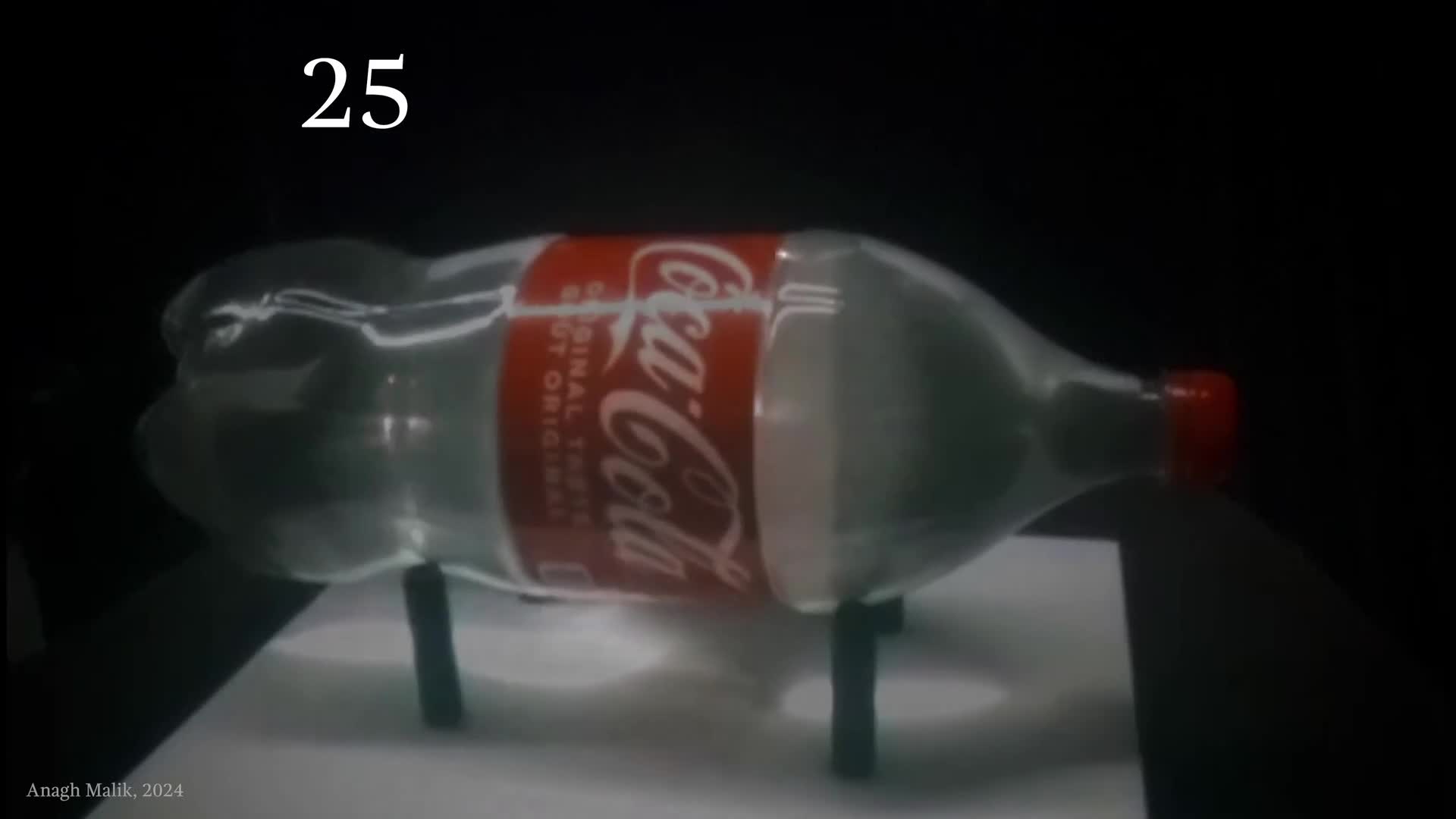
This is a video of light traveling through a bottle at 250 billion frames per second.
And here's that same video, but now with the camera moving.
You can see, it sweeps across the scene faster than the laser pulse itself, which means this camera must be traveling faster than light.
So how is this possible?
Well, in this video, I want to show you three unusual ways of stopping time and what you can see if you just keep slowing down.
From a century-old technique that still beats modern slow-mo cameras all the way to a massive quadrillion frames per second camera that captures electrons whizzing around molecules.
By the 1920s, electric motors were the new standard for powering factories and mills.
But many of these motors also came with a flaw.
They were sensitive to fluctuations in the electrical grid.
A power surge, like from a lightning strike, made them behave unpredictably.
So one MIT engineer named Harold Doc Edgerton set out to find a solution.
He had a setup that could induce these power surges in a lab.
But no matter what he tried, Edgerton just couldn't see what was going on with the motors, because the machines would spin too fast for the human eye to see.
And cameras at the time offered no help.
Their exposure times were too slow, so any photograph of a running motor would come out blurry.
But one day Edgerton noticed that every time he triggered a power surge, his equipment gave off a bright flash of light.
And when that flash hit the motor, the moving parts appeared to stand perfectly still, as if frozen in time.
Which gave him an idea.
He could turn off all the lights in the room, set up a camera, and leave the shutter open.
And since there was no light, no image would form on the film.
But then if he could illuminate the motor with a very brief and very bright flash, like the ones his equipment gave off well, then he would get a sharp photograph.
All Edgerton needed was a way to reliably create these flashes.
So he started by using a high voltage power source to load electrons onto a capacitor, where they piled up onto one of the plates.
But because there was an insulator slotted between the two sides, the electrons couldn't just jump to the positive side to balance out the charges.
The only way for them to get there would be to travel through the rest of the circuit.
And the circuit was intentionally designed so that electrons would have to cross a glass tube filled with a non-conducting gas like argon or xenon.
On their own, they would not have the energy to get through that gas.
So, Edgerton added a trigger that sent a high voltage pulse through a wire wrapped around the tube.
And the electric field from that pulse would rip electrons off the gas atoms inside the chamber, ionizing the gas and turning it into a conductor.
In that instant the charge stored in the capacitor would surge through heating the gas to around 10000 Kelvin, nearly twice as hot as the surface of the sun.
This would produce a very bright and very brief flash of light, lasting just 10 microseconds.
Then the electrons would recombine with the gas atoms, stopping the current, and the circuit would go dark again.
This was Edgerton's strobe.
By the early 1930s, he was eager to test it outside the lab.
So he packed up a strobe and hit the road with his wife.
When he saw a random factory, he pulled over, got inside the nearest phone booth and called up the factory's president and asked him something like do you happen to have any motors in there that don't work right?
I'd like to show you something.
More often than not, he ended up inside setting up the strobe next to one of the motors.
The workers would watch as Edgerton froze the motor in time, allowing them to take sharp pictures of the gears in motion.
Edgerton isn't the first to make a strobe.
Rather, he took new bits of technology that existed so that he could make a better strobe, a strobe that was brighter, shorter flash duration.
But he was not unique in that.
There were lots of electrical engineers in the world at that time who could have done that.
No, what Edgerton uniquely brought to the table was his eye for photography.
He took photos of synchronous motors and I think in part because he just thought synchronous motors were cool.
One day he showed his wife the 300th photo of a synchronous motor and she said Harold, can you take a picture of something a little more interesting?
And so he did.
Tennis balls pancaked against the racket.
Hummingbirds frozen in time.
He was one of the first to really start using strobes to communicate what's happening at these timescales.
We can't see.
He would do this through Life magazine, National Geographic magazines.
These magazines in the 30s, 40s were essentially the social media influencers of the day.
He just had this eye for composition.
Most of these pictures were taken in the 1930s.
And yeah, it seems easy enough to swing a racket and it's easy enough to press a button on the strobe.
But how do you time the strobe to go off exactly as the racket hits the tennis ball?
That is the million dollar question, right?
You have a strobe that turns on and off in half a millionth of a second.
That's nice.
How do you get it to go up the right half millionth of a second?
Because there are a lot of them.
And the answer is we use sound.
So we're going to try and recreate one of Edgerton's photos popping a balloon and freezing it in time.
Is it okay if we walk through the setup?
I think that would make perfect sense.
Why don't you blow up a balloon?
Step one is you set up the experiment, or in this case, the performer.
And the next thing you want to do is frame the image.
So you're framing now before the balloon pops to get focus and- Exactly.
If you can't get a good photo with nothing happening, adding the motion will not help.
And so the next step will be to get the strobe in the right spot.
Now the strobe is set up with a trigger unit with a microphone, and when a sharp sound hits the microphone, the trigger unit sends a signal to set off the strobe.
We're gonna turn the lights out and then we're gonna open the shutter of the camera, but there won't be an image because the room will be dark.
And I will say, three, two, one, pop.
And when I say pop, pop the balloon with an upward motion.
And when the sound from the pop hits the mic after a minor delay, the strobe will fire.
The camera will capture that image for the 1,100,000th of a second it's lit.
All right, we ready?
Lights out, please.
And three, two, one, pop.
Lights.
Oh, there you go.
You look very... Do not mess with this man.
Nope.
Oh, it's awesome.
You can see inside the balloon.
That's really cool.
Okay, here's another photo we took.
Can you guess what this is?
This hovering white orb?
Here it is just a moment later.
It's like a little sombrero.
It is.
Yes.
That orb is a drop of milk falling onto a plate.
That's a pancake.
But you'll notice the little drops are all spreading out.
Yeah.
It's so, so crisp.
Come around.
Have a look here.
Right.
It's translucent here.
You're seeing through it.
Oh, wow.
Now, once Edgerton showed the world how powerful strobe photography was, he attracted some unexpected attention.
In 1939, a US major named George Goddard walked into Edgerton's lab unannounced.
He was working in the Army's photographic lab developing ways to photograph enemy movements from a plane during the nighttime.
The old way of doing a night reconnaissance photograph was to fly over the site at high altitude and drop a flare on a parachute.
And then the reconnaissance plane had to fly in under the flare, where it would be silhouetted, where you could shoot at it.
Big problem.
Right?
So...
Totally exposed.
Goddard wanted a safer way, so he asked Edgerton whether he could develop a strobe powerful enough to illuminate the ground from a plane that was a mile or so up in the sky.
A strobe that would be bright enough to take a reconnaissance photo.
Edgerton pulled out some paper, did a few calculations, and said, we can do that.
The flash released about 60000 joules in a single millisecond, a peak power of roughly 60 megawatts, which is comparable to the output of a large solar farm.
The flash lamp was quickly utilized in World War II, and it allowed the Allies to take pictures of Normandy the night before D-Day.
This way, they could confirm that German troops were unprepared for the attack.
It's hard to ignore just how sharp these stroked photos are, especially the ones Edgerton took in the 1930s.
So we got a research-grade slow-mo camera from 2020 that shoots at 20000 FPS, and we're gonna compare its quality to Edgerton's technique by shooting a bullet through a playing card.
So let's do the slow-mo camera first.
Three, two, one.
Let's see the video.
Ooh.
It's great to see how long the top part, which is now levitating, stays.
It's now heavy, yeah.
Okay, and now let's do the same with Edgerton's method.
Lights going out.
Shutter.
Shutter open.
Three, two, one.
Okay, I think I saw it.
That's great.
The focus is amazing.
The edge of the card is beautiful.
You see this ghost effect?
Ah, you do see the ghost effect.
And that's because you open the shutter and it was a second or two before I actually fired the gun.
There's enough stray light in the room to give you a faint exposure there.
Also, we still used a microphone to time the bullet, even though it's faster than sound.
So here's the gun.
It fires.
The sound of the gun comes out.
But the bullet is coming out ahead of the sound.
But the bullet is supersonic.
And a supersonic object moving through the air creates a sound, a sonic boom.
Now, you can pick up that sonic boom with a microphone.
And by moving the microphone physically along the trajectory you get the time where the bullet is going to be, when the stroke goes off.
I think it's a brilliant way to solve the problem.
And I get to say that because I did not invent it.
Edgerton was very inventive and had projects all over the place.
He was teaching at MIT, but then he had companies for things like underwater cameras and he was making movies and oh, he even won an Oscar.
So if there's anything he wanted to do, he sort of just did it.
And I feel like I'm quite the opposite.
You know, when I joined Veritasium back in 2023, I started off as a researcher.
I was fact checking videos and setting up shoots.
But then Derek and the other writers suggested I should make a video of my own.
And I remember thinking, yeah, I don't know, maybe one day, but they kept pushing for me to do it.
And I'm so glad that they did, because when Derek and I made my first video, I fell in love with it.
So if there's anything you're putting off, you should just go do it.
And if that something is a project you want to set up as an entrepreneur or a creator well, today's sponsor Hostinger, makes that first step really simple.
Say you need a website or a store or any kind of online presence.
Hostinger is an all-in-one AI powered ecosystem that will get you up and running within minutes.
With Hostinger, you don't need any kind of crazy tech skills.
It's all frictionless and affordable.
So you can go from an idea to execution without needing 10 apps on your computer.
If there's a project you've been putting off for that one day, turn that into your day one with Hostinger.
Head to hostingercom, slash veritasium10 and use our code veritasium to get 10 off your subscription.
You can also scan this QR code here.
So I want to thank Hostinger for sponsoring this part of the video.
And now let's go look at pictures of that card we shot.
Okay, so here are the two techniques side by side.
And here's Edgerton's original as well.
So why does a research-grade camera from 2020 struggle to get the same resolution as a camera from decades ago?
Well, that's because there are really two resolutions we're working with here.
A spatial resolution, or how many pixels your image has, and a temporal resolution, which dictates whether you capture only one frame, like a strobe photo, or a progression of frames, like our high-speed video.
The problem is that more often than not, the hardware is limited, so that you have to trade one resolution for the other.
High pixel count or high frame rate.
The fundamental limit you hit is how fast you can get pixels off the sensor, and that's why there's a maximum speed to read every pixel.
And then to go any faster, you have to not read out all the pixels.
So this camera will give you a million frames a second, but you're like 16 by 128 pixels and that's not much of an image.
Okay, so there's always this trade-off.
Either you go for very high pixel counts and bring the frame rate down.
At the Edgerton Center, we push this as far as it goes with one frame and that's it.
But you can also push it the other way.
One pixel and very high FPS.
One trillion FPS in fact.
But wait, it's just one pixel?
What can you do with one pixel?
Great question.
The cameras that I can show you today are cameras that you're right, they can really only see one pixel at a time, but they can see close to a trillion frames per second.
And what that lets you do is ultra slow motion videos showing light actually traveling.
Here's that video of light traveling through a soda bottle.
You can see the actual wave fronts propagating underneath the bottle and even how the light bounces off the cap.
And even though this looks like a normal video, you can take it with a camera that only sees one pixel.
Here's how you do it.
A single pixel camera is one that captures just one thing, how many photons land on the sensor.
And the sensor here is typically sensitive enough to register when even a single photon hits it.
And it can count those incoming photons around a trillion times a second.
So each bin, and technically each frame, is roughly one picosecond long.
In that time, even light itself only travels around 0.3 millimeters.
Sounds impressive, but we've actually had this tech in many phones for years now.
It's just LiDAR.
You shoot out a pulse of light.
It bounces off and you time how long it takes for that pulse to come back.
And from that, you get the distance to the object that it bounced off of.
But this is all you need to take a speed of light video.
We have a setup here that is basically a scaled-down room and we just have some different shapes in it.
We have a cone, a sphere.
We have a mirror in the back.
And finally, we have the Veritasium and the Camera Culture logos.
We wanna see light propagating through a scene.
So the way we do that is we shoot out a really short laser pulse that hits just one point in the scene, and that laser pulse has a ton of photons in it.
Those photons will hit an object.
Scatter everywhere and we wanna see what that scattering looks like at all these portions of the scene.
To start, our single pixel camera will point at the top left corner.
So when a pack of photons from the laser pulse hit this random spot on the wall, reflect into the corner and finally bounce into the camera, the sensor is going to pick up their signal at a trillion frames per second.
But that signal will be pretty faint.
So the problem here is that we're exposing for such a short time that you actually just don't get that much photon return.
What we do is we actually take a bunch of measurements and then group them all together and that gives us actual, usable information about how far away the light traveled in a scene.
Then you move the camera slightly and repeat the experiment.
So you shoot out a laser pulse, let it scatter off the same spot and record the signal at this new position.
You do that over a million times and then move the camera again until you record a whole grid of points.
You're literally going just one pixel at a time.
One pixel at a time.
That's the caveat.
Yeah, exactly.
We actually have two mirrors here that let us steer the beam left and right and up and down.
So by turning where the mirror is, we can turn where the sensor looks.
The most important thing for this technique to work is that the scene has to play out pretty much exactly the same every time you move the sensor, because if it didn't, then every pixel would tell a different story.
It's like if I try to record this section four separate times and use a quarter of each to fill in the screen.
I would get a mess.
Thankfully, the laser pulse in our scene scatters pretty predictably.
That's what lets us get unlimited resolution.
So we can basically say, let's scan as many points in the scene as we need.
That gives us good spatial resolution.
The more points you scan along this grid, the higher your final resolution.
If you want 4K, you simply scan a 4K grid of pixels.
It's just going to take more time.
The nice thing is light is fast, so we can do this as fast as the mirrors can move.
Within just a couple of minutes, the sensor captures millions of laser pulses across this whole grid.
So this is now everything compiled together for a time of flight.
Exactly.
This is everything put together.
So what we're looking at now is going to be again for a fixed laser spot.
So I'm going to click play.
Oh, camera cultural logo.
Yeah.
All of this was less than eight nanoseconds of time.
And here's another scene we shot.
Now you can also take this a step further by rotating the scene and recording multiple points of view.
We have this algorithm that kind of takes this Coke bottle video capture from different views and is able to create these fly throughs, being able to see the light propagate from any direction and like flying through the scene as it's happening.
Oh, that's so cool.
So some things that are interesting to know is because we're moving towards the right and the light is propagating towards the right, but we're moving kind of faster.
In this visualization, this wave front appears stationary, as you can see.
Oh yeah, that is kind of breaking physics.
I mean, you are moving the camera faster than light.
Yeah exactly yeah, it's kind of mind-boggling, almost.
So this is a fish tank that we put a mirror into and this diffuse reflector.
So you'll see, a pulse of light will enter the fish tank and reflect off the mirror and then hit the diffuse reflector.
That's crazy.
This is a diffraction grating.
So it's kind of it diffracts the light into different modes.
Those are the different modes.
That's insane.
My first impression was oh, these are just simulations from, I don't know, Unreal Engine 5, but this is like real data.
It's like the bullet time video in Matrix.
You've probably seen it.
No way, is your motivation the Matrix?
By the way, these videos were created at the University of Toronto and MIT.
But Brian from Alpha Phoenix actually built one of these speed of light cameras in his garage, which is mad.
You should go check that out.
So those are the two extremes.
Stereo photography on one side and a trillion FPS on the other.
But if you combine both, you actually get to see what electrons are doing.
Even though what that means exactly is debated.
You say electrons act like waves.
No, they don't exactly.
They act like particles.
No, they don't exactly.
We can write mathematical expressions and calculate what the thing is going to do without actually being able to picture it.
Do electrons exist?
How truthful do you want me to be?
Now, we still don't have a video or photo of electrons, but this might be the next best thing.
And to pull it off, we had to build big.
Really big.
Okay, we're driving down what, up until 2017, was the world's straightest object.
So we've been driving for like, what, five-ish minutes?
Yeah, and we are all, I want to say, about halfway there.
Oh, I thought we were about to get... Oh, no.
There is a lot more there.
All right, let's do it.
Let's go see it.
This is SLAC, a US national lab that houses a 32 kilometer long, perfectly straight electronic accelerator.
Whoa, that is so long down there.
It just continues like this all the way down.
The noise you hear is exactly 120 Hz.
That's the frequency at which electron pulses are generated underneath this building 120 pulses a second.
And this is the sound of the equipment that accelerates them to over 99.9999992% the speed of light.
And this lets you see electron clouds move around molecules essentially.
Right, so why would you care?
Because essentially electrons create the fields in which everything else happens.
Molecular bonds break and form because the electrons essentially give them a push to do so.
So the electrons are responsible for everything that you see in nature, and being able to look into their motion is the most fundamental way of studying materials and matter.
Now, to achieve this, you need a nanoscopic equivalent of a strobe.
So you first feed these relativistic electron pulses through a set of devices called undulators.
They're stacks of magnets spaced only a few millimeters apart with alternating poles.
So the first pair has the north pole facing the electron pulse from above, and the south from below.
Then the second pair flips, and so on.
Now, because the electrons are traveling through a magnetic field, a force called the Lorentz force will push them in a direction perpendicular to both their velocity and the magnetic field lines, in accordance with the left hand rule.
So at one magnet pair the electrons will curve clockwise, and at the next pair counterclockwise, and so on.
This causes the electrons to wiggle.
Now, since electrons carry a charge, this wiggling motion causes them to emit electromagnetic radiation.
And even though they oscillate at these millimeter wavelengths because of the magnet spacing, the wavelength of the resulting EM radiation is much smaller.
This is the fun thing about the theory of relativity.
If you travel at near the speed of light, The length scales contract, while that periodic structure is microscopic for us, right?
We see each magnet.
These are centimeter scales.
For the electron, because it's traveling so fast, all of that space contracts.
And so it's actually oscillating really, really fast, and these oscillation periods are compressed.
And it means that if you compare that to wavelengths, that is in the X-ray domain.
Now, that actually only gets your wavelength part of the way to the true X-ray regime.
But if, as an observer, you stand at the far end of the accelerator, all those electrons will be coming at you at more than 99 the speed of light.
So in your reference frame, any light those electrons emit will additionally be blue-shifted, producing X-rays as small as 50 picometers in wavelength.
Initially, these X-rays are created randomly along the undulator, producing an incoherent light pattern.
But soon after the electric fields from the X-rays start to interact with the electrons, speeding some of them up and slowing others down.
This causes faster electrons to catch up with slower ones, so they get bunched up into periodic structures, these parallel sheets that are spaced at distances exactly equal to the wavelength of the X-rays.
This is called micro-bunching.
Now these sheets of electrons emit light as unified fronts, so the resulting X-rays come out coherently as a laser pulse.
This dramatically increases their intensity.
And the pulses come out incredibly tightly packed, being only a few femtoseconds long.
And they can even get as short as a couple hundred attoseconds.
That's 10 to the power of negative 18, an absurdly quick pulse.
To put it another way, the attosecond is to the second, what the second is to the age of the universe.
On an attosecond scale, you can see electrons zip around essentially atoms and molecules.
That's insane, yeah.
After the undulator, the X-ray pulses are sent to experimental stations at the end of the tunnel.
So where's the main X-ray beam?
The main X-ray beam is coming through this tube over here.
It's a little harder to see, but it's coming in through this tube over here.
So this is the main place where the X-rays come into the hut.
And so the X-rays focus into what we call an interaction point.
Now, you fill this interaction point with the molecules whose electrons you want to study.
Now we shine that X-ray pulse on a molecule and when it hits the molecule it will ionize the molecule, and it ionizes predominantly from these inner shells, from the very core parts.
The thing is, core-level electrons from different elements have different ionization energies.
So if you want an X-ray to eject a core-level electron from a nitrogen, it needs around 400 electron volts, whereas for an oxygen it needs around 550.
So, by tuning the X-ray energy to match these ionization energies, you get to choose which of these atoms within the molecule the X-ray is going to ionize.
And any excess energy left after an X-ray has ejected an electron will be taken by that electron as kinetic energy.
Now, once you ionize this molecule, the kinetic energy will tell you something about what's going on around that electron.
Well, electrons are not independent particles.
They talk to each other, right?
They have a negative charge.
So if you have a high electron density around a particular atom, the core level electrons will be bound less tightly to the nucleus because of the presence of all these other electrons around the atom, so its ionization energy will actually be slightly lower.
Whereas if you have a lower electron density than average around an atom, those core level electrons will be bound more tightly with a higher ionization energy.
Therefore, when you measure the kinetic energy of the electrons you eject, you can use the difference between the input X-ray energy and the output kinetic energy to infer what that electron density was.
Now, once we can take a picture of an electron density, we can change what the molecule is doing, make it do some process in time, and then we can look at how electron densities change.
We have above us, we actually have an entire laser hall.
So we generate laser light.
We bring it down through tubes, like here behind you or over here on the ceiling, traditional laser light.
These are infrared lasers.
We bring them onto this table and you see all these boxes on this table.
These boxes are to condition the laser, to give it the properties that we want.
We can change the color of the laser, we can change the polarization state, we can change the duration of the pulse.
So we sculpt these pulses, then we have them go co-propagating with the x-rays into our target.
And so now our first laser pulse will create some non-equilibrium state in the molecule, will drive some dynamics, and then our x-ray pulse will probe it.
This attosecond x-ray pulse ejects an electron from the molecule after a time delay t, And by measuring the kinetic energy of that electron you can study how the electron density of the molecule reacted to the trigger laser.
So you get an attosecond snapshot, like a strobe, of how the molecule changed.
Then you can get another sample of the same molecule.
Shoot it with the laser again, but this time increase the probe.
Delay slightly to t plus delta t.
This will tell you how the electron density changes a little later.
And you can keep increasing this delay each time to get a sequence of snapshots of how that electron density evolves over time.
Isn't there a big assumption here that every time you do it, you're expecting a repeatable result from the molecules?
Yes, absolutely.
You need for your initiator to drive the same dynamics over and over again.
If you have a new process happening every time, this technique will fail.
But if the scene is repeatable then, like the Trillion FPS camera, you can use this technique to create a molecular movie.
And here the smallest amount by which you can tweak the time delay for the X-ray strobe is around 300 attoseconds.
So you can get frames that are only a few hundred attoseconds apart.
And if you stitch those together you get a movie that technically runs at over a quadrillion frames per second.
So this is a movie of the dynamics that we might like to image.
So this is a small molecular system.
This is called para-aminophenol.
This calculation was done by some of our collaborators in Madrid.
They had calculated what is the response of this molecule to the removal of an electron.
So they simulate an x-ray pulse coming in and removing an electron.
So the red color here represents an increase in the density of the electron and the blue represents a decrease.
And so we see that when we've shined this X-ray pulse onto this molecule and we've removed an electron, we initiate some charge distribution that starts to move across the molecule.
And so we want to image this charge motion.
The video is a simulation, but it's been validated by the experiments done at SLAC.
Our method for probing these seems to work.
We can compare to a handful of points and say, oh, these look broadly similar.
Much after this few femtosecond, as we approach five to 10 femtoseconds, we start to diverge.
Our prediction starts to diverge from our measurement.
And actually this is the most exciting time in science, right?
When you have a prediction and then you have a measurement and they don't agree.
That's when you get really excited because you just found something you didn't know ahead of time.
You couldn't have predicted that.
I think the most powerful thing for me here is we animate a lot of electrons, right?
And pretty much every Veritasium video has electrons moving in some way.
So the fact that we're actually seeing these electron densities move around, I don't know.
I think it's spectacular.
Absolutely.