Attention.
It's our most valuable resource.
It's kind of all that we have.
So why is it so hard not to constantly give it away?
Hi, I'm Hank Green.
I'm Sage.
I'm Amanda Montell.
I'm Kusha Navidar.
Hi, I'm Curly Velazquez.
I'm Che Jim.
Hi, I'm John Green.
Hi, I'm Shambhu Dhram.
And this is Crash Course.
OK, so I think it's very important that you pay attention to this video.
So we've got a plan.
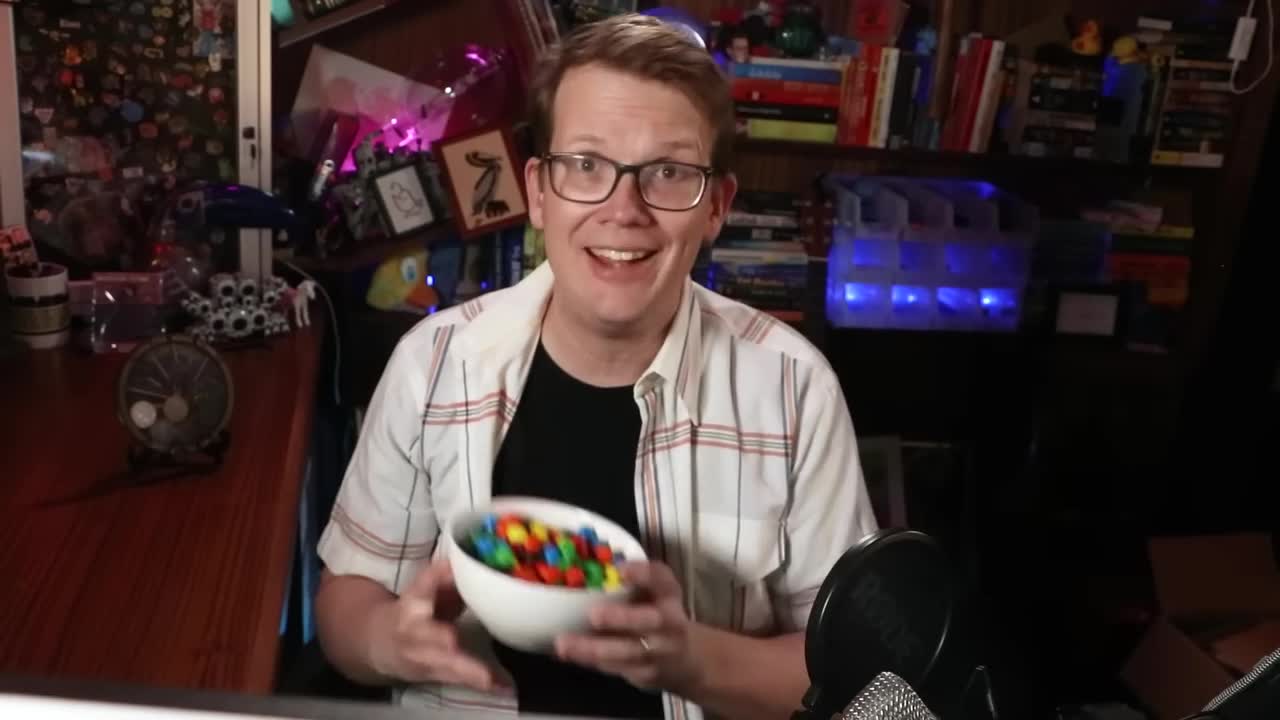
At random points, I'm going to flip a coin.
And if it's heads, I get to eat a peanut M&M.
And if it's tails, I get to eat a clove of garlic.
What's really driving what we pay attention to?
Is it the dreaded social media algorithm, the result of some evil genius design?
Or is it human nature that we are the ones who are simply hardwired for distraction and outrage and whatever this is?
Social media platforms, including YouTube, are what's called complex systems, meaning behavior happens in nonlinear ways, often unpredictably, and you can't fully understand it by looking at just individual components.
Instead, you have to look at how those components interact.
Oh my god, we're flipping a coin already.
We're flipping a coin already.
We got heads.
The door is heads.
When we talk about social media algorithms these days, we're mostly talking about content recommendation algorithms.
That's how your various feeds get generated and constantly optimized based on your previous behavior.
And the thing is, there's so much more data on your implicit or knee-jerk, unthinking behavior, like how long you lingered on a video, for example than on your explicit or intended behavior like clicking, thumbs up or thumbs down.
And that means that algorithms are plugged into our most underbaked lizard brain reactions, giving us more and more of that video you hate-watched in the moment and then felt gross about later, and less and less of what the best versions of ourselves actually want to see.
And that, in turn, puts pressure on creators to optimize for things like outrage.
I have an example of this.
My brother recently made a video called We Know How to End Tuberculosis.
And it was on track to be one of the vlogbrothers' worst performing videos in recent history.
Even though it is literally about the deadliest infectious disease of all time and the fact that we know how to cure it.
So.
I changed the title of the video.
I changed it to Elon cancelled this, let's do it anyway.
And it went from being our worst performing video of the month to the best performing video of the month.
Which was good for educating the world about tuberculosis, but also I still felt kinda bad about it.
So you see what I mean?
It's hard not to give into this pressure to change your story so it latches onto negative emotions.
It's everywhere.
It's how news is framed, it's in the scientific information we receive, and so much more.
And algorithms aren't just amplifying outrage.
Some studies have even shown that lies spread more quickly than true information on social media, precisely because they seem novel or surprising.
They capture our attention.
Okay, there it is.
They capture our attention.
And thus I capture— I got another heads, everybody!
I dropped it.
I love this game.
It's gonna be hilarious when I don't eat any garlic.
But here's the thing.
Over here at Crash Course, we're not really playing the algorithm game.
I mean we will try to hook you with engaging titles and thumbnails, and meat and garlic cloves, of course.
But a video about mitosis is always going to be a video about mitosis.
And what are we going to do?
Like, not teach you about mitosis?
That people gotta know!
At Crash Course.
We're not choosing what stories to tell based on what's gonna make the algorithm happy.
We're choosing to teach what needs to be taught.
In the last year we wrapped up our series on religions and political theory and we released new ones on sex ed, Native American history, Latin American literature, kids literature, futures of artificial intelligence and scientific thinking.
Science High Five!
We're also continuing to experiment with longer-form videos, the latest one featuring best-selling author Amanda Montell talking about linguistics and persuasion.
Many of the topics we cover are undertaught and underfunded.
Subjects where teachers and students have limited access to high-quality resources, and they're subjects that many of us wish we were taught.
I cannot tell you how many times I have heard from people decades out of school who were watching a series like Native American History, trying to fill in the gaps in their education.
And here's the amazing thing we're not really playing the algorithm game, and yet Crash Course was viewed 143 million times last year.
Because people all over the world made the conscious choice to give us their attention.
That is incredible, and we are so grateful.
And we've got lots more in store for you.
Geology, English Language Arts a series that will answer big questions on US government and politics more long-form lectures.
And now that our content studio Complexly is a non-profit, we belong to the public and Crash Course is better poised than ever to keep making trustworthy content that is freely accessible.
Can I continue my streak?
I cannot.
I chose a small one.
That's spicy.
That's why we cook those.
But listen, not playing the algorithm game comes at a cost.
It is expensive to make high quality educational material, especially when you don't cater to the whims of the internet though I admit I am kind of doing that right now.
But every Crash Course video is worked on by 20-plus human people who are absolutely devoted to quality and integrity, from subject matter experts to writers editors producers animators hosts, and the list goes on.
And that's why we need you.
Each year, we produce a new Crash Course coin, and each coin that people like you purchase helps us reach thousands of learners.
This year, the coin is inspired by our goal and commitment to being a signal in the noise.
It shows a sound wave that, for us, represents our commitment to offering clarity, context and meaning.
And actually this is the sound wave for the words knowledge weighs nothing, which is part of a phrase that we've printed on every Crash Course coin to date knowledge weighs nothing.
Carry all you can.
These coins are beautiful objects minted in Arkansas from hand-engraved dyes at Shire Post Mint, and they are only available for a limited time.
Each coin represents your ability to help us reach thousands of learners.
For example, every 100 coin helps us reach 2000 learners and every 500 coin helps us reach 10000 learners.
This year, we are also offering coins that help us reach 20,000 and 100,000 learners.
And this is our sixth year of the Crash Course Coin and our first year as a nonprofit.
It feels a little weird to say this, but some of you have asked for an even higher value coin.
So we created a big, hefty bronze coin that represents your ability to help us reach 200000 learners.
Oh, God.
Is this the last one?
And it's a tails.
Oh, this is a chunker.
Yes.
Okay.
Oh, my God.
It's getting so hot.
I'm fine.
I know that the conceit of this video is somewhat silly, but we are truly honored to do this work.
I think of Crash Course as one of the most meaningful projects I have ever been a part of.
Your purchase of the coin, at any level, allows us to create some of the best possible educational resources and make them accessible anytime, anywhere.
We take that responsibility extremely seriously, so thank you for your attention and for your support.
The 2026 Crash Course Coins are only available until May 29th.
Go to CrashCourseCoincom now or check the link in the description and help us keep Crash Course free for everyone forever.