Ted Audio Collective You're listening to Ted Talks Daily where we bring you new ideas to spark your curiosity every day.
I'm your host, Elise Hume.
There's a lot of talk about what needs to happen for the clean energy transition to really take place.
And the transition cannot happen at all without minerals.
People that are fought and negotiated over all over the planet.
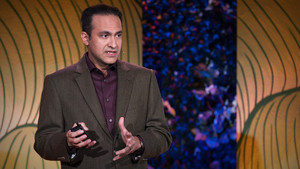
In his 2024 talk, Environmental Peacemaker Saleem Ali lays out a bold vision for global cooperation over minerals that might just save the planet after the break.
And now our Ted Talk of the day.
Consider a humble box of breakfast cereal.
On its side you'll find a list of minerals.
Those which are so essential for our metabolism that we are willing to make exceptions even in times of war for trade and grains.
This has happened indeed in the current conflict between Russia and Ukraine.
Now minerals are also essential for humanity in another pivotal way.
They help us build the infrastructure to deliver on clean, reliable energy.
Of course, drives life in all its various forms and mineral raw materials are the means by which we harness that energy.
Now the interesting thing is that the more sustainable forms of energy are the ones that require more materials.
Now I've spent most of my career studying environmental and social conflicts and finding ways of resolving them.
And what I've discovered is that those conflicts that involve minerals and energy are the most intractable.
Why is that the case? Well, it's because minerals and energy infrastructure are confined by geography.
You can only mine where there are minerals.
You can only have wind power where you've got wind and so on.
So you are in this situation where you're only going to be able to harness these resources in particular areas.
South Africa for example has massive reserves of platinum.
That's an accident of geology.
But that makes South Africa a pivotal player in the hydrogen economy.
Why would wonder hydrogen, platinum?
Well, you need platinum for hydrogen fuel cells.
China has invested tremendously in down processing their technologies around specially refining minerals.
And so downstream refining is also going to be pivotal in delivering those minerals.
Now diversification is something we are seeking.
And one of the ways in which we're trying to do that is to invest all over the world in other places where we can mine and refine.
But keep in mind that if you're going to do that, you will probably end up developing new sites.
And that may not necessarily be more efficient economically or cleaner even.
So while diversification builds resilience, it is likely to lead to green field development, new sites as opposed to brown field development.
Now with green field development, we have a challenge because communities often don't want these sites in their backyard.
We've just seen in the last year in Minnesota, there was a very lucrative green transition minerals project which was denied a permit by the US Department of Interior because of concerns on social and environmental risks raised by indigenous communities.
And indeed, we need to respect those concerns.
So you have this strange situation where you have geopolitical tensions between countries where there is immense supply of resources and those where there is demand such as between China and the United States currently and then you have domestic conflicts over social and environmental risk.
So this is the perfect storm, right?
How do we get out of it? Well, my big bet is that we can get out of it if we reconfigure the conversation around a planetary mechanism or what I'm calling a mineral trust for the green transition.
Now how would this mineral trust work?
Well, it would be similar to an asset protection trust where you've got a beneficiary that assigns a third party with control, which is a trustee, on how to manage those resources most effectively.
So in this case, in the mineral trust, the beneficiaries would be the mineral producing countries.
You would also have the technology producing countries who are demanding the minerals part of the trustee relationship, so the trustees would be both.
And so the minerals would go into the mineral trust.
You would have a market price that would be paid by those countries that are demanding the minerals.
Profits would still accrue in the same way.
And you would have key decision points managed by technical, not political arms of the United Nations.
And this would in this case be the International Renewable Energy Agency and the Climate Technology Center Network.
And so what you would have then is this mechanism that is much more technocratic and also much more efficient.
You would also pivotly have a green stockpile where under situations of commodity price changes, you would be buffered from those problems for mineral producing countries and it would also be like a rainy day fund.
Now in terms of the larger scheme of things, this is going to potentially play out pretty well, but you would wonder why would this be operationalized.
And so a country like Indonesia, let's say, it's the world's largest nickel producer, right?
It would still have the full control over producing nickel and also being able to sell the nickel for profit.
The only difference is it couldn't weaponize the control of its resource.
And that would make this a much more efficient system for the global economy as well.
And now back to the episode.
Now I can understand some of you may be still very concerned that this kind of mechanism is unnecessary.
Friends in the environmentalist community would say, we should just be consuming less.
We shouldn't be mining, right?
And I totally agree with you.
But that's for high income countries.
Keep in mind there are 760 million people at least who do not have access to even electricity.
You can't ask them to consume less, right?
So you've got that dynamic at play.
Now the second question, which our friends would often raise, again, within the environmentalist community is, why don't we recycle, right?
And that's a very cogent question.
But you need to have stock of material to recycle, folks.
If you don't have the stock, you can't recycle.
And the other challenge with recycling is that it puts you in this trade-off between durability of a product.
So you want your product to last long because that's an important sustainability criterion.
But if it lasts long, you can't recycle it, right?
So you have to find that sweet spot of how long you want to have that product in use.
And we did this analysis just for electric car batteries.
So the average sweet spot is 14 years for an electric car battery.
So you wanted to last 14 years.
And you cannot have that material available for recycling, okay?
But the good news with our mineral trust is that it can still be used as a mechanism actually to have recycling put through.
Where would it go? Put it in the stock pile.
So once you have the stocks, you want a circular economy, you put it in the stock pile, and you could even lease metal, which is really cool, right?
Like you lease your cars, you could lease your metal.
And you know that batteries could be leased and so on.
And that creates incentives as well.
But the trust can be used for that too, all right?
Now I know there are still friends who will be skeptics, especially in the defense establishment and they'll say like this guy coming from academia, you're rolling their eyes, basically saying you know this fellow is just singing some mineral kumbaya in Lala land.
He has no idea about real polity, you know, the high politics of war and peace.
Well, I would respectfully submit to them that I have actually looked at war and peace issues.
I come originally from Pakistan, which is a country that has endured much conflict.
So I am sensitive to those issues.
And you'd be surprised actually to find that it is precisely over planetary issues where humanity has cooperated in unlikely ways.
The only treaty in the United Nations system where we have ratification from all UN member states is a treaty on environmental protection.
It's the treaty to protect the ozone layer, all right?
Now you'd say that was in 1987.
It was a time of relative peace.
Well, go back to the 1950s.
We have the Antarctic treaty where you had multiple claimants on this massive continent and those claimants for the greater good of science set aside their claims and they signed the Antarctic treaty, including the former Soviet Union.
Ayasur was established at the height of the Cold War.
In the year I was born, incidentally, but that organization is still around today.
Why was this established even then?
Because during the Cold War II, the former Soviet Union, United States and many other countries, realized that global environmental data has to be shared and it is this institution where it develops many of the social protection models around climate change as well in terms of doing scenario analysis.
And so Ayasur shows us that we can cooperate over these kinds of issues as well.
Now even in terms of metals, we have had one experiment of trying to cooperate.
The United Nations conference and trade and development in the 1970s tried to set up a trading platform for the metal tin.
But it didn't work because it was never framed around planetary sustainability issues.
So I've tried to, in this idea for a mental trust, learn from these lessons and mistakes so that it is a very pragmatic idea.
It's not pie in the sky. It's something we can do.
The good news is we do have now a new panel that has been established by the United Nations Secretary General, that is focused on energy transition minerals.
So we hope that this idea can hopefully be taken up in a very timely way because time is running out.
Scientists have consensus that we have basically come to the point of crossing five key tipping points on climate change within the next few decades.
And without minerals, folks, we cannot mitigate emissions, but we cannot even adapt because even for infrastructure, for adaptation, you need minerals, right?
So minerals are a civilizational asset.
We don't need to fight over them.
We have the history and precedent to show that we can cooperate over them.
Just as we have cooperated over grains which have minerals in times of war, we can surely cooperate over minerals that energize our lives.
Our future depends on it.
Thank you. That was Salim Ali at the Ted Salon Big Betsy event in 2024, supported by the Rockefeller Foundation.
If you're curious about Ted's curation, find out more at Ted.com slash curation guidelines.
And that's it for today.
Ted Talks Daily is part of the Ted Audio Collective.
This episode was produced and edited by our team, Martha Estefanos, Oliver Friedman, Brian Green, Autumn Thompson, and Alejandra Salazar.
It was mixed by Christopher Faisy-Bogan, additional support from Emma Taubner, Daniela Balorezo, and Will Hennessy.
I'm Elise Hugh. I'll be back tomorrow with a fresh idea for your feed.
Thanks for listening.