How does the brain process memories?
Why is AI a solution and a problem for our climate?
What is leadership in 2025 and beyond?
The TED Radio Hour explores the biggest questions
and the most complicated ideas of our time
with the world's greatest thinkers.
Listen now to the TED Radio Hour from NPR.
You're listening to LifeKit.
From NPR.
Hey everybody, it's Maryl.
When I say the word fiber, what do you think about?
Maybe pooping?
You were probably taught that fiber keeps you regular
and it does do that, but also so much more.
NPR Science correspondent Maria Godoy says fiber is kind of like the Peter Parker of food.
You think it's kind of this nerdy new tram, but it's actually really
secretly a dietary superhero? Yeah, a superhero.
Because this carbohydrate, which occurs naturally in plants,
has a ton of health benefits.
It lowers cholesterol, it helps regulate blood sugar levels,
it keeps your hunger in check, and it is the primary food source for the trillions
of microbes that live in our guts.
And those microbes play really a critical role in so many aspects of good health.
The problem is we often don't get enough fiber in our diet.
That's true for an estimated 95% of Americans.
So let's change that.
On today's episode of LifeKit,
Maria and I talk all things fiber.
How it works in our bodies, the best ways to get it,
whether you should take supplements,
and how to avoid some of the uncomfortable side effects that can come with upping your fiber intake.
All that sitting and swiping,
your body is adapting to your technology.
Learn how and what you can do about it.
I really felt like the cloud in my brain kind of dissipated.
Once I started realizing what a difference these little breaks were making,
there's no turning back for me.
Take NPR's Body Electric Challenge,
listen to the series wherever you get your podcasts.
This message comes from Loveletters,
a podcast about real man's partnership,
loss, and the human heart, served with a side of advice.
Its new season pays tribute to the supporting cast of people's love stories.
Find Loveletters wherever you get podcasts.
This message comes from the Science of Happiness podcast.
Each week, learn from real-life stories about lab-tested practices to de-stress,
connect with others, spark joy, and more.
The Science of Happiness is produced by PRX and UC Berkeley's Greater Good Science Center.
This message comes from Nickelodeon.
Nickelodeon's got your kids covered from sunrise to bedtime with four new podcasts.
Sing, play, and snooze with your favorite friends like Blue, Dora, and Sky.
Listen wherever you get your podcasts.
Search for Nickelodeon in your podcast app.
Hi, have you signed up for a life kit plus yet?
Becoming a subscriber to Life Kit Plus is a way to support the work we do here at NPR.
Subscribers also get to listen to the show without any sponsor breaks.
To find out more, head over to plus.npr.org slash life kit.
And everyone who's already subscribed, thank you.
I feel like for a long time, I just thought fiber was something that was kind of like a room-sweeping
your digested food through your intestines. It does play that role, right?
Right. It also does all this other stuff.
Right. There's actually a huge body of research
that shows diets high in fiber, boost health, and lots of ways.
For example, there was this big review of nearly 200 studies and dozens of clinical trials.
And it found diets rich in fiber were linked to a lower risk of major health problems,
like obesity, type 2 diabetes, cancer, cardiovascular disease, even dying prematurely from any cause.
Do we know why it's so beneficial, like how it's working in our bodies?
One of the big things that scientists have learned over the last two decades
is that one of the reasons it's so important to health is that fiber is the primary food source
for those microbes in our gut. And those microbes we've learned play a critical role in
regulating health not just in our guts, but throughout our whole bodies. I mean,
they influence health in everything from immunity, really important to immunity, allergies,
heart disease, inflammatory bowel disease, even mental health. And scientists are still
untangling those mechanisms, but it's pretty clear that they play a critical role.
And fiber is the primary food source for these microbes, especially a type of fiber called
prebiotic fiber, which is the kind of fiber that these microbes can ferment. Let's linger here for
a second on the gut microbiome because this is so fascinating. Could you explain what the gut microbiome
actually is? What is the gut? And then what are these microbes? Okay, so your gut is your gastrointestinal
system, you know, so includes your stomach and your small large intestines, which, you know,
the large intestine or colon. And it is home, especially your large intestine is home to this
community of very diverse trillions trillions, very diverse microbes. And those microbes play
a critical role in influencing health throughout your body. And those microbes are adapted to work
with different fibers. So that's one reason why you want to eat a diversity of fiber in your diet,
because I like to think of them kind of like a team of builders building a house, right? Like you
want to have your gut is the house. And so some microbes are like plumbers and some are electricians
and some of them are, you know, masonry experts. And so they all need different tools. And the fibers
are those different tools to build different things. So you don't want to rely on one kind of fiber.
You want to eat lots of different fiber from foods. But what we do know from research is more
diverse types of microbes living in your gut equals better health. I feel like a lot of people
have heard of taking probiotics at either in a pill or through what they eat, kombucha or kimchi,
something like that yogurt, in order to help their gut microbiome. But fiber is the other element
here, right? Like fiber is called a prebiotic. Yeah. So both prebiotics and probiotics are great
for the health of your gut microbiome. Probiotics are foods or supplements that contain
live microorganisms that have a proven health benefit. So think foods like kombucha or yogurt,
prebiotics are the food or fuel for those good microbes in your gut. All known prebiotics are
fiber, but not all fibers are prebiotic. So prebiotic fibers are those that gut microbes ferment to
produce chemical messengers that go throughout your body. But not all fibers are easily
fermentable by microbes. But you know, just because microbes can't break them down doesn't mean that
they're not beneficial. For example, cellulose is a type of fiber found in foods like celery.
And gut microbes don't do a great job of breaking it down. But we have lots of research that shows
that cellulose can help keep you regular, which I think we can all agree is pretty important.
The human body is amazing. I know. It's really amazing. It really, really is. It's fascinating. And
I'll tell you the reason I got interested in fiber years ago was I thought I was eating super
healthy as having salads every day and whatnot. And I read an article about the benefits of fiber.
And I got curious like, hmm, I wonder how much fiber I eat in a day. And I started tracking it.
And it actually wasn't that much. Because you know, so fibers found in plant-based foods. And I
was eating a lot of salads. But the thing is like iceberg lettuce doesn't really have a lot of
fiber in it. So I started sort of targeting high fiber foods in my diet. And so one thing I'll do
nowadays is like I'll sprinkle tablespoon of chia seeds on my yogurt. And that one tablespoon
of chia seeds has four grams of fiber. And I think you'd have to eat like a truckload of iceberg
lettuce to even get anywhere near that. Wow. But I know or a cup of raspberries or blackberries have
eight grams of fiber, which is a lot. And those can be expensive. I was going to say maybe that's why
they're so expensive. Right. But but actually you could just buy them frozen, right? And like,
throw them in a smoothie. And they're a lot cheaper when they're frozen. Okay. The main issue I have
with raspberries and blackberries, which also have a lot of fiber is like they get moldy before I
can even look at them. Oh yeah. Yeah. No, I eat them up first because if I'm paying like six
bucks for a little pint or whatever, I'm going to eat them right away. Well, how much how much
fiber should we be getting a day? So the formula is basically 14 grams of fiber for every 1000 calories
you eat. And that translates usually for women, something around 25 grams of fiber. And for men,
it's something like 38 grams of fiber. But it's in a way, it's moot because the vast majority
of Americans get nowhere near that less than 10% of Americans eat the daily amount of fiber they're
supposed to. Most the average I think is something like 16 grams a day. So that's where like, you
know, maybe being a little more conscious about what you eat can help without being obsessive. But
really what you want to think about doing is eating the rainbow, which is something you've probably
heard a million times from like registered dietitian say it all the time. And that just means eating
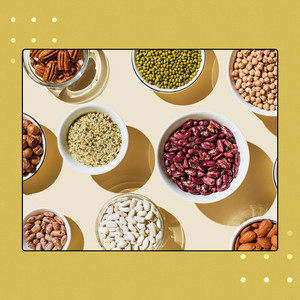
a variety of plant-based foods that are rich in fiber. So like sweet potatoes or avocados, very
rich in fiber, asparagus and artichoke, brown rice can help lentils and other beans, navy
beans, black beans, etc. Very high in fiber and not expensive at all. I mean, I eat lentils soup,
you know, at least half of the week. Do you count your fiber every day or periodically?
I do, but that's because I'm a little bit obsessed with fiber, but I don't think the average person
needs to at all. Really, if you're just sort of trying to eat a variety of plant-based foods,
you know, like fruits, vegetables, and obviously whole grains, legumes, like all of that can just
help you get closer to your goal. Yeah. What is the difference between soluble and insoluble fiber?
Because I feel like those terms are a little confusing and I'm not sure whether I need to be
keeping track. No, it was really thank you, do, for the average person who's got a million things
going on and isn't kind of a fanatic like I am. I don't think so. It's really easy to get really
in the weeds pretty fast when it comes to fiber, but basically soluble fiber means it can dissolve
in water, soluble fibers bind with water and kind of turn into this gel-like consistency that
slows digestion and that can be helpful, can lower glucose levels and blood cholesterol levels.
Again, like chia seeds, oak brand lentils, nuts and seeds, apples and pears have soluble fiber.
Insoluble fiber means it doesn't dissolve in water and that's helpful because it can help
food move through your digestive system and add bulk to your stool and help keep you regular
and prevent constipation. So you can think of foods like quinoa or brown rice, kale, walnuts,
that falls into that category and the thing that's important to remember is that different kinds
of plant foods have different kinds of fiber in them and they're all important to health in
different ways. So again, that's why you want to eat the rainbow. You know, eat lots of different
fruits and vegetables and whole grains, nuts and seeds and beans, just to make sure you're getting,
you know, a variety of fibers in your diet. Right. So is it ever a good idea to get fiber from
a supplement or a pill? Very good question. Every researcher I've spoken to told me your best bet
is to get fiber from a variety of plant-based foods. La la la la. I've said it a million times now.
And but that's really for a couple of reasons. One is, you know, when you eat fiber rich berries or
sweet potatoes, you're also getting all the vitamins and minerals and phytonutrients in those foods.
So not just the fibers, so they're good for you in multiple ways. But another reason is the
fiber used in supplements, it's been highly purified to simpler structure than the fiber that's
sort of bound up in complex structures naturally inside of plant foods. And so these simpler fibers
tend to get fermented faster by gut microbes. But that means they might not travel all the way
down the full length of your large intestine and feed the microbes there too. So basically,
they might not reach all the microbes that need it throughout your gut. That said, if you don't
get enough fiber, supplements are probably helpful. They just don't seem to be as helpful as
getting your fiber through plant-based foods. Yeah, I noticed too that like I was taking fiber
supplements for a while. And then once I realized how much fiber we needed today, I looked at the label
and it was like, I did take five capsules to get two grams of fiber. I was like, this is wild.
Like what is even in these? It was like caramel, mostly caramel coloring.
My advice is like eat a bowl of black bean soup. Right.
Right.
The lentils soup. Right. It's going to be tastier, hopefully.
Okay, so if you're someone who does not eat a lot of fiber right now, where do you start?
Because if you start really abruptly and crank it up, you could get gas and bloating and just like
gas or intestinal distress, right? Right.
Right. And I think that's a really important point. Like if you don't eat a lot of fiber,
I would definitely say the key is to start slowly. Just be very gradual about increasing your
fiber intake. So for instance, if you like to eat white bread, maybe the first week you're trying
to increase your intake, switch out one serving with whole grain bread. And the second, you know,
second week, do two servings until you've done all your servings a whole grain instead of white
bread. The other thing is drink lots of water because this can help the fiber bind. It prevents
it from hardening and try cooking vegetables or eating fruits without the skins or seeds that,
you know, can help make foods a little less likely to cause gas. One thing you might want to do
is if you're eating more foods with fiber and noticing gas, maybe take note of which foods cause
symptoms. You might want to adjust your diet. If you're particularly sensitive to something,
like for instance, I've said I'm a fiber fanatic, but I've realized I got to moderate my chia seed
intake. Like one tablespoon with my yogurt is fine, two tablespoons and I'm in trouble later.
That's just me personally, you know, totally. Yeah. And the other thing, you know, I find that
taking a walk after meals can also be helpful with gas and bloating discomfort. And so, yeah,
just moving a little bit afterward and it can help with digestion and help release some of that gas.
All right. Well, I'm, I'm like kind of pumped now to go eat fiber all day. Yay!
But like do it in moderation. All right. Well, thank you so much. This has been great.
It has been my pleasure as your official MPR of fiber fanatic.
For more life kit, check out our other episodes. We have one on how to handle constipation
and another on weightlifting. You can find those at npr.org slash life kit. And if you love life kit
and want even more subscribe to our newsletter at npr.org slash life kit newsletter.
Also, we love hearing from you. So if you have episode ideas or feedback you want to share,
email us at lifekit.npr.org.
This episode of life kit was produced by Claire Mauritian Eiter. It was edited by Sylvie Douglas.
Our visuals editor is back Harlan and our digital editor is Malika Gereb.
Megan Cain is our supervising editor and Beth Donovan is our executive producer.
Our production team also includes Andy Tagle and Margaret Sereno.
Engineering support comes from Neal T-Balt. I'm Mary Elcigara. Thanks for listening.
On weight weight, don't tell me we have very important people on our show and then ask them about
very unimportant things. Here's US Treasury Secretary Janet Yellen.
We are also reliably informed that among your enthusiasm in addition to a macroeconomic policy
is mobile games. There are some truth in that. There's some truth in that.
Join us for the NPR podcast that considers all the other things that's weight weight, don't tell me.
On the Ted Radio Hour, linguist Ann Kersan says she gets a lot of complaints about people
using the pronoun they to refer to one person. I sometimes get into arguments with people where
they will say to me, but it can't be singular and I will say, but it is. The history behind words
causing a lot of debate. That's on the Ted Radio Hour from NPR. With NPR Plus, there's more to
hear, like extended interviews with some of the experts we talked to at Planet Money and the
Indicator. It's a mistake for economists to only think about economic efficiency when considering
policies because you'll actually wind up with a worse outcome. And with NPR Plus, you help keep NPR
going. Learn more at plus.npr.org.