Well, we do have some firsthand accounts by conquistadors, including Hernán Cortés and Bernal Díaz de Castillo.
And they kept making comparisons to things of their known world around the Mediterranean.
And so they often equated Tenochtitlan to Venice because of all the canals.
Just to paint a picture, this episode, it's 1519.
the Spanish colonizers have finally summited the mountains that surround what's now Mexico City, and they are gobsmacked.
Tenochtitlan, which as Nikki said is where Mexico City sprawls today, it was so incredibly impressive that it kind of shook the Spanish idea of what was civilization, basically the notion that the Europeans were civilized and everyone else wasn't.
But Tenochtitlan shocked them with its grandeur and complexity.
And it was completely different from anything they'd ever seen before.
The other thing that was completely different, of course, was the food, what these people were eating and how they grew it.
And that's just what this episode of Gastropod is all about.
That's right. You're listening to Gastropod, the podcast that looks at food through the lens of science and history.
I'm Cynthia Kraber.
And I'm Nicola Twilley.
And this episode, we're taking a trip back in time to see how the Aztecs ate before there was any such thing as Mexican cuisine.
cuisine. Because Cynthia and I recently went on a reporting trip to Mexico City, and we couldn't help but wonder what it was like to be there before any Europeans had ever set foot in the region.
Unsurprisingly, what we really wanted to know was what were they eating?
And when you look at Mexico City today, it's a huge urban tangle of streets and cars and concrete, and it's surrounded by mountains.
So where did they grow all the food?
How did they feed themselves?
Without cows or sheep or chicken or pigs, what did they put at the center of the plate?
And how did they even survive without cheese?
Plus, can you still eat like an Aztec today?
This episode, we're going on a quest to find out.
It's a journey that involves lost flavors, salamanders with the secret of eternal youth, and some important lessons for the city's future.
Before we get started, we did want to ask a small favor of you.
We're planning for the future of Gastropod and we We want to hear from you to figure out how we can make our show better.
Plus, the information you provide will help us keep the show running.
It'll take you almost no time.
Just visit voxmedia .com slash survey to give us your feedback.
That's voxmedia .com slash survey.
Thanks. This episode was supported in part by the Alfred P.
Sloan Foundation for the Public Understanding of Science, Technology, and Economics.
Gastropod is part of the Vox Media Podcast Network in partnership with Eater.
Support for this show comes from Pure Leaf Iced Tea.
When you find yourself in the afternoon slump, you need the right thing to make you bounce back.
You need Pure Leaf Iced Tea.
It's real brewed tea made in a variety of bold flavors with just the right amount of naturally occurring caffeine.
You're left feeling refreshed and revitalized so you can be ready to take on what's next.
The next time you need to hit the reset button, grab a Pure Leaf Iced Tea.
Time for a tea break?
Time for a Pure Leaf.
Avoid your unfinished home projects because you're not sure where to start?
Thumbtack knows homes, so you don't have to.
Don't know the difference between matte paint finish and satin?
Or what that clunking sound from your dryer is?
With Thumbtack, you don't have to be a home pro.
You just have to hire one.
You can hire top -rated pros, see price estimates, and read reviews all on the app.
Download today. To understand why the Aztec people in Tenochtitlan ate what they ate, there are a couple of things you have to know about the ground on which Tenochtitlan was built.
One, it's in a basin, surrounded by really tall mountains, some of which are active volcanoes.
All the water drains into it and nothing flows out, so the bottom of the basin was really just a patchwork of lakes and swampy bits about two and a half times the size of the state of Rhode Island.
And two, this basin is is really, really high up.
Yeah, so, I mean, central Mexico, it is a mile and a half above sea level.
So it is a semi -arid climate.
David Carballo is professor of anthropology, archaeology, and Latin American studies at Boston University.
And even though water drains into the basin and does form lakes, it doesn't actually rain a lot in the basin itself.
It pretty much only rains during the rainy season, about five months a year.
I mean, 5 ,000 years ago, this was a huge valley with a lot of water.
that actually the water dries out in dry season and in rainy season the wetland is filled with water.
Luis Zambrano is a professor at the Institute of Biology at the National Autonomous University of Mexico.
Luis told us that it's not just that it was dry a lot of the year and really high up.
Occasionally the volcanoes would erupt, and as we've described, it was pretty swampy, so it doesn't sound like an ideal site for an incredibly large city that was also the home base of an empire.
Why we're established in a high altitude city that has a lot of earthquakes and sometimes it's really hot and sometimes it's really cold, etc., etc. And the reason why it's established here is because the hydrological system was highly productive and was really, really good for creating a civilization.
All that water was great to have around when it didn't rain for much of the year.
It's also why when the conquistadors first saw Tenochtitlan, a city built in the middle of a lake.
One of the only things they could think to compare it to was Venice.
Like Venice, it was crisscrossed with canals.
The canals were particularly helpful because there were no horses in Mesoamerica, there were no mules, there were no oxen, no large domesticated animals at all.
There's no wheeled transport, probably because there's no pack animals.
It just didn't make sense.
So everything is moving on foot.
But if you're in the Basin of Mexico with the lake system, you can go on canoes.
And so that actually really facilitated movement.
But the real edge that all that watery, swampy environment offered was that it's supercharged food production.
It helped to understand for the pre -Columbian people to see, oh, when the water comes, it came with a lot of mud and it fertilized everything.
And when the water retracts, then we can use the land in order to have production.
production. Also, that mud that made up the bottom of all the water and wetland area, it was super fertile because of the volcanoes.
Volcanic soil is full of nutrients that crops need.
And so over thousands of years, people migrated to the region and set up small towns on the edges of the lakes and on the islands.
And they eventually built bigger and bigger cities because the land could support a lot of people.
So this basin was always a hub for human habitation.
There were big settlements there long before Tenochtitlan.
One of those earlier settlements was called Teotihuacan and it was also one of the biggest cities in the world for its time.
If you go to Mexico City today, you can visit its very impressive ruins.
But Teotihuacan wasn't an Aztec city.
The Aztecs didn't show up in the basin until later and they probably didn't call themselves Aztecs at the time.
Nobody knows for sure where they actually came from.
They claim to have migrated from a mythical homeland, the Place of the Seven Caves.
There is this tradition, a narrative of having come, having migrated to central Mexico from somewhere else called Aztlan.
And so, you know, by definition, anyone who said that their ancestors came from Aztlan could be called Aztecs.
Now, one of those groups called themselves Mexica, and they're the ones who settled in this island in the center of Lake Texcoco.
Throughout this episode, we're calling these people Aztecs and Mexica sort of interchangeably, like all the experts we spoke to.
When the Mexica arrived in the region, they forged alliances with two other city -states in the basin.
And this trio, with the Mexica at their head, they created an empire that encompassed more than 400 towns and communities and more than 1 million people.
And they built an enormous capital city on an island in the middle of one of the basin's biggest lakes, Lake Texcoco.
Most of the earlier cities in the basin were built on the shores of the lake.
But this island city was different.
At first, it was only occasionally connected to the shores when waters receded.
But then the Mexica built up permanent causeways to their new capital.
And they covered the island in buildings to house their growing population.
Something on the order of maybe 150 ,000 to 250 ,000 people is what most experts agree on.
And so that would have been larger than any Spanish city.
Seville, Sevilla, would have been the largest one.
In 1519, when Cortes arrived in the New World, Seville's population was only about 40 ,000.
And then in Europe, Paris could have been approaching about a quarter of a million people.
The Spaniards described Tenochtitlan as a dream.
One of the soldiers with Cortes wrote about its great towers and buildings rising from the water.
And the city was so spacious and well built with beautiful stonework and cedarwood.
It even smelled great.
For them, it seemed very clean and sanitary.
And to the Mexica Aztecs, the Spanish seemed very dirty and they didn't bathe much compared to their own hygienic practices of the time.
Tenochtitlan was full of trees and flowers, all linked together with sparkling clean canals.
And at the center was a gigantic stepped pyramid with two temple buildings on top.
one of the two temples was dedicated to the ancestral god of the Mexica and the other was focused on worshiping the forces that truly made Tenochtitlan great so in their holiest of holies their greatest temple half was devoted to this storm water fertility agricultural god and half was related to this god that you know patron god of the Mexica as a people we've said that this basin was great because of the water and fertile soil and of course that's what the Mexica were worshiping at that temple But what really allowed the Aztec empire to grow exponentially, up to a quarter of a million people
in the city of Tenochtitlan and a million people in the basin itself, what made that possible were something called chinampas.
What are chinampas?
Chinampas are one of the best inventions from my point of view in terms of sustainability.
Making the chinampas is what eventually led to the Aztec population boom to a million people in the basin, where previously there had been a few hundred thousand, but there was this multifold increase in population because of chinampa agriculture.
So growing food in chinampas was clearly the secret to Aztec success.
But what exactly is a chinampa?
These days, chinampas often get called floating islands, but they weren't and aren't floating at all.
To get to know them, we have to go back to their origins, hundreds of years before the Aztecs got to the region.
Back then, there was a kind of proto -Chinampa.
These were small, raised mud islands people created in the shallower parts of the lake to plant their crops in.
And so that can just be as simple as sort of dredging up muck from these wetlands and piling up into mounds.
These proto -Chinampas were mostly in the southern part of the basin, where there were a lot of freshwater springs.
But they're incredibly productive because there's a few things that are happening.
One is that first you have this very rich lake muck that's very, you know, sort of organic soil for growing things.
Meanwhile, you're surrounded by the other thing crops need, water.
Normally, just relying on rain and at that altitude, you'd get one harvest per year.
Here is that you have two, three, four productions per year, all years alongside.
The people living in this southern part of the basin of mexico where they'd built all the mud pile proto chinampas for farming were called the xochimilcas and the mexica targeted them for takeover precisely because of this network of chinampas that was so productive the people of xochimilco had created the chinampas but the aztecs perfected the system so what were the aztec chinampas luis told us to picture a layer cake mud then dead plants then more mud piled on top then more dead plants and so on until you have And to avoid erosion, because it's very difficult to contain the mud, then they planted
willows. And these willows were really, really good for production too, because the roots help to the mud to stabilize all the island.
And the aerial part helped to reduce wind problems in terms of erosion.
The size of these mud islands was also important.
important. These Aztec chinampas were very skinny rectangles.
They were 80 to 100 feet long, but only 10 foot wide, because that way all the crop roots were close enough to the surrounding canals to suck in the water they needed so you didn't have to irrigate.
The Aztec farmers would use human earth to help fertilize new crops, but also every few years they would scoop out fresh mud from the fertile soil at the bottom of the canals and let it dry out some, and then use that to help replenish the fertility of those small islands.
It was a process, a continuous process of water, mud, and island that they used to produce large food production, basically.
What's more, the handy -dandy canals in between each chinampa were perfect for long, thin canoes to go back and forth, taking all these plentiful crops to market.
And as for what they were growing on those plots, it was largely based on what's called the milpa system.
You might have also heard this called the three sisters system.
Milpa is a particular type of culture which involves corn, well, maize, zucchini, chili, and beans.
And it creates a symbiotic relationship in the garden plot because maize sucks nitrogen from the soil and beans provide nitrogen to the soil.
And so they're sort of in balance.
And then squash have these sort of large leaves that allow the saplings of young maize plants shade so they grow better.
When you put all of them together, instead of having a competition between plants, they help each other to grow and to reduce pests.
So corn, squash and beans were the staples.
But chinampa farmers also grew lots of other crops, chilies and tomatoes and different greens to flavor the corn and beans, and other grains too, like amaranth and chia.
And the wetlands themselves were also full of animals like fish that the locals could eat.
In fact, the chinampa system made those animals even more abundant.
Yeah, that's the other thing that's the reason I said that this is a best technology for sustainability, because when you think that you have to create a land for food production, then normally the people think that you have to destroy the woods or destroy the wetland to have a flat land in order for having production.
Here, the creation of the island increased the heterogeneity of the water.
So because you have an island and then you have shallow areas and deeper areas and then you increase the amount of habitat for the aquatic animals and plants.
All kinds of edible aquatic animals and plants.
There were things most of us would recognize today like crayfish and ducks and other wild birds.
And other things that normally sound really, really strange, but they were very useful.
One of those was water bugs.
They were eaten and also their eggs were eaten.
The eggs were harvested from ropes that were in the water, and then those eggs were made into tamales that were wrapped in corn husks and cooked.
They supposedly tasted fishy like caviar.
Another big source of food from the wetlands was spirulina.
You might have heard of this edible bright green algae today.
You can get it in smoothies.
But the Mexica would scoop it up from the surface in nets, dry it out, and then shape it into small discs to age.
I haven't tried it like this.
It's hard to find today.
day, but the Spanish compared it favorably to cheese.
They also ate amphibians.
They ate frogs that lived in the wetlands.
And they ate a special amphibian that only lives in this particular wetland in the basin of Mexico and nowhere else in the world.
It's the axolotl. I mean, the axolotl was used very in terms of food.
It's really rich in fats and mussels.
So it's very good food, actually, source of proteins.
They're also a little odd as far as amphibians go.
The form is is really, really characteristic.
I mean, you can see that they are really, really ugly.
Hold up a minute. Luis is an axolotl expert, but on this point, he is wrong.
They are actually ridiculously, adorably cute.
And I am not alone in being an axolotl fan.
Luis said that all the cool kids are into axolotls these days.
Part of the reason they became very popular is because they have these gills that look like a crown.
They always have this eternal smile.
They are large. I mean, salamanders are normally small, but these are 30 centimeters length and chubby.
And normally when you see them in the water, they are calm, like a Buddhist monk.
They look really, really like they are meditating.
And you'll only see them in the water because a weird thing about axolotls is that they always keep their juvenile form.
Most amphibians live in the water when they're juveniles and then transform into their adult forms that live on land, like tadpoles that turn into frogs.
But axolotls are large, eternal, tadpole -like creatures, which is why they have that smile and crown and chubby body.
Which is very interesting for us, for biologists such as me, in terms of evolution.
I mean, in terms of understanding what is happening.
Biologists love axolotls.
I love axolotls. But the Aztecs literally worshipped them, as well as eating them.
They thought it was the representation of one of the most important gods.
And they had an important role in the creation of the world, basically.
there's an aztec legend about how one of the gods was supposed to sacrifice himself in the creation of the universe to make the sun rise and set but he refused he tried to escape he first transformed himself into a stock of corn and then a maguey plant it's the agave that's used to make tequila and mezcal and then finally he transformed into an axolotl at which point he was caught and sacrificed and so the universe could exist i don't believe in superfoods but if axolotls truly really created the universe, they might count.
Either way, supposedly they taste like eels, which sounds delicious.
And if that's not enough high -quality protein for you, the Mexica also had some land -based options.
Turkeys, a special breed of dog, and of course lots of insects.
Maguey worms and grasshoppers and ants are the best known.
Here in Mexico, we have a saying, if it crawls and moves, it goes into a pot.
This means that anything that crawls and moves, we're going to eat it.
All the insects were part of our diet since they gave us a lot of protein, like grasshoppers.
Roxana Larondo does outreach for the Herdez Foundation of Mexican Gastronomy.
And all that food that was grown and caught in the basin of Mexico?
It was a lot of food.
Just in terms of the staples that were grown on the chinampas, archaeologists and historians say it could have easily fed about half a million people.
That's just the farming side of it, not even taking into account foraging for insects and axolotls and catching ducks and turkeys.
But on top of that, the Mexica brought in foods from all over their empire.
Avocado is a big one that was grown in more lowland areas outside the basin.
It was carried up the mountains and into the city by porters.
A lot of the bulk foods came from relatively close by to central Mexico.
But some were mobilized as part of tax or tribute, and things that were more precious, like for instance cacao for chocolate, that can only be grown in tropical lowlands, and that would come at great distances.
Cacao was a particular favorite.
The Aztecs apparently hadn't even tasted it before they created this empire, but the cacao tribute became critical.
The Aztecs would regularly receive about 25 tons of cacao beans every year.
Cacao was extremely important to us, and not everyone had access to it, since it was the food of the gods.
Only the gods were offered cacao or the rulers or the priests were able to drink it.
Not everyone could get a hold of it, also because it functioned as currency.
Because the Mexica didn't have money or coins per se, But they did need something to use at the thriving markets where all this delicious food was being sold.
And then they took all these foods home and transformed them into what was an incredibly delicious and complex cuisine.
What their actual meals were like after the break.
Support for Gastropod comes in part from NetSuite.
If you run a business, times of economic uncertainty are scary.
And it's also when you really learn how to adapt.
You need the right tools to help you out with that, like NetSuite by Oracle.
It's the business management suite that more than 41 ,000 businesses trust. It's a cloud ERP, enterprise resource planning software, and it brings together all the parts of your business.
You can see your accounting, financial management, inventory, and HR all in one suite and one source of truth.
You get real -time forecasting with helpful data, so you can foresee issues and opportunities and actually do something about it for your business.
And NetSuite has AI embedded throughout, so you can automate a lot of those everyday tasks and let your team stay strategic.
So when your business gets stuck, NetSuite lets you have the full visibility and control you need to get unstuck.
If your revenues are at least in the seven figures, download the free ebook, Navigating Global Trade, Free Insights for Leaders at netsuite .com slash gastropod.
That's netsuite .com slash gastropod.
Support for this show comes from Pure Leaf Iced Tea.
You know that point in the afternoon when hit a wall.
You don't have time for self -care rituals or getting some fresh air, so maybe you grab a beverage to bring you back.
But somehow it doesn't do the trick, or it leaves you feeling even worse.
What you need is a quality break.
A tea break. And you can do that with pure leaf iced tea.
Real brewed tea made in a variety of bold and refreshing flavors with just the right amount of naturally occurring caffeine.
With a pure leaf iced tea in hand, you'll be left feeling feeling refreshed and revitalized with a new motivation to take on what's next.
The next time you need to hit the reset button, grab a Pure Leaf iced tea.
Time for a tea break, time for a Pure Leaf.
Fox Creative. This is advertiser content from Adobe.
As the chief marketing officer for a tech company, I lead a team that makes fresh content on a daily basis.
But this month has been particularly nuts because we're planning a conference.
There are dozens of people working together on all the documents, slides, posters, flyers, and merchandise.
Fortunately, our event marketer is the best in the business.
And she said two words.
Adobe Express. Adobe Express has been a lifesaver.
Brand kits have kept everything consistent.
Templates mean whatever content we need to create looks slick and professional from the start.
and easy syncing of assets means that anytime a change comes in, like a last -minute swap out of our new app logo, I know that every team member will instantly have access to the latest version.
That way I know when the curtain goes up...
Isn't that new logo gorgeous?
...everything will go off without a hitch. Adobe Express, the quick and easy app to create on -brand content.
Learn more at adobe .com slash express slash business.
When the Mexica would go shopping for food, they would often visit Tenochtitlan's sister city, a smaller town next door on the same island that had a huge market located right behind the temple plaza.
And that was the biggest marketplace of the Mesoamerican world.
That's the one they estimate maybe 60 ,000 people were buying and selling in every day.
A lot of trade was done by bartering, but like Roxana said, cacao beans also functioned as a kind of informal currency.
So for instance, one cacao bean would get you five chilies, or one tomato, or one prickly pear fruit, a tamale.
An avocado would cost you three cacao beans, and those are imported because those aren't grown right there.
A small rabbit would cost you 30 cacao beans.
And then when the shopper brought those chilies, tomatoes, rabbits, and avocado home, it was time to cook it up.
Roxana showed us a recreation in the museum of a Aztec kitchen.
It's a typical pre -Hispanic kitchen.
If you look closely, this one doesn't have a single piece of furniture, because at that time, we didn't have furniture.
We did everything at floor level.
In the middle of the room was a wood fire.
Often, a lot of foods that would be toasted would be cooked on a comal, so the sort of flat griddle, which in the pre -colonial period would be made of ceramics.
And to support that, you'd put three stones into the hearth.
So that would elevate the griddle from the direct source of heat.
And so that's seen as the fundamental sort of Mesoamerican cooking pattern.
And it's worked into cosmology like there were three hearthstones of creation.
Also in the kitchen, they had a two -part tool made of volcanic rock that was used to grind corn to make the dough for tortillas and everything else made of corn.
We'll be coming back to that because we're going to be doing an entire future episode all about corn.
The other important things were ceramic pots because everything that wasn't cooked on a comal was cooked in a pot.
I think a lot of Americans don't really appreciate how much at least central southern Mexican cooking is stew based.
And so a lot of it are stews with these really rich sauces.
So a lot of attention goes into all the ingredients that are creating these sauces or molis.
And that's where we, you know, the term guacamole just means avocado sauce.
They had all kinds of stews made with chilies and tomatoes and pumpkin seeds using different kinds of protein like fish or frogs or turkey, and then vegetables like greens or squash and in all different combinations and flavors.
Some of the best descriptions we have of these dishes come from the Spanish.
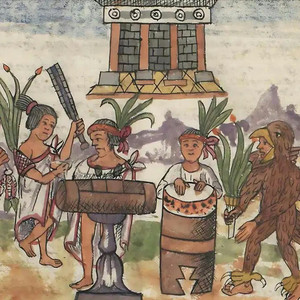
When Hernán Cortés and his men first arrived in Tenochtitlan, they were invited to magnificent feasts with Montezuma, who was the leader of the Aztec empire at the time.
And once again, the Spanish were a little stunned at how impressive everything was.
They wrote about the huge variety of dishes his cooks prepared, 300 dishes at a time, all kinds of stews and roast birds, all served with freshly made corn tortillas.
David told us that Montezuma not only had local fish from the canals at these feasts, But I even had fresh fish from the coast that was brought in by relay runners trading off to get it there before the fish went bad.
That was a serious flex. On the other hand, the peasants and the people who didn't have that social status, they only ate tortillas or maybe with some greens.
Because in Mexico, we have more than 500 species.
You would want to condiment them a little with different sauces or chili.
but then sort of what we might think of as lower -ranked proteins, like insects or small lake fish, things like that.
To be honest, even the peasant diet of tortillas, greens, and some hot sauce sounds pretty good.
But if I could time travel, I would definitely stop in at one of Montezuma's feasts.
Fortunately, the Herdez Foundation has a working kitchen, so they made a mini -feast just for us.
We headed to the kitchen to meet with Montserrat Castillejo.
She's a chef there.
And today we are going to make tortilla atole, and some figurines that were called suali in pre -Hispanic times.
These are based on amaranth flour, corn flour, and maguey honey.
Amaranth is a grain that's related to quinoa.
The young leaves of the plant make delicious greens, but the seeds are especially valuable.
They're smaller and rounder, but otherwise they look just like sesame seeds.
amaranth was known in pre -hispanic times as wildling it probably would have been the basis of our diet if corn hadn't existed and the amaranth plant gave us three resources which were the seeds the leaves the stems even the flowers we also use amaranth sprouts today amaranth seeds aren't eaten raw they can be cooked like quinoa into a kind of porridge but they're also popped and used like that with some crunch or they can be ground into a flour the popping is done using a clay comal people would add the amaranth seeds it's a bit like popcorn they would add them and they had a certain tool that's
like a little broom we would start turning this broom around the hot comal and the amaranth seeds start to burst Traditionally, boxes are placed on the sides.
Like across from where the cook is and two at the ends.
Because when you light the fire, you light the comal, the amaranth starts jumping all over the place.
So, they are like the little baskets that catch it.
Montserrat took a bunch of pre -popped amaranth seeds and mixed them first with ground corn.
I'm going to add the maguey honey.
Little by little, I'm going to make a paste.
Here I'm going to make the shape of a serpent, and you're going to feel the sticky texture.
That noise isn't sticking to our hands.
For normal everyday consumption, you'd just make this honey amaranth paste into little cakes, no corn flour, you'd maybe mix in some other dried fruit and then let them dry and solidify.
These still exist today.
It's a little candy called an alegría, which means joy.
Turning Amaranth into special figurines like this serpent, that was something done to honor the gods.
There are all sorts of different figurines to honor different gods, and there are different recipes, too.
When the Aztecs honored their main war god with an Amaranth figurine, they sometimes mixed in human blood.
When the Spanish arrived and heard about these types of recipes, that's where the prohibition of amaranth comes in.
It even carried the death penalty if someone consumed it.
The Spanish ban on eating amaranth lasted a few hundred years, which is probably a lot of why amaranth is way less important in Mexico today than it was in Aztec times.
Another thing that you can find today in Mexico, but it's not as popular as it was with the Mexicas.
It's a drink called atole, which comes from the Aztec Nahua language.
Atole has the word atl, which means water, and tole, which is the diminutive of masa.
Masa is the dough you use to make corn tortillas, and atole is one of the zillion and one ways to consume corn invented in Mesoamerica.
Even with atoles, there's a whole spectrum of different kinds.
You can make it from straight up masa, or you can let that dough ferment a little till you get an aged masa for a more funky atole.
And you can also flavor your atole with everything from chocolate to chili.
But Montserrat decided to make us a tortilla atole.
The recipe came from a book that included the original historical versions of these dishes.
It used to be made from toasted or burned tortillas, and these were pulverized.
And those recipes are very brief.
They tell you you need browned and crushed tortillas, Agave honey and water There are no proportions So Montserrat just had to make an educated guess And do some experimenting To come up with the recipe she made for us She set a pot of water to boil And grabbed a couple of already cooked tortillas She tore them up Into small pieces And then put a few pieces in the molcajete Which is a kind of pestle and mortar Let's listen to the sound Of the molcajete How the volcanic stones collide and we are going to create a paste once the water is hot i'm going to add it fast forward through a lot of very
laborious grinding and then diluting and heating and sieving and grinding and sieving again the process of making atole is long but half an an hour later, we finally had something to taste.
Montserrat told us that in the past, atole was considered more of a meal than a drink, and we could see why.
It's thick. It's a little bit grainy.
It's like drinking a kind of thinned porridge, but in a really lovely way.
Sounds bad, but let's see.
I mean, I will say aesthetics wise, it has something to be desired because it's like Like a gray, grayish, yellowish, watery.
You wouldn't give it prizes at a beauty contest. The smell is toasty.
Oh, funny. It's much tastier than I thought.
Weirdly, it doesn't taste super corny.
It doesn't have like a really intense corn flavor or even like a really intense tortilla flavor.
It's like lightly sweet, lightly grainy, kind of warming.
Like you feel like you are actually being fed food.
It just has water and tortillas and honey, so I was like, how can it be that good?
But actually, I mean, it's definitely it's a little like, OK, I like it's a watered down porridge, but in a very nourishing, delicious way.
After we each drank a glass of atole, Montserrat and her colleagues made us Aztec tacos.
macos. Some were filled with greens and beans, some were filled with squash blossoms, and some were filled with an incredibly delicious fungus that grows on corn.
It's called huitlacoche.
But the real star of the show was the salsa.
It was called salsa borracha, which literally means drunken sauce.
And it was made of chiles and tomatoes and pulque, which is a drink that's fermented from agave honey and is very slightly alcoholic.
Oh, it has a very sour fermented fermented flavor like from the pulque.
I mean it's a little spicy.
It's not super super spicy.
It has a very tangy flavor to it.
It's a very delicious condiment but get the word like salsa the way we think of it out of your head.
It's almost like a chutney in terms of tanginess.
Delish. And then the same way Montezuma concluded all of his feasts it was time for chocolate.
Growing up in England, my adventures in drinkable chocolate had been limited to the hot form, but we were served a cold chocolate -based beverage.
Obviously, cold chocolate is popular in America, and I've had more than my fair share of chocolate milk.
This was like chocolate milk without the milk.
Can I try some chocolate?
Yeah. Agua de cacao.
Agua de cacao. Here we go.
I'm very excited. I mean, what's not to love?
It's chocolate. It's delicious.
What I love about it is it doesn't feel as heavy and you don't have that kind of like intense creaminess.
So you really just get like the chocolate flavors.
Yeah, it's delicious.
You are so used to like creamy hot chocolate as a winter drink.
And this is like a perfect summer refreshing.
It's still got all the deliciousness of chocolate, but it doesn't have that heavy, fatty feeling on in your mouth.
It's really nice. Nice.
We didn't have the full 300 dishes Montezuma was used to, but we were full and, more importantly, very happy.
I personally love a little cheese in my tacos, so Europeans have brought something to the mix.
But Aztec food was straight up delicious.
The diet of the Aztecs was a little surprising to the Europeans.
They generally thought it was pretty tasty.
They liked the chocolate.
They thought the tortillas were great.
They were a little put off by all the spicy chiles, and they were a little skeptical of tomatoes.
But for a high -class European, someone who was used to thinking that meat should be at the center of the plate, the one thing that was really distinctive about the Aztec diet was that it wasn't meat -heavy at all.
The Mesoamerican diet, the pre -colonial Mesoamerican diet, was the most plant -based of all the sort of areas of global urban civilization developments.
Something Europeans didn't know at the time is that the way that Mesoamericans prepared corn for tortillas freed up a lot of nutrients in corn and they got plenty of protein from all those beans, so it was a really healthy diet.
Most of the time, thanks to the Chinampa system and tribute taxes, there was plenty of it, too.
There were drought years, of course.
You can see sometimes signs of nutritional stress that people might have gone through as children.
This often registers in the teeth where there's sort of interrupted growth lines and in some bones of the skeleton as well.
But overall, I mean, it's seen as a very nutritious diet, like it's balanced.
It has a mix of, you know, proteins and all the essential amino acids.
Certainly, the upper class had access to more meat like venison and turkeys and rabbits.
But even this baseline diet, the diet that most of the people ate, it was really healthy.
Like we said, it was largely tortillas and beans and vegetables and avocados.
You can basically subsist on that forever.
Like it would get boring after a while.
And so that's why you're making all these salsas and doing all these other innovative things to make cuisine a little bit different.
But, you know, that sort of is the backbone of a staple diet is very sustainable.
So far, so great. But obviously, in 1519, the Spanish arrived and things changed forever.
Did this healthy, sustainable and delicious food system survive the Spanish invasion?
Find out after this message from our sponsors.
Support for this show comes from Smartsheet.
Do you ever wonder how many times a day you toggle between different screens, applications, and windows on your computer?
Maybe 20 times? Okay, maybe 50 on a bad day?
Try 1 ,200 times a day in a single day.
Now, multiply that by all the days you work in a year, and that's 9 % of your time spent toggling.
That is so much wasted time simply clicking back and forth.
Imagine what you could do with all that extra time.
Smartsheet is here to help you take all that extra time back.
Smartsheet is the work management platform that helps your team remove roadblocks, ease friction, and cut those back and forth clicks down to a number that doesn't make your head hurt.
With tools that allow your team to manage their workflow all in one place, you'll spend less time toggling and more time driving results, fostering creativity, and scaling to new heights.
Smartsheet. Work with flow.
Learn more at Smartsheet .com slash Vox.
support for the show comes from mercury what if banking did more because to you it's more than an invoice it's your hard work becoming revenue it's more than a wire it's payroll for your team it's more than a deposit it's landing your fundraise the truth is banking can do more Mercury brings all the ways you use money into a single product that feels extraordinary to use.
Visit Mercury .com to join over 200 ,000 entrepreneurs who use Mercury to do more for their business.
Mercury. Banking that does more.
It's impossible to find more time in the day.
Until now. With HubSpot's suite of AI -powered tools, you can get more done way faster.
Speed up your lead generation.
and create attention -grabbing, lead -driving, quota -crushing campaigns in an instant, which will give you more than enough time to listen to podcasts like this one.
HubSpot. Impossible growth made impossibly easy.
Get started today at HubSpot .com slash AI.
So my vision of that was that the first 100 years were not so problematic.
I mean, after the conquest, the Spaniards didn't just leave their new territory completely alone to exist as it had beforehand.
One thing that changed, they brought over cows and pigs and sheep, and these ate up a lot of the vegetation and crushed some of the local crops and generally made a mess of it.
But the real problem was the water.
Remember, this entire city and its food system was built on a wetland.
He really carefully and ingeniously managed wetland.
But the Spanish had a much more European mindset.
They saw water as something to control rather than work with.
And this worldview started to change the Chinampas about a century after the Spaniards first showed up.
The first huge flood that they had was in 16 -something, 1605.
The Viceroy said, no, that's enough.
I don't want to have another problem like this.
And we started to dry out this because we don't like this.
The Spanish started to divert water.
They built some dams. They built a sewage system that flushed water out of the basin.
They didn't destroy the chinampa system, though.
There were still plenty left in the southern part of the city.
When the famous naturalist Alexander von Humboldt visited Mexico City in the very early 1800s, he marveled at the chinampas.
But he also saw that the whole system was threatened.
When you read Alexander von Humboldt's essays about Mexican valley, he said you will start to have problems in Templo's water if you are going in this direction.
Of course, no one listened to him.
And a century later, the problems he predicted eventually got too big to ignore.
By the early 1900s, Mexico City was running out of drinking water.
People had paved over so much of the wetlands, the natural springs weren't getting recharged, and the rivers flowing into the basin were drying up because so much of the forest had been cut down on the mountains around the city that it literally rained less.
So the government installed pumps for drinking water that withdrew groundwater and this started to dry out the wetland region to the south where all those great chinampas were still located in Xochimilco.
That was the first big hit.
The second huge moment that I think we started to really, really lost Xochimilco as a system was after the earthquake of 1985.
This was a huge quake, and downtown Mexico City was flattened.
So there was a huge migration of people from the center to the edges, and one of the preferred areas to live was Tochimilco.
So the urbanization process after 1985 in the area was huge.
And so they paved over a lot of the chinampas for housing.
You saw it when you're coming in the barrio de Xochimilco, the streets are so narrow because there used to be chinampas, no?
And that's, they were built, houses and everything.
This is Joanna Hernandez.
She was our guide to Xochimilco.
She works there as part of a team at a farming nonprofit called Arca Tierra.
And she and some of the rest of the team took us out in a boat to visit the chinampas.
We said that Mexico City is a huge concrete jungle, but actually within the city limits is this incredible and still quite large green space.
Right now, there's around 2 ,200 hectares of chinampas, all the systems of chinampas that exist. That is equivalent to 5 ,400 acres, which is like six times Central Park.
But before that, it was about around 20 ,000 hectares.
That's almost a 90 % loss from the original area.
As we headed out towards the farms that they work with, it wasn't particularly scenic.
There was a lot of trash in the water, and you could see that a lot of the chinampas that are still around today aren't being used to grow food.
It's really, really bad.
About 80 % of the chinampas are abandoned at this moment.
So what that means is, of the 10 % of the original pre -Hispanic chinampas that remain, only 20 % of them are being used for growing things.
The rest are either abandoned or used for recreation.
We paddled past a lot of football fields.
60 hectares of football and bars are there at this moment in Xochimilco.
Early on a weekday morning, it was pretty quiet, but those bars are hopping on the weekend.
end. Today, the chinampas aren't thought of as an incredibly diverse and important natural resource and a great place to grow food.
They're famous for being a place to go out with your friends on loud party boats.
Meanwhile, the chinampas themselves are different.
They're much bigger than the Aztec version, and because they're so much wider, they now have to be irrigated.
The people who work the remaining chinampa farms these days, they're called chinamparos.
They mostly grow lettuce and herbs and some greens and also flowers, and they mostly do so conventionally with chemical inputs, not using the Milpah system.
There's still water in the canals that remain, but instead of coming from underground freshwater springs, it's actually treated wastewater pumped from one of the city's sewage plants.
And that leads to other problems. Because the wastewater is a different temperature, it's harder for all those bugs and crayfish and axolotl that the Aztecs used to eat to survive.
As if all this isn't enough of a problem, the government introduced carp and tilapia into the canals as an extra food source for locals to fish in the 60s and 70s.
They didn't think that small crayfishes or small fishes or the proper axolotls were a protein source for local people.
So they said, no, they are not eating protein.
So let's fill with a lot of protein with carp and tilapia.
But those non -native fish eat bugs and axolotl tadpoles, and now those famous and even godlike axolotl are endangered.
Which no one realized until the government asked Luis to do a census of axolotls in 2004.
The first census in 1998 had showed that there were still quite a lot of axolotls per square kilometer, about 6 ,000.
Then Luis did his count.
The first census we did was in 2004 and they dropped from 6 ,000 to 1 ,000, so six -fold.
And then from 2000 to 2008, which was the largest, was from 1 ,000 to 100 per square kilometer.
So we made these projections that they started going to the extinction.
Luis laughs, but it's because of how alarmed he was and is.
Today, both the chinampas themselves and the creatures that live around them, the axolotls, they're on a downward spiral.
But Arca Tierra and Luis are both hoping to try to reverse that spiral and save the traditional Aztec system and all the biodiversity it supports.
Joana took us to one of Arca Tierra's chinampas.
They started to rehabilitate it for farming a couple of years ago.
It was abandoned like this.
The family that owns this, they used to have cattle until they didn't.
Arca Tierra runs a farm school to help train people who want to farm on the chinampas in a way that minimizes the use of pesticides and herbicides to help keep the water clean.
On this site, they had started farming by growing an herb garden.
Do you like epazote?
I haven't had it like a leaf like this, so we'll see.
I've had it, certainly.
Always in beans. Yeah.
Oh, it smells like epazote.
Yeah. Mmm, wow. It's good.
I could see this in a salad.
After nibbling on some tasty greens, we hopped back in the boat and paddled over to another of Arquetierra's chinampas.
They've been farming this one for a while, and Joanna gave us the tour, pointing out all the different types of greens, lots of squash and beets and amaranth, all sorts.
All the plants were very lush and healthy looking, but actually the thing we were struck by was all the creatures.
Are you distracted by all the butterflies and the birds?
There's a lizard doing push -ups up there.
That I don't see. Oh, there it is.
He's getting his reps in, and I applaud that effort.
We are really surrounded by wildlife here.
Arquetira raises money to rehabilitate chinampas and return them to farmland, they help train the next generation of farmers, and they bring local and international tourists to the area to demonstrate what they hope it could become again.
Joana says if the chinampas didn't exist as farmland, the entire ecosystem could disappear.
Only by sowing and consuming the foods from this area is how we can preserve this area.
Otherwise, if this weren't worked agriculturally, eventually the soil will be eroded.
And actually it's very high in salinity and the pH is hard to control.
So you need to add organic matter and add life in order for it to be alive and survive.
Luis started out caring exclusively about the axolotl.
So his initial focus a decade ago was just figuring out how to save that.
And we said, OK, we can create small refuges.
These refuges were protected spaces in the chinapas for the axolotls to live carefree.
They were surrounded by filters with native plants that would both keep out the tilapia and the carp to give the axolotl a chance to grow up.
And also the plants would help keep the water clean, too.
Then the water quality will increase.
And then the habitat will return to be the habitat that used to be 50, 60, 70 years ago.
So that was the first thing.
OK, it's feasible. I mean, it's possible to do that.
But the second part is the most complicated.
I mean, now you have the technology.
Who wants to do that?
Because the chinampas are owned by people.
This is where things always get tricky, the people part.
I mean, if you are in the middle of the Amazon with no people, it will be a little bit easier, not much more easier.
But here in the middle of a city with 22 million people that in a system that has been managed for 1 ,500 years, you have to work with people, which is not easy for a biologist because biologists normally work with plants and animals.
And the main people Luis has to work with are the people who farm the chinampas.
As we said, they mostly farm conventionally with lots of fertilizers and herbicides and pesticides.
As part of his restoration project these days, Luis helps them figure out how they can cut down on those chemicals to make the water cleaner for the axolotl.
He also showed them how to build these plant -based biofilters for their canals to create mini refuges.
But it turned out that the farmers thought they could design better ones themselves.
And they said, OK, let's try it.
And if it works, it works.
And every chinampero has a different filter, for example.
And they work. Luis is also in the process of creating a label that will help these chinamperos, who are trying to save the axolotl, get a higher price for their produce in the markets.
All of this sounds super positive, and in theory it would help save the chinampas, save the axolotl, and pretty much everything else besides.
But it is still really early days, and it's definitely an uphill struggle against urbanization and loss of traditional knowledge, and now also climate change.
But Joana thinks it is at least possible.
We could recover a lot of the chinampas if there was the willingness of people from the area, people in the government and maybe nonprofits are helping all each other to make the system work.
Colleagues of Luis at his university have done some calculations.
They say that even the remaining farms on the chinampas already provide around 15 to 20 percent of the veggies in the city.
And so certainly if they're mostly returned to farmland, the chinampa system could help feed Mexico City, at least in terms of greens.
And if the chinampas get restored, Luis thinks then the axolotl could also recover.
It could even recover enough to end up back on the menu again.
Oh, I hope so. I mean, it's the same optimistic vision that we can increase the amount of chinampas and increase the area of Xochimilco.
Yeah, I think that if we achieve that, then we will have enough axolotls to be in the menu of some restaurants.
I mean, we won't recover the five -lake system, obviously not, because we are 20 million people here.
But we can restore large portions of Xochimilco and expand part of the Xochimilco from the south to a little bit northern, for sure.
That said, these goals are still pretty far in the future.
Right now, most of the chinampas are not being farmed and the axolotls still haven't really started to rebound either.
Not at this moment.
I mean, I think that also there is a time lag.
Even if we had 100 refuge or 2 ,000 refuge, the recovery should be in five years, not at this moment.
But at this moment, we don't have time.
So, no, I am not expecting to be a recovery of the species in the next five years at least. It is a long road ahead, and it has been a long journey to get there, especially for Luis, who started out just caring about one weird kind of salamander and now has to figure out how to work with farmers and city officials and do marketing and business plans.
But he has a great vision for the future, and it's one that's rooted in the past. I would love to travel 100 years before Spanish came and travel in a canoe around Xochimilco.
I mean, when I am there in the early mornings or in the afternoons, I am in love.
don't get that email yet, you'll want to do so at gastropod .com support.
So you can find out why the axolotl are so critical to scientists who are trying to figure out how to help humans regrow limbs.
Also make sure to visit our website and our Instagram account.
We're gastropodcast on social because we have awesome photos, not just from our own feasting and chinampa adventures, but also reconstructions of what those gobsmacked conquistadors would have seen when they first caught sight of Tenochtitlan.
Thanks this episode to David Corbayo, Luis Zambrano, the team at the Herd's Museum, and to Joanna Hernandez.
You can find links to their research and their organizations at our website.
Also, we'd like to thank the folks who helped out with our voiceovers, Patricia Acosta and Maria Monica Ruiz, and a huge thanks to Rodrigo Perez -Ortega, who's a fantastic science journalist and gastropod fan based in Mexico City, and who was essential in helping us make this whole trip work.
Thanks to you all. And, of course, thank you, as always, to our our awesome producer, Claudia Geib.
We'll be back in two weeks with an episode inspired by your questions.
Stay tuned. Support for this show comes from Pure Leaf Iced Tea.
When you find yourself in the afternoon slump, you need the right thing to make you bounce back.
You need Pure Leaf Iced Tea.
It's real brewed tea made in a variety of bold flavors with just the right amount of naturally occurring caffeine.
You're left feeling refreshed and revitalized so you can be ready to take on what's next.
The next time you need to hit the reset button, grab a Pureleaf iced tea.
Time for a tea break.
Time for a Pureleaf.