Ted Audio Collective You're listening to Ted Talks Daily where we bring you new ideas to spark your curiosity every day.
I'm your host, Elise Hugh.
When we think about protecting workers from dangerous conditions, I first think of industrial accidents.
But these days, especially for farm workers, one of the most dangerous conditions to contend with is extreme heat.
Putting the humanity of farmers and farm workers first is at the heart of today's talk from farmer John S.
Farms and farm worker advocate, Herardo Reyes Chavez.
How they're keeping farm workers and our food safe is coming up after the break.
But please note that this episode contains some mature language.
And now our Ted Talk of the Day.
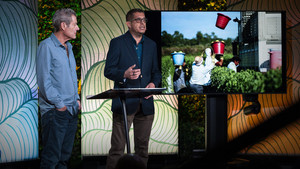
Well, Herardo and I are here today as a farmer and a farm worker to share with you how we turn decades of conflict into a collaborative partnership and positioned ourselves to meet the challenges of climate change.
Herardo, it's great to be here with you today in this air conditioned auditorium, not our normal workplaces in the fields of South Florida.
This place is definitely nice, John.
I'm really glad. But I'm really glad to be here today, especially because of what we are here to talk about.
You know, talking about what we have done to make sure that the fields are safer and more humane for workers, it's a very important thing to me personally.
Because when we first started our partnership 14 years ago, I was working harvesting water melons in northern part of the state in Florida, near Alabama.
When we were working there, I almost lost my best friend to heat.
I remember this as if it happened yesterday.
It was the beginning of summer before noon, but temperatures were already on the 90s.
So it was hot as hell. As farm workers, we were harvesting water melons and we usually do.
We were playing back and forward to not think about how hard the work was.
When suddenly my best friend, someone I consider my brother, collapsed in front of me unconscious and on moving, except for occasional spasms.
That was very scary for all of us.
We tried to call an ambulance.
Reception was limited.
We tried to call him as much as we could and protect him from the sun.
With our own shirt, we used water and placed that on top of him.
But those were very scary moments.
Locally, he came to once the ambulance arrived.
I went with him to the hospital.
There they said that he had severe dehydration and gave him an IV.
We were back with a crew within a few hours.
And the next day, we went back to work.
But the fear we all felt that day was all too real, too close and too personal.
That's why this conversation is so important to me.
Today, I'm proud to work with a coalition of immokali workers, or C.I.W.
A farm worker based human rights organization in immokali, Florida, that protects workers from dangerous and abusive conditions.
Our organization, I joined 25 years ago when I came to that United States to work in the fields.
For the next decade, we were organizing in a campaign for fur food, asking corporations to sign legally binding agreements that eventually led us to this collaboration.
But it wasn't until 2010, when we finally came together, farmers and farmers following nearly two decades of bitter conflict in a groundbreaking new human rights enforcement program called the Fair Food Program, or FFP.
In the 14 years since its inception, our program has leveraged the massive market power of 14 of the largest retail food corporations on the world.
To empower farm workers to identify problems and report them when they happen.
To protect workers and give the program's human rights standards real teeth, the FFP harness these massive market power of buyers and reward growers who respect the workers' rights.
The stop by from farms where workers were being mistreated.
With those new market incentives in place, the results were spectacular.
Before long, the worst abuses stopped altogether.
And the FFP program was called the best workplace environment in American agriculture on the front page of the New York Times.
Our program, among other things, keeps from workers safe from heat stress, where temperatures regularly climb well over 95 degrees.
We are speaking with you today because in 2022, we came up with comprehensive and enforceable standards with the plan for heat stress, illness prevention and response.
That was added into the FFP to protect workers from that heat.
Standards of Washington Post recently called America's strongest workplace heat rules.
But make no mistake. Conditions outside the Fair Food Program are still rough.
And a good day farm labor is hot, back breaking and dangerous work for too little pay or protection.
And on a bad day, workers' faiths outrageous abuses from waste theft and sexual harassment to force labor and heat stroke.
Why? Because workers are afraid of speaking up.
Because when they speak up, they will be fired or worst.
Fear of retaliation has kept many workers from speaking up in the face of gross exploitation and abuse for generations.
Farm workers like all outdoor workers are the canaries in our collective coal mine, as we face the growing real consequences of climate change.
We are to protect the most vulnerable workers, the most essential workers from the deadly heat and exploitation.
We need to change the relationship between workers and their employers.
We know the only way to do that is by collaborating together.
And now back to the episode.
Brother, I'm always in awe of your story and the distance we've traveled.
It's hard to imagine that our first cup of coffee 14 years ago led to this collaboration and this partnership.
Two hours are hanging out and we broke through decades of conflict.
But it always wasn't easy, wasn't it?
It was that easy at all. But I'm really glad we were able to sit at that table and talk when we started these conversations.
Two months of lawyers negotiating an NDA just so we could meet and there lies a problem.
An entire culture built up to keep employees and employers apart and us in them attitude that my friend Greg Asbed fondly calls our separate foxholes.
After that meeting, we boarded the same boat and started rowing together.
My path was different than her are those.
I grew up working in packing houses and farms as a kid and then later as a young man.
Along the way I developed the liking for booze and dope which led me deep into addiction, costing me my career, my family and very nearly my life.
After several years I was one of the fortunate and I found recovery.
In my early sobriety, I did the work required through the steps of alcoholics anonymous and it was that work and those lessons which opened my eyes to the world and helped me to understand the intentional blindness and deafness that I had been a part of.
To be clear, I'm a 61 year old guy who was once part of the problem and now I try to be part of the solution.
We're all guilty of this blindness, this blindness and this deafness.
One in this room asked before you came to the event whether this was a green building.
No, what? That's a question.
I know I didn't. What's powering these lights and the air conditioning and hearing the facts are we willing to do anything about it or do we just need it to work?
That's the blindness I'm referring to.
You know one of the best lessons I ever had was hearing that if I'm having a conversation with myself, I'm a very, very bad company.
This collaboration, who are though, keeps me from having those conversations by myself.
So thank you for that. In 2010, when we partnered, a lot of folks said we were crazy and maybe we were, I mean, farmers and farm workers together, coming together to ensure a fair and safe workplace.
That's nuts. Within a few months, the evidence was clear that the program worked and the culture on the farms was changing.
I want to share a quick story about what this is meant to my farms and operations.
In 2017, Hurricane Irma hits out Florida, came ripping through, destroying communities in its path.
Everything. Nothing was immune.
Whether it was fancy hotels on the beach, homes, businesses, the day after Irma hit the farm and hit all of South Florida with the businesses reeling and homes destroyed, our workers showed up at the farm the very next day wanting to know what needed to be done.
These are folks who lost their homes.
These are folks who didn't know where their next hot meal was going to come from.
We read about what the farm needed.
I need you all to take that in, because I'm getting chills right now with that memory.
That was a powerful day for us.
We had the evidence of this collaboration working.
But in that moment, it was very clear.
We were in the boat together and we were rowing together.
And that farm was everybody's farm and everybody's livelihood.
Within three days, that farm was cleaned up and replanted.
Weeks before power was restored to the general area.
That experience in the face of catastrophe proves the power of partnership to meet and prevail over any challenge.
So let's talk about challenges.
Folks of World Ain't Warming.
The world is hot. Just a couple of days ago, the general secretary of the United Nations said the world is on a highway to climate hell.
There's been reports that over the last 12 months, each of the last 12 months was the hottest month on record.
Pick any April. This April was the hottest month on record.
This is Pass May in Manatee County where one of my large farms is in Central Florida, recorded its hottest month on record in the midst of the spring harvest.
Temperatures were regularly above 90 degrees with heat indexes over 100.
Guess what? Our mandatory 10 minute breaks every two hours.
Our buddy system. Our supervisor and worker training.
Our unrestricted access to shade and cold water.
Our water infused with electrolytes.
Because guess what, folks?
The science says electrolytes helps replace what the body needs.
Those all worked. We kept people safe and tomatoes got picked.
You know, Harada, though, one of the most gratifying experiences to come from our partnership and the expansion is the expansion of the Fair Food Program.
And the interest in the model that comes from all over the world.
Some of my best days are spent talking to Scottish and Chilean fishermen who visited us with a desire to replicate what we've built for their unique challenges.
From tomatoes to flowers to seafood, we've created the basis for real and sustainable change.
Partnership and collaboration are the only hope we have if we're going to survive climate change.
So we all better get out of the fucking foxholes and get into the same boat and start rowing.
And by the way, we're going to need a bigger boat.
You're absolutely right, John.
Although it was a little hard to understand that delegation that came from Scotland.
But they were very lovely.
And we're really excited that these collaboration is ongoing.
And why can't I need a bigger boat, but we are also going to need more people on that boat with us?
Why? Because the Fair Food Program has become the blueprint for a 21st century human rights revolution.
This is a new model for human rights enforcement born in the fields of South Florida, once known as ground zero for modern day slavery.
That program is now being adapted to the garment sector in Bangladesh and Lesotho.
And it continues to grow in multiple industries across the globe in five continents so far.
Our work together is a testament.
The change is possible.
With room that transforming conflict into collaboration in other industries.
With these same model, empowering more workers to become the frontline monitors of their own rights, just like we did in the fields, doing that is going to help us create a more modern, more humane word for millions of workers across the globe.
I'm confident that if more people join in this with us, we can transform many realities.
And for all of that, for this opportunity, I want to say thank you.
Thank you. That was John S.
Forms and Herardo Reyes Chavez, speaking at Ted's Countdown Dilemma series on the Future of Food in 2024.
If you're curious about Ted's curation, find out more at Ted.com slash curation guidelines.
And that's it for today.
Ted Talks Daily is part of the Ted Audio Collective.
This episode was produced and edited by our team, Martha Estefanos, Oliver Friedman, Brian Green, Autumn Thompson, and Alejandra Salazar.
It was mixed by Christopher Faisy-Bogan, additional support from Emma Taubner, Daniela Balorezo, and Will Hennessey.
I'm Elise Hugh, I'll be back tomorrow with a fresh idea for your feed.
Thanks for listening.