Discussion keeps the world turning.
This is Roundtable.
You're listening to Roundtable with myself, He Young.
I'm joined by Steve Hatherly and Yushun in the studio.
Coming up, some college students say university life feels more disconnected than ever.
What if we could turn those familiar strangers into meaningful connections?
Let's explore how we can bring campus relationships back to life and need a boost to crush the week.
Our special segment, Motivational Monday, is your ultimate adrenaline shot to kick things off strong.
Our podcast listeners can find us at Roundtable China on Apple Podcast.
Got a question that's keeping you curious from social issues to tech and everything in between.
Let's take a stab at it.
I mean, us three on Roundtable.
Email us at roundtablepodcast at qq .com.
Emails are fine, but voice memos are always better because we're a radio show, after all, and also we do a podcast.
Now let's switch gears and talk about the familiar strangers on campus.
Remember the good old days when university life was all about forging meaningful, lifelong friendships, staying up late with roommates, and making lasting memories.
Fast forward to today, and something might have changed.
Some reports say students are living, studying, and even sharing the same space, but they're practically strangers to one another.
How did we go from songs about deskmates in the 1990s to describing each other as robot -like in their interactions.
Let's dive in and try to understand why we've become so disconnected and what we can do about it on campus.
There were songs from the 1990s about classmates.
Yeah. Okay. Could you say that is puppy love?
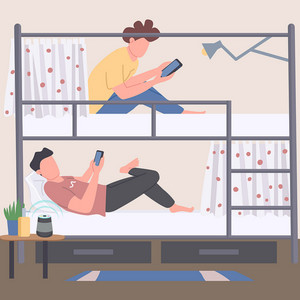
There's one about desk mates, another about staying on bunker beds.
Oh, yeah, yeah. I think that's still the reality for a lot of college students in China, usually has six people sharing one room.
And therefore you stay in bunk beds and you've become forever buddies, besties for life after those four years.
So now they're strangers?
I would say it is kind of a phenomenon that's referring to the thing that we're seeing right now.
it's increasingly alienated interpersonal relationships between university students and also between students and teachers you know despite their living and studying the same campus the same class or even the same dormitory there is a lack of communication and interaction and the relationships are cold
and distant resembling the most familiar strangers not like the songs that you said were saying, they even develop into romantic relationships with the people who sit next to you.
I guess this is maybe, I don't know, is this a post -COVID thing?
Don't think so? Is it just a sign of the times that people are focusing more on their studies than on the social aspect of university life?
I don't mean to point this thing out.
I know you've graduated for many years.
I have as well. And so is this something that people talk about in the West?
Like, you know, this relationship between classmates or just mates in university and how cold and distant it can be?
Well, I don't think we talk about it.
It's not something that's discussed, I guess, because we don't really pay attention to it so much.
But do you expect to have a whole lot of close friends since you're going to the same class?
No. And of the same year?
No. See, why is that?
Because here in China, I think the long assumption is that, oh, you'll make lifelong friends because you'll never get this chance to hang out with people the same age as you are and supposedly innocent.
Sure. And have so much time to have shared experience together.
Well, here's the kind of general thought process in Canada.
I can't speak to the United States, but in Canada, they say that it's a good idea to live on campus for at least your first year to live in the dorms.
Why? So that you can make some friends there.
Because university dormitories in Canada are quite social, I would say.
I met a lot of people there.
You live with strangers if you're not living in a single space, if you're sharing your space with others.
I lived with people that I didn't know, and I still know a couple of those guys today.
That's the dorm life.
going to class is a different experience because classes, university classes will often have, you know, what, 30, 40, 50 people in them.
And they don't live in the same dorm space sometimes that you do.
So you're just sitting there in the classroom.
And the class time, of course, is not a social time.
That's when you're studying.
So you don't make as many friends during the actual class times.
Maybe if you're put into group projects, something like that.
But generally, no. And it's not really expected that you're going to be socializing a lot there.
The reason I brought up the point about people say it's a good idea to live on the dorm for your first year and then maybe move off campus for your second year.
Well, like I said, the dorms are quite social.
And that can be a good thing, but it can also be a detriment to your studies as well.
It can be more difficult to study well when you're living in that highly social environment.
So that's kind of the general thought process.
And that's what I did.
I lived on campus for my first two years.
And then after that, I moved off campus nearby with a roommate and went and commuted to school every day.
It's quite, I think, similar here in China.
A lot of us, a university will suggest you to stay in the dormitory of the school for the first year.
And sometimes it's even mandatory for the first year.
And I have to say, I think I seem to have had this kind of experience of having familiar strangers in my class.
You know, first of all, most Chinese universities still have the concept of a class, meaning that, you know, for most of the compulsory courses, we attend them with a fixed group of classmates.
But even so, at least in my experience, there were some classmates that I hardly spoke to during my years at school.
So I might not even remember their names.
But there is a possibility that these are just a group of people that you don't constantly meet and you don't constantly talk to.
But they're just in the same class with you.
But I think that's all natural because they also have a group of people to talk to I have a group of people to talk to We don't necessarily need to, you know, we have to have some connection In that case then, what you've just portrayed doesn't sound like there's that much of a familiar stranger problem
I think so So I think the situation varies people to people And when you've got somebody who's quite sociable, like you should I find it difficult to imagine if he can't find a friend or make some friends hang out in the same room.
But I think the Chinese campus life is completely different to Steve's portrayal.
What might it be in Canada or in the UK where I went to university?
Because I think it's actually so much more difficult to make friends and have lasting relationships with people in the Western campus setting.
Like you said, because you don't necessarily, you don't have that many opportunities to really be with this bunch of people for a long period of time.
Usually you just go to class, go to lunch.
A couple of days a week you'll have that class, right?
Yeah, and then you just leave.
And then if you want to hang out with these people again, you have to make time for them to maybe join a study group or form, okay, let's just go to the pub together.
and hang out after school and go clubbing together, stuff like that.
And I had trouble to mingle with the cool group for some time.
And therefore, it was just almost impossible to make long -lasting, meaningful connections with those people.
And then you had to meet up with people.
Okay, let's go for a coffee.
And that was you making the effort.
But in China, it's a little bit more easier in theory because you have six people, usually six people staying in one dorm for four years.
There are exceptions when somebody leaves or, you know, rents a place outside of campus.
But for most people, you're kind of stuck with those people of six.
So at least you can form a relationship, good or bad, you know, fingers crossed.
Yeah, because that could be a good or bad thing.
But at least these six people you can have as your people.
And then you expand to, you know, the class, like you should mention, because there's a lot more activities in China with your class.
And it's usually of like 50 people.
Oh, class activities.
Yeah. Like like you.
It's more of like you guys are of a unit.
But in the West, you don't have the concept of this 50 people hanging out together.
It's usually, oh, the class of, let's say, 2024.
And that's like, OK, this year of people graduate in the same year.
But they don't they're not like always together.
Oh, absolutely. Rarely are they like together.
So. So, yeah, the organization of campus life is very different.
But what I find to be a little disheartening and also I have this memory of China.
People talking about, you know, your best buds are often these friendships are forged.
in university, but now a lot of young people are apparently not interested in forming these close connections.
And that's why this is a story because I was looking at this from a Western perspective thinking, what's the problem?
Why is this even an issue?
And now I understand that there was importance placed on that time in your life where this is your opportunity to make long -lasting friendships and bonds and socialize with small groups of people and large groups of people at the same time now now i understand it more well see you point to an interesting
angle of this discussion then uh you're maybe kind of implying that in the west maybe this is not such a big deal, then without it, it's not really a problem either.
Well, if it happens, it happens organically.
But it's not something that you go into the school year thinking like, OK, I have seven people that I need to meet this year.
Oh, who are you? OK, let's hang out there.
Check number one. We don't think about it just happens or it doesn't happen.
And we have some people that are really social.
We have other people that aren't social at all.
and it just whatever however it goes is how it goes and the thing is that with with all of these background that we've listed um some students when they even study together or live together in one dorm they prefer being alone or just um you know having their virtual communication with their online game
teammates or ai companions over face -to -face interactions with their classmates or when they're just in the dorm they play games or watch videos alone but not just have interactions with their roommates.
Why do you think this is happening?
I'm sorry to interrupt you because this is all very puzzling I think for a lot of folks.
Why is this happening?
I was also thinking about why.
If you don't have any conflicts with your roommates your relationship couldn't be like that or developing to like that at least because you are people you know living together and um from day to night you will have some conversation with them anyway so yeah inevitably but that's different from having
meaningful relationship like in 10 years time when you look back and or let's say you oh actually if you went to uh get your undergraduate degree together, if you get a degree from the same department or faculty, then in theory, in the future, your careers could be in a similar industry.
And then I remember some friends saying that once you're in your 30s, 40s, 50s, or whatnot, sometimes when you are in a true predicament in your career.
Some people still go back to their college mates who have also progressed in their careers for help.
And these become not only lifetime friends, but really the people you go to for help when you really need it.
But by the sound of this, hello, familiar strangers, it doesn't sound like those kind of relationships are forged the same way.
We're painting with a broad stroke here, aren't we, though?
We're just saying university life in general.
Maybe it varies from department to department.
Maybe if you do look at the engineering department from university one, two, three, then maybe you will find closer relationships happening because of the nature of the study, the opportunities to work in similar career paths or in the future.
Whereas if you're looking at, I don't know, the English literature department, where who knows what you're going to do in the future.
You may become a professor or a teacher or you may not.
Well, then maybe and you wouldn't be doing scientific experiments with each other.
Do you see my point?
So maybe the opportunity to become close wouldn't exist as much as it would from department to department.
And also people to people, because you should mention like, you know, for him, this isn't really that much of an issue.
But if you go online, there are also, you know, reports that paint a different picture.
Also, I'm just trying to understand the situation.
And I've graduated more than a decade ago.
What do I know about you people?
So feel free to tell Heian and say that you've completely missed the point.
All right. I'm OK in taking that.
I wonder if this is anything to do with how the Chinese educational system.
That's a big, big concept is evolving or has come to today's point in the sense that we all know that for the first 18 years of a young person's life, Gaokao is mostly the holy grail that they're aiming for.
And therefore, once they've graduated high school, they arrive in university and a lot of Chinese kids are burned out at 18.
And you treat your peers as competitors because it's such a competitive system that you've survived.
And therefore, gone are the innocent days when you're like, oh, I'm open to, you know, meeting friends, letting them see my flaws, I accept yours, and we can truly offer trust and become friends.
Instead, there's maybe this sense of, you're a competitor, and I don't want you to succeed.
And therefore, it's just a really complicated mindset.
And Professor Qian Lichun coined this term, or I call them egoistic thrusters or self -serving, sophisticated elites, maybe.
And then therefore, you know, it's just it might be quite transactional when they think of certain relationships, especially combined with this, you know, general climate that people have a lot of activities online.
And therefore, in real life, it's just not going well.
Okay. So if you combine that competitive nature of high school with screen time, online existence, social media, if students are graduating from high school where they've come from a very competitive environment where the focus isn't on making friends and being social and developing social skills, And
also they're worried about their online persona, their social media status, things like this.
Then when they finish the gaokao and then they get into university and expect to expect these students to all of a sudden just become super socialites, then that doesn't necessarily compute, does it?
I'm speculating here.
To your point as well, I'm trying to think of some answers.
Maybe that has something to do with it.
Also, I was thinking, as you said, people graduated from their high school and being in high school is more likely still have a mindset of being as a student.
And when you entered university, because university sometimes can be viewed as a small society, actually, and it is actually an environment for people to have that transitional mind.
and you can actually feel like being in a society itself where you need to start developing basic social skills while these might not be written in textbooks and they are certainly things we should and need to learn during our time in university and some students or some college students still have that kind
of a high school mindset or at the same time they're maybe being a little bit introverted And they don't like to be socializing a lot And then this could be the result of getting a little bit Or kind of isolated with their surrounding Is it a problem?
Does it need to be fixed?
Great question Like I said, when I looked at this story the first time I thought to myself, what's the issue?
This is how I attended university I'm okay I'm okay I had my friends You don't need to go to university and make 3 ,000 friends that you're going to keep forever.
That's not necessary.
I think if individual students are struggling with this, then it's a problem for that individual student.
But as a whole, I don't necessarily think so.
That's my initial reaction based upon what we've discussed.
But we still may have, you know, circumstances of students may have underdeveloped social skills and that prolonged isolation can result in poor, like interpersonal communication and making it harder for students to adapt to real world social settings, as we say, like working environments.
Hmm. So what can maybe the school do or individuals do if they want to be more sociable in the sense that maybe just making more friends?
Because I'm sure there are some people quietly in silence feeling that I don't really feel like I belong here and would be nice to have a person in my corner.
My university had a lot of extracurricular activities.
So I think it was twice a week in the evenings.
I played softball. In the middle of the campus, there was this huge football field, and we were allowed to play softball there.
There was a league, so you play against other quote -unquote teams.
And they were just different floors.
So you represented the floor in your dorm.
And that was a great way to make friends.
My point is the more extracurricular activities or programs that the university presents or makes available to students, then that's an outlet for kids to go and have fun in something that they're interested in and meet some people as well.
If those programs don't exist, then their options are very, very limited.
Not only like creating more these kind of activities.
Also, I think this is the point that we mentioned or we talked about before in previous discussions, creating third spaces for social connections, right?
the internet becomes more pervasive and modern society has seen a kind of shift where the concept of nearby or third places is gradually disappearing because you need to have an environment or a kind of atmosphere for students to create bonds or connections.
So to increase the third places in universities and measures can be taken like create open concept lounges and making space or just, you know, a lot of spaces like with like sofas or chairs and desks for students actually can chat.
It's not only about like canteens, also an actual space for them to have connections like that.
Yeah. And the key here is that it's free.
Right. Yeah. Yeah, when you're a student, then you don't have that much money to socialize.
Try zero. Yeah, exactly.
So I think that's a really good point.
And I'm thinking, see, I still don't think I've gotten truly to the bottom of it.
And I'm wondering what has disappeared in between people to people.
As an older person, when I look back, university is truly the last time in your life when you're not thinking about competition, money, or some of these really polluting, materialistic thoughts.
And it's so much more difficult to find friends, make friends at work.
So in the supposedly last days of Age of Innocence, why not try to find someone who can click with you for a long, long time?
Yeah, but you're making those comments with hindsight.
yes right you're able to look back and realize oh that was the golden opportunity was to make friends in a relatively stress -free environment yeah the opportunity to socialize the opportunity to find love if that's what you were interested in it's right there in front of you that's with hindsight i
don't think students who are in their first year of university are thinking oh this is the golden tie all the things that you just said because they can't have that perspective because they don't have the opportunity to look back so much of our knowledge as people as humans comes from retrospect yeah
right when we are able to look back five or ten years and go oh that was wonderful or that was terrible or I made that mistake or I did well there but in that moment it's hard to have that perspective yeah that's so true and that's why at the risk of sounding a million years old I'm still sharing that with you
and coming up next Motivational Monday Yuxun what do you have for us yeah this week's Motivational Monday actually comes from a very inspiring little comic that I came across called The Geometric Family.
I find several of its short strips quite interesting.
Sometimes we may feel that despite giving our best effort, success is not guaranteed.
So what's the point of trying then, especially when we're preparing for maybe exam or some important tests?
But we need to understand that life isn't multiplication.
It's not like if you multiply by zero at the end all of your previous efforts count for nothing life is more like addition even if a step only adds 0 .01 it still counts toward the final result so often what matters is the process and not the result um and whether it's you know there are times like like
this when we're feeling you know powerless helpless and like we need you know So but like we need saving.
But remember, the one who can and has saved you countless times is yourself, because the time when you're choosing to start the 100th attempt at losing weight or, you know, deciding to have a better version of yourself.
It is you to choose to, you know, open up to others and you to be happy.
So every time you look in the mirror, you are looking at the person who loves you most in the world.
Well said. Yes. And that brings us to the end of today's show.
Thank you so much, Steve Hatherly and Youshun, for joining the discussion.
I'm He Young. We will see you next time.