Hey you, it's me Carly Q.
Welcome back to your favorite secret podcast.
Today I went to the desert to check out a mysterious, oddly shaped phenomenon and let me tell you, it was full of surprises.
We've got bugs, fairies, strange circles and more.
So stick around. I'm Carly Q and this is Who When Wow Mystery Edition.
I'm a city in our business to recognize a few bugs you may not know.
Who When Wow made important inventions.
Who When Wow asked all the right questions.
History will never be the same.
When I got to the office this morning I was very eager to head right down to the basement.
And my hustle and bustle was not just for my love of the work.
No, I had an idea last night about this whole mystery letter situation.
I was desperate to start looking into it downstairs.
Perhaps you remember that I found an anonymous letter on my desk saying that someone was on to us.
They knew that Lewis and I were using the elevator to travel through time.
But I still have no idea who wrote it.
Who could have sent that letter?
And why? What do they want?
And why won't they just come out and ask for it to our faces?
But even though I didn't know who or why, I did have an idea about how they might have found out about us.
So when I got down to my desk, I told my rat friend Nibbles about it right away.
Do you think we've been bugged?
Yeah, you know, a bug, like a little surveillance device, a microphone or a camera or something.
In spy movies, they always call them bugs.
And yes, I may have watched a heart -stopping spy thriller in bed last night that gave me the idea.
I don't know where it would be.
That's the question.
But if someone did place a bug down here, that could be how they know what we're up to.
Exactly. Let's look around and see if we find anything.
We immediately started our search.
I looked in, under, and all around my desk, while Nibbles started on the walls and ceilings.
Nibbles, it's a regular safety.
But before we'd gotten very far, I'd been debating whether or not to tell Lewis about this, since I was sure he'd be dismissive or rude about it.
But when he walked in on me taking apart my keyboard, I decided to just come clean.
And to my surprise, Lewis, I think my office is bugged.
Huh, bugged. Not a bad theory.
He was actually kind of supportive.
But like, have you actually found anything yet?
Emphasis on kind of supportive.
Not yet, but I do have Nibbles on the case, too.
Weird to think someone could be spying on us right now.
Hey, if you're listening to us, this was all Carly's idea.
She made me come along.
Lewis, stop that. I'm totally kidding.
Sort of. We can just make yourself useful.
Why don't you help us?
Lewis helped me finish checking the office, and just as we gave it the all clear.
A new time's a file!
Event 2022. And a mid desert, Africa.
Fairy circles. Fairy circles?
What an utterly delightful concept.
You know what they are?
Well, no, but sounds fun.
I pulled out H dad my handheld digital assistance device.
Thank you for pressing the power button.
And plugged in the clues from the file.
2022 Namib desert, fairy circles.
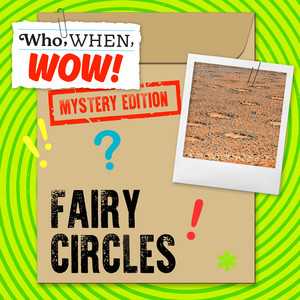
Fairy circles, also known as arid grass formation, are barren spots in the desert where no plants grow.
Found in the Namib desert of southern Africa, these circles are typically seven to forty feet in diameter and ringed by grass along their outer edge.
Okay. So, bad lawn care in the desert.
Why is this a thing?
Fairy circles are similar, but distinct from fairy rings, which are round patterns of mushrooms found in forests.
Okay, so these fairies are busy.
Scientists have yet to conclusively prove what causes fairy circles and continue to debate various hypotheses, such as analyzing.
I mean, obviously they're caused by fairies, right?
Otherwise, what? Maybe the desert just has little bald spots like my grandpa, or if it really isn't fairies, then, well then it's got to be aliens, right?
Maybe aliens? Pretending to be fairies!
Okay, I'm pretty sure you're mocking me, Louis, but it's actually an incredible theory.
Seriously? Yes, whatever.
I have a surveillance sweep, AKA Bug Hunt, AKA the great debugging of the basement to complete, so unless you're gonna keep helping...
Yeah, I'm gonna go.
And, ahem, I won't be back anytime soon, so don't plan on seeing me at lunchtime for any kind of adventure.
Just, you know, maybe for...
Louis winked at me.
Book, pleb. He was using code words in case we were bugged.
It was thrilling. After Louis left, Nibbles and I got back to our search, but between a slew of distractions and me having to get some actual work done, we didn't get very far.
Nibbles told me she's not a big fan of the desert, so she offered to stay here during lunch to keep up the bug hunt and just then, I grabbed HDad and we took off for the elevator.
A very licious mystery set in the sand dunes of Africa.
Ever heard of fairy circles?
Baron Spots in the Namib Desert?
Nailed it! How does she always know?
Because she is the OG time -traveling master.
Odie, any idea what causes these fairy circles?
Let me see the file on your HDad.
Oh yes, I do remember hearing about this.
Unfortunately, the time seal on this event will prevent me from sending you to 2022.
But there were other dates on the file, right?
Indeed. It looks like I can send you to 10 years earlier when scientists at the research station were working to identify the cause of the fairy circles.
Great. Then let's remember our time travel rules.
No changing the past, be back by the end of lunchtime and...
Pack an extra pair of socks in case your first pair gets sandy.
Bring lots of sunscreen.
Yes, yes. And also water.
You're going to the desert, don't forget it.
Ooh, good call Odie.
I'm bringing my extra canteen.
Then just remember you do.
Light doesn't always make right.
Wait, what? Okay, here you go.
Stay hydrated. What does light have to do with anything?
Hey grown -ups, Mindy here from Wow in the World.
And let me tell you, Carly Q and I are so excited to make it Wow in New York City, I mean New York and San Francisco with our new live show, Make It Wow, presented by Audible.
There's more to imagine when you listen.
And apparently you're excited too because our San Francisco performance is filling up and our New York City performance is almost sold out.
So we're adding even more Wow with a second show for New York City.
Grown -ups, get your tickets today at Tinkercast .com slash events.
That's Tinkercast .com slash events.
That's it. We'll see you there.
Looks like we made it.
At least I think we did.
Is this Africa? I'll take that as a yes.
And wow, is it hot?
Glad we brought some extra water.
I'm already parched.
Whoa, whoa, easy. Don't drink at all.
We were just outside of a research station, a few small buildings huddled together on an open stretch of desert.
But this wasn't any normal desert.
As far as the eye could see, the terrain was dotted with what had to be fairy circles.
It was like a whole sheet of polka dots extending far off into the distance.
It looked like an alien landscape from outer space.
We walked around to the front of the main building, just as a pair of scientists were coming out.
Hello there. Hello.
Who are you two? Oh, this must be the documentary filmmakers auto coming to make a film about the fairy circles.
Yeah. Ah, yep. That's us.
We are professional documentary filmmakers here to get some footage for the very professional documentary film we are making.
Excellent. Wait, where are your cameras?
Oh, we left them back at the camera shop.
Yeah, yeah. They're getting fixed.
They needed a tune up.
You know how it is.
All the sand out here getting in the camera gears.
So much sand, so many gears.
Okay. Well, you would probably like to hear about our research.
Yes. My colleague Stephanie and I are here with a group of scientists studying what causes the fairy circles.
Right. And is it fairies?
Ah, the currier, the American woman is very funny.
Stephanie. Such jokes.
We love jokes. The answer is no.
It is not fairies. We believe it is termites.
Termites? Termites.
Here, we can show you.
They led us out into the sand dunes away from the station.
Our team is led by Dr.
Norbert Jurgens and the college based at the University of Hamburg in Germany.
He's back here right now, but we don't need him to show you our termites.
Follow us. Oh, boy.
We've only been walking for five minutes and I've never been so hot in my life.
Yeah. My water's almost gone already.
How did that happen?
We were maybe a quarter mile out into the desert when we arrived at a large fairy circle.
There was grass and some other shrubs growing all around it, but all the growth stopped at the hard edge of the circle.
Here we are. These are the fairy circles.
Okay. These circles look totally fake.
They look man -made.
They do, but if you look closely you will see that they are actually termites made.
We got down on our knees to have a closer look.
Sure enough, there in the sand were little brown spots moving about to and from.
It looks like a whole little world.
Send termites to be precise.
According to our theory, these termites damage the roots of the grasses that grow in the circles after it rains.
This makes the plants outside the circles grow more, which the termites then feed off of.
These termites are creating their own ecosystem, much like your North American beavers use dams to engineer their local rivers and waterways.
So the termites are just busy little beavers shaping their environment to provide more food?
That's our theory, yes.
Aww, look, this one likes me.
You can introduce him to your friend, the rat.
Yeah, maybe I will.
One of the termites had crawled into my hand.
The termites are not always so friendly to newcomers.
Ah, what can I say?
I am very welcoming.
So that's it then? It's definitely termites causing the fairy circles.
There are some other possible explanations.
Poisonous gases, noxious bushes, fungi.
All of these could be killing the plants that would otherwise grow inside the circles, but we are focused on the termites.
We found them at almost every fairy circle we've studied.
Oh, my termites running away.
It's a bug, Carli. It's just living its life.
Hello, head Roman. There, how are you going?
Sorry, I've just become kind of attached.
Lewis, come on. Lewis came after me as I chased the termite across the sand.
Come here! What's the plan here?
Take it home as a pet?
Maybe. Don't you want to come back and be my roommate?
What about the fairy circles?
Do you think these scientists are right that the termites are causing them?
Because these circles are so perfectly round.
I can't even draw one that good, and I'm the top student in my art therapy for actress class.
I'm not sure. I guess their theory seems a little complicated.
I mean, couldn't the explanation just be as simple as water?
Right. This is the desert.
Water is kind of key out here.
Exactly. Maybe it's not termites.
Maybe the plants surrounding the circles just soaked up all the water.
That actually makes sense.
Yeah. Oh, there he is!
I lunged into the sand and caught the termite in my closed hands.
I think I'll call you Terry.
Terry the termite. Oh, you're a good little termite, aren't you?
Oh, yes, you are Mr.
Terry the termite. Alright, Terry, Carly.
Miss Terry, with an eye.
Where are we? Uh, what?
I looked up, and sure enough, I had no idea where we were.
I don't see the German scientists anywhere, or the research station.
Is it back on the other side of that sand dune?
We hustled back the way we thought we came, but after 15 minutes, we still didn't see the station.
Carly, are we lost in the desert?
Of course not. We have H -Dad.
H -Dad, any chance you can guide us back to the station?
Negative. Location sensors not calibrated from the desert.
You are lost. Carly!
Thirsty! It's gonna be okay.
I think. Uh, let's go this way.
H -Dad, have you at least finished analyzing that data yet?
Affirmative. In 2013, Dr.
Yurhen published a paper advocating for the termite theory, which was a major contender for explaining the fairy circle phenomenon until 2022.
Right, the time seal.
What happened in 2022?
A paper was published with a new theory that was much more widely accepted.
It claimed fairy circles were caused by an effect called water stress.
Plants create the circles themselves.
They leave empty spaces in order to save water and maximize their chances of survival.
Wait, so I was right?
It really is all about the water?
Affirmative. The study found that after rainstorms, the roots of the plants just outside the circles create a vacuum effect, transferring water from the middle of the circles outward.
Like when you open your office window in winter and the warm air totally rushes out and everyone yells at you.
I mean, water! Affirmative.
Minus the cranky co -workers, of course.
So what about all the termites?
The 2022 paper claims that no termites were present at any of their study sites, and there was no evident termite damage to the vegetation.
So I was right, too!
Just because termites are sometimes present at the fairy circles, it doesn't actually mean they are causing them.
Nice, we are getting good at this.
Well, I'm sure glad we got that all cleared up before we die out here in the desert.
H -Dad, are you sure you can't navigate us back to the research station?
Negative. Navigation service is inoperable, but I would suggest using the elevator key fob button.
There's a key fob button?
The elevator! I'm so glad we aren't lost forever out here!
I used way too much moisturizer to die from dehydration!
It's too ironic! Here it is!
Oh, what a relief! I kneeled down and kissed the ground if it wasn't, you know, incoming message from FUDHEAD HQ.
A sentence FUDHEAD is for you.
Five minutes until the end of Fucho Mango Macaroni's east day.
And remember, upset tummies will not be a valid excuse for leaving Earth.
Definitely time to go!
Welcome back, you two!
How was the desert?
Pretty good! Other than almost getting lost in the desert and dying of thirst.
Oh no! Terry, the termite's gone!
We must have jumped off before we got back in the elevator.
Now, I know you weren't planning on bringing a termite from the past back into the office.
Uh, psh, no! I would never do that!
What? No? Good. Now, tell me about these scientists studying the circles.
Well, as it turns out, the scientists were wrong and I was right.
Excuse me? Fine. Carly was right, too.
Termites were not the cause of the fairy circles.
The alternative theory from 2022 was about water stress and seems much more accurate, even if it's not 100 % certain.
Wait a minute. Termite!
Ter -mite? Mite doesn't always make right.
That's what you meant!
Of course! You didn't mean mite like strength, you meant mite like termite, M -I -T -E, because the scientists ended up being wrong about their termite theory.
It's true. Bugs are very easy to blame, but not everything is their fault.
And besides, sometimes the true answer is staring you right in the face.
Like the water! Exactly.
All right, you two, back to work.
Have a pleasant rest of your day.
Louis, I'm proud of us for both being right, and I'm proud of us for me for being a little more right.
Well, I don't think that's right.
Well, ouch! Louis walked me back to my desk where we found nibbles waiting for us.
Well, speaking of bugs, nibbles, did you find anything?
You searched this place up and down, checked every light fixture, every desk drawer, everywhere, and you didn't find a thing?
Well, how about that?
Maybe we aren't being bugged.
Yeah, that's starting to make more sense.
Most of your conversations are about pie anyway.
Not super interesting!
Okay, I mean, well, it's definitely interesting.
And with that, it was back to work.
What a day! I searched for bugs, made friends with a bug, lost a bug, didn't find any bugs.
Lots of bugging going on, but not the kind that spies on you.
Looks like we'll have to come up with another theory.
The search for the mystery letter writer continues.
Until then, this is Carly Q signing off.
And remember, you never heard this.
Grownups! If you like Who Went Wow, you can listen early and ad -free right now on Wundery Plus.
Join Wundery Plus in the Wundery app or Wundery Kids Plus on Apple Podcasts.
Prime members can listen ad -free on Amazon Music.
And before you go, tell us about yourself by filling out a short survey at wundery .com slash survey.
HDAD initiating end credits mode.
Who Went Wow Mystery Edition is an original Tinkercast production with help from GZM shows.
Handshake emoji. High five emoji.
For Tinkercast, the executive producers are Guy Ross, Mindy Thomas, and Meredith Halpern -Ranzer.
The shows are written by Aaron Weissman, Susan Muwati -Darrage, and Tom Van Kalken.
The head writer for Tinkercast is Kenny Curtis and Carly Shiraki is a producing consultant.
Big shout -outs to the rest of the Tinkercast team, including Jed Anderson, Jessica Bodie, Rebecca Caban, Natasha Crandall, Lizzy Freilich, Kristen Jang, Twi Mac, Erica Medina, Henry Moskle, Jody Nussbaum, Ali Paxima, Linda Rothenberg, Steph Sosa, Tyler Thall, Joanna Weber, and Anna Zegorski.
Megaphone emoji. Applause emoji.
The Who Went Well theme song was composed and performed by The Pop -Ups.
For more information on their three -time Grammy -nominated All Ages music, find them at thepopups .com.
Producers for GZM shows are David Kreizmann, Ben Strauss, Chris Terry, Amy Cervini, and Claire McClanahan.
The production manager is Sharon Michaels.
Sound design and editing for Who Went Well Mystery Edition is done by Chris Terry and Oded Levaree.
Headphones emoji, microphone emoji, thumbs up emoji.
Original music was created by Jennifer Roacamp.
Voice editing is by Yoni Rekim.
And voice direction is handled by David Kreizmann and Amy Cervini.
And voice direction is handled by David Kreizmann and Amy Cervini.
Our main cast features Carly Shiraki as Carly Q, Brandon Salerno as Lewis, Melissa Vanderschiff as Nibbles the Rat, Kenny Curtis as H -Dad, and Angel Desai as Odie.
Help support Who Went Well by becoming a member of the World Organization of Wowsers and discover Wows all year long.
Sign up today at tinkercast .com slash membership.
You can also subscribe to our YouTube channel at tinkercast .com slash YouTube for full -length episodes of Who Went Wow Mystery Edition.
And reach out to us at hello at tinkercast .com if you have a mystery you would like butthead to investigate.
H -Dad, powering off.
Peace sign emoji. Music Who Went Wow was made by Tinkercast and sent to you by Wondery.
Shh. I'm sorry. GCM shows.
Imagination amplified.