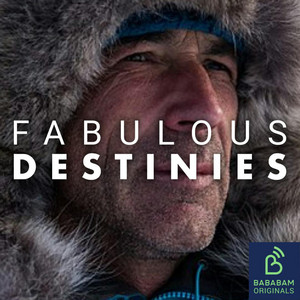
Hello everyone, this is Fabrice and today I'm going to talk to you about an extreme explorer.
He has sailed around the world 15 times, climbed the highest peaks, traveled over 40 ,000 kilometers around the equator and even explored the north and south poles.
He has led all of his expeditions alone, facing nature head on.
And despite all of this, he continues to push himself and dreams of going even further.
His name is Mike Horn.
Through mountains and oceans, discover his fabulous destiny.
From a young age, Mike Horn realized he wasn't like the other boys, in the 1970s, sitting on school benches in Johannesburg, South Africa.
He grew impatient. It's not that he hated school, it's just that he felt better outside in the midst of nature that fascinated him so much.
He watched Commandant Jacques Cousteau's films dozens of times and dreamt of exploring the world on a boat, just like him.
He even tried to ask the famous sailor to hire him as a cabin boy.
Unfortunately, his letter would never receive a response.
No matter, he would embark on his own adventure.
His first feat came at the age of eight when he cycled 300 kilometers to his uncle's farm.
Even though he engaged in various sports, rugby, cricket, trekking field, tennis, cycling, thanks to his father, a professional rugby player, everyone was amazed by this achievement.
At the age of 20, after serving for two years in the South African Special Forces, he returned to civilian life and completed his studies.
His uncle then offered him a small job in his vegetable import -export company.
It was far from being the great adventure, yet it was there that Mike would open up to the world.
He patiently saved money until he made an exceptional move by selling a large shipment of cabbage at three times its price.
Now at the age of 24, he had a big house, a comfortable life, and a lot of money.
But he didn't know what to do with it, and more importantly, he was bored.
It was time for a change of life.
One evening, he invited all his friends not only to party but also to give them everything he had.
He even asked his sister a notary to prepare the paperwork to make things official.
The next morning, after a great farewell party, all he had left were a few clothes, a backpack with only the bare essentials, and a small stack of bills in his pocket.
He went to the airport and had to choose a destination.
Due to the embargo in South Africa, he only had three options, Israel, England, or Switzerland.
The next flight was to Zurich.
So off to Switzerland it was.
A new life begins, but it doesn't turn out to be as smooth as he imagined.
Mike struggles to find work and has to take on odd jobs.
Fortunately, he's a jack of all trades who adapts quickly.
He becomes a river guard, then a ski instructor, a bartender, lomajat, and a great picker.
Eventually, after a few months, he leaves Zurich and settles in the Vo Alps in Chateau Decks.
Not only does he find stable work there, but he also meets Cathy, whom he quickly falls in love with.
He tells her about his dreams of great adventure, and together they decide to leave everything behind and explore the world.
Starting in 1991, Mike Horne embarks on his first major adventures.
He explores a part of the Andes Mountains by rafting and paragliding, and then climbs two other Andean peaks over 6 ,000 meters high.
Even though he has brushed with death, he had only one desire, to start over and go further.
And precisely because of his initial accomplishments, the young adventurer was selected to join a group of athletes, sponsored by a brand that had only one goal, to constantly push the boundaries of what is possible.
With this new partnership, Mike could pursue adventures without worrying about funding.
Descending Montblanc on a bodyboard, setting a world record for waterfall hugger speed jumping and improved form of bodyboarding with a 22 -liter jump in Costa Rica, and hydro speeding down the world's deepest canyon in Peru.
In 1997, Mike aimed higher.
Breaking record is rewarding, but what he truly wanted was to live in nature to discover places where no one had been before.
He embarked on this first expedition.
After exploring various parts of South America, he would finally fulfill his childhood dream, solo descent on the Amazon River, without assistance, without motorized vehicles.
The challenge seemed insane, but he was confident he would succeed.
For that, he first had to climb Mount Mismee at an altitude of 5 ,800 meters, a 600 -kilometer high to reach the spring of the river.
Once at the summit, he launched himself on his hydro speed, which became his home, covering a distance of 6 ,700 kilometers.
He spent 10 days without leaving the water, fishing and hunting in the jungle.
After almost six months, he could taste the salt of the water and realized he had reached the mouth of the Atlantic Ocean.
He had just crossed South America from west to east, and yet, he was already thinking about what comes next.
Yes, because the taste of salt plunged him into a sense of melancholy.
He felt that the adventure was already over, and that he would return to his normal life, where nothing was unknown to him.
He wished he could continue straight ahead without looking back, and swim and walk without stopping.
For over a year, he prepared for his next expedition, the one that would make him known worldwide.
Precisely because he would circumnavigate the globe, following the equator line, once again alone and without motorized transportation.
The project, named Latitude Zero, was divided into several stages to complete the approximately 40 ,000 kilometers that would bring him back to his starting point.
On June 2nd, 1999, Mike departed from Libreville, Gabon, to cross the Atlantic on his 8 -meter tramaran.
It was the first time he set sail alone, but there was no fear in his face, only a hint of sadness for leaving his wife and two young daughters behind.
He was already far away, excited to encounter the unknown once again.
During the first four days at sea, he didn't sleep.
As he approached the islands of São Tomé and Principe, he finally allowed himself some rest.
However, he woke up four hours later, just in time to avoid cliffs.
He had a big scare, and realized that the adventure could quickly come to an end.
After only 19 days, he arrived on the Brazilian coast.
His team took care of transporting his boat to the other side of the continent, and his family was there to cheer him on.
But he quickly set off for a new stage, the longest and probably the riskiest one, as he would cross the Amazon rainforest.
After a few kilometers on established trails, he disappeared into the foliage and darkness.
By canoe or on foot, he traveled through swamps, rivers and forests, alongside crocodiles, snakes, monkeys, iguanas and parrots.
It was hot and humid, with rare but torrential rains.
It took him five months to emerge from the jungle, which reminded him of the insignificance of humans, in the face of nature, as he stated in his documentary, Latitude Zero.
It's so far, the world's so big.
Starting in 1991, Micorn embarked on his first major adventures.
Upon reaching Colombia, he found himself back in civilization, and felt like an alien.
Adding to that, the atmosphere was tense due to gorillas and drug traffickers.
They warned the adventurer, who was just a stranger to them, that he could cross the river, but if he set foot on land, they would kill him.
Luckily, Micor arrived safely and now had the simple task of crossing the Andes.
He reached Quito, Ecuador, where his team and his wife awaited him, providing assistance even from a distance, resolving diplomatic and logistical issues, and cheering him on through their thoughts alone.
In December, Micorn left South America to cross the Pacific, still aboard his sailboat.
This leg of the adventure lasted 79 days and brought him to Indonesia, where he explored on foot and on bicycle, before embarking on the most challenging part of his journey, crossing the Indian Ocean.
The adventure was set to conclude in Africa, but not without obstacles.
First, Mic faced a violent storm in the middle of Lake Victoria, aboard a canoe ill -suited for such strong currents.
Then, in the Congo, he received death threats from soldiers, who mistook him for a spy.
Held at gunpoint, he was saved by policemen, who punished a soldier's excessive zeal.
By beating him to death, run in front of Mic.
Despite all this, after 18 months, he reached the end of his journey.
What he remembers most from his voyage are those intensely emotional moments, after spending days and days alone in the wilderness, reaching the summit of a mountain, finally seeing the shore, reuniting with loved ones, enjoying a hot meal, conversing with strangers, biking a few meters accompanied
by those he encountered.
Exhausted, yet invigorated.
Thanks to this highly publicized feat, he received the award for Sportsman of the Year, 2001.
The organizers had to fetch him from Greenland, where he was on an expedition to present him with the trophy.
But an award is not enough to satisfy his thirst for adventure.
In 2002, Mic set off on a new world tour named Arctos, this time following the Arctic Circle.
The change of scenery was drastic, temperatures dropped to minus 60 degrees Celsius, there was strong wind and icebergs dotted the ocean.
He was alone amidst silence and cold.
Yet for him, it was not about survival, it was a privilege.
Snug in his tent, he reveled in being where few had ventured before him, marveling in nature in those unique moments.
Unfortunately due to the thin ice, he had to detour 1200 kilometers.
He completed his second world tour in 808 days.
In the 2000s, he embarked on multiple expeditions to the north and south poles and climbed the great Himalayan peaks.
He then embarked on another world tour aboard his sailboat, Pangea, named after the supercontinent that once existed on Earth.
He aimed to connect the five continents to launch the Young Explorer program, an expedition where he invited dozens of young people to accompany him and implement ecological and social projects following his motto, Explore, Learn, Act.
If this makes you feel better, the incredible Mike Horn has also experienced failures.
Sometimes he had to give up due to weather conditions.
He almost lost a friend during an expedition and he was even repatriated due to an injury, but nothing stops him.
While he has always been fascinated by the unknown, by the beauty and dangers of nature, today he continues to explore the world also for his wife.
After her passing in 2015 from cancer, he contemplated giving up his dreams and even joining her.
However, she asked him to keep on living, for both of them, and for their daughters Annika and Jessica.
Today, Mike Horn remains one of the greatest adventurers in the world.
He ventures into the most extreme regions to conduct research on climate change, survival techniques and more.
He shares his expeditions, anecdotes and advice on his YouTube channel.
So, if like Mike, you believe that each day should be lived to the fullest, and if you want to embark on wild expeditions, pay close attention to his advice.
Thanks for watching, and I'll see you in the next one.