Valentine's Day is coming up and the perfect gift for the NPR lover in your life is waiting at the NPR Shop.
From cozy sweaters and mugs made for slow mornings to our tiny desk hoodie, there's something for every NPR fan.
Each purchase supports public media and the journalism you love.
Find something meaningful at shopnpr.org.
You're listening to Shortwave from NPR.
This Friday, the Olympic cauldron will be lit, signaling the start of the Winter Games in Italy.
We will see figure skating, ice hockey, and, of course, the sliding sports.
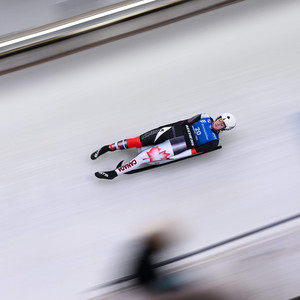
Bobsled luge and its sister sport skeleton, where you slide down the ice track headfirst, going up to 80, sometimes 90 miles per hour.
To me, it felt like the closest thing you could get to flying.
It was like a roller coaster that you could control.
But then on the bad days, it felt like a minute of a car crash.
Aaliyah Snyder was a competitive skeleton athlete.
The sport gave her a huge adrenaline rush.
But there was something else, too.
Some runs left her feeling shaky afterwards, disoriented.
Then it became more clear over the course of the day that I would have trouble concentrating.
I would be feeling more nauseous.
I would just kind of feel more irritable, have trouble with lights, things like that.
And she was told back then, don't worry, it's normal.
Oh, you know, everybody's kind of a little bit concussed all the time.
But nowadays, there is a term for the symptoms that can follow a really shaky or high G-force run.
And that term is sled head.
The dizziness nausea, exhaustion and cognitive problems that eventually damaged Aaliyah's brain and body.
My head didn't tolerate the vibrational forces.
And I just kept training through a lot of symptoms that I kept accumulating the more time I spent on the track.
I probably ended with Around six concussions that I was really not able to compete at all.
Like I had to be medically retired.
I was advised to stop because I was just not recovering from smaller and smaller hits on the track.
And she was far from alone.
Throughout the history of the sliding sports, many bobsled and skeleton athletes have struggled with sled head.
But a lack of research meant the medical community didn't have good answers on how Aaliyah could treat her symptoms.
So that's where I decided to go into neuropsychology and focus my career on those types of questions.
Now a neuropsychologist at the University of Florida and UCLA.
Aaliyah is among a handful of scientists who want to get to the bottom of what is going on with sliding athletes and their brains.
Sled head is something athletes talk about, but researchers found they're not always telling their coaches about it.
They wouldn't tell the coaching team or the medical team for fear of being excluded from the next training day and potentially overlooked for the team.
That was a disincentive to that player to tell anybody it was happening.
Peter McCarthy is a neurophysiologist at the University of South Wales and the Durban Institute of Technology.
And he says to truly protect athletes' brains, it may be the sport that needs to change.
So today on the show shining a light on sled head, how the impact of bobsled and skeleton on athletes' brain health has been under-researched for years, and what science is needed to make the sport safer for all.
I'm Emily Kwong, and you're listening to ShoreWave, the science podcast from NPR.
This year's Grammys featured historic wins for Bad Bunny and Kendrick Lamar, lavish performances and occasional chaos.
And it was a night of speeches that reflected this moment in America.
Listen to a recap on Pop Culture Happy Hour in the NPR app or wherever you get your podcasts.
This is Tanya Mosley, co-host of Fresh Air.
You'll see your favorite actors, directors, and comedians on late-night TV shows or YouTube.
But what you get with Fresh Air is a deep dive.
Spend some quality time with people like Billie Eilish Questlove, Ariana Grande, Stephen Colbert and so many more.
We ask questions you won't hear asked anywhere else.
Listen to the Fresh Air podcast from NPR and WHYY.
Okay, just for a second here, I want to talk about g-forces.
Sliding athletes are experiencing really high g-forces when they go around those turns, especially at the elite level like in the Olympics.
Gravitational force attracts objects to other objects.
For us walking around on Earth, the acceleration due to gravity is 1 g.
But say you're in a car going around a curve.
People in the car feel their velocity changing.
Acceleration.
And that feels like an intense force.
More intense than the pull of Earth's gravity keeping you stuck to Earth.
And it is.
It's more than 1G.
Roller coasters can give you over 5Gs.
And bobsledding can go just as high on those turns.
In skeleton, the intense G forces and positioning can cause the athlete's heads to hit the ice.
And Peter McCarthy says all of this can be really rough on the body.
The consequence of that in that you've got soft brain tissue hitting an accelerating skull.
So the brain basically squidges up against the skull.
And remember, as Aaliyah Snyder says, the brain is the central command system of the body.
Yeah, the brain is tethered as well in the brainstem.
So it's not just the impact to the skull, but there is the stretching forces.
Like You have a set point as the brain goes into the spine and the rotation from that as well.
And in those moments when athletes are experiencing those G-forces, helmets can protect against some damage, but they can't protect the brain moving within the skull.
That can cause a concussion or subconcussive impacts.
And to study the vibration that athletes are experiencing on the sled, Peter built a special sensor for their helmets.
He told us how it works and why it matters.
Yeah, we put little sort of three-axis devices inside the helmet, on the back of the person and so on.
And that's how we were able to tell when the head was going in one direction and the body was going in another.
But basically, you pick up a range of frequencies.
There's some quite low ones, but majority are below 50 hertz, 50 shakes a second, in a sense.
And the problem with it is that the lower frequencies allow more movement to transmit through to the system.
What are you planning to do with the data?
We reported the findings to the International Bobsleigh Skeleton Medical Committee.
Right, and they're part of the international group that administers the sport, the International Bobsleigh and Skeleton Federation.
Yeah, because I wanted to alert people to the potential risk to the athletes.
But again, it's unquantified.
At the moment, this is not fully known.
There isn't a ton of published research, but you both have been a part of an effort to create that body of work.
And Aaliyah, you work in a clinic now as part of the UF Health Interdisciplinary TBI program.
And you work with sliding athletes who have injuries.
They are sent to your clinic for evaluation, for treatment.
What have you seen sled head do to the brains and bodies of your patients over time?
There's a wide range of how sled head can look.
And, you know, I think sled head is a useful term for discussing kind of the phenomenon broadly.
Less useful individually, because what our athletes are experiencing is kind of a combination of the specific type of sport that they're in whether it's bobsled or skeleton, but also what their position is, what their medical history is.
But what we're seeing is that for some athletes after I'll speak for some bobsled athletes after they have One pretty good concussion or TBI from a particularly bad crash.
Traumatic brain injury, TBI.
Yes, a traumatic brain injury.
That there seemed to be showing some reduced tolerance to those stress forces on the track.
And one of the things that my research and our clinical experience we're interested in is the role of the autonomic nervous system.
What that is is the kind of automatic regulation, the subtle changes that your body and brain are doing all the time.
Your brain is the central control unit for that.
So that could be, you know, those really small changes in pupil size in response to light.
It can be changes in your heart rate as you breathe, breathing patterns.
All of that are making microscopic level changes and macroscopic level changes at all time.
And that carefully choreographed relationship between your nervous system branches has heavily involved in cognition, emotional regulation and physical symptoms.
And so what we're seeing for some of these bobsled athletes is that they'll have a big injury, and then they will start to tolerate the large, high G-force curves less well.
So start to either feel like they're losing consciousness in a couple cases, kind of more susceptible to these broad non-specific headache fatigue irritability, attentional difficulties afterwards.
You're saying this is more of like a subtle disconnect in your body's responses over time.
Kind of yeah, a wear and tear on the accuracy and kind of tolerability of the nervous system to stressors.
And I use stressors, not just cognitive or emotional stressors, but any type of thing that your body is having to adjust to, which can even be like standing up.
And there's other factors as well.
One of the people I've looked at in the past that had a concussion, and when the eyes were closed on this individual, there was a noticeable head shake, like they were trying to find something.
It was an uncontrollable one, which was exacerbated, made much worse by doing some runs.
And this is why there needs to be a recognition within the system, because if you're treating a person who wants to go back as an athlete and recover, they need to be given sufficient time to actually recover.
Yeah.
What it sounds like medically is happening is the sub-concussive injury like that initial insult to the body is a problem.
It's not great.
But the deeper problem is that the athlete is not then taken off the track and allowed to recover.
And that leads to like this cascade of effects.
Is that right?
Or is that what you theorize?
You know, I think one of the issues is that we talk about concussion as all or nothing.
We're trying to extend the discussion to subconcussive.
But that also comes to this idea of what do we do afterwards?
And part of recognition is also the idea that it can be better, that this is not necessarily a retirement, or everything's fine or you have to retire, kind of decision.
The brain is always changing in positive and negative ways.
We can leverage that, we can do cognitive training, we can do physiological training, we can do autonomic re-regulation training, but it doesn't abide by the rules that we typically think of the push through it mindset.
So there's not just like one medication we can do or develop.
We have to think of it as a living organism, that that is biological but also responds to a lot of other types of inputs cognitive emotional physiological, behavioral.
We need to take all of that into consideration when we're rehabilitating someone, and it is possible.
It sounds like there is hope, you're saying, for these athletes, and things can be done.
Peter, what do you wish the International Bobsleigh and Skeleton Federation would do?
You've spoken to that body, to their medical committee.
Well, I think the key with it is this.
I'm a great believer that athletes want to compete and they will suffer to compete.
Everybody who's ever played a sport will quite happily play that sport injured, if it means they've got a chance to win.
And I think the problem there is you cannot rely on anybody to actually observe and say time out, come here.
You need to have an objective measurement.
And that's why I feel there needs to be some recognition sensors, something in place to actually record what's going on.
If you were to wear an exposure meter and say you've had sufficient for this week, go and have a rest.
You can get higher performance.
You can do all of these things.
But it's recognizing and putting a structure in place to actually protect the athlete.
That is Aaliyah Snyder and Peter McCarthy.
Thank you both so so much for sharing this enormous amount of information what we know and what we don't and really centering the athlete's well-being.
Thanks so much, Emily.
It was a pleasure.
Yeah, thank you, Emily.
And a final note here we reached out multiple times to the International Bobsleigh and Skeleton Federation, USA Bobsled Skeleton, the British Bobsleigh and Skeleton Association and Bobsleigh, Canada Skeleton for comment on how they're trying to address Sledhead.
And they didn't get back to us before publishing.
If you liked this episode, follow us on the NPR app or wherever else you get your podcasts.
That way, you never miss another one.
This episode was produced by Rachel Carlson and edited by our showrunner, Rebecca Ramirez.
Tyler Jones checked the facts.
Jimmy Keeley was the audio engineer.
I'm Emily Kwong.
Thank you for listening to Shortwave from NPR.
See you next time.
On NPR's Wildcard podcast, Oprah on the art of being alone.
Are you good at being alone?
Oh, my God.
I'm a master at it.
Tell me more.
I cherish it.
I revel in it.
I can't wait to be alone.
Watch or listen to that Wildcard conversation on the NPR app or on YouTube at NPR Wildcard.
Venezuela, Iran, Greenland.
We bring you on-the-ground reporting from around the globe in just a few minutes every weekday.
Listen to State of the World on the NPR app or wherever you get your podcasts.