This message comes from Greenlight.
Ready to start talking to your kids about financial literacy?
Meet Greenlight, the debit card and money app that teaches kids and teens how to earn, save, spend wisely, and invest. Start your risk -free trial at Greenlight .com slash NPR.
You're listening to Short Wave from NPR.
Hey Short Waivers. Regina Barbour here to tell you about a treasure hunt.
Though, not the treasure you may be expecting.
Yeah, almost certainly not.
Ari Daniels, you're a science reporter and you're bringing us the story which took place like a year and a half ago, right?
Yes. OK, so set the scene for us.
Right. OK, so that's when this Brazilian neuroscientist I met named Camila Sosa gets the call she's been waiting for.
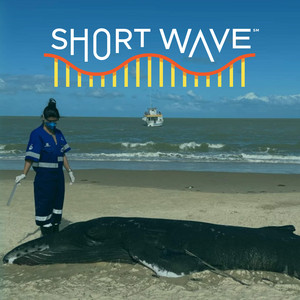
A baby humpback whale is adrift just offshore in the waters off southeastern Brazil.
It's just dying. And she wants its brain.
It's like Alice in Wonderland.
Give me the hat. Oh, no. I went from sad to like now I'm just surprised.
She wants the brain?
What? I know, I know.
But there are some really important reasons to study the brains of whales and dolphins.
And I will get to that.
Okay, I trust you. Great.
I'm glad. But first let me finish telling you what happened to that baby humpback.
Okay, deal. By the time Camila and her colleagues arrive on the scene by boat, the whale has washed ashore on a tiny island.
And they have a problem.
They can only get so close without running aground.
You look at the situation and you say, okay, I need it.
I'll get this whale no matter what.
And then I didn't have time to think.
You just have to go.
So Camila grabs her scalpel and saw and swims to shore.
She swims? She swims. she really wants that brain.
Wow. She gets to the beach, and she's totally soaked.
But she whips out her tools, and after a couple of hours, she manages to extract the fresh, intact brain from the recently deceased whale.
Whoa! She is elated.
It was the first extraction of a whale brain here in Brazil.
Camila brings it back to her lab, where it joins the ranks of what she says has become the largest collection of whale and dolphin brains in all of Latin America.
So today on the show, why this early career neuroscientist is going to all the trouble of getting her hands on so many whale and dolphin brains.
And how she's recruiting a new generation of Brazilian researchers to roll up their sleeves to join her.
I'm Regina Barber. I'm R .A.
Daniel. And you're listening to Shortwave, the science podcast from NPR.
This message comes from Charles Schwab.
When it comes to managing your wealth, Schwab gives you more choices, like full -service wealth management and advice when you need it.
You can also invest on your own and trade on thinkorswim.
Visit Schwab .com to learn more.
Support for NPR and the following message come from Edward Jones.
What does it mean to live a rich life?
It means brave first leaps, tearful goodbyes and everything in between.
With over a hundred years of experience navigating the ups and downs of the market and of life, your Edward Jones Financial Advisor will be there to help you move ahead with confidence, because with all you've done to find your rich, they'll do all they can to help you keep enjoying it.
Edward Jones, Member SIPC.
This message comes from Charles Schwab.
When it comes to managing your wealth, Schwab gives you more choices.
Like full -service wealth management, and advice when you need it.
You can also invest on your own and trade on thinkorswim.
Visit Schwab .com to learn more.
Okay. All right. Now that we're back, clear something up for me.
Like, does Camila have to swim to shore every time she wants a brain?
No. Usually, the brains come to her at the Orca Institute.
That was where I met up with of Kamila in mid -December.
She was bedecked in marine mammal jewelry, dolphin earrings, a whale bracelet, you get the idea.
That's adorable. Cause people know that I like dolphins.
The Orca Institute is a conservation organization outside of Vitoria in southeastern Brazil, where before recently taking time off for a short fellowship at Oxford, Kamila worked as the scientific director.
The morning I was there, a van had just pulled in.
So there's a van with a special delivery?
I would say yes, it's a dolphin that's stranded on the beach. The Orca Institute tends to any marine mammal that strands itself along its section of the coast and either rehabilitates and returns it to the water if it's alive or as is the case with this recently deceased Guiana dolphin being hoisted into the air brings it back to their facility to figure out what might have gone wrong.
We are going to analyze all the organs of this animal and to investigate the cause of the death.
With an eye towards preventing similar deaths in the future.
Ah, ok, I mean, when these dolphins and marine mammals get stranded, do the scientists know why that happens, Ari?
Well, one of the vets told me that often the animals become entangled with fishing gear, or they suspect loud underwater noises might cause the animals to surface too quickly.
The staff here rotates through a daily on -call schedule because an animal can strand pretty much any time.
But for Camila, these animals are a means to an end.
Those brains, right?
Yes. I think about the brain.
You think about the brain.
It's something she's been fascinated by ever since she was little.
And here's why she thinks brains are so important to study.
See, I knew it, I knew I could trust you, we're there now.
True to my word. Camila says there's actually very little known about the brains of whales and dolphins living in the waters off Central and South America.
But mapping how those brains are wired up can teach scientists about the inner workings of these animals, about their behavior, and how they're adapted to living underwater.
Plus, dolphins have Alzheimer's, encephalitis, meningitis, so it's an opportunity to understand diseases that can also affect humans.
Really Alzheimer's, that's fascinating.
It's still early days of confirming the disease Regina, but yes, there have been signs of the hallmarks of Alzheimer's in certain dolphins.
So for all these reasons Camilla is intent on gathering and studying the brains of cetaceans.
Cetaceans is that a word for whales and dolphins that I don't know.
Yes, yes. Okay. And now you know it.
Now I do, you're teaching me so much today.
I do what I can. So back to Camilla, she's collecting and gathering cetacean brains from this part of the world and is making real progress.
She points to the 200 pound suspended Guiana dolphin, a coastal species that lives in the Atlantic off Central and South America.
They have a lot of studies about the behavior of this animal, but studies about the brain we didn't have. So we published the first brain description for this species.
Wow. OK, so how do they like study these brains?
Like, what can they learn from a brain that's like no longer on, for lack of a better word?
Yeah, well, a few years back, Camila and her colleagues used an MRI to describe the neuroanatomy and internal brain structure of a giana dolphin that washed ashore west of Rio de Janeiro, which was a real achievement.
Because these brains are really hard to get, right?
Bingo, and that becomes super clear when Camila takes me to the necropsy room.
Oh, my goodness. What is that sound?
That, Gina, is the sound of knives being sharpened.
Ugh. The vets are dissecting another dolphin, a female that recently stranded, and a parade of organs appears on the table before me to be measured and photographed.
And you saw this? I did.
I saw the heart. I saw a kidney.
The uterus. Wow. Camila brings me around to the head.
Oh, no. So, here we have this call.
There is no brain. OK, it's liquefied.
Yeah, exactly, and that's the point.
We need to have a fresh carcass.
OK, so fresh as in, the brain hasn't turned to goo, so they can still study it.
Right, and that's a challenge in a big country like Brazil.
The heat accelerates decomposition, so minutes matter, which means that sometimes soza has to extract the brain from an animal right on the beach, and put it in preservative.
This all makes sense now like why she had to like swim to that baby humpback?
Precisely. We have to do with people, animals, the weather, sometimes it's raining.
But Camila's relentless, Daniela Teles told me.
Daniela's one of the Orca Institute vets.
She can find the treasure that it's hidden inside all of this flesh and carcass and smell and all.
She finds the brain and all, and studies it and its amazing.
So whenever the conditions do conspire in her favor, Camila gets herself another brain.
I mean, I love the way they talk about these brains, but did you actually get to see one?
I did. What do you think I've been building up to, Gina?
I don't know. I'm in suspense.
I follow her next door to her office.
This is definitely a refrigerator filled with brains.
In this fridge alone, she's got a brain from a pygmy sperm whale, various dolphin species and more.
She lifts a brain out of the largest plastic container.
It's from that baby humpback she swam ashore to dissect.
And it's twice the size of a human brain.
So this brain is huge.
I need the two hands to hold this brain.
Wow. Wow. There before me is arguably the convoluted essence of a humpback whale.
The thing that lets it swim and sing and so much more.
Alright, I really like this story.
It's fascinating, but it also kind of grows.
And Camila is so cool.
She's early in her career, like what is she planning to do next?
Like, where is she gonna go?
Well, Camila says she'd likely be able to work abroad.
She's got all this expertise, she has access to these understudied species.
She's even done stints abroad, but there's only one place she wants to be, and that's Brazil.
I'm here because I want this kind of research here.
I want to bring this knowledge to Brazil.
I want to inspire Brazilian people to do something new, to do something special.
People like Hitor Minsing, a PhD student in the lab who's developing a fancy tool to model the cetacean brain in 3D.
He, too, wants to contribute to the field from Brazil.
We don't have to always rely on other countries.
We can actually do it on our own and show the world that we can actually do good science.
Being able to be a scientist in Brazil, that's very different.
It feels like part of me.
My last stop on my trip is a nearby stretch of beach. Camila looks out at the ocean, And she considers the trajectory that brought her to this moment.
I think that I did the right thing because I'm super happy with my work and with the things that I'm doing for my country and for me as a researcher.
Camila says that little girl she used to be would be happy.
Aww. I just love the way she talks about her work.
It's so joy -filled.
It sounds like it's healing her inner child.
Ari, thank you so much for this lovely story about cetacean brains, right?
You got it. Cetacean brains, of course.
My pleasure, Gina. Thank you.
New word! For all you listening, if you liked this episode, make sure you never miss a new one by following us on whichever podcasting platform you're listening from.
And if you have a science question you'd like us to investigate, send us an email at shortwave at npr dot org.
This episode was produced by Hannah Chin and edited by showrunner Rebecca Ramirez.
Tyler Jones checked the facts.
Bet Donovan is our senior director, and Colin Campbell is our senior vice president of podcasting strategy.
I'm Regina Barber, thank you for listening to Short Wave, the science podcast from NPR.
This message comes from Greenlight.
Ready to start talking to your kids about financial literacy?
Meet Greenlight, the debit card and money app that teaches kids and teens how to earn, save, spend wisely, and invest. With Greenlight, you can send money to kids quickly, set up chores, automate allowance, and keep an eye on your kids' spending with real -time notifications.
Join millions of parents and kids building healthy financial habits together on Greenlight.
Get started risk -free at greenlight .com -slash -npr.
This message comes from Total Wine & More.
Summer's here, and whether you're hosting friends or chilling on the patio they've got the season's best. Wines, spirits, beers and all the cocktail fixings all at the lowest prices.
Hosting a get together this Memorial Day weekend?
Their friendly guides can help you find what suits your needs.
With the lowest pricing for over 30 years find what you love and love what you find.
Only a total wine and more.
This message comes from Whole Foods Market.
Save on spring brunch with great everyday prices on bacon, organic salads and more.
Look for the yellow low -price signs and the $3 .65 by Whole Foods Market logo.