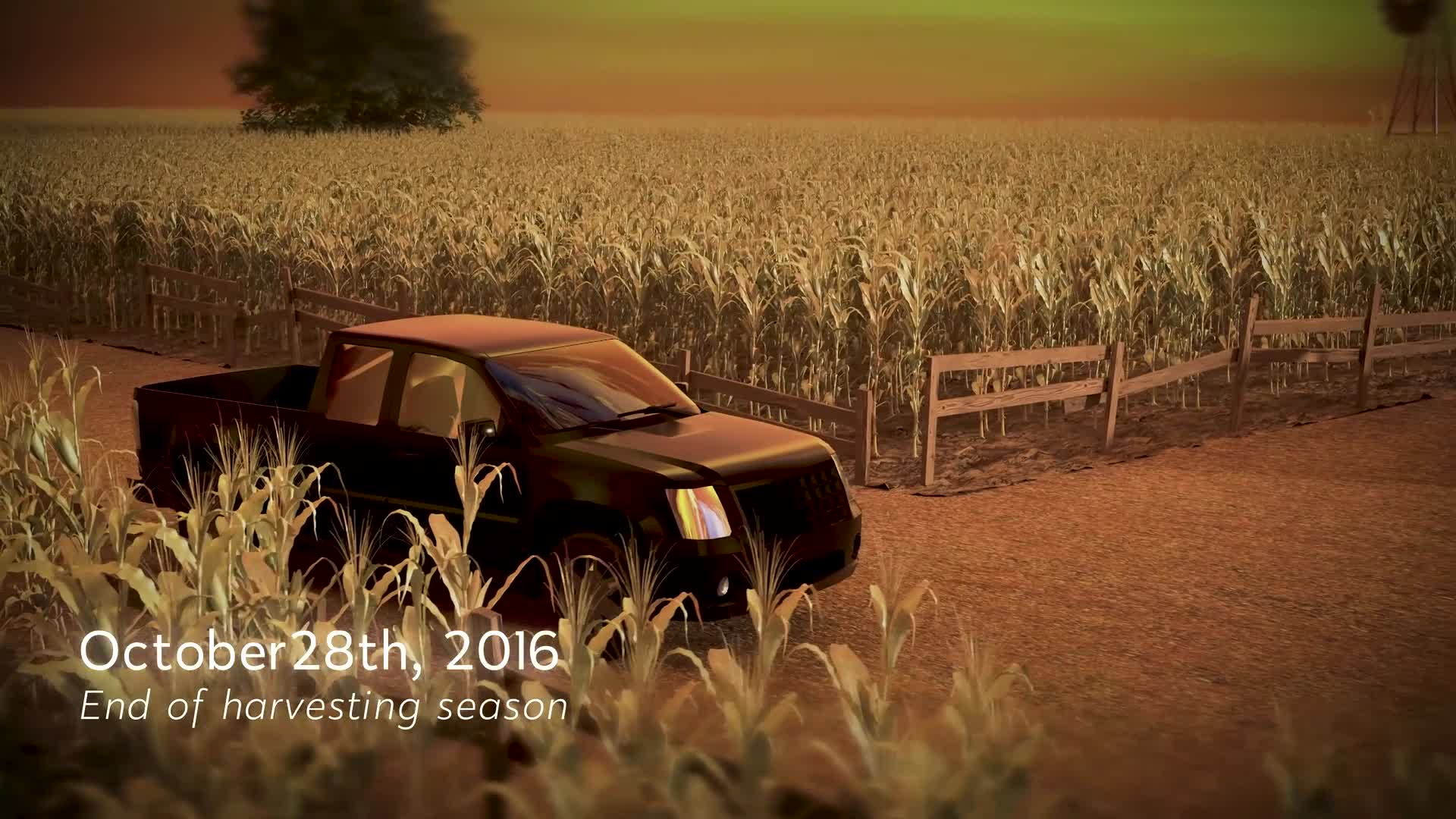
One October evening in 2016, an Arkansas farmer was sitting in his pickup truck just outside his field and he was growing impatient.
Suddenly, another car pulled up beside him, so the farmer got out.
Seconds later, he was murdered.
The farmer's name was Mike Wallace.
He wasn't killed over money or land.
He was killed over a herbicide. a chemical designed to destroy weeds.
This herbicide spread fear through rural America, turning farmers against each other, all because it belonged to a certain company.
This company's policies.
They pitted farmer against farmer and they could just send henchmen to your door.
Even if you just had the wrong seeds in your field, they could send you to court and bankrupt you.
In effect, they had a farmland monopoly.
They owned more than 80% of the seeds planted in the United States.
And to get this monopoly, they played the legal system.
Colluding with corrupted EPA officials.
Twisted scientific evidence.
It appears to have been caught red handed.
But the chemicals they were making destroyed the health of communities all over the world.
This is a video about Monsanto, one of the biggest agricultural companies in the world.
Our investigation is based on publicly available documents, recordings, and third-party opinions.
All sources are linked in the description.
In 1942, a chemist named Franklin D. Jones made an unusual enemy, poison ivy.
See, his children had a very violent reaction to the plant.
They would get intense rashes and swelling when they brushed up against the ivy.
So Jones wanted a way to kill it.
He experimented by spraying the ivy with hormones, chemicals that could regulate the plant's functions the same way they do in humans and animals.
His hope was that one of these hormones would cause it to die.
Unfortunately, many had no effect and others only made the ivy grow better.
But then one day Jones noticed that certain samples began to show autumn colors much sooner than they should have.
He watched as the vibrant hues turned to twisted shapes and then, within days, these plants shriveled up and died.
Jones checked the chemical he sprayed them with and surprisingly, it was a growth hormone called 24-D.
It's an acid made up of a ring of six carbons and hydrogens called a benzene ring with an acid tail.
There are also two chlorine atoms in the two and four positions of the ring, which is why it's called 24-D.
To keep things tidy, we don't have to draw all these carbons and hydrogens, but keep in mind they're still there.
Jones realized this synthetic hormone was incredibly potent.
Tiny amounts of it would still encourage the ivy to grow.
But if he sprayed on a lot of it, 24-D would trigger such uncontrollable and unsustainable growth that the poison ivy would die in the process.
So effectively, he had plant cancer in a bottle.
I was just going to say plant cancer.
Right?
My brain went.
What was even more remarkable was that it only targeted the ivy.
The grass around it was barely affected, like it was resistant to 2,4-D.
So over the next two years, Jones performed over 100 different experiments by pouring the herbicide into many different plant species.
And what he figured out was that 2,4-D was really picky.
It killed broad-leaved weeds like dandelions, chickweed and poison ivy, but it virtually ignored crops.
Wheat, corn and barley were all mostly unaffected by 24-D, because all of these are species of grass.
To improve this pickiness further, Jones also tested chemicals similar to 2,4-D.
He found that adding another chlorine to the benzene ring, transforming it to 245-T, left grasses even more unscathed.
He was onto something huge.
Because up until then, farmers could get rid of weeds one of two ways.
Either you spray them with dangerous chemicals like arsenic or you have to pull the weeds out manually.
Either way, you're at a loss.
But with 2,4-D and 2,4,5-T, you could spray your entire crop field, and only the weeds would die.
Jones had stumbled upon the first practically viable selective herbicides, so he was quick to patent them in 1945, just as the war was ending.
After the Allies' victory, the patent secrecy restrictions in most countries were lifted, and it turned out that there were other scientists, both in the US but also in the UK, who discovered these herbicides independently.
Soon the world was blessed with modern miracle weed killers like Weedun and Weedabomb and EndoWeed all formulations of 24-D and 245-T herbicides.
This man is ready to kill weeds because he's going to do it the easy way.
These chemicals literally replaced the hoe in everything from farm fields to railroad tracks and sidewalks.
And they are essentially what gave us that beautiful green American lawn just grass and nothing else.
Because with these herbicides, dad knew there was no longer any excuse for a weedy lawn.
By the late 1940s the herbicide business had turned into a roughly 10 million industry and everyone wanted in, including one of the biggest chemical companies at the time, Monsanto.
One of Monsanto's main herbicide factories was in Nitro, West Virginia, where they pumped out almost a ton of 245T a day.
By 1949, Monsanto's business was booming, when all of a sudden, the plant exploded.
Over 100 workers rushed out to see a dark cloud rising 40 meters above the factory.
They watched as a black stinking powder started raining down on their faces.
Within hours, many of these men fell ill.
First they got headaches and nausea, but then their skin began to erupt with bumps, pustules and acne.
The lesions on some of the workers' faces got so bad that Monsanto's on-site doctors had to peel off layers of their skin in an attempt to remove them.
The doctors later noted that when these men are in a closed room together, there is a strong odor.
They wrote, we believe these men are excreting a foreign chemical through their skins.
But neither the doctors nor anyone else at Monsanto knew what the chemical was, because both 245T and 24D were marketed as very safe.
See when the herbicides were first getting introduced.
Jones, the original inventor, even remarked that he knew people who would accidentally drink or spray the herbicides onto themselves, and they suffered no ill health effects.
They were fine.
And one of the doctors after him remarked that I've personally taken one half a gram of pure 24-D a day for three weeks.
You judge the results.
It was the 40s, so people were a bit crazy, but yeah, it seemed pretty safe.
Back at Nitro, Monsanto analyzed all the other ingredients they were using to make 245-T, but they still couldn't find what was causing their workers' skin to erupt in this way.
This is where their search seemingly stopped.
With no culprit.
The conditions at the plant stayed mostly the same, and Monsanto just offered their workers a choice.
Either you'll keep on working with 245T, or you can take the gate.
For many, this was no choice at all, since there were hardly any other jobs in town.
So most of the workers stayed, with something inside the factory poisoning them for years to come.
It wasn't until 1957, eight years after the explosion, that a German dermatologist, Karl Schultz, found himself treating patients with similar looking lesions and acne.
He wasn't surprised by the symptoms because many of these patients worked in 245T factories around Hamburg.
But when Scholz would test these ingredients from the instruction list on rabbit ears he had at the lab, he would get no reactions.
And this puzzled him.
How do these ingredients do nothing in his own tests but at the same time cause these painful skin disorders inside 245T factories?
Well, to make 245T, you start with tetrachlorobenzene, a benzene ring with four chlorine atoms attached to it.
These chlorine atoms are very electronegative, so they want to steal electrons from nearby atoms.
Luckily for them, the six carbons in the benzene ring are all sharing their electrons in these fuzzy, donut-shaped clouds around the ring.
That's what this circle in the diagram is meant to represent.
The chlorine atoms pull on this electron cloud, bringing it closer to themselves.
And, as a result, the carbons in the benzene ring become slightly positively charged and the chlorines slightly negatively charged.
Now, if you heat up tetrachlorobenzene with sodium hydroxide, one of the negative hydroxide ions will want to bind to one of the slightly positively charged carbons in the benzene ring.
And to do that, it forces out the chlorine atom, taking its place.
This creates trichlorophenol, or TCP, a key ingredient in making the herbicide.
From here.
If you keep the reaction at 170 degrees Celsius, you can add a series of chemicals to grow out this oxygen tail into an acid giving you 245T.
On paper, this is all there is.
If you follow the exact steps here and control the conditions, then none of these ingredients will explain the horrible phase eruptions that the nitro workers were experiencing.
But Schultz wasn't satisfied with this.
Maybe the conditions aren't perfect.
Maybe there is something in this process, some secret reaction that is contaminating the whole chemical supply.
Ideally, the industrial process of transforming tetrachlorobenzene into 245T should happen at 170 degrees Celsius, but if the temperature gets any higher, even just a few degrees higher, there is suddenly enough energy in the system for two molecules of TCP to fuse together.
This creates a molecule commonly known as dioxin.
It forms only in trace amounts, so you might expect to end up with roughly one or two molecules of dioxin for every 100000 molecules of 245T.
It seemed too small to be a problem.
Nevertheless, Schultz decided to test it.
He took some TCP, this time contaminated with trace amounts of dioxin, and rubbed it into his own skin.
And he got the same acne as the workers at the nitro plant.
Once Scholz realized the threat here, he immediately contacted all the big chemical producers in Germany.
And one of these German companies even sent letters to both Monsanto and Dow, the other big herbicide producer in the US, and they warned them that the acne-causing effects are stemming from pollution through byproducts referring to dioxin.
They even listed when, exactly during the process, the contamination was happening and what to do to prevent it.
Yet Monsanto denied ever getting these letters and Dow said they somehow misfiled them.
Regardless, it was obvious to both companies that something in the production of 245T was poisoning their workers.
But Monsanto didn't warn the public about the danger, perhaps because the herbicides were about to make them a whole lot of money.
In 1961, the president of South Vietnam was at war with the newly founded Viet Cong.
This guerrilla force was set on overthrowing his rule and uniting Vietnam under a communist regime.
The Viet Cong were masters of the jungle.
They laid deadly traps for their enemies and ambushed them using underground tunnels.
South Vietnam was losing the war, so the president faced a choice.
Either accept defeat in the jungle or destroy it.
He reached out to his allies, the US, and asked them for help, and soon they came in flying with thousands of barrels of herbicide.
This was the start of Operation Ranch Hand.
The US's herbicide of choice was Agent Orange, a 50-50 split of 24-D and 24-5-T supplied by the US's biggest chemical manufacturers.
The largest supplier by volume was Monsanto.
Agent Orange ravaged through South Vietnam, destroying 20 of the jungles, and civilians and soldiers on both sides got sprayed with it too, mostly by accident.
The government assured them that it is not toxic to humans, animals or drinking water, but Monsanto and Dow knew otherwise.
See, during Ranch Hand, they secretly exchanged information on their herbicides.
And in one of the letters, Dow acknowledged that dioxin, which had been contaminating 245T for years, was the most toxic compound they have ever experienced and that even trace amounts of it caused incapacitating acne.
By 1965, it was obvious that both companies understood what sort of threat dioxin was.
And yet there are no records that Monsanto or Dow ever sent communication to the US government warning them about the threat.
In fact, Dow's vice president reportedly said if the government learns about this, the whole industry will suffer.
As a result, the US sprayed South Vietnam with 72 million liters of Agent Orange, within which was just 80 liters of dioxin.
And even though that doesn't seem like much, the damage was irreparable.
Civilians and soldiers on both sides suffered from skin diseases and cancer.
Children were born with physical and mental disabilities.
By some estimates, as many as 3 million people suffered from the effects of Agent Orange.
This outraged the public.
In 1967, 5,000 scientists signed a petition to the president condemning his use of the herbicides.
And Monsanto was under scrutiny too, because regulators were catching on to the dioxin contained in 245T.
The herbicide was about to be phased out, compromising their bottom line.
Monsanto needed a miracle, and they needed it fast.
Their idea was to replace 245T with a safer herbicide.
But after nine years of research, they weren't getting anywhere.
All of the scientists in the agricultural department referred to this new initiative as a dead area.
One of the last remaining scientists on the project was John E. France.
And by early 1970, he was about to give it up too.
But before abandoning the project, France decided to do one final set of experiments.
So he thought up 19 possible acids that could maybe work as herbicides and decided to test them out.
He prepped the first herbicide.
But nothing happened.
The plant was completely fine and the herbicide had no activity.
Then he decided to test the second herbicide and he applied it to a plant.
It was 10 times more powerful than any herbicide the team had ever seen.
And allegedly, it made the plants super... It made the plants super nasty.
That was disgusting.
This miracle compound was glyphosate, a phosphonic acid group on one end and a carboxyl group on the other, with a nitrogen hydrogen or amino group in between.
To make sure it was commercially feasible, France and his colleagues set up tests in these outdoor fields.
And as one of the scientists was getting back to these test sites, he saw the results from the plane.
It was clear as day.
All he could do is write Eureka across the performance report.
It was the best herbicide they'd ever seen.
So what made it so great at killing plants?
Well, for plants to survive, they use a chemical pathway, a series of reactions, to create three important amino acids, acids without which they die.
This process is known as the shikimate pathway because it starts with shikimic acid named after the Japanese shikimi flower.
During one of the steps, two acids, S3P and PEP, need to transform into a third compound, But they can only do that with the help of an enzyme called EPSPS, which catalyzes the reaction and helps the two molecules combine.
However, if glyphosate is present during this reaction, it will begin to mimic PEP, because they have a very similar geometry.
And because of that, glyphosate actually binds first to EPSPS, blocking it from acting as a catalyst.
Now, the acids can't transform and the whole shikimate pathway is destroyed.
Without it, there are no amino acids and the plant dies.
Crucially, the shikimate pathway is unique to plants and things like bacteria and fungi.
Humans and animals don't have it.
In fact, we have to eat foods that contain these three amino acids.
But for Monsanto this was good news, because they could market that glyphosate targets, an enzyme found in plants but not in humans or pets.
So after decades of toxic products, Monsanto finally had one which they were sure was safe.
And research was also showing that after you spray glyphosate, the microorganisms in the soil break it down into safe byproducts.
It was biodegradable.
Glyphosate was perfect, so they wasted no time in getting it on the market.
In 1974, Monsanto had a new hit herbicide.
Roundup.
Roundup is better.
It goes through the plant to kill it.
Tops and rhizomes.
My roots hurt real bad.
Farmers loved it because, unlike 24-D, glyphosate killed every weed, not just broad-leaved ones, but grassy too.
It allowed them to practice something called no-till farming.
See, usually to get rid of weeds you'd have to plow up the entire field before planting anything and that would hurt the soil and it was also just a lot of work.
But with Roundup what you do is you spray the whole field.
Everything dies, and then you just plant directly into the residue.
It was easier, faster, and cheaper.
And Roundup was safe to use too.
They marketed it as safer than table salt and safe enough to drink, basically.
Roundup can be used where kids and pets will play and breaks down into natural materials.
By the late 80s, Monsanto was selling 7 million pounds of Roundup and making a billion dollars each year.
And they weren't going to share a penny of that money with anyone.
See with other herbicides like, for example alichlor, which was moderately popular at the time.
You can tweak the molecule a bit here or there and you still get a very potent weed killer.
So if you patented a specific herbicide, your competitors could still use hundreds of its close relatives, which would still work perfectly well without violating your patent rights.
But glyphosate was different.
If you were to modify the molecule in any way, its herbicidal properties were completely gone.
So Monsanto could rest easy, knowing that until the year 2000 they would be the only ones able to sell it.
There was a little problem with glyphosate.
See, unlike 2,4-D, which only killed broad-leaved weeds, Roundup kills everything.
I sprayed some of my own houseplants here and, well, you can see the results.
Chances are, if it's green, Roundup is gonna kill it.
And this was a problem because farmers could only really spray Roundup on their field twice, either right before planting the seeds or right after a harvest.
But for Monsanto, this wasn't as much of a problem.
See, they thought if we could somehow make the crops like soybean or corn resistant to Roundup, well then farmers could spray it on their field during the whole year and it would keep killing the weeds but not the Roundup resistant crops.
Crops which Monsanto could sell them.
And as a result, they would have a complete monopoly over both the herbicide and the seed supply.
Monsanto's idea was this.
If glyphosate blocks the EPSPS enzyme in plants, then they could edit the plant's DNA so that the cells just create more EPSPS.
If there's enough of the enzyme, then glyphosate can't block all of it, and so the plant can still survive.
They tried this out on petunias, but it didn't work.
The flowers would survive a tiny amount of randup, but a normal dose would still kill them.
Monsanto was kind of stumped and they didn't have time to rest because while glyphosate and Roundup were under their patents, a Roundup resistant seed wasn't.
And their competitors knew this.
In 1985, a company called Calgene published a paper in Nature showing that they made tobacco slightly resistant to glyphosate.
The paper showed promise but, more importantly, it made it clear to Monsanto that they were running out of time.
The researchers were desperate, calling this patent race the Manhattan Project.
And then one of the engineers had a genius idea.
Monsanto had a ton of these factories where they were converting phosphate into glyphosate and they had a lot of sludge leaching out of these factories.
So if there was anything living around these factories in this sludge, there was a chance it was resistant to glyphosate.
So the researchers went to one of these factories, scooped it out and found a strain of salmonella in there, which was kind of surprising to them, because salmonella usually relies on the shikimate pathway.
But here it was thriving in glyphosate.
Monsanto's scientists isolated the salmonella's genetic sequence and found that it had evolved a way to mutate the shape of its EPSPS enzyme so that glyphosate couldn't bind to it and block the Shikimate pathway.
The scientists took that salmonella DNA and loaded it onto a gene gun.
Not this one here, but it's actually surprisingly similar.
See, they placed thousands of these salmonella DNA strips onto microscopic gold particles in the gene gun, which they then fired into the plant tissue all over at 1400 kilometers per hour.
The gold particles would bombard the plant cells and some of them would make it into the nucleus.
Here, the DNA detaches from the gold and it integrates itself into the plant's chromosomes.
Now, every time this cell divides, it copies over the new EPSPS gene.
Monsanto scientists planted seeds with these genes out in the field and sprayed them with Roundup.
But nothing happened.
The soybean was resistant.
Monsanto made sure to act quickly.
Soon after they found even more potent bacteria, and they were able to make other crop species immune too.
And by 1998, they had patents for glyphosate-resistant canola, corn, and cotton.
They called this lineup of GMO seeds Roundup Ready.
These Roundup Ready seeds took over the market in an instant.
Already, by 2001, more than 70 of all soybeans grown in the US were Monsanto's with Roundup, making them more than 25 billion a year.
It was the best-selling agricultural product ever.
And every farmer could join in on this Roundup plus Roundup Ready revolution just by signing Monsanto's Technology Use Agreement.
I got one of these agreements from 2011 here and I just wanted to read some terms.
So the grower or the farmer who accepts and wants to use these seeds agrees to not save or clean any crop produced from the seed for planting and the farmer also agrees not to supply the seed produced from the seed to anyone for planting.
Meaning you cannot save the seeds you bought last year to plant this year and you also cannot share or sell your seeds to anyone else.
Here's another one.
The farmer agrees to identify and allow Monsanto and its representatives access to the land farmed by the grower or the farmer.
And this allows Monsanto to examine and take samples of the crops, crop residue or the seeds located therein.
And here's a final one.
The grower accepts the terms of the following notice requirement by signing this agreement or by opening a bag of seeds.
So you're agreeing to these terms even just by opening a bag of seeds.
If you thought that this contract was crazy, you should see the stuff that we sign up to today online.
I have some terms and conditions here from a social media website.
Here's what it says.
We may collect biometric identifiers and we may infer your attributes such as age range and gender.
So they're able to scan your face and sell that data to advertisers.
And just in the last couple of months, companies have been making these aggressive pushes to their terms and conditions to try and get more of your data.
And they can use it to train AI models or just sell it to data brokers.
And this doesn't just mean annoying ads and spam emails and phone calls.
Law enforcement can buy your data and normal people can buy it too.
Even stuff like your location history.
And all of that is perfectly legal.
But luckily you can take steps to prevent it with the help of today's sponsor, Incogni.
See, I started using Incogni in June.
Look, you can see that they already contacted 46 data brokers to delete my personal data and 42 of those requests have been completed and I've actually been getting fewer spam.
The new thing is that they now offer an unlimited plan with custom removals.
So if you are browsing online and see a website with your data, even though it shouldn't have the data, you can ask one of Incogni's experts to manually take it down for you.
And if you want to extend that sort of protection to someone else, they also have a family plan that supports up to five members.
To try it, go to incogni.com slash vertasium and use the code vertasium to get 60% off.
You can also use this PR code.
That's incogni.com slash vertasium, or you can also click the link in the description.
I want to thank Incogni for sponsoring this part of the video.
And now back to farmers and the terms and conditions they had to sign.
Well, couldn't farmers just decide not to use Monsanto's seeds and herbicide?
The thing was you have Roundup Ready seeds and you spray them with Roundup.
Everything's going to be fine on your end.
But your neighbor doesn't have Roundup Ready seeds.
So if your herbicide drifts over to your neighbor's side, it's going to kill his plants.
So neighbors were concerned, thinking their crops were going to be lost.
So they got Roundup Ready as well.
And soon enough, Monsanto controlled the whole market.
And the control didn't end there.
As one seed grower from Ohio remembers it, Monsanto's salesmen would tell people they could either sign on or they'd all be out of business within the next two years.
Monsanto was going to dominate the entire seed industry and there was nothing anybody could do about it.
So hundreds of thousands of farmers signed the deal and it wasn't a good one.
One evening in late July 2004, an Indiana farmer named Dave Runyon was relaxing at home when two men knocked on his door.
They led me to believe that they were doing a survey for a magazine.
They wanted to know what kind of crops I planted.
They wanted to know what kind of herbicides I used, the seed I bought and purchased and used.
Runyon wasn't interested so he decided to shut the door when he heard one of the men say I think he's guilty.
Runyon didn't know what they meant, but a few months later he got a letter from Monsanto saying that he had seven days to turn over all of his business records to the company.
He was shocked because Runyon was one of the few farmers that never signed a contract with Monsanto, and yet here they were threatening to sue him for patent infringement.
Apparently someone had tipped Monsanto off that Runyon had been replanting their seeds illegally and farmers all across the country were getting the same types of letters.
Honestly, it's kind of hard to overstate how much Monsanto tried to control farmers.
They sent private detectives and ex-cops to inspect farms all over the US, waving their terms and conditions of the contract into farmers' faces to let them onto their property.
They hired plane and helicopter pilots to survey the farmlands from above for signs of infringement.
The lawsuits, the threats, how could people possibly stand up to them?
And they even had a company hotline 1-800-ROUNDUP that farmers could call to snitch on their neighbors.
It still exists.
1-800-ROUNDUP.
You're calling them now?
I think I got it right.
If you have information about the misuse of seed or a compliance issue, please press 3.
That phone number was in existence in the same time that we're talking about there, where people could rat out, you know, their neighbor.
As Runyon himself puts it, there is much mistrust in the countryside today.
You never know who might report on you.
You could actually willfully plant unauthorized seed in somebody's land if you want to destroy them.
Now, in 2010, Monsanto responded to farmers' concerns about these investigations and released a commitment statement regarding their patents.
They mentioned their pledge to transparency and ethical behavior, properly introducing themselves with displayed identification and not exercising their patent rights when only trace amounts of their seed is present in a farmer's field.
And while Monsanto ultimately ended up letting Runyon go, by 2013 they sued over 400 farmers, raking in over 20 million.
Many of these farmers went bankrupt and countless others settled with Monsanto out of court, even if they were innocent, because they just couldn't risk the legal fees.
You know, they were actually influencing radio stations at one point and the radio stations would publicly say the name of the people who were saving Roundup seats on air.
It sounds like a supervillain plot, really.
Yeah, well, people actually started calling them Monsatan, so...
This culture of fear and paranoia turned neighbors against each other, especially in communities where some farmers didn't wish to use Monsanto's herbicide system.
One of those farmers was Mike Wallace.
See, Mike had a field of soybean here that wasn't resistant to Monsanto's herbicide.
But his neighbor, who was also growing soybean, did use Monsanto's system.
Now to be clear this herbicide wasn't glyphosate itself.
It was Monsanto's other herbicide product called Dicamba, but it was still packaged in this Roundup and Roundup Ready system.
Now, one day Mike noticed that some of his soybean was dying and he suspected it was the herbicide from the neighboring farm drifting over, killing his soybean.
And he could tell this was the case because the weeds underneath the neighbor's soybean were dying allegedly because of the herbicide.
And he believed this caused him around 100000 in damages and the neighbor denied that it was his fault.
Now the tensions between the two farms grew, so Mike wanted to chat with one of the workers from the farm to discuss the situation.
They met on a country field road near both farms, and what happened next isn't really clear.
Things got sour quickly.
Allegedly Mike grabbed the worker's arm so the worker pulled back and pulled out his gun, shooting Wallace until the gun was empty.
Similar kinds of tragedies were happening all over the world.
Monsanto infiltrated farming communities in India, Argentina, Canada, Brazil, and even Vietnam.
By the 2010s, they were an almost untouchable monopoly.
Then, out of the blue, on March 20th 2015, An independent science panel called the International Agency for Research on Cancer, or IARC, came out with this
A paper saying glyphosate is probably carcinogenic to humans.
The most popular weed killer in the world may cause cancer.
IARC's classification of glyphosate as a probable carcinogen.
Damage to chromosomes and DNA in human cells.
This came as a shock to everyone, especially Monsanto.
They don't know how IARC could reach a conclusion such as this one.
See other big health organizations like the US Environmental Protection Agency, the EPA, and even the World Health Organization, which is actually the parent organization to IARC.
Both claimed that glyphosate posed no carcinogenic risk to humans and animals.
I think the IARC designation took the public by such huge surprise because Monsanto had really done such a good job for 40 plus years convincing the world that this stuff was safer than table salt.
Monsanto was furious about this ruling, so on the same day they sent a scathing letter to the World Health Organization complaining how this classification needs to be rectified immediately.
They claimed, IARC chose to disregard dozens of studies and that conclusions on glyphosate must be non-biased, thorough and based on quality science.
Soon after five review papers came out bashing the IARC classification and criticizing their decision.
So why would IARC disagree with all the other agencies, and why would they ignore so many studies?
Well, this is exactly the question California lawyer Brent Wisner wanted to answer.
Wisner had been looking into Monsanto for a while now.
Allegedly, Roundup was causing a decline in the bee population, so he thought he could make a case out of it.
But one day one of Wisner's colleagues told him that her cousin-in-law had been using Roundup on his farm for as long as she could remember, and then both he and his dog developed non-Hodgkin's lymphoma or NHL, a type of cancer targeting the lymphatic system, and he died in late 2015.
He didn't stop using it until he was too weak to do anything.
He didn't think there was any danger with Roundup.
See the IARC paper that came out saying glyphosate is a probable carcinogen, actually pointed out that the strongest evidence was for non-Hodgkin's lymphoma.
And reports of Roundup users getting diagnosed with NHL were popping up more frequently.
This seemed like more than just a coincidence.
Wisner thought he had a case, but Monsanto was a corporate giant he couldn't tackle alone.
So he teamed up with other lawyers and also an investigative journalist who had been reporting on Monsanto for decades.
So there's a lot to write about.
Spent a lot of time at Monsanto headquarters.
It became pretty clear this company really doesn't care about its customers.
Right.
OK.
Together, this group of lawyers started a lawsuit against Monsanto, and they forced them to hand over their company documents.
Monsanto had to comply, and so the lawyers got access to their internal emails, memos and safety studies.
Saying one thing publicly and saying something completely different internally.
The duplicity, the deception is just you know jaw-dropping really.
In 1983, Monsanto submitted a glyphosate toxicology study to the EPA to get it classified as safe.
But the data was showing that mice receiving higher doses of glyphosate were developing rare kidney tumors.
The EPA was obviously worried with this and they wanted to classify glyphosate as a possible human carcinogen.
So they asked Monsanto to do more studies.
And Monsanto fought back against that.
No, you just need to trust what we're telling you.
You know, you're reading the data wrong, et cetera, et cetera.
Monsanto wouldn't comply and they pushed back against the EPA until 1989, when the EPA suddenly changed its mind.
They said a repeat of the mouse oncogenicity will not be required at this time.
And instead, in 1991, the EPA classified glyphosate as having evidence of non-carcinogenicity for humans.
The cancer concern in mice was never made public, and this new classification certainly helped push Roundup sales, at least until more independent research came in.
See, one of the most influential research papers on Roundup actually came out in the year 2000.
It was the Safety Evaluation and Risk Assessment of the Herbicide Roundup and its active ingredient, glyphosate for humans, commonly just called Williams, Crows and Monroe after its authors.
This was the landmark paper on glyphosate safety, which concluded that Roundup herbicide does not pose a health risk to humans.
This paper was cited over 1,200 times, which is a lot.
And it was considered then by regulators of the foundational research paper to say that glyphosate was safe.
This independent paper
Except the paper wasn't independent at all.
See.
Monsanto's director of the toxicology group, William Hadens, was listed on the paper as someone who provided scientific support.
So, in a 2017 deposition, Wisner and his fellow lawyers decided to ask Hadens about it.
Were your contributions, in your view, to the Williams paper substantial?
No, they were not.
As I said, they were editorial just to make it easier to read.
But here's how Hadens referred to his involvement in the paper internally.
I have sprouted several new gray hairs during the writing of this thing, or I'll strangle Crows or Williams if they ask for any rewrites.
And much later we would be keeping the cost down by us doing the writing and they would just edit and sign their names, so to speak.
Recall, that is how we handled William Crows and Monroe.
And they celebrated when it was finally done.
You see, in their internal documents they talk about how this is going to be our defense glyphosate around the world.
The patterns of Monsanto's manipulation were just popping up everywhere.
They tried to change glyphosate cancer classifications at different agencies.
They seemingly colluded with corrupt EPA officials to try and kill opposing research and they ghostwrote safety studies.
By mid-2017, Wisna released all of these internal documents to the public, now known as the Monsanto Papers.
People were furious.
Newly released docs show Monsanto executives colluding with corrupted EPA officials who try to influence media and science reports.
Monsanto appears to have been caught red-handed.
We have a paper trail that goes back to the 1980s.
Stakes for Monsanto are extremely high.
Soon, lawyers were overwhelmed with calls from cancer patients who used Roundup and got diagnosed with NHL.
They wished to be included in the lawsuit.
By the end of the year, more than 3,000 victims had signed onto the case.
But Monsanto tried to do everything to dismantle these carcinogen claims.
You remember the five independent papers that came out bashing the IARC decision to call glyphosate a probable carcinogen?
Well, the main review article there was ghostwritten by Monsanto.
So you could see this paper getting edited and changed by people who worked for Monsanto.
And it's been frustrating to see journals, basically at every step of the way you know, declining to retract.
That paper is still online today.
And Monsanto went all the way to discredit anyone who was opposing their view with something called their let nothing go strategy.
Let Nothing Go was essentially like, let nothing go.
Somebody tweets online, roundup causes cancer.
You don't let that go.
Like you have an onslaught of people responding to that.
They had whole training operations where they would bring in nutritionists and academics and other people to train them like what to say and how to say it.
I do not believe that glyphosate in Argentina is causing increases in cancer.
You can drink a whole quart of it and it won't hurt you.
You want to drink some?
We have some here.
I'd be happy to, actually.
Not really, but... Not really?
I know it wouldn't hurt me.
If you say so.
I have some glyphosate.
No, I'm not stupid.
But they very much became an army that Monsanto could deploy when a news article came out, for instance.
Are we going to get some comments under this video that are actually written by Monsanto?
I wouldn't be surprised.
But all of the confusion Monsanto tried to create around glyphosate wasn't enough.
By the summer of 2018, the truth was out and over 11,000 plaintiffs filed lawsuits against Monsanto.
This was going to destroy them, but unfortunately, Monsanto had an escape plan.
Just as the first lawsuit against them was starting, they signed an acquisition deal with German chemical giant Bayer.
Monsanto cashed in, the executives rode off into the sunset, and Bayer was left holding the bag.
Why would Bayer buy Monsanto?
If it's so obvious that they have hundreds of thousands of plaintiffs waiting for a verdict, why would a company do something?
Well, I think that's the big question that the investors are asking or have asked.
Why in God's name did you do this?
Like, why did you do this?
I think it was Wall Street Journal that had a headline worst acquisition in history, or something like that.
Bayer's stock tanked immediately after the acquisition and things only got worse for them.
A few months later, the first case against the Monsanto Bayer Company went to trial.
The plaintiff was Dwayne Lee Johnson, who had developed non-Hodgkin lymphoma after accidentally getting doused with Roundup at work.
The jury, faced with evidence from the Monsanto papers, sided with Johnson, awarding him 289 million in damages, and Bayer had to pay up.
By 2025, Bayer had to settle more than 100000 cancer lawsuits for the damages caused by Monsanto's Roundup, amounting to over 10 billion in settlements.
Monsanto, which is now owned by Germany's Bayer, denies any wrongdoing.
And they don't accept that Roundup could have caused the plaintiff's cancer.
So after all this publicity and scandal, how dangerous is Roundup really?
My question has always been if it doesn't cause cancer and it's not dangerous and there's no real risk to human health, why in God's name would Monsanto have to spend millions and millions and millions of dollars to create ghostwritten studies?
And Well, according to IARC, one of the biggest concerns with glyphosate is genotoxicity.
Some studies have shown that if you get overexposed to glyphosate, like many farmers would, then the chemical might substantially damage the DNA in your cells, which is a common mechanism of action for many carcinogens.
And other studies have actually pointed to the shikimate pathway.
Again, we don't use it, but the bacteria in our gut do.
So if you ingest trace amounts of glyphosate, for example, through your food, it could disrupt your gut's microbiome.
If you can disrupt the enzyme in the microflora in your gut, the EPSP enzyme, the synthase, it could have all sorts of effects.
Now, IARC never specified at what dose glyphosate actually becomes dangerous.
Just that overall, glyphosate is a probable carcinogen.
And to put it into context, the other things in the same classification category are eating red meat or high temperature frying or pulling a night shift.
These are lower than the number one category, which is a certain carcinogen.
And here, of course, you have alcohol and tobacco and sunlight.
And to give you context for our previous episode on Forever Chemicals, PFOA was a category one, so a certain carcinogen.
But PFOS is actually a category 2B, which is lower than glyphosate and only a possible carcinogen.
From the data I've seen, glyphosate doesn't seem to be a particularly potent carcinogen, but high exposure to glyphosate is certainly associated with a modest increase in your ability to get certain types of cancers.
And people who have higher exposures are clearly at higher risk.
However, the EPA and many other organizations, like the European Food Safety Authority, still disagree with the IARC and claim that glyphosate isn't a likely carcinogen.
But the courts in the United States have repeatedly told the EPA that they're not doing a proper analysis.
They're not doing a proper assessment of glyphosate.
They're not following their own rules.
You said like something like 50 of the papers that were about glyphosate safety and research and toxicity were probably like industry funded.
You know, that's just a guess off the top of my head.
Honestly, it could be much higher than 50%.
I certainly do not think it's lower than that.
There's just always a desire by these companies to control the science.
Today, Bayer still denies that glyphosate is a carcinogen.
They would still tell you.
They don't think there's anything wrong with it.
When my book came out, Bayer reached out to me.
They sent me an email and it was really kind of quite strange.
It was like, congratulations, we've read your book and we've learned a lot.
I think Bayer feels different.
And Bayer actually removed glyphosate from commercial products.
So this bottle of Roundup here doesn't even have glyphosate in it anymore.
Part of the reason for that must be the public backlash and the lawsuits.
But the other reason is that it doesn't work that well anymore.
We overuse glyphosate.
See, since the 1970s, more than 60 species of weed have become resistant to glyphosate, just like that first salmonella sample found near the factory.
What do they put in those Roundup sprays if not glyphosate?
Well, mostly full circle.
So it's 2,4-D.
Isn't that crazy?
Well, you know, many people will probably go through life not being affected in the slightest by glyphosate.
But others may develop cancer or other disease.
And that's why it's really important to protect the most sensitive individuals.
I think another part of the problem here is how a company as big as Monsanto can just infiltrate academia.
They have these big resources so they can just push around scientists and manipulate results.
They create so much confusion and then they just avoid the punishment.
When you don't create firewalls between the regulated and the regulators, you have created distrust in science.
Inherently, science is always going to be political.
It's never going to be disconnected from the realities of the world.
It's always socially constructed.
But we can do a lot of things to put rules and regulations in place to try and make sure that there's a better sense of independence and disconnection between us.
I want to shout out two books, Kerry Gillum's The Monsanto Papers and Bart Elmore's Seed Money.
They were both incredibly valuable in researching this topic.
And I also want to shout out people in the comments of our previous video on PFAS suggesting that we should cover Monsanto.
Thank you for suggesting that idea and thank you as always for watching.