NPR. This is The Indicator from Planet Money.
I'm Weyland Wong. And joining us today is a very special guest, founding producer of The Indicator, Darius Raffion.
Welcome back, Darius.
Thanks, Weyland. Great to be back.
And you have brought us something super cool today.
That's right. As journalists, we so often these days are finding stories on Google or TikTok.
But today, I am thrilled to be able to bring you something that every journalist dreams about, a great story that I heard in a bar.
The first time I ever heard this story, it almost stopped me in my tracks.
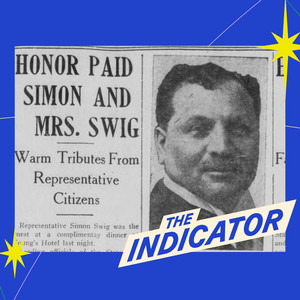
That's Kent Swig. He's a New York real estate developer and a friend of mine.
And we were out recently at a bar in the Financial District, and Kent suddenly turns to me and says, Hey, you know my great -grandfather uncovered the first Ponzi scheme, right?
Right. This is a great story.
He was talking about Charles Ponzi, the creator of the scheme that gave its name to all the others.
The father of all fraudsters.
The very same. And when I heard this story, it sent me down a rabbit hole that included hundreds of newspaper clippings, personal letters, court documents, and a pretty charming anecdote about Ella Fitzgerald.
So today on The Indicator, we bring you the untold story of Simon Swig.
He's a radical people's banker who upended the stodgy world of Boston politics, helped expose the first major financial fraud of the modern era, and was ultimately destroyed for it.
at bowlinbranch .com with code NPR.
Exclusions apply. See site for details.
Simon Swig was born around 1865 in modern -day Lithuania.
As his great -grandson Kent told me, his parents sent him to the United States speaking not a word of English and without a scent to his name.
They either thought he was expendable or that he was one that had the most moxie inside that could preserve the family.
He found work as a junk peddler, selling whatever odds and ends he could scrape together.
From those humble beginnings, he built a business empire.
At the center of it all was the Tremont Trust Company.
The newspapers called it Swig's Bank.
He called it the People's Bank.
And at that bank, he had done several things that were very unique in the banking world.
One of the things, he was Jewish.
So having a Jewish banker, there was no such thing.
And Boston was a very, you know, provincial -type city back in those days.
Tremont Trust marketed to women, working people, immigrants, basically all the people that had been left out of the traditional financial system.
The bank pioneered the practice of paying monthly interest on savings accounts, something that had actually been illegal until Swig got the law changed.
And he took out these big front page newspaper ads where he would call out other banks for hoarding all the profits.
That wasn't very highly regarded because his banking industry friends did not appreciate that.
Swig also took on the local political machines, leveraging the support of immigrant workers to bulldoze his way into the state legislature.
He became the first Jewish person ever elected from his district.
And he championed policies that would be considered radical today.
For example, a bill to ban all corporate money in politics and a bill to allow police officers to be removed for bad behavior.
He denounced lynchings, fought for women's suffrage, and personally hired Boston's first black bank tellers.
All of this made him something of a folk hero in Boston.
Then in 1919, he crossed paths with an enterprising charlatan who was poised to leave his mark on history.
Charles Ponzi was his name.
Ponzi was, like Swig, an immigrant who had arrived in the U .S.
with nothing and through sheer force of personality built himself into a businessman.
He also turned out to be running a financial fraud so big that to this day, his name is synonymous with this particular type of scam.
So quick primer on how a Ponzi scheme works.
Basically, I tell everyone that I'm a genius investor and if you give me your money, I'll promise you amazing returns.
But instead of investing the money, because, you know, investing is hard, I sit on it and just tell everyone how well I'm doing.
That attracts other investors who add their money to the pile.
Then I simply take the money from my new investors and pay the old investors.
It's a classic case of robbing Peter to pay Paul.
And as long as there's more money coming in than going out, everyone's happy.
But maintaining this elaborate fraud required Ponzi to spread his money around multiple financial institutions so no one could get a full picture of what he was up to.
He chose Tremont Trust as one of those institutions because of its willingness to do business with immigrants like him.
And so he parked a significant portion of his ill -gotten gains at Swig's Bank.
And the gains were significant.
At the height of his scheme, Ponzi was bringing in more than $6 million a month.
That's more than $100 million in today's dollars.
But for Swig, something wasn't adding up.
He noticed a lot of money was coming in, and then money was going out in drips and drabs in an odd way, and it wasn't being invested.
And he recognized that it was basically a scheme.
So in July of 1920, Swig told Ponzi basically, we want nothing to do with you.
Close up your accounts and get lost.
He then did his favorite thing, which is he took out front page newspaper ads in which he took thinly veiled shots at Ponzi.
This is a great hobby.
And you know, your own banker calling you on in public?
Not a great look. Yeah, no, doesn't inspire confidence.
No, it does not. And the authorities were taking notice.
By the following month, the entire house of cards had come crumbling down, and Ponzi was arrested.
It's estimated that his victims lost more than $300 million in today's dollars.
So Ponzi was caught, the fraud was exposed, and Swig lived happily ever after as a hero, right?
Well, not quite. About a month after Ponzi's collapse, the Tremont Trust experienced a bank run that nearly destroyed it.
Officially, it was chalked up to lingering fallout from the Ponzi panic.
But Swig took to the press and claimed that the run was a conspiracy, orchestrated by his fellow bankers who didn't like his radical ideas or his egalitarian approach to banking.
The bankers slowly started putting money in his bank more and more and more.
When they knew that he had it lent out, they made a run on his bank and tried to take all their money out at once.
By the way, today that's illegal to do.
But the people came to Swig's aid.
The bank was able to fend off the run thanks to a flood of new money from his many supporters.
One person even hand -delivered $200 ,000 in small bills just to alleviate a shortage.
And so the bank returned to business as usual and never missed a payment.
Then, inexplicably, just a few months later, the banking commissioner suddenly declared Tremont Trust hopelessly insolvent and took over the People's Bank.
That evening, more than 100 Tremont bank tellers, newly unemployed, marched to the commissioner's office in protest, demanding that he reopen the bank.
When reached for comment, Swig rose from his sickbed and in a bathrobe and slippers addressed a crowd of newspaper men to decry what he called a deliberate banking murder.
The guy knew how to give a quote, huh?
But even so, the Tremont Trust Company never reopened.
Swig eventually went bankrupt trying to pay back his creditors.
When he died in 1939, the newspapers ran a short one -sentence obituary.
But his great -grandson Kent says that in his mind, Simon's legacy has nothing to do with what was printed in the newspapers, and everything to do with takkun alam, a Hebrew phrase meaning to repair the world.
It's the idea in Judaism that you have a duty to leave the world better than you found it.
It's a very big driving force in my family.
To explain what he meant, he told me a story about his grandfather, Benjamin Swig, Simon's son, who had worked alongside him at Tremont Trust.
Benjamin used to own the Fairmont Hotel in San Francisco, and one night he invited Kent to come to the hotel to see Ella Fitzgerald perform.
She finishes, she's at the microphone, and she said, you know, are you Ben Swig's grandson?
I said yes, and she goes, can you come back to my dressing room and talk to me?
She told him the story of the first time she played at the Fairmont back in the early 1950s and how Benjamin had met her in the lobby and given her a tour of the glorious old hotel.
Finally, she says to him, young man, I have to go to the bathroom.
I need to go to my hotel.
Can you please get me a taxi to my hotel?
He says, let me just introduce myself.
My name is Ben Swig.
I own the hotel. If you're playing in my hotel, you're staying in my hotel.
You're in the presidential suite.
And he walks me up to the presidential suite, and she said, I was stunned the first time in my life I ever, ever stayed in a hotel where I played.
To Kent, that said more about his great -grandfather's legacy than any obituary ever could.
He was someone who fought to leave the world better than he found it.
And it's an idea that Simon Swig passed down to his son, Benjamin Swig, who passed it down to his son, Melvin Swig, who passed it down to Kent.
And Kent says he's worked hard to pass it down to his own children, including his son, Simon.
This episode was produced by Julia Ritchie with engineering by Jimmy Keeley.
It was fact -checked by Sierra Juarez.
Kicking Cannon edits the show, and The Indicator is a production of NPR.
At Radiolab, we love nothing more than nerding out about science, neuroscience, chemistry.
But we do also like to get into other kinds of stories.
Stories about policing or politics, country music, hockey, sex of bugs.
Regardless of whether we're looking at science or not science, we bring a rigorous curiosity to get you the answers and hopefully make you see the world anew.
Radiolab, adventures on the edge of what we think we know.
Wherever you get your podcasts.
There's a lot going on right now.
Mounting economic inequality, threats to democracy, environmental disaster, the sour stench of chaos in the air.
I'm Brooke Gladstone, host of WNYC's On the Media.
Want to understand the reasons and the meanings of the narratives that led us here?
And maybe how to head them off at the pass?
that's on the media's specialty.
Take a listen wherever you get your podcasts.
Support for NPR and the following message come from Jarl and Pamela Moan, thanking the people who make public radio great every day and also those who listen.