Grownups, Wondery Plus subscribers can listen to Wow in the World early and ad-free right now.
Join Wondery Plus in the Wondery app or Wondery Kids Plus on Apple Podcasts.
Hey, Wowzer fans, Mindy here.
And before we start the show, I gotta let you know that this November, with a special new episode featuring our friends at Circle Round and Terrestrials on Radiolab for Kids,
And don't miss when Elmo from Sesame Street stops by Wow in the World to make us all belly laugh on November 24th.
Oh, but that's not all, Reg.
On December 1st, we are sharing our 250th episode of Wow in the World with all of you.
We think this one is going to be music to your ears.
Literally.
Did I mention it's a musical?
And if you're a member of the World Organization of Wowzers...
Oh boy, do I have a surprise for you.
You can listen to our 250th episode early with me and other members from around the world on Saturday, November 22nd, at 7 pm.
Eastern.
That's right, we are throwing another listening party.
Join us as we dance along to our new songs.
React to the episode with other members in the chat and more.
Grownups.
If you want your wowzer to join this members-only listening party, you can sign up to become a member today at Tinkercastcom.
Slash wow.
Already a member?
Well, you can find the link and password to join the event when you sign in at Tinkercastcom.
Slash wow.
That's it.
It's going to be a November to remember.
But for now, let's get on with the show.
Woo!
Cartoon Cacophony will be right back after these messages.
Tired of eating boring old regular ants?
No.
But you do like eating ants off the sidewalk, right?
Ah, gee, mister.
You bet I do.
Then you're going to love the new Exploding Ants.
Whoa!
Same great ant texture, but with an explosion of flavor.
Holy moly!
It's like a chili ranch pizza dog.
Exactly.
Wow!
An explosion of flavor and fun!
And ants!
Yeah!
Oh, now you're getting it.
Mom, can I have some more exploding ants, please?
Not until after you've finished your homework.
Wait, what?
Have you been eating ants?
Mom!
Exploding ants!
Just like regular ants, except for these ones.
Explode!
Uh, turn this off, Mindy.
What kind of garbage TV is this anyway?
Hey, I was watching that.
Exploding ants?
An explosion of flavor and fun.
Mindy dehydrated.
FDA-approved Ants that have been cleaned, cooked and prepared for human consumption.
Okay, Roz, you and your food safety standards, blah, blah, blah.
Well, it's true.
Ants that have been approved by the Food and Drug Administration actually are a good source of protein.
Plus, they're better for the environment than some other kinds of meat.
And they can make for a nice crunchy topping on a kale salad.
But... But the ants that you're talking about don't literally explode in your mouth.
Right, because there's nothing natural about exploding ants.
Au contraire, mohair.
Mo-what?
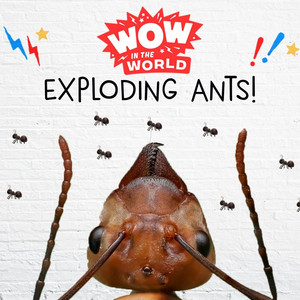
Take it you haven't heard of the newly named ant species now known as Colobopsis explodens.
Colobopsis explodens?
This sounds like something you'd make up, Mindy.
Only I'm not making it up, Guy Raz.
I just read about the colobopsis explotans in the journal Zoo Keys.
They were discovered by these researchers at the University of Vienna who gave them their name.
So you're saying that a new kind of ant was just discovered?
Well, scientists have known about exploding ants for like 200 years.
But the Colobopsis explodens are the first new species of exploding ants to be named since 1935.
So what causes these ants to explode anyway, and why?
Well, I could tell you.
Yeah?
But I'd rather show you.
Or you could just tell me.
Reggie!
Reggie, you...
Why does your breath smell like... Spaghetti, nacho, cheeseburger, pie-flavored exploding ants?
Reggie, what about the healthy, nutritious lunch I made for you?
Reggie said it tasted like bird seed.
It was bird seed!
So, Reggie, we need you to take us to the Borneo jungle in Southeast Asia, okay?
The jungle?
Now let me just grab my adventure toolbox...
And, oh, I'm going to grab these costumes I've been saving for the right moment.
And I'm going to take a quick bath and some bug spray.
And some horn frog spray.
Come on, Guy Raz.
And some orangutan spray.
What?
And, of course, hairspray.
Hairspray?
What, Guy Raz?
Mindy, flying on a pigeon always makes my hair go frizzy.
Get your caboose on this bird right now.
Come on.
I'm coming.
I'm coming.
I'm coming.
Okay, finally.
You ready?
Mindy.
Now hold on to your hair helmet, Guy Raz.
Because here we go!
What an adventure.
Nice tree landing, Reg.
You okay?
There is no such thing as a nice tree landing, Mindy.
Look.
How are we going to get down from here?
Thanks for the ride, Reg.
Hey, Roz, we're not getting down from here.
Oh, boy.
What have you gotten us into now, Mindy?
A tree.
I know we're in a tree, but why?
I thought we were coming here to witness some exploding ants.
Oh, we are.
The exploding ants we're looking for make their nests in the trees of this jungle.
Huh.
Okay, so...
How exactly are we supposed to know what we're looking for?
Well, first things first, I need you to put this on.
Why does everything always have to be a costume party?
Look!
I got one for me too.
Where did you even find these giant ant suits anyway?
My aunt, Mojo, made them for us.
I've been saving them for a special occasion.
Her aunt made them.
Get it?
Now, each costume comes with three parts, just like a real ant.
Let's see here.
We've got the heads, the thoraxes, which are the middle of the ant, and the abdomens.
Which are the butts.
Uh, more or less.
So here you go.
This part belongs to you.
And looks like this thorax belongs to you.
OK.
Putting it on.
There.
How do I look?
Ah!
Mindy, you look like a two-headed ant.
You look like a two-butted ant.
A butt for your head and a butt for your butt.
Mindy, give me back my head.
Gairaz, what makes you different makes you beautiful.
Mindy.
Now, ready to shrink down to the size of an ant?
No.
A la Kazimba, Sukamagant, turn Gairaz to the size of an ant.
Hey, Mindy, you look like a big, scary giant.
Aw, and you look like a little, tiny, crazen raisin.
Flo Ranch-flavored exploding ant.
Aren't you cute, Guy Fawcett?
I could just eat you up.
Don't you dare eat me.
Okay, better shrink down there with you, little buddy.
Alakabuki Mukamasindi.
Use this shrink wand to shrink me, Mindy. a shrink wand to unshrink our voices.
I don't know, Mindy.
I think I kind of like my voice like this.
You do?
I sound really cute.
Oops.
Better dial it back a notch.
There.
Still the size of an ant, but my voice is back to normal.
OK.
And now for myself.
Testing, testing.
That's better.
OK.
So now that we've got that all out of the way, time to go find some exploding ants.
You ready, Guy Raz?
Uh, so what exactly are we looking for again?
Ants.
I know what ants look like, Mindy, but what do these exploding ants look like?
There's nothing too extraordinary about the way they look when you find them in the wild.
I mean, they pretty much look like your average, everyday, tiny little red ants.
Ooh, look, I think I see some of them over there in that ant colony, Mindy.
There must be millions of them, and they look surprisingly busy.
Yeah, that's them all right.
Take these magnifying goggles, look closely, and check out the ones standing outside.
Notice anything strange about their faces?
Well, it looks like they don't have any big mandibles, those claw-like balls that are usually attached to an ant's mouth.
Good eye, Guy Raz.
Without these mandibles, these exploding ants aren't able to bite or sting, which makes them look like a pretty easy target for any larger predators with a big appetite.
Interesting.
And I'm noticing some patterns to how the ants move around that nest or colony.
It looks like there's a queen at the top, And then different sets of worker ants below her.
It's almost like a kingdom of ants.
Yep.
And every ant's got their own job in the colony.
Wow.
Fascinating.
So those little brownish red ants below the worker ants are the colobopsis explodens?
Yep.
Those are the exploding ants, all right.
So the exploding ants are at the bottom of the colony hierarchy?
Uh-huh.
Look at them marching outside the kingdom colony like tiny little guards on duty.
You know, Mindy, I'm starting to notice something.
Oh, yeah?
What's that?
Well, all of these worker ants, including the exploding ants, well, they all appear to be female.
Hmm.
How can you tell?
Well, they're wingless, for one.
And generally, the only ants that have wings are males and the queen ant.
Well, I guess that is the case in a lot of ant species, but...
What's up with that queen ant?
Well, the queen ant is the founder and leader of the colony and she lives deep, deep down within the colony, far out of reach of any predators.
Must be nice.
So what does she do all day?
It's her job to lay thousands of eggs, and from those eggs come all of the ant predators that then grow up to live and work in the colony.
Wait a minute.
So the queen ant has a bunch of ant babies and then makes them grow up to do all of her dirty work?
Well, that's one way to look at it.
See, every ant within a colony has a specific job.
Yeah, I know that.
But what exactly are all of these different jobs?
Well, some forage or search for food to bring back.
Some build the anthills or dig the holes.
Some protect the colony.
Man, busy little guys.
You mean busy little gals.
What?
Mindy, almost all of the ants we ever come across are female.
Whoa, so you're telling me that all of these little worker ants and soldier ants are gals?
Girls?
That's right.
The male ants are known as drones, and their only job is to use their tiny wings to swoop on into the nest, mate with the queen and then die shortly after.
But the females... Well, the females are actually stronger and larger than the male ants.
And in the colony, they pick up all the slack.
Once the males are finished with their job...
They die off, so we're left with females.
And since the females are doing all of the work and protecting the queen ant who lives deep down inside the nest, then pretty much all of the ants that we ever see on the outside are females.
That's right.
Whoa.
Most worker and soldier ants are girls.
What was that?
Oh, look.
Guy Raz.
Danger!
Dead ahead!
Run, run, run, run, run, run!
Roz, stop running in place!
We're not even the ones in danger!
Well, then who... See that menacing-looking beetle approaching the ant's nest?
He looks like he's ready to attack the colony, Mindy.
We should warn the ants crawling around in there.
Hey, ants!
Watch out!
Intruder!
Okay, Roz, stop screaming.
They don't even have ears to hear you.
Well, we've got to alert them somehow.
Let's stomp on the ground so they can pick up the warning vibrations.
No need for that guy, Roz.
But he's bigger than the exploding ants.
He could... Shh, just trust me.
Now keep it on the down low while we watch what happens.
Okay, well, the enemy is approaching the nest.
Yep, and the exploding ants are starting to plump.
They're latching onto that beetle.
Show them who's boss, call the Bob Sisters.
Oh, wait.
What are they doing now?
Are they... Sticking their butts up in the air?
But why?
And it looks like they're moving their stuck-up butt.
Butts closer to their predator.
Now they're flexing and squeezing their tiny bloated abdomens.
Mindy, if they don't stop flexing and squeezing, They're going to burst out of the walls of their own bodies and Explode.
What's all that bright yellow sticky goo they're spewing?
Goo!
Poison the predator.
Look, he's getting all tangled up in that gooey, poisonous mess.
Rest in peace, ferocious beetle.
Mindy, does that toxic goose smell like curry sauce to you?
Um, yeah.
Smells like my favorite Indian takeout place.
In fact, don't mind if I do.
Mindy, don't eat it.
Right.
Just because it smells like curry does not mean it is curry.
Remind me to tattoo that on my forehead when we get back.
Wow, that was intense.
Why would an ant explode itself in defense of a predator like that?
Well, Guy Raz, that's the thing about these ants.
They work together as a colony or group and have an agreement that the needs or in this case, the survival of the group is more important than the individual ants themselves.
These exploding ants sacrifice themselves so that the rest of the colony can survive.
Talk about sisters having each other's backs, am I right?
Well, Mindy, I think it's about time we get out of here before the queen ant puts us to work.
Yeah, plus this ant suit is so tight on me.
I feel like I'm about to explode out of it.
But first, we better unshrink ourselves.
Oh, right.
Shrink wand, reverse activate.
Much better.
Yeah.
Looking down at that ant nest, I'm realizing how... tiny these little creatures really are.
Yeah, it's amazing to think that each tiny ant running around is serving a purpose and cooperating with the other ants to pitch in and make sure that the colony runs smoothly.
If only those little colobopsis explodens didn't have to explode themselves to do it.
Yeah, it's a strange, wild world out there, Guy Raz.
Anyway, you ready to get out of here?
I'm ready, Mindy.
Reggie!
Hey, Reg, we're ready to head home.
But first, I'd like to make a little pit stop on the way.
A pit stop?
Yeah, you think we could just pop into a grocery store or a place that sells snacks?
Guy Raz, it's only been like three hours since you've had a dehydrated mung bean.
No, Mindy, I was thinking that maybe we could get a bag of those, you know... You know what?
A bag of those exploding ants we saw on TV earlier.
Wait a minute, that whole episode we just witnessed...
Made you want to eat the exploding ants we saw on that TV commercial?
Well, it's just that that spicy smell from the yellow goo actually made me kind of... Hungry?
Well... Man.
Well um oh, they do have a new yellow curry nacho meatball-flavored variety.
Pack of exploding ants.
It's limited edition, so... An explosion of flavor and fun!
Wow, I thought watching an actual ant explode itself was going to be the weirdest part of my day.
What's that, Mindy?
Oh, nothing.
I was just saying, here we go!
This message is for you.
Our Wow in the World toys help your wowzer learn about their world through play.
Plus, you can hear exclusive audio content from me and Guy Raz to help your wowzer discover even more wows.
Grownups.
Give the gift of wow and wonder this holiday season with our latest Wow in the World toys designed with your curious wowzer in mind.
You can shop our Wow in the World toys at Tinkercast.com slash toys.
That's Tinkercast.com slash toys. show.
Hi, thanks for calling Wow in the World.
After the beep, get ready to record.
Hi, Mindy and Guy Raz.
My name is Anna Sophia, and I live in Flowery Branch, Georgia, and I'm seven years old.
My wow in the world is that narwhals can have two tusks and it like a long tooth that grows out of their mouth.
And it's really cool.
Bye, Mindy and Guy Raz.
I love your show.
Kia ora, Guy Raz and Mindy.
My name is Lucy and I'm eight years old.
My name is Ollie and I'm ten years old.
We live in Auckland, New Zealand.
And my wow in the world is that cows' farts cause most of the climate change.
My wow in the world is that swaths are the first mammals in the world to.
They are so slow.
Sometimes they grow moss.
Thank you, we love the show.
Hi, they are.
Hi, my name is Leo.
I'm from Butevi Illinois, and my wow in the world is that in Africa they speak over 1500 languages.
Hi, Kairos and Mindy.
I'm Amosa, and I'm 11 years old.
I live in Houston, Texas, and my wow in the world is about the singularity.
Singularity is when robots get as smart as humans.
Bye, Guy Raz and Mindy.
Love your show.
Hi, Mindy and Guy Raz.
My name is Jake, and I live in Rehoboth Beach, Delaware.
But I was born in Scotland.
And my wow in the world is that peanut butter can be turned into diamonds.
Bye, and I love your show.
Hi, Guy Raz and Mindy.
My name is Naomi. and I live in New York City.
My wow in the world is that my mom has anesthesia.
Hi, Mindy and Guy Ross.
My name is Charlie.
I live in Dexter, Michigan, and I'm eight years old.
Hi, Mindy and Guy Ross.
My name is Chloe, and I'm five years old.
And our wow in the world is that if you shine a black light under a scorpion, then it glows.
Bye, Mindy and Guy Ross.
Wives, wives, we love you.
End of messages.
Hey, everyone.
Thank you so much for joining us this week on Wow in the World.
And if you want to keep the conversation going, check out some of the questions we posted on this episode at our website, wowintheworldcom.
And grownups.
There you can find more details on how your kids can become part of the World Organization of Wowzers.
Lots of cool perks there.
Exclusive t-shirts, autographed pictures of us, and a bunch of other cool stuff.
Wowintheworld.com.
Our show is produced by Jed Anderson.
Say hello, Jed.
Hello.
With help from Thomas Van Kalken, Chelsea Erson, and Jessica Bode.
Meredith Halpern-Ranzer is the big boss.
Our theme song was composed and performed by The Pop-Ups.
You can find more of their awesome all-ages music at thepopups.com.
And parents and teachers, if you want to send us an email...
Our address is hello at wowintheworld.com.
Grownups, you can also find us on Facebook, Twitter, and Instagram at wowintheworld.
And if you want to be featured at the end of the show, call us up and tell us your wow in the world.
Our phone number is 1-888-
And parents.
If you want to upload any photos or videos or messages to us, please visit wowintheworldcom and find a link where you can do just that.
And if you haven't already done so, please subscribe on Apple Podcasts, or however you get your podcasts.
Leave us a few stars and a review and be sure to tell a friend about the show.
Until next time, keep on wowing.
Wowing.
And before you go, tell us about yourself by filling out a short survey at wondery.com slash survey.