When was the last time someone asked you about a big decision you made, like in a conversation with a friend or even in a job interview, when someone wants to know why you moved, why you turned down that job offer or how you determined the best way forward on a difficult project?
In that moment, you might have heard one of these questions.
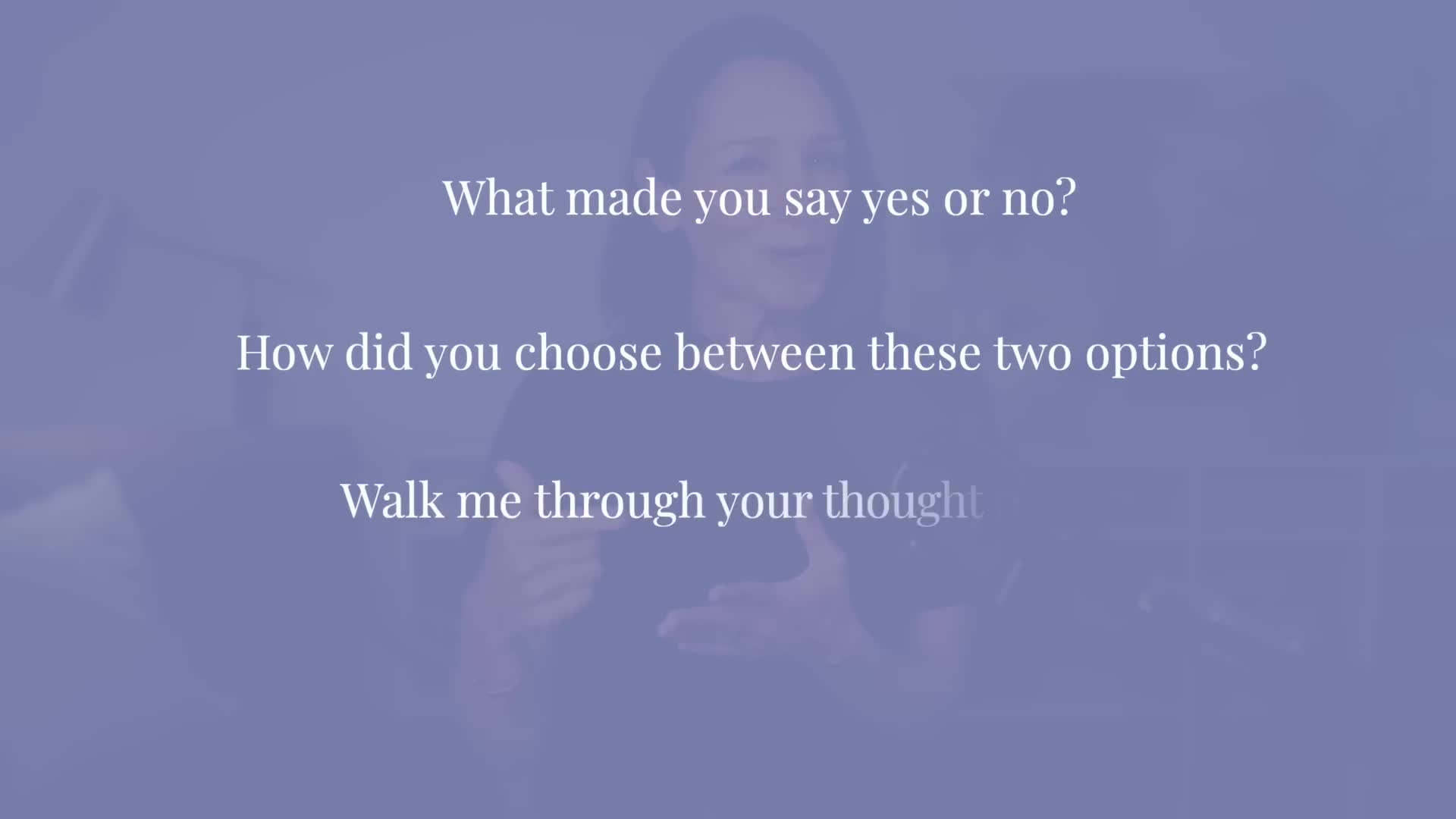
What made you say yes or no?
How did you choose between these two options?
Walk me through your thought process.
Or what factors did you consider?
And of course, you know exactly why you made the decision you made.
You know what mattered to you at the time.
But explaining all of that in English, that's where things get messy.
Maybe you're not sure what someone really wants to know or what they should know.
What details do you need to share?
And how do you get it all just right?
Today I want to walk you through a simple method to organize your ideas in English so you can talk through a decision clearly and confidently.
Now the truth is, any English speaker, native and non-native alike, can struggle to explain a difficult decision clearly.
Because, in the moment, you're thinking about how to respond, trying to organize all the information in your mind and speaking all at the same time.
So it's easy for your message to get muddled or lost completely.
And that's why structure matters.
When you know how to shape an answer, what you say first, what to leave out, how to wrap things up, your thinking becomes clear.
To help you with this exact situation, explaining your decisions clearly in English, my team and I created a method called STEP.
It's a simple four-part structure that you can use.
Anytime you need to talk through a decision.
And here's what it stands for.
S is for set the scene.
T is to tell your thought process.
E is to explain the options.
And then finally, P is to present the decision you made.
This method works whether you're updating a colleague, sharing a personal choice with a friend or reflecting on a decision in a group conversation.
It gives you a quick way to organize your ideas and speak with clarity, confidence and control.
So now let's walk through each part of that method, one step at a time, with useful English phrases, natural expressions and real examples that you can use.
So let's start right away.
Step one, set the scene.
Before you explain what you decided or why, you have to give a little bit of background.
What was going on at the time?
What possibilities were you deciding between?
If you skip this part, your answer can feel confusing, like you're jumping into the middle of a story and the other person has to figure out what is this story about?
So your first job in explaining a decision is just to give the context, the background.
And here are a few simple ways to start.
First, I was faced with, or I found myself in a situation where.
And here's one more.
The decision I had to make was Each one of these is a clear, direct phrase and they give the listener a starting point.
You can also use a couple of useful expressions, things that native speakers say all the time.
For example, I was in a quandary.
That means that I didn't know what to do at the time.
I had to make a tough decision.
Or everything was just up in the air.
In other words, nothing was decided yet.
I was still figuring things out.
And here's one more that you're going to hear often.
I was trying to keep my options open.
This means I didn't want to make a decision too quickly.
I wanted to see what all the possibilities were before choosing.
And here's a quick example of what this step might sound like when you begin to explain a decision you made.
I was faced with choosing between renewing my work contract or taking a sabbatical.
And that's it.
That's your setup.
And here's why this matters.
It doesn't just help your listener have that context.
It helps you too.
When you start with a clear picture of the situation, it's easier to keep going.
Instead of trying to explain everything all at once, you just start with the situation you had at the time.
This gives you control.
And from there, it's easier to follow each step with clarity and confidence.
Once you've set the scene, the next step is to tell your thought process.
What was going through your mind when you were making that decision?
This is where you can share what you were thinking, how you were feeling or even who you talked to in the process.
And you don't need to explain every single detail.
You just want to highlight what influenced your thinking.
And here are a few natural ways to do that.
You could say, at first I hesitated because… or I was on the fence about it.
I talked it over with… or I needed to sleep on it.
I want to explain a couple of those.
Let's talk about I was on the fence.
What that really means is you were undecided.
You could see the pros and cons of both sides of the issue.
So you were really unsure of which way to go.
And then the second one I want to talk about is I needed to sleep on it.
This is what we say when we want to Wait for the next day to really decide.
We want to give a little bit of extra time and space to think before we have to make a decision.
Another expression that's wonderful for this part of the process is I was of two minds.
This shows that you were feeling pulled in two different directions.
Again, you could see the benefits of both options, and it was hard to decide which one was best.
And similar to that I wanted to sleep on it example.
You could also say I wanted to give it some thought.
This is another way to say I don't want to rush into a decision.
Now, here's what some of these might sound like in a real conversation.
You might say I was of two minds at first, but then I talked it over with my mentor and decided to sleep on it before making the final call.
When you're explaining a decision that you made to someone.
This part of the process, this step, makes your decision process a little bit more human.
It shows the challenges that you might have gone through in making the final call.
It helps your listener understand that you didn't just decide instantly.
Instead, you thought through it carefully.
That's what this step is all about.
Okay, once you've shared your thought process, the next step is to explain the options.
This is where you help your listener understand what you were deciding between.
What were the pros and cons?
Again, you don't need to explain every little detail, but you do want to show that you considered your options carefully.
And here are a few ways that we do that.
First, I weighed the pros and cons.
Or, I considered both sides before making the final call.
The turning point was when.
Again, let's talk about each one of those a bit.
When we say I weighed the pros and cons, it means that you thought through the good and the bad of each choice.
And then when we say the turning point was this is a great way to highlight the moment that something shifted.
Something became clear to you, and it made the decision that you needed to make easier and more obvious.
You'll also hear people use expressions like at the end of the day, which means when everything was considered, this one thing is what mattered the most.
This is the thing that helped you make that final decision.
Another one is, it was kind of a no-brainer.
This means the right choice was clear.
You really didn't have to work hard in weighing the pros and cons.
And here's another.
I decided to play it safe.
This tells your listener that you chose the more cautious or secure option.
You didn't want to take any risks.
And now here's an example of how this step might sound in your explanation of a decision.
At the end of the day, I realized that staying in this position would be more secure, but leaving this position aligned better with my long-term career goals.
That one sentence shows both sides of the decision and it helps the listener understand what you were thinking about at the time.
This is what this particular step is all about, making your decision process visible.
Not just the final outcome, but how you got there.
And now the final step in explaining your decision is to present that final decision that you made.
This is where you clearly state what was decided and why.
At this point, you've already given the context.
You've shared what you were thinking at the time and the options you were weighing.
So now it's time to share the most important piece of information, the decision you made.
And here are some ways that we tend to do that.
In the end, I decided to.
Ultimately, I chose to.
After thinking things through, I settled on.
And looking back, I'm glad I Now, in addition to those common sentence starters, you might also hear expressions like these
I took the plunge.
This means that you finally did something that you were nervous about, but you made the decision to go for it.
Or I trusted my gut.
This means that you followed your instincts or your intuition.
Another one is I made a snap decision.
This tells the listener that you chose quickly, without overthinking or overanalyzing every single little detail.
And finally, I made up my mind.
This simply means that you reached a final decision.
So, once again, let's look at an example of how we might use these expressions to help us wrap up the final step in explaining a decision.
I trusted my gut and took the plunge.
And looking back, I'm really glad I did.
This last part wraps everything up.
It gives your listener a clear answer and it shows confidence in the choice that you made, even if the decision itself wasn't easy.
And that is the full step method.
You now have a clear, repeatable way to explain a decision that you've made from start to finish.
Of course, knowing these steps is one thing.
Actually using them aloud in real conversations is That is something else.
And now that you've seen how this method works, you might be thinking okay, I get it, but how do I actually get better at doing this in conversations?
And that's where practice comes in.
It's exactly what we focus on inside the Confident Women community.
In the CWC, we take real-life situations, real-life topics just like this one expressing a decision, setting clear boundaries or sharing an opinion and we break them down into the exact English you need to participate, to speak up aloud with clarity and confidence.
And then we practice in real speaking practice with real people in a safe, supportive community.
So if you're ready for more of that, if you want to get better by doing, not just by watching, I'd love for you to check it out.
You can learn more at speakconfidentenglish.com slash community.
And I'll leave a link for you in the episode notes below.
Now, of course, if you want a little practice right now, here's how you can do that.
I want you to think of a decision that you've made recently.
It doesn't have to be a big one.
Maybe it was about how to spend your weekend time, or what to cook for a group dinner, or whether to say yes or no to something at work.
Whatever it might be, I want you to use this step method to tell your decision story.
Start with S, what was the situation?
And then T, what was going through your mind?
Tell the decision process.
Then E, what did you weigh or compare?
Explain the options that you had.
And finally, P, what did you decide and why?
And if you want to take it a step further, you can share your example in the comments below.
I would love to see how you use this method to explain your decision.
With that, thank you so much for joining me today.
And if you found this lesson helpful, I would love for you to follow or subscribe wherever you're watching or listening from today.
You can also share it with someone you know who needs it.
Thank you again, and I look forward to seeing you next time.