This is Planet Money from NPR.
Malia Bamsuin is a composer slash bassist slash singer-songwriter.
She plays different genres from jazz to rock.
She actually just performed two shows with cellist Yo-Yo Ma.
And Malia says that a few years ago, she remembers ticket prices for other bands going up to $150.
And I was like, wow, I'll never charge more than that.
I remember saying that to myself, like, that's insane.
Like, I still want to be able to reach people who actually can't afford a $150 ticket, you know?
And I think it's important to be able to choose your audience that way and not just, like have your own success, curate an audience that is of a specific income bracket.
Live Nation CEO Michael Rapinoe, though, has a much different view on ticket pricing.
Live Nation is the parent company of Ticketmaster.
And Michael Rapinoe said last month that concert tickets are underpriced and have been for a long time.
That comment was tough for a lot of music fans to swallow.
I mean, take Bruno Mars. is playing two shows in Las Vegas in December.
I went on Ticketmaster yesterday and the cheapest seat I could find was $850.
Ticket prices going to Mars.
Maybe that example is on the higher end, but the price of concert tickets has gone up faster than overall inflation.
And the ticket market is this economic puzzle that continues to bedevil fans, venue owners and artists.
Hello and welcome to Planet Money.
I'm Jaron Woods.
And I'm Waylon Wong.
We're hosts of Planet Money's daily podcast, The Indicator.
With rising inflation, consumer prices up, job growth slowing, Americans are feeling the financial squeeze.
So we're doing an occasional special series on the rising cost of living.
Today, we bring you two stories from that series.
First, how the strange economics of the ticket market has given rise to reseller bots.
They're considered an industry scourge that makes prices higher.
And yet, in the world of economics, they do have a function.
We go through the arguments for and against the ticket bots and why it's so hard to get rid of them from the ticket market.
We travel to one state that is battling the bots.
Then after the break, we'll hear why pet care costs have surged too.
The answer goes deep into econ nerdery.
This message comes from NPR sponsor Adobe.
Introducing the all-new Adobe Acrobat Studio, now with AI-powered PDF spaces.
Need to turn 100 pages of market research into five insights with a click?
Templates for a sales proposal that'll close that deal?
Or an AI specialist to tailor the tone of your market report?
You can do all that with the all-new Adobe Acrobat Studio.
Learn more at adobe.com slash do that with Acrobat.
This message comes from ServiceNow.
People should do the creative work they actually want to do, not boring busy work.
Now, with AI agents built into the ServiceNow platform, you can automate millions of repetitive tasks in every corner of your business IT, HR and more.
So your people can focus on the work that they want to do.
That's putting AI agents to work for people.
It's your turn.
Get started at servicenow.com slash AI dash agents.
Lauren Wayne can tell when the ticket reselling bots show up.
It's easily recognizable, but it causes a lot of pain and suffering.
Lauren runs the State Theater in Portland, Maine.
It's a historic venue that's been a vaudeville house, an adult film theater, and a dinner theater.
Today, it's a concert and event venue.
And in the last few years, that has meant constant battle with the bots.
Lauren has learned to spot their activity.
If we see tickets on the secondary resale sites that they're selling before we go on sale, that's obviously a red flag.
Those tickets are called spec tickets.
They show up on sites like StubHub and SeatGeek and they don't exist, despite both those companies having policies against them.
So that's one telltale sign of bots.
And then, once ticket sales do get underway, Lauren looks for other signs like 500 tickets getting bought overnight.
They've been purchased by... bots who are not even people.
It's just technology just grabbing whatever they can.
Lauren's theater has a capacity fewer than 2,000.
So a bot that grabs 500 tickets at once is wiping out a huge chunk of tickets that could have gone to fans.
Lauren says when this happens, her staff has to manually void the purchases.
They refund the money and then return the seats to the regular inventory.
It's time-consuming work.
And There is another problem.
Resellers sometimes offload those tickets to fans anyway.
That fan doesn't know that the ticket that they bought has been voided.
So when they show up to the show that night, their ticket can be denied.
There's nothing sadder than having someone show up at their favorite artists and thinking that they're going to get in and they don't get in.
Not only that, but the buyer might have paid three or four times more than face value.
These kinds of horror stories are what makes fans, artists and venue operators super frustrated with ticket reselling.
There's actually a federal law meant to curtail illegal bot activity, but that hasn't stopped the problem.
So there's a lot of finger-pointing when it comes to the secondary market.
The obvious villain is the resellers who operate the bots.
Then there are big online resale platforms like StubHub.
It's being criticized for not doing enough to police bot activity on its website, while also benefiting from those sales.
We reached out to StubHub, but didn't hear back.
In a recent interview with Axios, though, its CEO says the company has publicly lobbied for stopping bots, and its website says that customers will get their money back if their tickets aren't valid.
The Federal Trade Commission and seven states have also accused Ticketmaster of being part of the problem.
Ticketmaster controls 80% or more of the major concert venue's primary ticketing market.
But it also allows customers to resell tickets on its platform.
In September, the FTC sued the company.
It said Ticketmaster was coordinating with resellers and profiting from the sale of marked-up tickets.
Ticketmaster and its parent company, Live Nation, deny the government's accusations.
And the companies say they've invested over a billion dollars on ticket security and anti-bot technology.
Now, no matter who you want to blame the most, the secondary ticket market does serve an economic purpose.
That's according to Alan Sorensen.
He's an economist at the University of Wisconsin-Madison who has studied this market.
Tickets are so often mispriced in the primary market Especially, I think, for music concerts, because artists have some control over the pricing.
I think many artists imagine that by setting low prices they're doing their fans a favor.
And that leads to sort of you know, funky things.
Among other things, that leads to a really active resale market.
Here's what Alan means by mispricing.
Think of a perfectly efficient free market where a good is sold at a price where supply meets demand.
If that doesn't happen though if say, an artist prices tickets below that equilibrium level, then the secondary market will correct that mispricing.
It might feel like the price really shouldn't be $250 for that ticket.
But if it sells in an open free market for 250, then yes, that kind of is the market price, whether you like it or not.
Now, before you start waving your pitchfork at Alan, he does acknowledge that there are many problems with how ticket markets function.
Like, let's say an artist prices their tickets below that maximum that a fan is willing to pay.
That fan ends up spending more than face value on a resale site.
Now that's all profit that goes to a reseller instead of the artist or the venue, and that can feel crummy.
I was trying to think like how could an artist guarantee that they're just granting a bunch of surplus to their fans?
Someday maybe some artist will experiment with this, where they will charge high prices for the concert but then just give out tons of awesome stuff to the people who actually come.
Okay, like get the t-shirt cannon out.
Yes, the t-shirt cannon would go wild, you know, and it would have better stuff than t-shirts.
Someone should definitely give Ellen a research grant to try this.
But in the meantime, venue operators are pushing for state laws to combat what they say are predatory ticketing practices.
The National Independent Venue Association is an industry group that helped get laws passed in Maryland and Maine over the last couple of years.
Lauren Wayne was part of the effort in Maine.
The new law bans bots.
It also makes spec tickets illegal.
Those are the ones that resellers advertise but don't actually own.
And Maine now has a 10% resale cap on live event tickets.
And Lauren says this cap is important because it cuts down on price gouging.
A regular fan who bought a ticket and then gets sick or changes their mind can still resell that ticket to another fan, as long as they don't mark it up more than 10.
StubHub now asks sellers in Maine to confirm that their ticket prices are within the legal limits.
And at Lauren's theater.
If her customers spot any activity that looks like it's violating the new law, they can fill out a form that gets sent to the state's attorney general's office.
And remember how Lauren says her employees would have to manually scrub ticket transactions to cancel the bot purchases.
She hasn't had to do that since the law went into effect in September.
So that's great news for Lauren.
But she does acknowledge that Maine's victory has probably pushed the bot problem to another state with looser laws.
That's why we're encouraging that every state try to enact tougher ticketing legislation, because they're just going to move to the easiest market.
Darren, you know what you can do at Lawrence Theatre if you want to avoid dealing with ticketing websites.
Just full stop.
What?
You can go in person to the box office.
No fees.
I'll get my tent ready.
Next up, the rising cost of pet care.
During the pandemic, you may have noticed that people fell in love even more deeply with their pets.
Or maybe you're included in that.
Well, that increased demand is contributing to higher prices.
But there's a lot more to it.
After the break, what is behind the rising cost of care for our furry or feathered or scaly friends?
And we have an economic theory that helps explain what's going on.
Adrian and I pick up the story after the break.
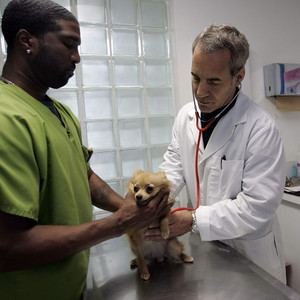
Paying for healthcare isn't just a problem for people.
In the past few years, the cost of healthcare for pets has actually been surging.
For a point of comparison, get a load of this stat.
According to the Consumer Price Index, which tracks the price of goods and services, Overall prices in the economy are about 25 higher today than they were five years ago.
But over that same period, the cost of veterinary services increased by about 41%.
Yeah, that is a steep increase.
And according to a recent Gallup survey, most pet owners say they have skipped necessary vet care because of the cost.
So what is going on here?
Adam Hetchko loves the unpredictability in veterinary medicine.
Vets might have to treat a dog and a cat and a snake and a flying squirrel all in one afternoon.
I do everything, but surgery is my thing.
We helped a pet this week that had a foreign body and an obstruction, had eaten a toy.
Adam runs an independent veterinary practice in Cleveland, Ohio.
Can I ask what kind of pet and what kind of toy, or is this like a HIPAA violation?
This one was a squeaker toy.
So the little squeaky thing that comes out of a stuffed animal, those little discs.
Yeah, they go hee-hee.
So the dog had pulled out that, swallowed it whole, and it had gotten stuck.
It was a lab.
And labs are known for being silly and eating things sometimes.
The dog's name is Callie, by the way, and Adam says she's doing great now.
Even though Adam loves his job, he knows the rising price of veterinary services is a problem.
My sleepless nights are because I want to deliver the best service I can for the best value that I can.
Sometimes some of that is out of my control.
So we asked Adam straight up, what's up with the soaring cost of vet care?
And here's the headline.
Adam says the costs of operating a practice have just gone up a lot.
Medication is more expensive, thanks in part to tariffs.
For the same reason, medical supplies like bandages, gowns, and syringes are more expensive.
Adam says a box of exam gloves costs more than twice what it did just a year or so ago.
But maybe the biggest cost pressure Adam says has been the cost of labor wages for veterinarians and support staff like nurses and office managers.
Our labor costs have gone up significantly over the last few years.
And in veterinary medicine, many practices, that labor cost exceeds 50% of our overall costs.
In a way, what Adam is describing here is a perfect example of a classic economic idea called Baumol's cost disease.
This is one of my favorite economic theories.
Yes, this is like an econ nerd deep cut.
Baumol's cost disease is a theory devised in the 1960s by two economists, William Baumol and William Bowen.
Okay, Bill Baumol and Bill Bowen?
That's right.
We got...
BB and BB.
The two BB kings.
And according to the two BBs, there are certain industries that get a lot more productive each year thanks to advances in technology.
Things like manufacturing.
And then there are industries where productivity is really hard to increase because the jobs are just so inherently dependent on human labor.
Yeah, and this explains why, over time, we've seen big screen TVs and computer software become cheaper, but certain services that require human labor have gotten more expensive.
There isn't yet a robot or an AI in the world that can watch your kid or administer an IV or unclog your toilet.
Or remove a plastic squeaker disc from a dog's insides.
Yeah, I don't think I would trust that to a robot.
Not yet.
And if we as a society want people to become caretakers and nurses, plumbers and animal surgeons...
Wages for those jobs have to rise over time.
Otherwise, a lot of people that might have chosen to do those jobs will choose to do something else.
And that is Baumol's cost disease in a nutshell.
So Baumol's cost disease helps explain the rising cost of pet care, but it doesn't give the full picture.
There are a couple more factors we haven't yet talked about.
One is the influence of corporate ownership.
In recent years, veterinary care has been increasingly taken over by private equity firms, and vets who work at corporate-owned practices are under significantly more pressure to generate profits than those who work at independent ones.
That's according to a 2023 study.
If you're interested, we did a whole episode on private equity and pet care which we'll link to in the show notes.
Finally, one more reason people are spending more on pet care is that many pet owners are just willing to spend more on pet care.
Adam Henchko says he's noticed a shift in the culture of pet ownership compared to a few years ago, and he chalks it up to pandemic lockdowns.
When people were isolated, some of the only social interactions that people had or companionship was their pets in their house.
And leaning on them to get through some of those challenges, I think only strengthened the bond.
And once you strengthen that bond, there's definitely a change in how you look at the care of your pet.
The shift to remote work meant many people were, for the first time, spending all day with their pets.
So they became more attuned to their fur baby's every hiccup or odd behavior.
And Adam believes that's made many people more willing to pay for the very best care they can afford to keep their pet healthy.
So I think pet owners are driving some of that up because they're looking for more options and more services relatively expensive services like annual blood testing or sonograms or procedures that can cost thousands of dollars.
So let's recap.
Vets are facing higher costs for supplies, medicines and employees.
Some are under pressure from their bosses to be more profitable.
And some pet owners are just willing to pay a premium for a premium level of care.
But for those who can't.
There are still a lot of people who are being priced out of veterinary services.
It's stressful because I want to be able to do everything I can for the pet and my team wants to be able to do everything they can for that pet.
And it's hard sometimes when we can't.
And I think what's even harder is when we get the comment well, you're just in it for the money, or you don't care about my pet.
That cuts me deeply when I hear that.
When I was seven years old, that's not why I chose to do this.
I chose to do this to help animals, to support the human-animal bond.
Adam did have some advice.
He says get to know your vet and take your pet for regular checkups to help spot health issues before they become serious and more expensive to treat.
And he says you could consider buying pet health insurance.
But we should say those policies are not cheap.
Often they can run several hundred dollars a year.
And like pet care in general, the trend is that they're only getting more expensive each year.
These episodes were originally produced by Angel Carreras.
Cooper Katz McKim produced this episode.
It was engineered by Robert Rodriguez and fact-checked by Sierra Juarez.
Kate Concannon edits The Indicator.
Alex Goldmark is our executive producer.
This is NPR.
Thanks for listening.