This is Roundtable.
Hainan, China's absolutely stunning southern island getaway, has gotten plenty of attention for its beautiful beaches and climate.
But now the island is getting attention for a more delicious reason we can say.
The planting of exotic fruits could help with rural revitalization.
We'll look at the challenges and opportunities that come with such an undertaking, and find out what other regions can learn from Hainan as well.
Coming to you live from Beijing, this is Roundtable, I'm Steve, and for today's show, I'm joined by Neo Honglin and Lai Ming.
First on the program.
Recent reports highlight Hainan's cultivation of exotic fruits as an innovative rural revitalization strategy, capitalizing on the province's favorable climate to create new agricultural opportunities and boost local economies.
While this approach demonstrates significant potential through increased farmer incomes and market expansion, it also faces challenges, of course.
But those challenges offer valuable lessons for other regions to develop tailored solutions, their own tailored solutions, based on their own geographical advantages and market conditions.
Good afternoon, Lai Ming and Ngo Hong Lin.
Today we talk exotic fruits, and I, for one, am a fan.
Yeah! Super delicious.
I love going to the market and going, ooh, what's that?
Ooh, what's that? Let's get one and try it out.
I was off -air on another day, Ngo Hong Lin.
I was bragging to you about my discovery of mini mangoes and I'd never seen those before.
I asked you, do you know what those are?
And you said, yeah, of course I know what those are.
But that's just a little bit.
Just an example of what we're talking about here today.
Yeah. We're talking about things that you and I probably haven't seen.
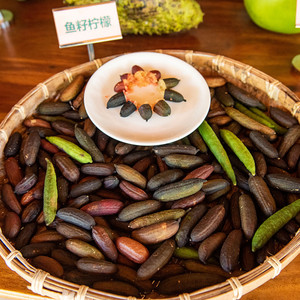
And I'm talking about Australian finger lime.
Have any of you any idea what they are?
I had to look it up.
It looks like to me, from my Western perspective, a jalapeno pepper or a giant pod of peas.
But the peas would be about seven times the size of the average.
It's kind of a plump, tiny little green thing.
I'd never seen it before.
It looks like vegetable.
And I would not call it lime if I do not have the information.
No, no, no. It looks like a vegetable.
What's the right word for chiu kuei?
Ah! No, we don't have the vocabulary for that for now, at least for the show.
But it's a common vegetable, both in Chinese and Western cuisine.
So the shape is like it's an elongated thing and it's green, some water, brown or orange really depends on the maturity of it.
And it's very sour, more sour than the lemon you would put into your tea or sashimi which is why the top chefs they prefer them because they go very well with raw fish, salmon, and stuff.
Very nice! And steaks.
But the thing is, well they grew in Australia originally and they are picky about the environment.
They couldn't survive under temperatures below 10 degrees Celsius.
If you put them in such an environment, this might affect the yield.
It takes a long time to cultivate and usually about five years.
In the year 1977, China started importing this fruit and tried to cultivate it.
Still, it's not there yet in terms of the product, meeting the local Chinese people's demands, so now Hainan is thinking about expanding the growth of it.
Another example is Central American Yellow Pataya.
Another fruit that I had never heard of before and had to look up.
This looks like a yellow dragon fruit to me.
It's precisely yellow dragon fruit, but it's rare, and it's also very picky with the environment, not only does it require one temperature environment to thrive, it also demands the soil to be somewhat acid with a rich ingredients of nitrogen content.
So it's picky, it's a picky fruit.
Yes, it's a picky fruit.
It's not easy to grow.
The price can be several dozens times the average red dragon fruit, so it's rare and it's expensive, and it also contains very valuable nutritional factors.
One more example is West African Miracle Fruit.
Take a guess, why is it called Miracle Fruit?
I don't know do you have the answer?
Because it has the magic of turning sour fruit into sweet.
I feel like I just listened to a TV commercial.
Yeah if you taste it for like a two microgram or milligram I couldn't remember the the unit, but a small taste of the American food might help you experience and taste sour food in the flavour of sweet, so if you if you taste this and then you go for finger lime you'll feel like this is so sweet.
Oh the combination!
So interesting and actually you can find all the these fruits in the window of world tropical fruits park, yes that's the name of the park, not the nickname I gave and it is located it in the countryside of Chilhai in South China's Island province of Hainan.
Actually this vast kingdom of tropical fruits spans 1000 Mu, which is about 66 hectares.
It is home to an astonishing variety of exotic fruits from around the world.
And when I say astonishing number, I'm actually talking about nearly 700 types of tropical fruits from over 50 countries and regions.
They have been introduced to the park so far and 420 of these varieties were introduced to China for the very first time, with 380 of them proving successful in trial cultivation, and I took a look at the websites of this place and I found that currently you can already book some fruits from the website, meaning that they would send a box of the miracle fruit to your doorstep.
You can order directly from the park.
you can order directly and another thing you can do.
That's the next thing I do when we finish the show.
Yeah right. And another thing you can do is to buy a sampling of that exact plant.
I do not recommend you to plant it in your garden because you might not know exactly how to cultivate it but when you do that you can actually on the website they say that there are successful examples of farmers using these different plants to be to bringing better income.
And they say that the simplings are strong with vitality and if you gain if you receive one, which is not good enough, they would send you a new one.
Nice. And they also provide services from experts helping you to cultivate the plant.
Oh, that's that's great service.
a product quality guaranteed too, by the sounds of things.
This has really helped boost the local agriculture industry then.
You talked about 700 types of tropical fruits, 50 countries represented, 50 regions represented, and 420 different varieties introduced to China for the first time, and a lot of them proving successful.
So this has done a lot for the industry and I'm guessing that this has helped bring people to the park, too, to the island in general?
Yes, actually in 2019, we see an example of someone surnamed Chuan, she used to toy in her own orchid.
And in 2019, she learned that the park was recruiting farmers to pick fruits.
So she thought that she could work for them without affecting her own farm work.
So what she does is to, again, working her own farm.
but see this as a side job.
So this is one way of working and another way of benefiting from the park is like I said you can actually get a seedling of the park and then put it or plant it in your own orchid and that is another chain of business.
The Zhonghai Tropical Crop Service Center, they are operating on a model consisting of enterprise, cooperatives, and farmers.
I like to stress the about cooperatives and farmers.
That is to say the center they give or sell seedlings to the local farmers and teach them how to grow and cultivate these plants so that they can earn extra income based on these exotic and soon to be very popular fruit products over the market.
This is an interesting business model that doesn't often apply to other industries because you have this massive park, which is its own business, correct?
But then they support the local community through education, providing services, providing materials for local people to have their own success.
I'm trying to think of another industry where this applies and I'm having trouble doing that.
I don't think it's that uncommon here in China because we've seen examples of in certain counties, for example, or certain villages, because of this one factory, one very successful company, people wanted to expand the business in the company.
So they would, I mean, that successful company would introduce their technologies to people in adjacent counties or adjacent villages, and then by using them as the upper link of their industrial line or the lower link of their industrial line, they actually improve their own business environment by helping others.
This is the legacy of the massive scale of poverty alleviation projects that China had been pushing over the past few years.
And in many cases, the regional governments and businesses had to be very inventive and innovative in coming up with the unique ways to help boost income for the local villages.
A lot of the thinking behind it was to try and encourage farmers and villagers to stay where they are instead of looking for employment elsewhere in big cities.
When they move and when they migrate to look for jobs, they often leave their kids behind.
If there are business opportunities where they live then that really helps.
So this cooperative and this cooperation between business and farmers is I think a legacy of what will prove to be successful in the past few years.
It's a great idea. Pineapples are very well represented on Hainan as well, are they not?
Yes they are actually according to a report by China Food News we see Cheung Mai County, It is a core production area of pineapple in Hainan.
And now the pineapple planting area of the County has exceeded 30 ,000 moo, which is around 2000 hectares with an annual output of about 70 ,000 tons and an output value exceeding 500 million yuan.
That is almost 70 million US dollars.
And the products are exported to mega cities, such as Beijing and Shanghai and a pineapple farmer, Sanan Yuan, said, one move of land can produce 3 ,500 kilometers of pineapple with an order purchase price of six yuan per kilometer.
So that's - Kilograms, thank you, and that is really good income for her family already.
Yeah, and that model is proven to be successful then, hasn't it?
The county, they follow that model consisting of enterprise and cooperatives and farmers so that a person in charge of a township pineapple production cooperative, they know that farmers can reduce planning costs by about 20%.
They can increase the rate of high quality fruits to over 90 % by unifying seedling supply.
And then you have your technical guidance from those who know.
And then brand support, too.
It's a business ecosystem.
Definitely. Actually, another example is not from the park we talked about, but a high -cool Jingluo Guo fruit production and marketing cooperative, they actually cultivate more than 20 ,000 moo of lychee trees.
And last year their sales exceeded 100 million yuan, helping 4 ,000 surrounding farming households increase their income.
So it's the same idea with one of these—Oh, because the example I just mentioned, the fruit production and marketing Cooperative.
What they do is not only to cultivate the Lychee trees but also to find and to cultivate different types of subspecies of Lychee.
Actually, they have already successfully their base trial planting area has already cultivated more than 50 Lychee varieties and they would sell the different varieties to local farmers so they can choose the ones they like and benefit their household income.
So each fruit is kind of like its own industry?
Yes, yes. And the advantage of having businesses working with farmers is that, like Neu Halling said earlier, they can expand the upper and lower reaches of the industry.
The China Food News reports that leading pineapple enterprises have also introduced intelligence sorting equipment to classify and package pineapples according to weight and sugar content, increasing their added value by 30 percent.
and e -commerce empowers the industry as well.
Through cooperation with e -commerce platforms, the country can deliver an average of over 20 ,000 orders of pineapples a day during peak season.
And also, given the size of the production output there, maybe there's not enough time for farmers to sell them all together.
So also they need to process the raw material before they're sold.
So, yeah, so pineapple cakes, pineapple jam, we can actually choose another products.
Yeah, you name it. You know what?
The window of road tropical fruits?
You can actually see a lot of different types of fruits through the window.
What I'm saying here is that it's not only a farm land or orchid, it's also a tourist spot.
It's a destination.
And there are different areas.
There is this area named 100 types of fruits.
You can actually go inside and see all these different types of fruits.
There is an area of education, which means there are information about each and different types of fruits, the kind of condition it requires, the nutrient benefit it will have, and also there's the area of picking orchid.
You can actually pick the one you like and taste it on site.
And the last one is related to what Lai Ming has just said, that is a delicious food area and most of the food has something to do with the fruits that you have just seen.
How much fun is that?
Hainan, why Hainan?
Why not somewhere else?
China is a big country, but the southern areas of the mainland also have this kind of weather, kind of tropical weather.
Why specifically Hainan?
It's the second biggest island in China after Taiwan, is not as densely populated as the rest of the country.
The average per capita land is very huge as compared to different parts.
And then, there's a variety of terrain in the island.
The tallest mountain, Wu Zhifeng, is 1967 meters tall and there are three major rivers throughout the island.
So you can see different climates, different environments within the islands, in the east it's more humid, in the west it's semi -dry temperature or weather.
And also, because of the latitude, I mean, in terms of latitude, let me give you a hint.
Think Hawaii, Yuba, Mexico City, and Chiang Mai in Thailand.
Okay, yeah. So it's tropical and so it's not very cold in winter and about 80 % of new species in China's agriculture they come from China because in wintertime is not so cold and therefore the the grains or the plants they can grow even in winter.
So in other areas it might take several years for a new species to cultivated, but on the Hainan Island, the time span can be greatly shortened, which is why Hainan Island really delivers, really commands an advantage in terms of cultivating new plant species.
And though we're talking about new species introduced to China, actually Hainan has been an area famous for its delicious fruits for quite a long time.
Around five, six, seven years ago when I visited Hainan, I can already say I want this mango and I want it on my doorstep instead of bringing it in my suitcase.
They can already mail it to wherever I want it to be.
So their fruit industry, I mean, the whole industrial chain of the food industry or the fruit industry is quite mature in Hainan, which means the technology is there already, the transportation system is there, let alone the transportation system has actually been proved.
we see the local chain logistics system has been improved with the addition of 10 Lychee dedicated airlines in the province.
Lychee airlines. Yes.
And that achieves direct transportation from Lychee trees to supermarkets across the country within 48 hours.
And now through deep processing and coaching, the Lychee loss rate has been reduced from 20 % to below 5%.
And with all that, all the conditions ready actually it is a very favorable place for these newcomers, these strange yet delicious fun fruits to take home, take roots here in China.
And in case you have their own airlines.
Right, right, and in case you haven't noticed, it seems over the past few years, every year you have a influential fruit species or fruit product.
Yes. A few years back is the Papagán or the Tríngjian, and then there is the blueberries, and then there is the sunshine.
Oh, I think blueberry is for this year.
Blueberry is big this year.
I know. They took turns to take the market to grab people's attention over the Internet.
So I think it's wise for businesses to have this in mind and try to cultivate, perhaps, the future popular or blockbuster product, even as they are trying to cultivate new species.
There's policy support in place then, to help with the boosting, I guess, of any particular product.
And I guess Laiqi is a good example of that.
Exactly. In recent years, Hainan's Laiqi has taken advantage of the policy benefits of Hainan free trade port.
The province has started the Likqi export to Middle East countries and expanded the Lychee exports to South East Asian and North American markets.
So, because we know that the free trade port in Hainan has been helping the local industry in all different ways, and fruits are taking advantage as well.
What about when it comes to the industrial chain?
Because fruits are a product that's really sensitive, right?
From the planting to the growing to the shipping.
anywhere along the way, things can go wrong.
So Hainan's done a good job of supporting that too.
Definitely, to start with, the technology is helping a lot.
Nowadays, simply taking a photo with a mobile phone can easily identify pests and diseases affecting fruit trees, and provide a complete and accurate treatment plan.
And we also have agricultural robot.
The robot... Just one robot can handle all orchid tasks, such as weeding, tilling, fertilizing, and harvesting.
And in a lot of different orchids, there are integrated water and fertilizer systems. It delivers water and nutrients directly to the root zone based on the growth needs of the fruit trees, which makes it very efficient and actually cost -effective while being very nice to the planet.
And there are also drones in the area helping out the problems in the orchid And a fun thing is the AI -powered fruit sorting line.
The fruit -sworting system can identify and sort fruit based on weight, sweetness level, and imperfections, increasing sorting efficiency.
So there's no waste, then, essentially.
Well, essentially, they try to improve the efficiency of all the different links of the process so that farmers can be benefited and we can get to the kind of fruit we want.
I don't know if you are huge fans of blueberries.
I am. And I now notice that these years when you buy blueberries, actually you can buy them based on how sweet they are, whether or not they have a flavor of flowers, how big they are, and they can be really, really precise about these different categories.
And I'm pretty sure this is due to the fact that we can use better technologies to sort them.
To satisfy the snobby blueberry customers.
That too! With all their demands.
Right. There are machines where you can roll the fruits onto and then have the sugar ingredient tasted even before doing invasive operations on the fruit, you just roll them over and you know it is sweet, you know it's sour.
Well, let's talk about that a little bit then.
Fruits are becoming sweeter.
This is a trend now, this is because consumers' tastes have changed I suppose.
Yes, and being sweeter.
I think it's easy to assume that they're becoming sweeter.
And you may have already also guessed that it's because farmers and researchers are finding different ways to cultivate them into a better species.
So they taste sweeter.
Guess what? They're also being smaller and they're also being more convenient.
and the reason behind that is because consumers are opting for the kind of fruit that they can eat while they're browsing on their phone meaning that once you clean them you can just use one hand to eat the fruit hence blueberry and then use your other hand to work or to play with your smart phone so that is another trend we're observing.
The influence of smartphones or tablets on the fruit industry this is really unexpected you can imagine but there you go that's that's the the result of business decisions and business decisions based on consumer preferences and and when it comes to fruits becoming sweeter there's no doubt people all want sweeter fruit unless unless the african magical fruit is introduced on a massive scale then then perhaps yeah people might think otherwise yeah i guess there are other examples of fruits becoming sweeter from around the world.
So this must be a worldwide trend from Japan.
There's a prefecture there that launched a cherry variety in twenty twenty two and the sweetness level was over twice that of your ordinary cherry.
Gosh I never thought an ordinary cherry to be bitter before, but I suppose if you up the sweetness, if you double it then that might prove it to be just that.
There's also a downtown Tokyo store that sold high -end fruits, they launched a new strawberry variety last year, the sweetness level for that was nearly twice of ordinary strawberries.
But they sold at around 20, this price though, this has got to be an issue, they sold at 3 ,000 yen each, that's about 21 dollars, each. That's extremely expensive, but I guess there's a market for that, too.
And also the good thing is you can always find a cheaper choice alternative.
There are so many different choices nowadays.
And actually according to a recent consumer survey, more than 57 % of consumers here in China believe the quality of domestic fruits is granted.
And 56 % of consumers believe that quality of many domestic fruits has surpassed that of similar imported fruits.
So here in China, it's becoming more and more accepted among the consumers.
Yeah, you mentioned too, this is a popular thing for people to do because you can go there, you can have the fruits shipped back to your apartment.
Nobody's going to put a bunch of fruits in their suitcase.
That's not going to work, right.
But because of these types of conveniences, plus the novelty, plus the beauty, I guess, all of these reasons combined is why tourism tourism has really helped out the park too?
Right, right. Tourism revenue is another source of income for the Tropical Fruit Park.
Since opening to the public in 2022, the park has welcomed more than one million visitors in 2024 alone, it recorded 455 ,000 tourist visits.
That's a 25 % increase year on year.
And that's natural because for many years we've been talking about fruit picking as activity that urban dwellers can do over weekends and during holidays, I would like to take my kid to — I've yet to do that, but I'm definitely going to do this, take my son to, for instance, Pinggu in rural Beijing, to try and pick some apples, and so it makes sense for highland to think of this because as we stressed enough on the show, this is definitely the highlands advantage in the variety and the size, sheer size of the fruit industry.
So I think it makes sense to attract tourists to go and just see how exotic fruits are being grown and cultivated in this land.
Recently, I had the experience of trying different subspecies of durian, and some of them are sweeter, some of them have a bitter foretaste and the sweeter aftertaste and some of them are very creamy some of them even have a taste of alcohol and after doing that I realized I didn't know I want to try different types of durian before so I think my two takeaways from that experience the first one is you never know what you want until you're open to choices.
So introducing more exotic fruits into the Chinese market, you never know it might lead to a next best or next internet, internet celebrity kind of fruit in the Chinese market.
And the second thing is in these kind of fruit parks, you get to experience these strange different types, 50 types of lychees in the park, and that could be a huge fun in our life.
I think it's a win -win -win -win -win, because people like fruits, people like sweet things, people like holidays and vacations, and fun family activities.
They also like to buy little trinkets or souvenirs from their trip, and what better souvenir than one you can eat and one that you can send back to your house on a different airplane, other than your own or send a gift to someone else.
More inspiration on the part of businesses to develop more sustainable or durable vegetables that don't go bad during precipitation.
Yeah exactly. What a great chat.
I kind of wish we had prepared a fruit plate for that conversation today.