Thanks for watching!
I'm talking about the polarity of plants.
I've been interested in this subject for 50 years or more.
I've always been interested in plants since I was a child.
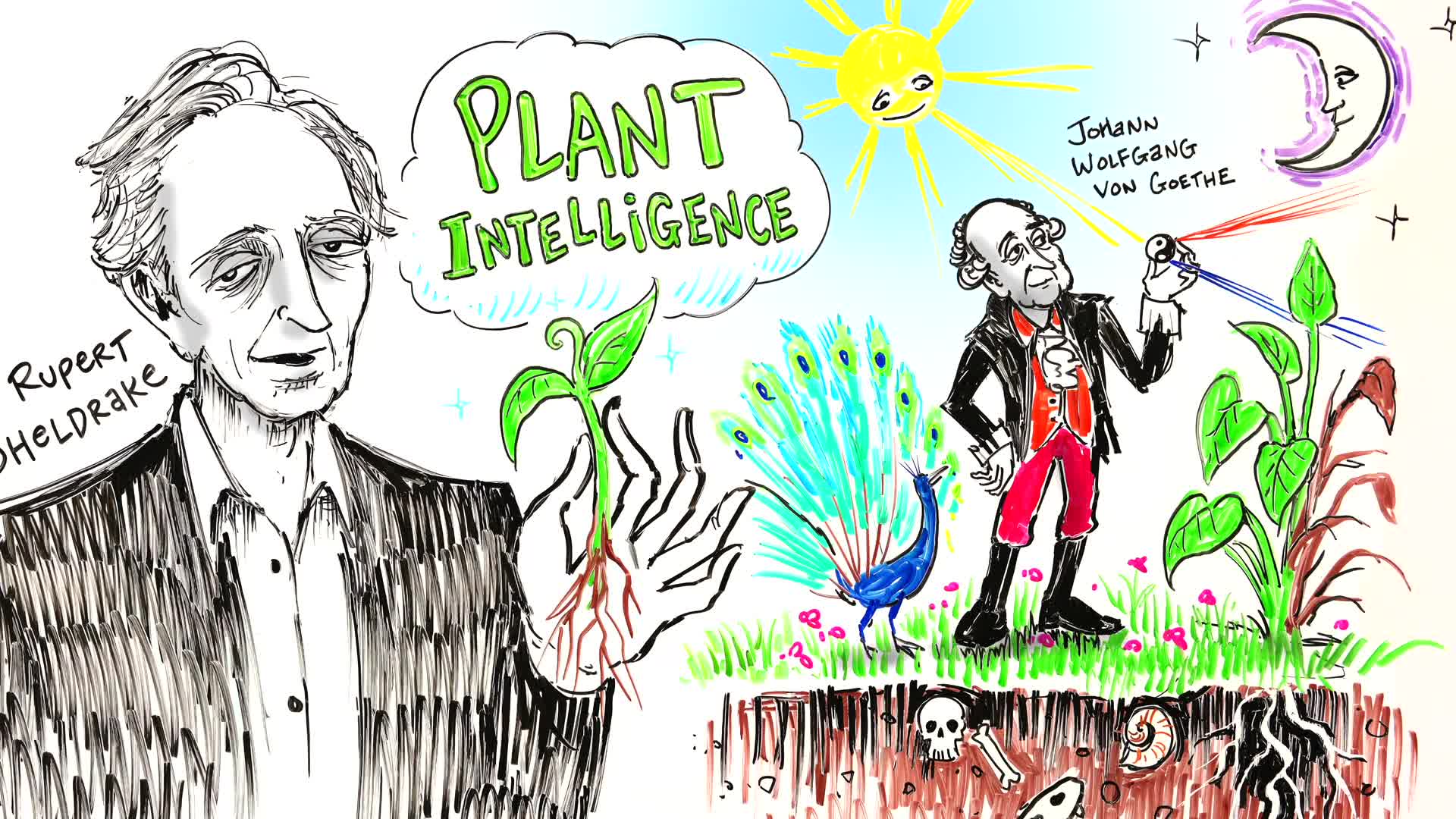
But when I was an undergraduate at Cambridge I got very interested in the ideas of the German poet and scientist Goethe, and goethe was fascinated by polarity in nature.
He thought that, as indeed many of the people at the time thought, that there were polarities all over nature.
This was shortly before faraday worked on electrical and magnetic polarities.
But there we have obvious polarities of the north and south pole of the magnet.
We have the positive and negative polarity in electrical circuits and in electrostatic phenomena.
And he was interested in the polarity of plants, and the obvious polarity of plants is between roots and shoots.
There's also a polarity between the top and bottom of a leaf and the right and left of the leaf.
But the primary polarity is the root-shoot polarity.
And this is expressed in all sorts of ways.
The shoots grow up.
They're attracted to light.
They grow up straight up against gravity, the trunks of trees.
The roots are attracted towards the darkness.
They grow into darkness.
They grow down. so you have opposite behaviours in relation to light and gravity.
And when you cut off a part of a plant, the top of a plant, it regenerates in a polar way.
Here, for example, is a willow tree that's been pollarded.
It's a normal way of pruning willow trees.
And what you see is that at the top of the trunk, new shoots have come out.
A few come out down a little bit further down, but there are none towards the base of the trunk.
This is clear polar behavior.
And if you take stems of willow, a branch of willow, and you cut it into bits, each bit will regenerate and it will form roots at the bit that was closest to the roots before and shoots at the other end.
They regenerate in a polar way.
And this shows a willow branch that I cut into pieces.
On one side you see the oldest and then on the right-hand side you see the youngest one, and each bit has regenerated, with roots at the basal end, the end towards the roots in the original tree, and shoots at the other end.
So each part when cut away from the tree has an intrinsic polarity.
This is a little bit like magnets.
If you take a magnet, here's one long magnet and it will pick up little bits of metal and attracts metal at both ends.
This magnet will act as an entire magnet, but if you break it in half, This is actually two magnets that have been stuck together by magnetism.
Each of these magnets is now a complete magnet with a north and a south pole.
They each have their own polarity.
It's very similar with the willow that I showed here.
Each part of the willow takes on a polarity of its own.
So the polarity of the whole is expressed in the parts.
The polarity runs right through.
And this kind of polarity is established in plants right from the beginning.
In the embryo, as a plant develops, there's an embryonic root and an embryonic shoot.
And here's a picture showing a plant growing, a plant embryo.
It's of a shepherd's purse embryo and at the top you see the fossilized egg and then a line of cells developed called the suspensor, and that is connected to the part of the embryo which becomes the root tip and the opposite end becomes the shoot tip.
In this particular case you see the cotyledons, the seedling leaves folded over in the fully grown embryo.
So this polarity is intrinsic in the plant.
It's established right from the beginning.
It affects the way the plant grows and the way it behaves.
And one of the things that was discovered very early on by Charles Darwin, in fact, is that there's an influence that moves downwards in plants from the shoot tips and from the shoots towards the roots, which maintains this polarity.
And how he discovered this was he found that in grass seedlings, if you cut off the tip and then you put the tip on one side, a bit to one side, the seedling will grow more on the side where you've put the tip.
Something's coming out of the tip, which makes it grow more.
If you take the tip off altogether, it stops growing for a while.
If you put the tip back, it starts growing again.
It was discovered in the early 20th century that if you put the cut-off tip on a little block of agar, the substance that diffused into it from the shoot tip could diffuse out of the agar and make things grow again.
This was later identified as the hormone auxin, which is one of the principal plant hormones and one on which I've done a great deal of research.
I spent about 15 years working on auxin at Cambridge and elsewhere.
And the growth of plants is stimulated by auxin.
It's a growth hormone.
It does a lot of other things as well.
Chemically speaking, auxin is indole acetic acid.
It's a breakdown product of the amino acid tryptophan.
The key thing is that auxin is made in the shoots and it moves down towards the roots in a polar way.
It's transported in a polar way towards the shoots, actively transported.
This flow of auxin towards the roots has a lot of effects.
If you cut off the top of a plant, the apical bud, the apex is called the apical bud at the top of the plant.
If you cut it off, then side shoots will grow out, which normally don't grow out from the buds at the side of the plants, in the axils of the leaves.
They're little buds.
When you cut off the top bud, these grow out.
The side shoots grow out, and gardeners do this all the time.
They pinch out the top bud to make the plant more bushy.
If you put auxin on when you've removed the top bud, that doesn't happen.
What's happening is you're removing a source of auxin and when you've removed it, you release the plant from what's called apical dominance.
So auxin, by moving down from the top of the plant, suppresses the growth of the side buds.
And when you remove the source of the auxin at the top, the side buds can grow.
And as it keeps moving down the plant, it stimulates the growth of roots when it gets into the root system.
So the more auxin that comes down from the shoots, the more lateral roots grow out from the plant.
And if you make a cutting, then the auxin will move down, accumulate at the basal end, the morphologically basal end, and stimulate roots to grow.
This is what happened in the willow cuttings I showed you.
The auxin moved down in the stems and stimulated these roots to grow at the base.
This is an intrinsic polarity.
It's not to do with gravity.
For example, if you take a weeping willow, the branches are hanging down.
The basal part of the branch is not at the bottom as it is in a normal stem towards the base.
It's actually at the top because the branch is upside down.
If you take bits of stem from a willow, the auxin moves in a polar way.
It moves upwards because it's moving upwards towards the roots.
It moves up and then it goes round and down the trunk towards the roots.
It's not moving in accordance with gravity, but in accordance with the intrinsic polarity of the cells and the tissues.
Well, this is a very important fundamental feature of plants.
It fascinated Goethe, it fascinates me, and it's visible whenever you look at a plant.
The very fact the roots are sticking up and the roots are down in the ground is an expression of this polarity.
So I was interested in the question of how this polarity is established in the cells.
The fact the cells transport auxin towards the roots, towards the root tips, means the cells have an intrinsic polarity themselves.
Why do they have that polarity?
How is it established in the first place?
When I first got interested in this one suggestion, the prevailing theory put forward by a plant researcher called Daphne Osborne in Cambridge was that this was because the upper ends of the cells are younger than the lower ends.
As a plant grows, the cells divide, making new cells and they grow more and they divide again.
The result of this is that the lower ends of the cells are always in most plants, at least in many plants older than the upper ends.
She thought the polarity had something to do with the age of the ends of the cells.
So one of the first things I did to test that theory was to look at the leaves of monocotyledons.
Monocotyledons are plants like grass bamboo daffodils crocuses, lilies.
They are plants that have flowers in threes.
Lilies have three petals and there are another three petals.
Typically, their flowers are in threefold patterns and their leaves are long, thin leaves like grass leaves or bamboo leaves.
Now, the interesting thing about monocotyledons is that the leaves don't grow from the tip like most leaves do.
They grow the leaves of dicotyledons like beech trees cabbages, tomatoes grow from the tip and from the edges, so the leaves expand.
The growing points are diffused through the leaf, but mainly at the tips and the edges.
In the case of grasses and other, They grow from the base.
It's as if the leaf is extruded upwards from the bottom.
So the youngest cells are actually at the base of the leaf and push it up as they grow.
The older cells are at the tip.
And that's why, when you mow a lawn, the grass can go on growing, because you haven't taken away the growing tips by mowing it.
If you mow dicotyledonous plants, which are the ones with these broader leaves and networks of veins in the leaves, then they have to grow a whole new shoot, because they grow from the tips, or they have to regenerate side shoots.
But the grass leaves just keep growing because they grow from the base.
And because they grow from the base when they form new cells.
The new cells divide to make a new cell and that's pushed up the cell and then another new cell is made.
And the result is that the oldest cell wall is at the top, not at the bottom.
So it's the reverse of what's happening in a normal plant stem growing from the tip.
The polarity of the cells in terms of age is the opposite.
Now, what about the ability to transport auxin, the polarity as measured by their physiology?
Well, no one had looked at this, so I did a study of monocot leaves, studying how they transported auxin.
This involved a technique which was extremely simple.
It was a relatively new technique when I first did this, which was in the 1970s, involving radioactive auxin.
It's a radioactive tracer.
You could get carbon-14 labeled auxin.
How you do the experiments, you take a bit of stem.
Imagine that's a bit of stem.
This is the tip end.
This is the root end.
Normally, it would be growing like that.
And you put a little block of agar, agar jelly, on each end.
And at one end you put the auxin, radioactive auxin.
Then you wait an hour or two.
It moves at a rate of about one centimetre an hour.
And then you collect the block from the other end and see how much radioactivity is in it.
Now, what happens is that if you put auxin in this block at the apical end, and then after a couple of hours measure the radioactivity here, there's a lot because it's transported the auxin this way.
If you do it the other way round, you put the auxin, the radioactive auxin, on the basal end and you wait a couple of hours, and then you see how much radioactivity is at the apical end, moving in the opposite direction.
There's practically none showing that this is a transport system that only moves things one way.
I did these experiments with a whole variety of monocot leaves, grass leaves, crocus leaves, daffodil leaves, rush leaves, lily leaves, orchid leaves and palm leaves.
I published a paper on this in the journal Nature.
It's called the polar auxin transport in the leaves of monocotyledons.
And in this table here you can see the actual amounts of auxin that were transported in each direction.
For example, in daffodil leaves, Narcissus species, the amount moved towards the tip acropetal, in other words, opposite of the normal direction, was zero, whereas the amount moved in the normal direction towards the base was 4616 counts per minute.
So clearly there's an extremely strong polarity, and you can see similar figures for these other leaves, some transported more than others.
But in all cases, the polarity of transport was towards the roots.
In other words, the same as in all other plants.
So the age of the cell walls, the age and end of the cells, in this case is the opposite of that in stems of growing plants, where the older cell wall is at the top, not at the bottom, and it makes no difference to the polarity.
So it's nothing to do with the age of cell walls.
There's something else that's causing the polarity of the plants.
I then looked at the way in which auxin is transported in stems.
In the stems of Dichotyledon's plants, like beech trees, oak trees, and tomatoes, and tobacco plants, and hollyhocks, and all these kinds of plants, as the plants grow, the stems get thicker. a process called secondary thickening and there's a region between the bark and the wood called the cambium where the cells divide that way not that way they divide that way to produce new cells and that's how the plant gets thicker so they're longitudinal cell divisions as opposed to transverse cell divisions So I wanted to see what would happen to auxin transport when the cells are dividing that way, not that way.
So I looked at the transport of auxin in the stems of tobacco plants.
In a paper here called the transport of auxin auxin transport in secondary tissues in the Journal of Experimental Botany.
And what I found was in this first figure which you see here at the top.
The top graph shows the increase in thickness of the stems as you go down the plant.
At the top they're thinnest and at the bottom they're thickest.
And that simply shows how they're getting thicker, and the graph below that shows the amount of auxin transported towards the roots basi-petal, towards the base, in the whole stems and in segments of the stems where the outer part had been stripped off.
So the upper part of the graph shows complete stems and the lower part, with the black marks, shows the inner part, where you strip off the bark and look at the inner part of the stem.
Both of them are transporting auxin towards the roots.
At the bottom.
You can barely see it because it goes almost along the axis.
At the bottom is the amount transported in the opposite direction towards the tips.
So it's extremely polar.
There's practically none moving upwards and practically all moving downwards towards the roots.
The graph here on the right shows the amount of auxin travelling through the pith.
The pith in the centre of the stem which is ageing.
The axis is different from the other ones.
Actually very little moves through the pith.
And as the stem gets older, the amount of auxin goes down.
So this is the opposite of what's happening in the other tissues.
The pith isn't growing and dividing.
It's just getting older.
The amount of auxin transported is getting less.
In the other tissues, it's getting more because the amount of tissue is increasing.
The stem is growing.
There's more cells.
So it's the newly formed cells that are transporting it.
I then looked at the different kinds of cells that transport it in this figure here and you can see the amount transported when you have the complete stem at the top.
Acropetal means towards the tip, basepetal means towards the base.
In all cases the amount moving towards the tip, in the opposite of the normal direction, is practically zero.
If you take away the pith and just look at the outer tissues, quite a lot is transported.
What you see by looking at these is that the transport's happening mostly around the cambium, the bit between the bark and the wood.
When you pull that off you damage those cells and a lot of auxin stops being transported then.
But most of it's actually been transported in what's called the interior phloem bundles of phloem, the tubes that conduct sugar in the plant, which are on the edge of the pith inside the wood.
Tobacco is unusual in having an internal phloem.
Most plants don't.
But most of it's going in these young cells near the phloem.
It's not because it's being transported by the phloem itself.
It's just the sensitive auxin transporting cells are near the phloem.
So what this shows is that the auxin is being transported by cells that divide longitudinally as opposed to transversely.
So it's still polar going that way, even though the cells are dividing that way.
So again, it's nothing to do with the plane of cell division.
I then looked at the question of whether you can reverse the polarity of plants by growing them upside down.
If you take a cutting from a plant and you turn it upside down and you put rooting hormone, which is synthetic auxin, on the apical end, you can make roots grow there.
They wouldn't normally.
You can make roots grow there and then shoots will grow out and grow up.
The whole functioning of the stem is then inverted.
Sap is going in the opposite direction.
The sugars are flowing in the phloem from the leaves to the roots in the opposite direction to the way they'd normally flow.
Does that make auxin move in the opposite direction as the stem thickens and new cells are formed?
But I discussed that in this paper published in the journal New Phytologist called The Polarity of Auxin Transport in Inverted Cuttings.
And I did this with a number of species, including tomatoes.
And you can see here a picture of a tomato plant that was grown from a cutting, where the roots are at the apical end and the shoots are at the basal end.
It's been grown upside down.
So the stem was functioning in the exact opposite of the normal polarity.
But then what about the auxin transport?
Well, it turned out that the auxing transport, as shown here in this table, was going in the normal direction.
It still retained its original polarity, despite the fact that everything else was working in the opposite direction.
This shows that the polarity of the cells is deeply embedded in their nature.
You can't change it by switching everything else around.
They retain their original polarity.
It's very deeply embedded in their being.
Well, after these studies, I wanted to find out whether one can study polarity and find out more about it by looking at much simpler systems.
And I did some research on a tropical fern.
I did this research mainly at the University of Malaya in the botany department, where I worked with a colleague, Dr V Raghavan, an Indian scientist who was the world expert on the early stages of fern growth.
And I worked on a fern called the bird's nest fern, Asphalium nidus, which grows epiphytically on trees in tropical forests.
And like other ferns, it forms spores on the backs of the leaves.
And these spores, when they germinate, germinate in a polar way.
They first form a little root here and then a thread grows out of them called a protonema, just a single file of cells which then divides to form a plate of cells, and from that the sexual organs are formed which give rise to the fern.
As we know it, the sporophyte is called.
The first stage that germinates from the spore is called the gametophyte.
Gametophyte it has half the number of chromosomes of the sporophyte, But the point I was interested in was its polarity.
It has a little root, a rhizoid, a root cell, and then it grows a file of cells one by one.
It divides to form this long, thin tube of cells.
And the polarity is there in a single file of cells.
It's nothing to do with auxin transport here.
It's just pure polarity.
It must involve nutrients flowing towards the growing tip from the photosynthesis in the cells that make them, and also things absorbed by the little root hair.
The rhizoid from the soil.
Minerals and so on must all be moving through the cells towards the growing tip in a polar manner.
The cells are polar, they're polar in their functioning and the whole thing shows a kind of polarity.
If you cut off the tip, then the cells in the middle branch.
It's a kind of apical dominance, even in this very simple system.
So what I was interested in is do these cells show any visible signs of polarity?
That will give a handle on understanding how polarity is working.
And to do this, I used a technique called plasmolysis.
It's been well known for a long time that if you put plant cells in a strong solution of sugar or salts, By osmosis the cell shrinks because water moves out of it across the semipermeable membrane of the cell and the cell shrinks inside the cell wall.
Plant cells have a cellulose cell wall around them and the cell is normally turgid, pressing up against the cell wall swollen with the water that comes into it.
But in these stronger salt solutions, they shrink, they get smaller.
As I say, it's called plasmolysis.
When you do that to the cells in this thread-like structure, of these ferns, the cell shrinks, as you see here.
The shrunken bit where it pulls away from the wall remains connected to the wall by little threads called hechtian strands, after a German botanist called Hecht.
And the cell you see is pulled away from the wall.
But interestingly, when I did this plasmonosis with a sugar alcohol called mannitol, the plasmonosis was polar.
In other words, the plasmonosis meant it pulled away from one wall and remained attached to the other.
And it pulled away from the basal wall, the wall towards the rhizoid or the base of the plant, and remained attached to the top wall, towards the apex, the apical wall.
And when one did this with the whole strand this is a drawing of one of these threads It's called a protoenema.
This first strand formed when the spore germinates.
You see the spore.
You see the rhizoid that's grown out of it.
You see a file of cells moving towards the apical cell.
And when it's plasmalized with mannitol, they all pull away and move towards the apex, detaching from the base of the cell.
And this shows that there's a differential attachment.
There's something different about the cell membrane at the two ends of the cell.
And you can actually see how it behaves differently.
I looked at the way in which different salts and sugars would affect this.
And it turns out that they behave rather differently in all cases.
The majority move towards the apex.
But this effect was much stronger with some substances than others.
And here you see an effect comparing the effects of menotol with three other compounds or salts.
Magnesium sulfate shows a very similar effect to menotol.
Practically all the cells are polaroplasmalized towards the apex, shown in red.
That's the percentage shown in red.
The percentage towards the base is shown down here in blue, and the ones that detach from both ends is shown in yellow.
It's practically zero.
Magnesium sulphate shows a very similar effect to mannitol.
Calcium nitrate shows a much less pronounced effect.
It's still polar, but more cells remain attached to the base and some detached from both the apex and the base of the cell.
And potassium nitrate shows, even more than calcium nitrate, a tendency to be less polar than mannitol and magnesium sulfate.
So this shows that there's something about the way the attachment of the cell wall to the cell membrane works that can be affected by all these salts.
Now this becomes very relevant when we look at the way in which auxin is transported in a polar way in higher plants.
I just want to say one more thing about polarity.
There's an aspect of polarity which has been very much ignored by researchers, and that's electrical polarity.
It's been known for a long time that when spores or eggs germinate, there's an electrical polarity between the bit that becomes the root and the bit that becomes the shoot.
The whole thing is electrically polarised.
It's very well known, in fact, that the Earth, the roots, are in the Earth.
Of course, the Earth is electrically charged in a negative direction in relation to the atmosphere.
And the further up from the Earth you go, the greater the difference.
The difference near the Earth is enormous.
It's not microvolts or anything.
It's about 100 volts per meter.
So if you go a meter off the ground, there's a 100 volts difference between the air there and the ground.
Two meters is 200 volts.
And when you look at a diagram here showing the polarity of the Earth and some coniferous trees, there's an enormous polar envelope.
And the tree, because it's connected to the soil through the sap growing up through the wood, which is electrically conductive, the tree is negatively charged, sticking up into the positive atmosphere.
And so there's a big difference between the tree and the air around it, which means that the electric tips of the tree and of the branches and of the shoots attract positive ions and they affect the electric field all around them, as you see on the left.
Now, a recent study with flowers showed that this gradient is present in the petals.
If you shoot out positively charged paint particles through an electrostatic spray gun at the petals of flowers, It turns out that the petals of flowers show this kind of electrical gradient and the positive particles go to the most negatively charged bits of the petal, which are the tips.
Here you see a series of flowers.
On the left you see the normal flower as it is, and on the right you see the flower after it's been sprayed with blue positively charged particles in the case of the upper flowers, and right at the one at the bottom, it's been sprayed with yellow charged particles and you see that there's an electric gradient.
You can actually see the electric gradient in the petals.
Oddly enough and very surprisingly, no one has yet done this for leaves, and I think that the electrical polarity of leaves may well be important in setting up the primary polarity of the auxin transport system in growing leaves.
It wouldn't be difficult to do this.
If anyone watching this has an electrostatic spray gun that sprays out positively charged particles, Try it out on some plants in the garden and see whether you get a pattern like these flowers with the leaves, whether you get more around the tips and any sticking out bits.
I think it's very likely you will.
This is still an ongoing investigation.
The polarity of plants is an open topic.
Still still not known how this initial polarity is established, but I think it's very likely that electric gradients play an important part, not only in germinating spores and eggs but in developing plants, because the whole plant is in an electrical gradient and somehow, once that polarity has been established in the cells, it leads to the transport of auxin in a rootward direction and affects all other aspects of plant polarity.
But the auxin is a reflection of a polarity that's already there.
A lot is now known about the details of how the auxin transport system works, and even at the molecular level, where the polar distribution within the cell of molecules that are involved in auxin transport is.
But it's still not known exactly how that initial polarity is set up, and that's the bit where I think electricity could be playing a key role.
So this is very much an open question.
I've been working on this and thinking about it for 50 years and I can't give you the final answer to this because it's not known.
No one's done some of the experiments, and some of them could be quite simple.
There is more known about the details of how that works, but about the initial polarisation there's still a lot that isn't known.
Thanks for tuning into this episode of After School.
I hope it will help you to look at plants in a new way.
If you'd like to learn more about my work, you can go to my website wwwsheldrakeorg, or you can follow my work through my Substack, which is rupertschildrakesubstackcom.