N .P .R. This is The Indicator from Planet Money.
I'm Waylon Wong. And I'm Paddy Hirsch.
In the wake of the Trump administration wrecking Cruz visit to Europe two weeks ago, European politicians and bureaucrats are desperately trying to figure out what the future of their relationships with the U .S.
look like. The UK Prime Minister is in the White House today trying to get a handle on it.
One thing that looks increasingly certain, when it comes to defence, members of the North Atlantic Treaty Organization, which of course includes a lot of European nations, are going to have to pay more.
For years, President Trump has complained that many NATO members have been getting a free ride.
Yeah, well, that ride appears to be coming to an end.
Trump's envoys signalled not only that they will be insisting on all NATO members meeting their obligations, but they want to see the threshold raised from 2 % to 5 % of GDP.
We're talking about hundreds of billions of dollars being spent by countries that are already struggling economically.
On today's show, we'll talk about where all of that money might come from.
This message comes from Intuit TurboTax.
Now, taxes is matching with an expert backed by tech to get you the most money back at TurboTax .com.
Experts only available with TurboTax Live.
See guarantee details at turbotax .com slash guarantees.
Support for NPR and the following message come from Edward Jones.
What does it mean to be rich?
Is it having a million stories to share?
Is it having more time to give?
Edward Jones's financial advisors will support what matters to you.
Edward Jones, member SIPC.
The hits to America's relations with Europe came hard and fast.
First, there was the U .S.
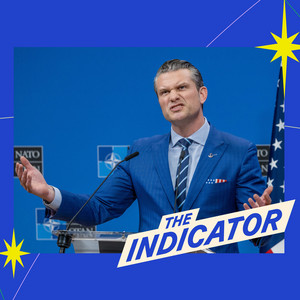
Defense Secretary Pete Hegseth telling NATO that President Trump wants them to crank up defense spending to 5 % of GDP.
Then there was Vice President J .D.
Vance at a security conference castigating European nations on freedom of speech.
And then there was America at the UN refusing to blame Russia for the war in Ukraine.
It's all sent European leaders a -scurrying.
French President Emmanuel Macron flew to Washington to gauge Trump's mood on Monday.
And U .K. Prime Minister Sir Keir Starmer visits the White House today.
They're all trying to figure out what this means.
Is America siding with Russia, withdrawing from NATO, ending its relationships with Europe?
Well, one thing that is absolutely certain when it comes to defense, Europe is going to have to pay more, a lot more.
I think that this should not be necessarily surprising to people.
Nevada, Joan Lee covers European and American defense relations at the Stimson Center, an international security think tank in Washington, D .C.
Trump has been discussing European defense spending and NATO defense spending since before he even ran for president.
All members of NATO, as indicator listeners might remember, agreed to spend at least 2 % of GDP on defense.
But in the past, most, with a few notable exceptions, like Poland, Greece and the U .K.
have not done this.
And that has been a source of complaint for the U .S.
for many years, long before Trump came into office.
Robert Gates, who served as defense secretary under Presidents George W.
Bush and Obama, left his office urging European members to up their game spending -wise.
So the demands are nothing new, but this time they do feel different.
Jocelyn Maudsley is a professor at Newcastle University specializing in European security.
I think everybody was mentally prepared for a U .S.
that didn't care very much anymore.
and was much more focused on Asia.
What we perhaps hadn't really expected was the US as an enemy.
Jocelyn says that European countries were already ramping up spending on defence well before Trump came into office in response to Russia's invasion of Ukraine.
Some countries, because they're NATO members and a NATO has announced its support for Ukraine, other countries because of fears that if Russia's successful in Ukraine, well, they might be next.
Some countries, particularly in the Baltics, Poland, have already raised defense expenditure far beyond this.
Poland's defense expenditure is higher than that's the U .S.
at the moment by GDP measures.
But defense is expensive.
Poland is a medium -sized European nation with a GDP of around $900 billion.
It spent 4 .2 % of that on defense last year, about $41 .5 billion.
But Poland's state of economic health is a lot better than many of its neighbours.
The core economies of Europe, France, Germany, Italy and the UK, are all sluggish.
And getting much beyond the 2 % is actually economically quite challenging.
Jocelyn says her home in the United Kingdom provides a good example of how challenging it could be to increase defence spending to 5%.
and where the choices that leaders are going to have to make will be particularly difficult.
We're coming off the back of over a decade of austerity politics.
Public services are in a mess.
And you suddenly have a demand like this at exactly the same moments that the newish Labour government was trying to pump money back into public services.
Some countries might make the decision not to cut services.
Instead, they might borrow.
The question then becomes, can European governments borrow under current conditions?
Ethan Nilsetsky is a professor at the London School of Economics.
He notes that a number of European countries have borrowed to fund their defense spending.
Poland, Lithuania and Romania are just three.
But debt -to -GDP ratios in some European nations don't look healthy right now.
Some countries are fine.
Poland's at about 50%.
But in the UK and Portugal, debt -to -GDP is closing in on 100%.
And then you've got Greece at 160%.
God, I'm recalling the great sovereign debt crisis of 2009 in Europe.
I know. But just for context, America's debt -to -GDP is around 123%.
So it's all relative.
And besides, Ethan says investors don't seem too worried about European debt loads right now.
The market is telling us that it is willing to lend to European governments at rates below the United States and very low by historical standards.
So while the whole world has a public debt problem, it doesn't seem like Europe at the moment is the biggest concern of investors.
It smells like an opportunity, one that Jocelyn Maudsley says European governments are already preparing themselves to embrace.
She points to the new leader of perhaps the most anti -debt nation of all, Germany.
Friedrich Merz, who had always been a hardliner on the idea that Germany must run a balanced budget.
Now he's leader, he's saying we need to spend on defence.
Britain's Prime Minister announced this week that the UK will increase defence spending and it'll cut foreign aid to pay for it.
Jocelyn says the UK Chancellor, Rachel Reeves, is going to have to give up her rigorous fiscal rules on debt and spending.
The U .K. might also tap the bond markets for defence funding, she says.
And we shall have to go for a bout of military Keynesianism.
Potato? Potato? Keynesianism?
Keynesianism? Yes, there you are, Keynesianism.
You know, that concept where the government spends a great deal of money to kind of resuscitate the economy.
The idea that if you invest in the military, that you do get a growth spurt that can then go into the wider economy.
In fact, Ethan Nilsetsky says, by insisting on increased defence spending, Trump actually could be doing Europe a favour here, both strategically and economically, in a number of ways.
There are some long -run benefits to increased defence spending.
The reduced uncertainty of external threats, that is an economic benefit.
OK, so good for macro security, but good for employment too.
Historically, defence build -up have been good for employment.
They have increased employment.
They also tend to be relatively good jobs in terms of their pay, benefits, etc.
The nature of the arms race is such that it really incentivizes you to going to the most speculative, the most advanced technologies.
And that's why defense spending does tend to have some longer term benefits in terms of productivity growth, technological advancement, and therefore economic growth.
The result could be a thriving independent defense industry in Europe, one that is less dependent on the U .S.
Yeah, but hold on. Wouldn't that be bad for America?
I mean, like around 60 percent of all the EU defense purchases are made from U .S.
companies. Nevada Leigh at Stimson says, yes, the U .S.
might sell a little less to Europe, but the U .S.
defense industry sometimes has trouble meeting the needs of its own military.
Assuming the U .S. doesn't become an enemy of European NATO, having an ally with a robust defense capacity of its own would be good for both sides.
At the end of the day, when our allies do well and create incredible systems, we benefit as well.
And we would also benefit from being able to rely on Europeans to take care of their own security a little bit more.
She says there's no doubt that the way the Trump administration is handling this issue is fracturing the relationship between the U .S.
and Europe. But she says this creates an opportunity for Europe to make itself less dependent on the U .S.
and maybe give itself an economic shot in the arm at the same time.
This episode was produced by Angel Carreras with engineering by Jimmy Keely.
It was fact -checked by Sierra Juarez.
Kate McCannon is our editor and The Indicator is a production of NPR.
financial future start your risk -free trial at greenlight .com slash npr this message comes from tourism australia no matter what you're into australia has something for everyone all year round like the dane tree rainforest this spring melbourne's music scene in the summer and the wineries of barossa valley
in the winter come and say good day more at australia .com support for npr and the following message come from ixl online is your child asking questions on their homework you don't feel equipped to answer ixl learning uses advanced algorithms to give the right help to each kid no matter the age or personality one subscription gets you everything one site for all
the kids in your home pre -k to 12th grade make an impact on your child's learning get ixl now and npr listeners can get an exclusive 20 off ixl membership when they sign up today at IXL .com slash NPR.