This is the Global News Podcast from the BBC World Service.
I'm Valerie Sanderson, and at 1600 hours GMT on Tuesday, the 6th of January, these are our main stories.
European leaders back Denmark after President Trump's threat to annex Greenland, an autonomous part of the NATO ally.
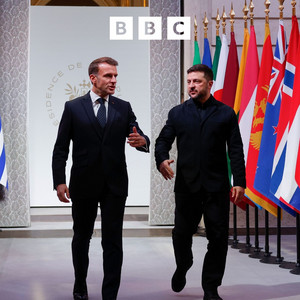
It comes as talks are held in Paris on Ukraine's security if a ceasefire is agreed with Russia.
It's emerged, no proper safety checks were carried out for five years at a bar in Switzerland where 40 people died in a fire.
Venezuela's exiled opposition leader says she'll return.
Also in this podcast.
As the new year prompts people to get fit, why does the fitness challenge High Rocks appeal?
It's very addictive and many people when they first try it, they absolutely get hooked straight away.
They see how fun it is, how many people they can meet and how much they can get involved in it.
As Donald Trump doubles down on his territorial ambitions for Greenland, European leaders gave what sounded like a warning to the US president.
In a joint statement France Germany, Britain and others declared firmly that the Danish territory is out of bounds, saying only the people of Denmark and Greenland themselves can decide what happens to their land.
Speaking ahead of a meeting in Paris to discuss post-war plans for Ukraine, Poland's Prime Minister, Donald Tusk, said Denmark could count on European solidarity.
We are very keen for any potential disputes to be resolved through friendly dialogue between NATO members.
European solidarity and respect for the integrity of European states are fundamental issues.
So, of course, Denmark can count on the solidarity of all Europe.
We must do everything to ensure that European-American ties do not suffer in the coming days and months as a result of various announcements, decisions or misunderstandings.
Some EU leaders have faced criticism for not taking a tougher stance with President Trump over the US military action in Venezuela and the seizure of Nicolas Maduro.
But there's been steadfast support for Ukraine.
Another draft statement was released which talks of binding commitments to support Kiev in the case of a future armed attack by Moscow.
The hope is that President Trump's special envoy, Steve Witkoff, and his son-in-law, Jared Kushner, will support that view at the summit in Paris.
Our correspondent Hugh Schofield in the French capital told me more.
There was an awful lot of criticism of leaders like President Macron for being mealy-mouthed, woolly in their reaction to Venezuela.
President Macron, for example, in his initial statement said nothing about international rights or sovereignty.
He played it a very, very... cool hand and did not publicly attack America at all.
That angered a lot of people in Europe, certainly in France, where other leaders, including the far-right National Front, were much more forthright in criticizing America.
And so there's as a result, I think, pressure on people like Macron and others in Europe to say something and to stand by Denmark of.
But you know, the point is that Macron and the others are playing a very delicate balancing act because they need to keep America on board at a very crucial time in the Ukraine talks.
That's what's happening here now in Paris.
The Elysee, the palace where I am now, is where Steve Vitkoff, Jared Kushner,
Vladimir Zelensky, Emmanuel Macron are right this moment possibly settling the future of a kind of structure for security guarantees for Ukraine in the event of a ceasefire.
So, at this key juncture, Macron has clearly decided he does not want to antagonize President Trump, because right now he's absolutely crucial to their plans for securing a deal in Ukraine.
And that is what, as you said, these talks today in Paris are all about.
What can realistically be achieved do you think?
Well, I mean for the first time there is a measured degree of optimism, notwithstanding the cataclysmic events which have taken place in Venezuela and the threat to Greenland.
But you know, now there is the possibility, by the end of today and certainly this is what the French and British are hoping for that the Americans come on board publicly with a guarantee for a security structure, that for Ukraine, in the event of a ceasefire.
This plan.
This guarantee would involve support for the Ukrainian armed forces, with American backing for that support to the Ukrainian armed forces.
It would involve a multinational force, not including the Americans, though that's not ruled out on the ground in parts of Ukraine helping with Ukrainian air and sea power.
British, French, Turks may be involved in that.
It'll involve as well some kind of juridically binding guarantee to act in some undefined way if there is a breach by Russia of this putative ceasefire.
We won't have anything written down and explaining point by point what will happen, who will be where, and so on.
That's not going to happen.
They cite reasons of military secrecy and so on for that.
Maybe it's more that the language is in itself fuzzy and needs to be fuzzy because they haven't actually agreed on all the fine points.
But nonetheless what they hope is at the end of the day, for the first time, there will be American commitment and signature on this plan.
Hugh Schofield in Paris.
And for more on this story, you can go on YouTube search for BBC News.
Click on the logo, then choose podcasts and global news podcast.
There's a new story available every weekday.
Next to Switzerland, where officials have admitted that the bar in which a catastrophic fire took place on New Year's Day had no regular fire safety checks for years.
Forty, mostly young people, were killed when the fire ripped through Le Constellation Bar in Kranz Montana.
The authorities say 83 people remain in hospital, some of them with horrific burns.
At a news conference at the Alpine Ski Resort, the mayor of Kranz Montana, Nicolas Faro, said he was profoundly sorry that adequate checks had not been carried out.
As you can see, periodic inspections were not conducted between 2020 and 2025.
The municipal council became aware of this fact when it consulted the documents submitted to the public prosecutor's office this weekend.
We bitterly regret this.
A correspondent in Switzerland, Imogen Fuchs, told me more about that news conference.
The entire town council of Kramontana was there, including the safety officers, but it was only really the mayor who spoke to us journalists.
As you said, no inspection since 2019.
No explanation of why that had happened.
They're supposed to be carried out in places like bars and restaurants every year.
There should be a regular inspection. there was no note of the sound insulation foam.
It hadn't been viewed to be a risk, I think, even when the bar was last inspected.
But what is really, I think is going to be very shocking for Swiss people is that town council appeared not to know why there had been this gap in inspections.
But it's Their responsibility.
Town councils have big powers in Switzerland.
People vote for them and they like this devolved system.
So the Swiss journalists at this press conference were quite well, I wouldn't say hostile, but they repeatedly asked the mayor questions whether he'd considered resigning.
He said no, he wanted to take part in the investigation.
He bitterly regretted the fact that the inspections hadn't taken place and that the law would have to take its course.
So what measures are being introduced immediately?
So immediately they are banning these sparklers and indoor fireworks, which are quite common in Switzerland, at New Year.
They will be banned immediately, but there will still be questions about what was, in fact, widespread social media pictures well before this fire, from 2024 even, I believe of people on each other's shoulders waving sparklers, very close to this ceiling.
You would think a town council would notice some of this in a very popular bar where hundreds of people danced and had fun regularly.
So There are questions.
People are really, really asking questions.
It's not a surprise that one of Switzerland's major newspapers is just within hours of that press conference, come out with a picture of the mayor and a headline just saying complete disaster.
Obviously, it's not for us to judge the investigation and what prosecutions there might be, but...
I think there are many, many questions about whether local authorities are really taking their powers as seriously as they need to.
Imogen Fowkes, the international figurehead of Venezuela's opposition, has described the capture of President Maduro as a huge step forward for humanity.
Speaking to Fox News in her first televised interview since the dramatic events of Saturday, the exiled politician and Nobel Peace laureate, Maria Karina Machado, pledged to return to Venezuela.
I'm planning to go back to Venezuela as soon as possible.
Every day I make a decision where I am more useful for our cause.
That's why I stayed in hiding for over 16 months and that's why I decided to go out, because I believed that at this moment, I'm more useful to our cause being able to speak out from where I am right now.
But I'm planning to go as soon as possible back home.
But over the weekend, President Trump dismissed the idea of working with Ms Machado.
He said she didn't have the support within the country.
Ms Machado has warned that Nicolás Maduro's deputy, Delcy Rodríguez, who's been formally sworn in as the country's acting president, can't be trusted.
Venezuela's new interim leader faces huge challenges as she walks the tightrope between keeping her socialist base in the country happy while also avoiding conflict with Washington.
Our Latin America correspondent Will Grant reports.
Delcy Rodríguez Gómez.
At almost the exact moment Nicolas Maduro appeared in court in New York, his former vice president, Delcy Rodriguez, was sworn in as his replacement.
With that, she became Venezuela's first woman president and only the third person to lead the country this century, barring a short-lived coup in 2002.
Yet she showed no signs of celebration.
I come with pain for the kidnapping...
Instead, flanked by grim-faced military men, she denounced Maduro's removal from Venezuelan soil by elite US troops as a kidnapping.
We have two heroes being held hostage in the United States of America, she said of Mr Maduro and his wife Celia Flores.
And if they are Monroe, we are Simon Bolivar.
Earlier to a packed chamber.
The first deputy to speak was Nicolas Maduro Guerra, the son of the deposed former president, and he launched into a passionate defence of his father.
If we normalise the kidnapping of a head of state, no country is safe, he said.
Today it's Venezuela.
Tomorrow it could be any nation that refuses to submit.
This is a direct threat to global political stability, he added.
Meanwhile, the Colombian government has ramped up its troop numbers on its side of the border, fearing regional instability.
The Simón Bolívar bridge between the two neighbours is abuzz with traders, motorbike taxis ferrying people back and forth and foot traffic.
And people here are getting on with the business of daily life.
But this border region is largely controlled by left-wing guerrilla groups allied with the socialist government in Venezuela.
And many fear it could be affected by either an uptick in violence or an exodus of Venezuelans, fleeing worsening circumstances and even more authoritarianism.
We spoke to Venezuelans as they crossed the bridge into Colombia and most expressed quiet satisfaction at the removal of Nicolas Maduro, even if it came via US military power.
We're in shock, said Nalji, a Venezuelan who splits her time between the two nations.
I don't see the intervention by the US as a negative thing, she added.
I'm optimistic.
Her friend Maricela was even more pleased.
It's spectacular news Maduro is gone, she said.
The very best news.
We've been waiting 25 years for this.
What we've been through in Venezuela is unbelievable.
Marisela added that she considered Del Cid Rodriguez to be a temporary fix and that eventually, the Trump administration would install opposition leader Maria Corina Machado as president.
That's what many might have thought when they heard Nicolas Maduro had been forcibly removed from power by Washington.
President Machal announced within days.
Donald Trump seems to have sidelined the woman who beat him to the Nobel Peace Prize, much to his apparent frustration.
Instead, those dancing in the streets in Caracas were the socialists celebrating acting President Rodríguez taking power and demonstrating against US imperialism.
However, that support may soon ebb away if she's as willing to do Washington's bidding as President Trump claims.
Will Grant reporting.
Despite the seizure of former President Nicolás Maduro in Venezuela, his opponents have not been seen in big numbers celebrating on the streets.
One reason, the colectivos, armed pro-government paramilitaries, continue to operate with impunity.
The government don't want America's actions at the weekend to become the catalyst for a full-blown revolution, and nor perhaps to the Americans who prize stability, especially if Venezuela's oil industry is to be revived.
This man, who asked not to be named, previously participated in protests against President Maduro.
But despite being pleased to see the back of him, he hasn't been celebrating publicly.
There's a mix of emotions.
There's an emotion of absurdity, There is an emotion of hope.
I mean, people, we have lived under the same regime for 27 years.
It has been a hard dictatorship for around 10 or 15 years now.
We have tried everything, elections, nonviolent protests, march, and we are stuck.
So people, a lot of people logically see this as an alternative, polemic as it may be.
That procession needs to go on the inside because on the outside, in the street, it is quiet.
It is nervousness.
You know, there is still the same secret police, the same political police, the same Gestapo, which is the Hezim and the Sevin.
Those guys are still the same guys in the street.
So you can't really... go out to protest, you know.
I delete my phone every time I go out of my house.
So, although Mr Maduro has gone, you don't feel able to go out onto the streets of Caracas and celebrate his departure.
No no, I don't feel it's safe to do so, because I know Mr Maduro's regime and what's left of it here.
How optimistic are you feeling about the future now?
Right now, it's a mixed bag.
We're not sure what's going to happen.
I think there is a chance that a transition happens.
Yeah, you know, Trump's military threats were to have free elections, but it's going to be very tricky.
The majority of Venezuelans just want democracy and normal lives, to have food, to have medicines.
They just want the regime change.
That massive route of popular support is what's going to make this go well, under the exception that Chavismo goes absolutely crazy and violent, which they have a tendency to do, which is the big threat here.
An anonymous man speaking to Sean Lay from the Venezuelan capital of Caracas, still to come in this podcast.
Craig the elephant was a majestic king of the landscape.
Kenya mourns the legendary Super Tusker, an elephant called Craig, which has died at the age of 54.
The giant food company Nestle has issued a global recall of some baby formula products over concerns they contain a toxin which can cause food poisoning.
Nestle said specific batches of its SMA infant formula and follow-on formula were not safe to be fed to babies.
Ella Bicknell has this report.
With the power to make you smile in an instant.
SMA, follow on milk.
The global market for infant formula is valued at more than 90 billion, and Nestlé is one of its major players.
Its warning goes out across several European countries, many of which sells Nestlé's baby formula under different names SMA in the UK and Ireland, and Biber and Alfere in Germany and Austria.
The recall follows.
Tesla detected a quality issue in an ingredient supplied to Nestlé which may potentially contain seralide.
The toxin is heat-resistant and cannot be destroyed by boiling water.
It can cause digestive symptoms, including nausea, vomiting and abdominal cramps.
This time, Nestlé has recalled 11 products in total, has listed batch codes on its website and asked retailers to display recall notices in their shops.
Consumers who have purchased affected products have been told not to feed them to their babies and to contact Nestlé for a refund.
In an online statement, the company said the move was made out of an abundance of caution and that the safety and wellbeing of babies is an absolute priority.
Ella Bicknell.
In Kenya, tributes have been paid to a beloved elephant, which became a symbol of the country's increasingly successful efforts to protect the animals from ivory poachers.
The elephant, named Craig, died on Saturday at the age of 54.
The Maasai community lived closely with Craig and described him as a gentle giant and a living symbol of Africa's natural heritage.
Known as a super tusker.
He was among the last elephants, with tusks weighing more than 45 kilograms each.
Ansoy spoke to Joel Nyika, chief warden at Amboseli Conservancy, and asked him why this elephant was so special.
Craig the elephant was a majestic creature. iconic king of the landscape, so to speak.
So he comes from a lineage of elephants with big tuskers.
And just tell me about his relationship with the local community, especially the Maasai.
The relationship between Craig and the Maasais was more spiritual and quite interesting, because Craig stayed outside the park most of the time and he only ventures into the park during mating seasons.
So he was very comfortable with herders, with the pastoralists, with the community.
Hadi was a conflict-free individual.
So I just want to say that he was quite friendly to the people.
What would you say made him so?
Because we often hear of human-wildlife conflict.
It's not unheard of to hear conflict between people who have been injured by elephants.
What made Craig so special?
Was it training?
Craig was not training.
You know, these are wild animals.
Craig was never in captivity his entire life.
He was born wild, and he stayed that way until his last day.
But you just find individuals who are friendly, who are polite.
Frank, you could see in many pictures, he was very close to...
And then they carried these huge tasks.
I think it's been estimated that they were weighing 45 kilos per individual.
How did they manage to survive for so long, especially Craig, without being poached?
We have a network of community rangers who are always by his sides, but also because he never ventured.
And in very few occasions, he just ventured close to Tanzania.
But he was a lucky individual.
He never broke his task, and with these long, huge tusks that were almost always resting on the ground,
Did that come at a... Very iconic.
Really iconic, yes.
And did that perhaps become a problem for Craig, having to lift them and move around?
Did it slow him down?
I think there is always this dictum in our Maasai culture that people say that an elephant will never be tired of his task.
His big task was not really giving him problem in terms of the weight because it was part of him.
And the fact that he wasn't poached in spite of having these long, heavy tasks.
What does it tell us about the anti-poaching efforts and habitat protection in the area where Craig lived?
Remember Amboseli.
We have less than 40, so to speak, KWS rangers, but we have more than 600 community rangers or game scouts.
So the security situation in Amboseli has been boosted by the role of communities getting involved and employed in the security surveillance of these rangers, majestic animals.
I can say authoritatively that we have zero cases of poaching in Amboseli because of community rangers.
When it comes to making New Year's resolutions.
Getting fit is a favourite and running is a popular choice.
Some might sign up for a marathon.
Now a competition called High Rocks is gaining ground.
Formed in Germany in 2017, it's one of the biggest amateur and professional fitness events around.
But it requires huge commitment and importantly money, with competitors spending hundreds of pounds on outfits and even more on travel.
As Annabel Rackman has been finding out.
Many of us a fitness challenge involves notching up the treadmill a bit during a run or lifting slightly heavier weights, but for people taking part in high rocks, that challenge is quite a bit more difficult.
It involves a race that combines running and strength exercises and, after being set up five years ago, more than 13 million people are set to take part in a race this year in locations across the world, including the United States Australia, India and Germany.
I'm here in a gym in London that is full of athletes who are getting ready to compete in the coming days.
200 or 250 metres, then rest in.
Hi, my name's Alana Faulkner and I'm a High Rocks athlete.
What I love about High Rocks is it's such a great community.
I think it brings together so many people that are enthusiastic about fitness.
It's a really high-intensity exercise.
Travelling is very expensive, kit is very expensive.
Is this all of your money aside from work that you're putting into High Rocks?
All my holidays revolved around High Rocks and incorporating holidays into events.
Shoes.
I burn through shoes regularly ridiculous amounts, unfortunately.
I also love and i think a lot of females will agree with me on this when you do a female's doubles, do you like a matching outfit?
So you've got to get that.
Half of us are starting there inhale as you come down, exhale as you drive up, catch it at the bottom.
My name is evgenia.
I'm the founder seo of one london leading high performance functional fitness gym.
What are the costs involved in creating your own high rocks gym specifically?
So ultimately, you can do high rocks anywhere?
That's the beauty of it.
But in order to make a bespoke high rock space that's fit for training many athletes at the same time and being able to run high rocks classes, you need somewhere between 50 to 100000 pounds to really well-equipped space to provide high performance facility.
This is something that is increasing in popularity.
How do you attract people to this space?
Because on the outside it looks brutal, it looks difficult, but everyone that is training seems to absolutely love it.
The beauty of High performance training high rocks it's very addictive.
And many people, when they first try it, they absolutely get hooked straight away.
People do high rocks races and they sign up again and again and again.
And what we find is we just show people through community class, through a lot of community activation.
We do a lot of things where we just get people to try once and then they see how fun it is, how many people they can meet and how much they can get involved in it.
Annabel Rackham.
In the South Atlantic, a team is trying to preserve a place tied to one of the great explorers of the 20th century, Sir Ernest Shackleton.
Here he is speaking more than a century ago.
The recording is on a wax cylinder.
We landed at Cape Royd in the Antarctic, under the great volcano Mount Erebus, at the beginning of February.
On the 3rd of March, a party ascended that mountain, encountering severe blizzards and, for the first time in human history, the great mountain Erebus, 13350 feet high, was ascended by men.
A team from the Saving Shackleton Heritage Project is on the remote island of South Georgia working to shore up the manager's villa at the old Stromness whaling station.
This is where Shackleton arrived back in 1916 after a brutal trek across the island with two crew members.
He was dirty and exhausted, and one of the first things he heard was, Who the hell are you?
Well, the explorer used the station as a base while organising the rescue of the rest of his men who were stranded after their ship, the Endurance, became trapped in ice.
Shanley spoke to Dickie Hall from Intrepid Solutions, who's managing the restoration and is heading back to the site on board the vessel Meridian.
This building is a real link, not only just to Shackleton but to a very key moment in Shackleton's life.
He is undoubtedly famous for his disastrous journey to the Pole, the sinking of his ship.
But he's famous for the way he rose to the occasion.
And he mustered his men, he inspired them, and ultimately saved his men.
Not a single loss of life on his entire team, despite 18 months of arduous conditions in which few others would have survived.
And this building is a direct link to that very key moment in Shackleton's history and his life.
It is the point that he got back to civilization.
That is the first building that he got to.
That marked for him success in saving his men because he knew when he was back there he had a real fighting chance of getting help from outside to go and rescue his men from Elephant Island.
I just wondered when you were in the villa, have you found any signs at all of that connection?
Is there any of that past still visible?
I don't suppose by any chance anyone scratched their initials on the inside of the wall.
We have been keeping a very close lookout for any historical evidence.
Because we're delving into the very fabric of the building as it was constructed in 1913.
We are pulling out timbers which need replacing and some of those have pencil drawings on them or signatures from some of the people who built the structure back in 1913 and then maybe who've dated it over the years when the whaling station was running.
I suppose it's fair to say, isn't it, that Shackleton is still one of the reasons that many of the 18000 or so people who visit the island every year come to South Georgia, because of that connection, because of the legacy of his explorations.
Absolutely.
He is very much the face of the exploration from South Georgia.
If you ask anybody about why they're coming down here on the cruise ships, many of them will refer to Shackleton.
He is buried here.
He died not far from South Georgia on one of his later expeditions.
And every single one of his expeditions really was linked to and through South Georgia.
The intention of this work is to stabilise the building and save it for future generations to take it to the world.
Dickie Hall speaking to Sean Lay.
And that's it from us for now, but there'll be a new edition of the Global News Podcast later.
If you want to comment on this podcast or the topics covered in it, send us an email.
The address is globalpodcast at bbc.co.uk.
You can also find us on X at BBC World Service.
Use the hashtag Global News Pod.
This edition was mixed by Darcy O'Brie.
The producers were Ariane Kochie and Carla Conti.
The editor is Karen Martin.
I'm Valerie Sanderson.
Until next time.
Bye bye.