Hey everyone, it's Ested Herndon, political reporter for The New York Times.
When I became a journalist, I made a promise to my readers, like the way that doctors take an oath to their patients.
I committed to make sure I'm getting to the truth, no matter which party, business, organization, or person I'm reporting on.
That's what The New York Times has been doing for more than a century.
We believe the public deserves the right to make up their mind based on the facts.
If you want to support this kind of work, you can subscribe to The New York Times at From The New York Times, I'm Michael Barbaro.
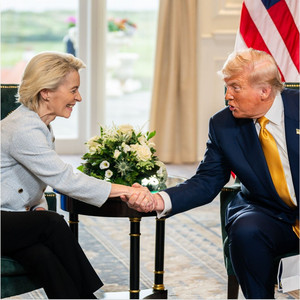
This is The Daily. By almost all accounts, the historic trade deal that was just reached between the United States and the 27 nations of the European Union is far better for the U .S. than it is for Europe.
Today, my colleague, Brussels Bureau Chief Gina Smiling, on why the EU caved to President Trump and the blowback that it's causing.
It's Tuesday, July 29th.
Gina, always a pleasure.
Thank you for having me.
You know, it occurs to me that, Gina, when two sides reach any kind of major deal, they usually find a way to tout it, to celebrate it, even if they don't exactly like it.
And that's not exactly what's happening on the European side of this enormous trade deal that was just reached between Europe and the U .S. No, that is very much not what is happening on the European side of this trade deal.
I think the most optimistic takes we're hearing are things like, well, gee, this could have been worse.
Not exactly a ringing endorsement.
No, no, not at all.
This is a humiliating capitulation on behalf of the EU, and it really calls into question this amazing negotiating strength that the EU was supposed to exert.
And the most pessimistic things we're hearing are this was a political capitulation.
This is a shame for Europe.
It's not a win for anybody.
It's a miserable deal.
I'm appalled. I'm absolutely appalled.
And one quote was, it's a dark day when an alliance of free peoples gathered to affirm their values and defend their interests resolves to submit.
And that one was from the French prime minister.
So very negative reviews.
Right. One of the leaders of France just basically accused all of Europe of submission to President Trump.
Yes. And it wasn't just the French complaining about this.
We saw it coming from the Belgians.
We saw it coming from analysts.
We saw it coming sort of across the board. There were a lot of complaints about this deal.
It really makes you wonder, what is it actually doing for its member states?
It's a real failure on the part of the European Commission in negotiating here.
And just explain what's behind these dramatic, somewhat abashed, embarrassed, even ashamed reactions from some of these European officials.
Why this does appear to them to be so bad for the European Union.
I think it's really a matter of this deal looking a lot worse in the details than what had been expected for a long time.
Europe is, depending on how you measure it, either the world's second or third largest economy.
with a huge trading relationship with the United States.
And for a long time, European Union officials thought that that would give them some amount of leverage when negotiating with the Trump administration.
And what they discovered is actually they ended up having a much more difficult time than they had expected, and they had to accept a worse deal than I think that they had thought they would, even as recently as a month or a few weeks ago.
And just take us on a very quick spin through the important numbers that reflect the worst -than -they -expectedness of this.
Yeah, the big number is 15%, which is the across -the -board tariff rate that the Trump administration has agreed to here, which would apply to about 70 % of all European Union goods being sent to the United States.
And that is up from what?
That is up from the low single digits, depending on how you measure it, coming into this year.
And it is pretty dramatically higher than what Europe had expected that they were going to arrive at.
So at first, Europe was hoping that they could negotiate Trump back down to those low single digits.
And then even up until a few weeks ago, they were hoping that they could get him to 10%.
They were hoping that 10 % would be the prevailing tariff rate.
And so 15 % is not a particularly good outcome.
But just to ask the obvious question, why has Europe agreed, submitted, in the words of this French prime minister to a trade agreement that almost none of them seem to really like.
I think there are two really big forces that argued for them to make a deal and for them to make this deal now.
The first is that they were increasingly worried that this could turn into a real tariff trade war spiral.
And I think that that was not initially on their radar in the way that it ultimately became on their radar.
Going into this, if you rewind to Liberation Day, April 2nd, that day when President Trump stood out in the Rose Garden with his poster saying what the across -the -board tariff rates were going to be on different economies.
Back then, European Union officials really thought that they could negotiate down their across -the -board tariff rate, which was 20 % as of Liberation Day.
Right. Then those negotiations did not go well.
And President Trump threatened to slap them with 50 percent tariffs.
But he backed off of that relatively quickly.
And so I think they thought that they could still negotiate down.
And then you get up until very recently when President Trump was threatening Europe with 30 percent.
And just as these threats kept rolling in and as he kept doubling down on them, it became more obvious to Europe that he was pretty serious about them.
And a tariff rate around 30 % would absolutely have crushed transatlantic trade.
European Union officials were really clear about that.
And so I think they got increasingly worried that if they retaliated, they might just poke the bear.
President Trump might still double down.
It could just result in this spiraling situation where they're retaliating, the administration is reacting, and that it would both cost jobs here in Europe and also potentially crush an economy that has been growing but not growing very quickly.
Interesting. So at some point in the kind of yo -yoing of Trump's position, which starts off very firm and then there's a pause and sometimes it feels like he's backing down, but then he's back up with an even higher threat.
At some point, European Union officials say to themselves, this is becoming real, even if it's very unpredictable.
And maybe because it's becoming so unpredictable, we now fear that the worst version of this is going to become our reality.
Yes, or a very extreme version of this.
I think there was this growing recognition that the Trump administration was really willing to inflict some serious pain to achieve their trade goals.
I'm just curious what an example would be of the pain that they most feared.
Yeah, so I think the most specific and clear example might be the pharmaceutical sector.
And so pharmaceuticals typically not tariffed because these are really important, potentially lifesaving medicines that consumers need.
But President Trump has opened an investigation into the global pharmaceutical industry.
He's been very clear that he wants to bring some of it back to the United States.
And he has been threatening to put potentially really huge tariffs on this industry.
He's thrown out numbers like 200%.
Wow. That would be a very big deal for Europe because pharmaceuticals and the chemicals related to them are the number one export that the EU sends to America.
And so this was a real point of concern.
And I think it was one that became more and more salient because you were seeing the pharmaceutical companies really warning that if big tariffs hit, they might have to pick up and move operations to the United States.
You were seeing pharmaceutical companies companies trying to stockpile product in the United States to try and sort of mitigate disaster if this actually came to pass.
And so I think it just became, as the months wore on, more and more real that this might happen.
And that was sort of an example of the kind of cautionary tale, the kind of, you know, reworking of economic relationships that really started to catch people's attention.
We've already started to see a lot of pain in the automotive sector.
So obviously, American consumers are probably very familiar with German carmakers, you know, the BMWs, the Mercedes -Benzes of the world.
They were staring down pretty serious tariff rates.
And if those had continued for a really long time, could have been very damaging to their business.
And so I think there was also a very, you know, intense push by the German carmakers and by carmakers in general to try and come to some kind of deal to make it a little bit less punishing and certainly to increase the certainty around what tariffs were going to look like.
Right. You said that there was a second reason beyond fear of economic trauma from the U .S. towards European Union countries.
So what was that? Yeah.
And I think this one is actually the more surprising one.
But there have been all of these other issues that have become sort of bundled up into this trade war that are typically thought of as pretty unrelated to trade.
So things like defense, things like America's involvement in NATO, things like America's support for the war in Ukraine, the other parts of the transatlantic relationship became very much tied up in this trade war.
And the idea that if you ended up in a huge trade battle and if you ended up with really, really rapidly declining relationships between the United States and the European Union, all of these really important geopolitical strategic priorities could get caught up in that mess.
In other words, EU trade officials began to feel like they couldn't disentangle doing a deal on tariffs with the U .S. from getting what they want from President Trump when it comes to arms for Ukraine or ongoing commitments to NATO.
And so they decide, let's do this deal because it will make everything else we're negotiating with the Trump administration easier.
Yeah, and they've been really explicit about that.
So Mario Sefcovich, who is the European Union trade commissioner, told reporters on Monday explicitly that it's not only about trade, it's about security, it's about Ukraine, it's about current geopolitical volatility.
So you really kind of can't get more blunt than that.
Like he was saying that this deal is not just about trade anymore.
more. Right. And primarily what he seems to be saying and what you seem to be saying is this was about fear.
And just to summarize what appears to have happened here, President Trump spooked the European Union, these 27 countries that collectively operate as one economic unit, on a variety of fronts, military, diplomatic, economic.
And this spooked EU decides to give of the president more or less most of what he wants in the biggest trade deal that he has gotten so far.
And that's how you get to a 15 percent tariff deal that most European leaders don't really like.
Yeah, I think that's right.
I think even the fact that they emphasize so clearly that this was the biggest deal, that they kind of helped him to advertise this in very Trumpian language, kind of speaks to the fact that they were really in sort of appeasement mode here.
Okay, well, when we come back, we're going to talk about what this pretty lopsided deal means precisely on the ground for both sides, what Europe gave up and what the U .S. seems to have gotten.
And we'll be right back.
This podcast is supported by Strawberry .me.
Be honest. Are you happy with your job?
Or are you stuck in one you've outgrown?
Or never wanted in the first place?
Sure, you can probably list reasons for staying.
But are they really just excuses for not leaving?
Let a career coach from strawberry .me help you get unstuck.
Discover the benefits of having a dedicated career coach in your corner.
Go to strawberry .me slash the daily to claim a special offer.
What's up, everybody?
I'm Indomitian Soup, Super Bowl champ and investor.
Throughout my NFL career, when I wasn't sacking your favorite quarterback, I was networking with some of the sharpest business minds in the world.
Now I'm bringing those conversations to you on No Free Lunch, a podcast from The Athletic and The New York Times.
On the show, I talk to experts and athletes to find out how the most successful people in sports and business are growing their wealth and how we can learn from their example.
No free lunch drops Tuesdays and Thursdays.
Find it on YouTube and wherever you get your podcasts.
So Gina, let's talk about what exactly Europe gave up here.
Clearly, we've established that almost every industry is now going to be paying 15%.
So let's talk about what that is going to mean, its impact, and other things in this deal that stand out as being tough for Europe to swallow.
So I think the first, most important thing to really sort of digest is what that 15 % tariff that's going to apply to 70 % of European goods will mean in practice.
And what it will mean in practice is that products that are being sold into the American market are going to become a little bit less competitive vis -a -vis things that are comparable and are produced by American producers.
producers. And so I think a good example, assuming that it doesn't end up having an exemption applied to it in the next couple of days, could be a bottle of Italian Chianti.
You're selling Chianti into the American market now.
It's competing with some nice wines from California, and suddenly it is 15 % more expensive, assuming the entire tariff is passed along to the consumer.
And so we're looking at a situation where European producers are going to have a slightly tougher time selling into the U .S. market.
That could also apply for things like cars.
Suddenly, depending on how things play out, your BMW or your Mercedes -Benzes are going to be a little bit more expensive to get into America than they previously would have been.
Now, on the flip side, Europe is giving more favorable terms of trade to some American companies that are sending products here into Europe.
And so cars are another good example just to sort of follow along that line.
They are now going to be subject to zero percent tariffs coming into Europe.
Wow. American cars will be imported into Europe with zero tariffs, whereas European cars imported into the U .S. will be hit with 15 percent tariffs.
Yes. And so European cars are getting a little less competitive within the United States market at the same time that American cars are getting more competitive within the European market.
I'm just trying to understand why Europe would agree to terms like that for cars, that would suggest that there has been a pretty serious existing imbalance, trade deficit within the car industry with way more European cars being brought into the American market than American cars being brought into the European market.
Is that the case? It is the case that Americans buy more European cars than Europeans buy American cars.
And it It is also the case that prior to this year, there were slightly higher tariffs on American cars coming into Europe, especially if you count in trucks, than there were on European cars coming into America.
So those things are true.
This reversal is bigger than an offset.
And I think that the reason that this industry became such an important issue here is really that it's one that President Trump has been fixated on.
He really cares about this.
A lot of times when he's in Europe, he'll remark on the fact that there are no American cars on European streets, you know.
Right. He's not seeing Fords on the streets of Munich. And so I think that that is part of the reason that this became sort of one of the sort of swap -a -roos, if you will, in this deal, is that it was something that President Trump found very salient.
Okay. So beyond giving a boost to American car manufacturing, how else does this deal benefit the American side of the ledger?
So we have heard from the Europeans that they are going to drop tariffs to very low rates or potentially even zero on a couple of products.
We don't have the exhaustive list yet.
They haven't published it.
But it's going to be potentially industrial goods, so things like machinery.
And then we're also hearing that it could be things like frozen seafood and lobsters.
Don't know who in the lobster lobby managed to pull that off, but yeah.
What is more American than a Maine lobster, though?
Yeah, well, Maine lobsters coming to a Berlin bar near you.
Without a tariff. Without a tariff.
And then we are also expecting some investments that the EU has reportedly pledged to make and that Trump made a really big deal out of when he was announcing the deal.
For one thing, there is going to be $750 billion in investments in energy over the next three years.
That's real money if it's real.
Yeah, big headline numbers, big questions about exactly how that's going to play out.
The European Union, as such, does not have the ability to just make those kinds of purchases.
That's something that would happen at the member state levels.
And the EU can't necessarily force their hands when it comes to making such purchases.
And so some serious questions about how that part would work.
Okay, so now that we understand the ways in which this deal clearly benefits the U .S. considerably and disadvantages Europe considerably, considerably, I want to understand how it fits into President Trump's goals for the second term trade war.
And really, he's laid out two main objectives in each negotiation.
To have a fairer trade relationship with whoever the trading partner is, Japan, China, EU, and to encourage more American manufacturing through these trade deals.
On those two scores, how should we think about what the U .S. and the EU just agree to?
Is it making trade fundamentally fairer than it had been between the United States and the 27 countries of the EU?
And is it likely to spur more manufacturing in the U .S.?
So I'm going to leave the question of fairness aside, but it is definitely the case that for years, the European Union has sold more to American consumers than European consumers have bought from American producers.
And I think all else equal, you would assume that this would slightly rebalance that.
I think it's also the case that American consumers spend a little more and European consumers spend a little less.
So I'm not going to pretend that this is just going to completely change that relationship overnight.
On the question of whether this brings manufacturing back to the United States, 15 % is probably not a prohibitive tariff.
It's probably not going to be the thing that, you know, causes company X to decide tomorrow that it needs to up and move to Syracuse.
But I think that at the same time, if you are a company and you've just lived through this really uncertain tariff period, and you think there's a possibility that the Americans could do this again, or that this uncertainty could last into the future, or that, you know, this is not the end of the story.
Maybe if you're thinking about expanding, you're a little bit more more likely to set up shops somewhere in the United States where you are shielded from some of those concerns.
Right. But I think it's important to emphasize, and I think the European Union would emphasize, that this comes at some cost to Americans, right?
When we talk about tariffs, they are fundamentally a tax and somebody's got to pay that tax.
And what we know from historical tariff experience is that that tends to be the end consumer, which in this case is the American consumer.
Of course, what President Trump would say is, if he's doing this right, and the European maker of Ozempic, for example, decides that its next factory should be in Syracuse, New York, or Atlanta, Georgia, then American manufacturing just gains some new jobs, and the people buying that Ozempic are not going to be hit with that 50 % tariff.
Yeah, you could theoretically think that might happen over time, But in the interim, you've got that 15 percent tariff on the OZMPIC that's coming into the country from Europe.
And so I think that the point that this is not costless is still worth emphasizing.
Got it. So, Gina, looking ahead, do we think that 15 percent tariffs are likely to be the template for the next few deals that the president wants to achieve with countries that haven't reached deals with the U .S.?
I know that so far he has reached a deal with the U .K., a very close ally, for 10 percent tariffs.
That's another framework that's not yet fully in force.
With Vietnam, it was a 20 percent tariff.
Japan was 15 percent, and now we have 15 percent with the EU.
Should we expect 15 percent or so to be the template for the rest of the deals with the rest of the world?
Yeah, so President Trump indicated on Monday in Scotland that something in the range of 15 to 20 percent could basically be the template, that we could see that applying pretty broadly.
And so I think that's interesting because it is not as punishing as some of the worst rates that he had been threatening.
But it's also obviously going to be a big step up for many economies that were facing much lower tariffs than that.
And so we're going to have to wait and see how all of that plays out.
It's going to be difficult to predict, especially because all of these changes are taking place at the same time, which makes them a little bit harder to understand.
You have to think about how they interact with one another.
But I think that the upshot here is we would see a pretty significant change in the global trading system.
And that's where I think I want to end this conversation, by assessing exactly where we are in Trump's second term trade war.
And I think if we're being honest, it began on Liberation Day with a fair amount of snickering from foreign ministers, from domestic economists, from political observers who saw his tariff strategy this time as fickle and volatile.
And there was a sense that the White House was perhaps a little out of its depth in this trade war, and yet here come the deals, especially the EU deal, and it's a capitulation from the other side, and what looks like a victory for President Trump, and suggests that his strategy, which might have looked chaotic from the outside, has been quite effective.
Yeah, I mean, I think, you know, having covered this closely for several months now, the strategy was chaotic.
But I think this idea that just because it was chaotic meant it wouldn't ultimately achieve what President Trump was trying to achieve maybe was a misreading.
And so we're still in the process of finalizing these deals.
They could still fall apart.
But it does certainly seem to be the case that President Trump is getting many things that he had asked for.
And we've really heard from officials, including Marek Sefcovic, the EU Trade Commissioner who I had mentioned earlier, this idea that April 2nd, that Liberation Day, was sort of this turning point.
You know, that we're not going back to the world as it was before April 2nd.
This is a new world and we need to adjust to it.
And adjust to what Trump wants when it comes to trade.
At least to some extent, yeah.
Well, Gina, thank you very much. We appreciate it.
Thank you for having me.
We'll be right back.
Here's what else you need to know today.
On Monday, President Trump broke with the leader of Israel, Benjamin Netanyahu, by acknowledging the starvation in Gaza, a subject that until now, Trump has largely ignored.
Prime Minister Netanyahu said there's no starvation in Gaza.
Do you agree with that assessment?
I don't know. I mean, based on television, I would say not particularly because those children look very hungry.
As he spoke, Trump stood next to British Prime Minister Keir Starmer, who said that the people of the United Kingdom were horrified by the scenes out of Gaza.
Right, it's an absolute catastrophe.
Nobody wants to see that.
And I think people in Britain are revolted at seeing what they're seeing on their screens.
Meanwhile, two of Israel's best -known human rights groups said that Israel was committing genocide against the people of Gaza.
It marked the first time that major groups inside of Israel have reached that conclusion.
And a gunman with an assault rifle has killed multiple people, including a police officer, in a midtown Manhattan office building.
The shooting occurred at around 6 .30 p .m. inside a building that houses the National Football League and the financial firm Blackstone, whose workers built a barricade of couches to protect themselves from the shooter.
As of Monday night, the shooter's motives and target remained unclear.
Today's episode was produced by Diana Nguyen and Rochelle Banja.
It was edited by M .J.
Davis -Linn and Lisa Chow.
Contains original music by Dan Powell and Marion Lozano. And was engineered by Alyssa Moxley.
Our theme music is by Jim Brunberg and Ben Lansford of Wonderly.
That's it for The Daily.
I'm Michael Barbaro.
See you tomorrow.