Hi there.
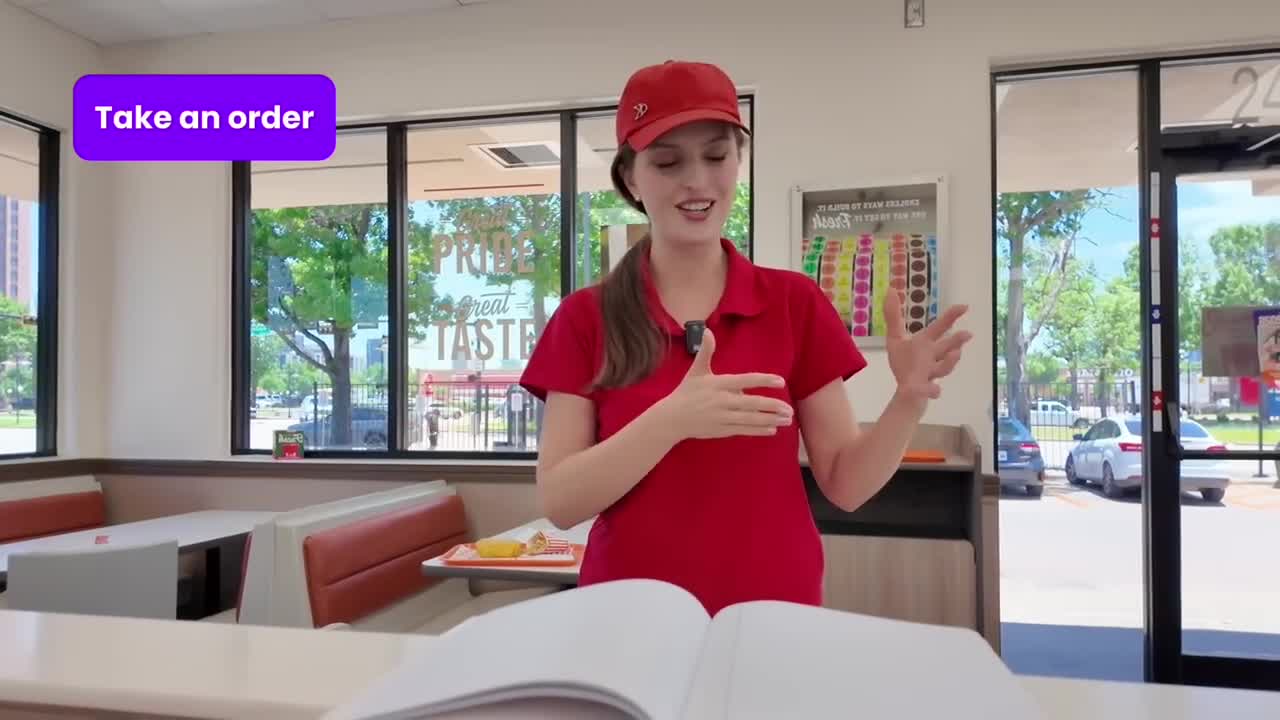
I'm here to take my order.
Sure.
Oh, what's this?
You can take your order.
No, no, no, no, no.
I mean I already ordered.
I just need to take it if it's ready.
Oh, then say I'm here to pick up my order.
Pick up, not take.
Yes in english there is a fixed expression take an order which means to write down or type what the customer wants to order
Usually it's the employee or the attendant who takes your order
That's why when you come to grab the food you already ordered we say pick up not take
Hi everyone and welcome to my YouTube channel.
Today I came to a fast food restaurant here in Texas just to teach you English in a creative way.
These are some of the phrases you'll learn in this video.
Hi, can I have a glass of Coke?
Sorry, we don't have that.
What?
How can you not have it?
This is classic.
No, it's not.
We don't use glasses in fast food restaurants.
Huh so how will i drink it wait we only have cups in fast food restaurants they typically serve drinks in cups so you just say can i have a small coke
Can I have a medium coke?
Can I have a large coke instead?
Glasses are usually made of glass while cups are usually made of plastic, paper, or foam.
At a sit-down restaurant, like a normal restaurant, it's totally okay to order a glass of coke.
A glass of water.
But at a fast food restaurant, they're commonly served in a disposable cup.
Hi, can I have a sandwich?
A sandwich?
Huh?
Like this?
No, no, no, no, no.
I mean a sandwich with meat.
Oh, a burger?
A burger.
Yes.
Technically, a burger is a type of sandwich.
But in general, if you order a sandwich, this is what most people will think of.
A sandwich is made by putting ingredients between any kind of bread but if you order a burger, this is what people will give you.
A burger is specifically made with buns and a patty.
It always has a patty.
This is a patty.
Oh, sorry, can I get a package of salt?
This is not a supermarket.
Huh?
Oh, do you mean a packet of salt?
A package of salt is usually those big containers they sell in supermarkets.
So basically, we can say that this container is called a packet.
Oh, a salt packet, okay.
We can say a mayo packet, a pepper packet, or a ketchup packet.
These are called salt packets because they're smaller and for single use.
Sorry to bother you again.
My burger is falling.
Are you lying?
I can't see anything on the floor.
But look, it's falling here.
Oh, it's falling apart.
If you say just falling, it means that something is falling to the floor.
For example, the pen fell on the floor.
Thank you so much.
No worries, let me bring you another one and let me get you some napkins so you can wipe your hands.
Excuse me again, this ketchup doesn't open.
Yes, it does.
Hey, no, it doesn't open.
Look.
Oh, it won't open.
Oh, there's no way I'll remember all these things.
There are many things I still get confused.
I understand you.
I used to have trouble memorizing words, grammar rules, natural phrases in English, and in other areas too.
I used to write things on a piece of paper and put it in my pocket to remember every once in a while.
But that's
Too much work.
Exactly, it didn't really work.
That's why I started researching easier ways to do that, like slides for memorization.
As an English teacher, I always need to make slides for students.
Kimmy helps me solve that problem.
In English, if you say that something doesn't open, it means that it generally doesn't open.
Like if it was made not to open.
For example, this window doesn't open.
It was built not to open.
You can say this store doesn't open on Sundays, meaning that it usually doesn't open, like it's not meant to open on Sundays.
However, when you want to say that you tried opening something but it didn't budge, you'd say something won't open.
For example, I tried opening this ketchup but it just won't open.
So when the issue is temporary, we say something won't do something.
Another useful example is my phone won't turn on.
Oh, so this ketchup won't open.
The slides are very well created and organized.
Did you make them yourself?
No, actually, I don't have much time.
So I ended up using Kimi AI.
Just click the slide.
Then choose visual mode.
I typed create slides teaching the difference between it doesn't open and it won't open.
After that you describe the visual style you want or upload a reference photo.
It's
Even editable and can be exported in various forms, PDF, HTML.
All the information generated by Kimi draws on data from Google Scholar.
You can create any slide you think of in Kimi.
I have attached the link in the description.
Wow.
Yeah, and I read every night before going to bed to improve my vocabulary.
Oh, but when I read, I have problems to understand every word.
I used to have the same problem.
Now I upload the book to Agent Swarm and Kimmy creates everything I need to learn the vocabulary.
It generates a vocabulary list, a word frequency visualization, and even vocabulary quizzes to help me remember the new words.
Look at this vocabulary list Kimmy created for me.
It's CEFR graded, which means every word is labeled according to its English level, like A1, B1, B2.
That's so useful!
Yeah, the vocabulary frequency visualization is a chart that shows which words appear most often in a book.
And when I finish reading, Kimmy generates a quiz to test what I've learned.
Click the link in the description and start using Kimmy today!
Have you finished?
Yes, I have.
You can clean the table.
Clean?
Okay.
No, no, no, not clean, I mean clean the trash from the table.
No, no, not clean, remove the things, remove the trash.
You mean clear the table?
Huh?
Clear or clean?
Isn't that the same thing?
Oh my gosh.
No, they're different.
Clear means to remove items from a place.
While clean means to remove dirt.
Oh, interesting.
Here you are.
Have a good one.
Yes, to have a good one means to have a good day or more generally, I hope things go well for you.
It's a very common and casual way to say goodbye in American English.
Oh, so how can I reply when someone says, have a good one?
You can say, thanks, you too.
Or simply, you too.
Hi.
Can I have a double meat Whataburger and a large Coke and one fry?
Yes, the meal.
Just a double meat Whataburger.
To go.
Okay.
Thank you so much.
If you learned something from this video, please like it, share and subscribe to my channel.
I love you guys.