It's the book club for kids.
The book club for kids.
It's the book club for kids.
It's the book club for kids podcast.
Hi, I'm Kitty Felde.
This week we get a new look at an old fairy tale.
The story of the Russian witch known as Baba Yaga.
She had a bad reputation for eating small children.
It was a little disturbing at first, but it never happened, so it ended up being fine.
That's one of our readers, a boys' book club we caught up with at Powell's Books in Portland Oregon.
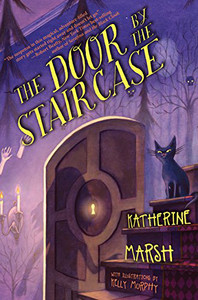
We discussed a novel chosen by the boys, The Door by the Staircase.
She headed for the foyer and her eyes fell on the locked door by the staircase.
She was certain that there was something besides mops and brooms that lay behind it.
She had to figure out a way in.
That's our celebrity reader, Congressman Earl Blumenauer, who represents the Portland area.
We're also joined by our writer, Catherine Marsh, who says she believes there's good inside of everybody, even a witch like Baba Yaga.
I don't think anybody is truly, you know, always good or evil.
I think we have that inside of ourselves.
So I think it's a challenge like it is for Mary to try to draw the good part out, just like it's a challenge for us to do that with other people.
This is the Book Club for Kids, the podcast where kids talk about books.
We'll tell you how you can be on the show a little later on, but first, let's meet our readers.
Hello, my name is Cole.
My name is River.
My name is Sayer and we are all going into sixth grade, and at the moment we're in Powell's Bookstore, which is in Portland Oregon.
So the book is?
The Door by the Staircase by Katherine Marsh, and it's about a girl named Mary who has just been adopted by who later she finds out is a witch, and she has to face many challenges and there's a lot of magic in the town she's now living in and She's met a new friend named Jacob.
She has to find sort of her family in the tale of The Door by the Staircase.
And Madam Z isn't who she thinks she is.
How would you describe this book?
What kind of book is it?
We mentioned the magic, but what would you describe it as?
Magic, yeah.
Russian fairy tale.
Fantasy, definitely.
So Russian folk tale...
It's kind of a famous character that we see showing up in Russian folk tales.
A witch, Baba Yaga.
That's what they call witches.
And what's she like?
She likes eating children.
Did that bother you at all?
It was a little disturbing at first, but it never happened, so it ended up being fine.
What is she like, Baba Yaga?
She's a character who sort of has a lot of trickery in her personality and tries to make an image in front of Mary that isn't really what she is.
She wants to make those kids feel like they can trust her and then she'll eat them.
Because that's what Baba Yaga does.
Yep.
She lives in a kind of unusual house, I thought.
Yeah, the house grows legs and has a bunch of very mysterious stuff in it.
Like, there's hands working for her, a Russian kitchen tool called a peck.
Moving hands that can weave, write, and do sort of household chores and cook and chop vegetables.
I'd like to borrow that one from time to time.
What else?
She's got a cat that can talk.
The house can run.
It can basically lock down and then nobody can break in.
And what about her main character, Mary?
What do we know about her?
Um, she had a brother and a mom who died in a fire.
Then she went to an orphanage that she didn't really like.
And then she thought she had found a home when she was adopted by Madam Z or Baba Yaga.
How would you describe her?
Adventurous.
Tons of curiosity.
Because by the time like the third or so night, she's gotten some sort of suspicion about a door with a keyhole and no handle.
Some of Baba Yaga's famous lines, busy hands never rest.
I think she's very clever because she's trying to escape the hands of a witch and that takes a lot of courage and Baba Yaga has a lot of power.
Let's hear a bit from the book when our heroine Mary, gets an inkling that her adopted mother has a darker side.
Our celebrity reader is Congressman Earl Blumenauer, who represents Portland Oregon on Capitol Hill.
In the peaceful stillness after Madam Z had finished her last song, Mary turned to her.
Did you ever have children, she asked.
Madam Z blinked.
Are you asking me if I've ever been a mother?
Mary nodded.
I just thought since you adopted me.
Divaksha, Madam Z said sharply.
I am no one's mother.
Mary stiffened.
Madam Z had never spoken to her in this harsh tone, which seemed reserved only for Kashki.
Perhaps it was just the dying embers in the hearth. but the parlor suddenly seemed cold.
In a flash, as if she realized her error, Madam Z's face reassembled itself.
Her eyes crinkled kindly, and a smile played on her lips.
I've never been a mother, if that's what you mean, but I'm happy you're here.
That's all.
I was just wondering, Mary said blithely, if she hadn't noticed the old woman's first reaction.
But she knew now that her instincts were right.
Madam z did not think of herself as a mother or mary as a daughter, so why had she adopted her?
But before mary could ask another question, madam z stood up.
It's late.
Mary nodded.
The turn in the conversation had clearly made the old woman uncomfortable.
Mary bid her goodnight.
She headed for the foyer and her eyes fell on the locked door by the staircase.
She was certain that there was something besides mops and brooms that lay behind it.
She had to figure out a way in.
Had you guys read any Baba Yaga folk tales before this?
No.
Any fairy tales?
Did you go through a fairy tale or folk tale era in your reading?
Yeah, I did, because I read Land of Stories, which was a good book, and all the like fairy tales that a lot of people hear as kids.
So was this book like those?
No, it wasn't because it was more than just a fairy tale.
It had main characters, a lot of adventures, a big plot to it, and it was just more complex.
The character's personality isn't really what you'd think in a fairy tale, like all happy, and I personally don't hear a lot of fairy tales from other countries, so a Russian one was very cool for me.
I thought it was, like, just super cool.
Yeah.
And different words that, like, I had to figure out what they meant.
Took you on, like, this long imagination path that was cool.
Who picked this book?
You picked this book.
Tell me why.
I knew that a lot of us had read it because it was a part of Oregon Battle of the Books.
And it had a lot of things to talk about and a lot of details and a lot of characters.
Good choices for a book club.
What'd you think of the book?
I thought it was very cool to read and it was very magical.
Is it right up there with Harry Potter?
Uh, different than harry potter?
Yeah, maybe like just below it, i don't know like about there, but not like past harry potter.
So did you read this during battle of the books?
Yeah, and this was one of my like super focused books that i almost had to memorize, so i know a lot about it.
So what have we not talked about, mr expert?
Well, there is a character that we haven't really went over yet.
His name's Koshke, kind of Madam Z's servant, in a way.
And Madam Z hired him to take care of the horse Sivka, which is a magical horse that can breathe fire.
But he's not what he seems.
No.
I don't really want to spoil the book, so probably at this point you might want to close your ears if you don't want to spoil the book.
But he's kind of the main villain in the story.
Did that work in the book with him being the villain?
Were you surprised?
Yes and no.
I mean, he did kind of seem not who he should be.
He didn't really seem like a side character, unlike some of the other people that could perform real magic in the town.
But later in the book, you find out he can do some seriously wicked magic.
A little bit of a spoiler.
He's working towards getting Sifka from Madam Z.
He has to work for 300 years and he's already worked like over 250, I think.
And I could see him sort of becoming that villain.
Does he work as a villain?
Yes and no because, if you ever like, watch any of those movies that have a villain that wants to take over the world.
He's kind of like that because he wants to take over the kingdom of Baba Yaga, but he's um Sort of not a villain at the same time, because he's never shown it before.
He's actually been pretty kind and helpful and talks to Mary, friendly.
And he did suffer through, what, almost three-quarters of his servitude time.
He was almost about ready to be set free.
Yeah.
So he was a lot more patient than I would have been.
Yeah.
300 years is a lot just for a horse.
I think he was kind of trying to act the part in gaining Madam Z's trust, because from what I heard in the book it seemed like he held Madam Z's trust.
And by the end of the book, he...
Kinda didn't do that.
Seems like a good time to talk to our writer, Katherine Marsh.
You guys got some questions?
What gave you the inspiration for making this book?
I was inspired to write this book, in part because I grew up with my grandmother, who was from Ukraine.
And so I was familiar with some of these Russian fairy tales and folk tales.
And I was always intrigued by the character of Baba Yaga because, unlike the witches that are in Western fairy tales, who are usually very, very bad, Baba Yaga is mostly bad.
She does eat children, which is not good.
But sometimes she will do a good turn and actually be nice to people.
And I was kind of intrigued by that idea of a witch.
A witch you could possibly win over through trickery or love.
Does that make it a more interesting character, rather than black and white?
The good witch, the bad witch.
Oh, I absolutely think so.
I love characters that have a duality like that, because I don't think anybody is truly always good or evil.
I think we have that inside of ourselves.
So I think it's a challenge like it is for Mary to try to draw the good part of Baba Yaga out, just like it's a challenge for us to do that with other people.
Were you living in Russia at the time, and is where you were living your inspiration?
No, I was actually living here in Washington DC, but I actually did spend some time in the Soviet Union.
That's how old I am.
But when I was 16 years old I went and I studied Russian and I was able to live in Moscow in the last months of the Soviet Union.
So my knowledge of Russian and Russian culture played into the book.
I saw on the back of the book that you live in Belgium right now.
And if you are going to make another book, will it be about Belgium?
I have another book that is set in Brussels, Belgium, where I lived for three years.
And I just moved back from Brussels to Washington, D.C.
And that book is really.
It's partly based on the experience of my family there, because it's about a boy who who is unhappily moved to Brussels by his family, but a friendship develops for him with a Syrian unaccompanied minor refugee who's a child, who's traveled from Syria in the refugee route without his parents.
And it's about their friendship, and it's based partly on the experience of my family and partly on various news events that were going on in Brussels during 2015-16.
So sometimes it's imagination, but other times it is place that inspires.
And with The Door by the Staircase.
I was very inspired by the story of the town of Lilydale, New York, which has a history as a spiritualist community.
And I wanted to create something like that with Iris, which is the town in The Door by the Staircase.
When you're not writing a book or writing.
What do you do in your free time or what do you enjoy doing?
With my free time, I love to travel.
I speak a little French and a little Russian, and I like to try to keep those up.
I love spending time with my kids, and I love to read.
I think probably all writers say that, but it's true.
This book has a lot of magic in it.
Some of them are tricks and some of them aren't.
Talk a bit about that, about the idea of what is magic.
There's real magic in the town and also fake magic.
When she first met Jacob, him and his dad were performing a magic trick, and it was a bird in a cage.
The cage collapsed.
But there's also real magic, like Rosalina, who's a water druid who's been captured, sort of.
She seems very depressed, always sad, and she's like the fortune teller in the town, supposedly.
But not a lot of people go to her shop, I guess.
I guess that makes her depressed.
Yeah.
So again, the difference between real magic and tricks.
Well, the tricks are also kind of illusions.
A lot of people in the town create many illusions, but some other people actually have real magic, like one person can breathe fire, another person can shape-shift.
Yeah, there's a lot of illusions, a lot of good magic, and they're all competing with one another to be the best.
All the people in the town?
Yeah.
So why do you think we like illusions?
What is it about us as people, as human beings, that make those so appealing to us, do you think?
Curiosity and how do they do it and what's the secret to doing it?
For entertainment.
Curiosity.
Yeah, and just leaving people stunned.
Do you think we want to believe that it's real, that it's not a trick?
I think so.
Yes and no.
Because there are some scary tricks that... Like what?
Throwing knives and... But there's also like the cool card tricks and... Same thing.
Yes, I think a lot of us do want to believe it and then a lot of us don't.
Well, if I had a magic wand and I were to give you one real bit of magic that you could do, what would it be?
Invisibility.
Why?
Sneak cookies.
Money.
All sorts of different things that you can do.
Sounds like you'd be a trickster if you were invisible.
Oh, yeah.
What would be the best trick you could pull if you were invisible?
Probably stealing.
Oh!
I have a little bit of a disagreement on that, because people would notice that it's moving and like how would that be possible?
So then they would like go and figure it out.
So what magic trait would you like to have?
To fly, because you can do tricks.
You could swoop down and steal something.
There's a lot of theft going on in this group.
What's going on?
You could kind of like almost teleport, not really though.
You could go from one place to another quick.
Kind of drone speed, not Star Trek teleporting speed.
Yeah, I mean, drone speed.
I would say probably, like, being, like, super fast.
All of your, like, reflexes and everything, do, like, memorizing everything super fast.
So then you could do, like, if you had to memorize a test real quick, then you could do that.
If you had to get somewhere real quick and you might not be on time, you just go there real quick.
All right, we have to ask the hardest question, which is what is your favorite book?
My favorite book is The Lightning Thief by Rick Riordan, because I like the Greek gods and he has to go on a big adventure.
I'm more of a dystopian guy myself, and I like books like The Maze Runner and Hunger Games.
Why?
Why do you like dystopian novels?
Just because they seem sort of realistic, but in a way, not really.
I don't necessarily have favorite books or like a genre.
Sports novels and like mysteries and like sports novel mysteries are definitely the best for me.
I like them because like since I am like really athletic myself, I sort of like relate to them.
I don't think I could name a sports mystery book.
Give me a title.
There's a series I really like called Ballpark Mysteries by David A. Kelly.
What about you, Congressman Blumenauer?
Got a favorite book?
Reading has been a critical part of my life for as long as I can remember.
And my favorite book is always the one I'm reading now.
And what is he reading these days?
Eat, Drink, Vote, an Illustrated Guide to Food Politics by Marion Nessel.
Well, what about you, Catherine Marsh?
You know I always loved Island of the Blue Dolphins when I was growing up and I'm an only child and I felt lonely a lot as a kid.
I had divorced parents and that book really spoke to me because it was about isolation and about being alone and how to make that into something positive.
So I just loved that book as a kid.
And it's also historical fiction, which I have a soft spot for.
We'll have a list of everybody's favorite book at our website, bookclubforkids.org.
And if you have a favorite book, you can be on the Book Club for Kids podcast, too.
Just give us a call at 323-639-3560 and leave us a message telling us your first name, the city where you live, the name of your favorite book and why you love it.
That number again is 323-639-3560.
This episode is funded in part by the DC Commission on the Arts and Humanities, an agency supported in part by the National Endowment for the Arts and by the Nora Roberts Foundation.
Thanks this week to producer Ilse Setziel.
Jonathan Jensen composed our theme with additional music from Charles Nilman.
Emma Steinkalmer designed our logo.
Thanks to our writer, Catherine Marsh, and our celebrity reader, Congressman Earl Blumenauer.
Thanks as well to Kim Tano at Powell's Books for hosting our taping, and to our readers this week, Cole River Sayer and Stephanie O'Malley Hopp, for organizing our book group.
We have a free newsletter for teachers, parents and librarians full of free tips about how to turn kids into lifelong readers, particularly those who are a little more reluctant to pick up a book.
You can sign up at our website, bookclubforkids.org.
I'm Kitty Felde.
Thanks again for listening.
Bye.