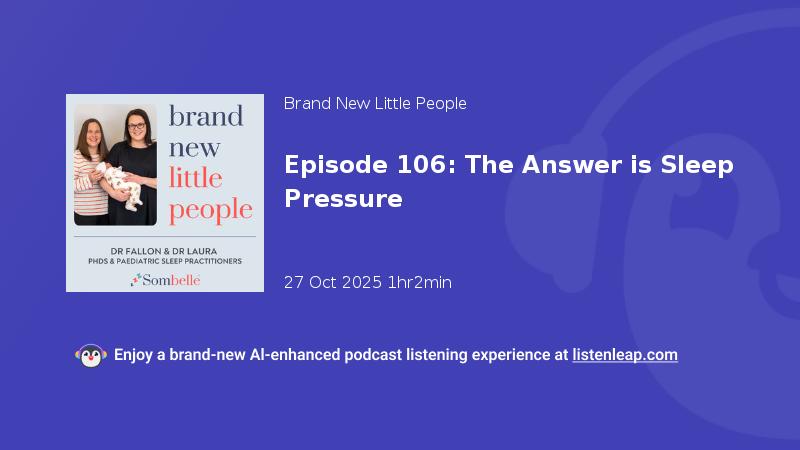
The advice in this podcast is general in nature and does not constitute medical advice.
In the spirit of reconciliation, Dr Fallon and Dr Law acknowledged the traditional custodians of country throughout Australia and the continuation of cultural, spiritual and educational practices of Aboriginal and Torres Strait Islander peoples.
They pay respect to their elders past and present and recognise that sovereignty was never ceded.
If your baby or toddler has false starts where they wake soon after going to bed, or split nights where they wake for more than 30 minutes in the middle of the night, or if they're just really hard to settle to sleep taking longer than 20 minutes, then there is a very good chance that your little one has a sleep pressure difficulty.
The good news?
These problems are easily fixed by taking a close look at the daily rhythm.
That's why we dedicate an entire chapter of Slum Bells specifically to mastering sleep pressure.
When sleep pressure challenges are resolved, the door to easier settling and quieter nights swings wide open.
Music.
Welcome back to Brand New Little People, the podcast companion to the Sombel Pediatric Sleep Clinic programs created by us.
I'm Dr Fallon Cook and I'm here with Dr Laura Conway and we're the directors of Infant Sleep Australia.
Laura, how was your weekend?
Yeah, it was good.
Thank you.
Did a fair amount of bulk shopping and bulk cooking this weekend.
So I'm feeling really productive.
Oh, nice.
Awesome.
The freezer's stocked.
The freezer is stocked.
So now I don't have to do any cooking for a week or so.
It's really nice when I do that.
Good way of getting ahead of things.
Yeah, I finally got an oven now so I can actually do some cooking, because we've mostly moved in to our renovated part of our house now.
And we had, yeah, no, it's so good.
We had months and months with no oven, no stovetop.
You know everything being cooked in the microwave.
I tell you what, if I never eat a microwave meal again, it would be too soon.
Oh, it's been so nice to like cook things.
And all the meals that we were actually really sick of, that we just had had a million times before, are suddenly like brand new again.
Yes.
Yeah, all the old favourites are coming back out.
Oh, good.
It has been really nice.
And all the kids are in their own bedrooms now, so are they happy with that?
They are.
Oh, my God, it is amazing, Laura.
The other day I was like, this is really weird because –
They were all in their own room doing their own thing and they're so happy just to be able to close their door and have their own private space.
Poor thing.
I bet, yeah.
And then I was like sitting on the couch in the lounge room on my own.
And I was like, this is luxury, absolute luxury.
Like I know it won't last long.
Soon enough, they'll be sick of their bedrooms and they'll be climbing all over me on the couch again, and I'll probably have missed them, weirdly enough.
I'll be quite happy for that to happen again.
But just to sit there in the quiet in this completed lounge room, it was just like, oh my God.
It feels like we've been in a tumble dryer for the last seven months and now we've been spat out and I'm kind of.
Walking around a little bit dazed, like, is this real?
You're, like, slightly creased and you're, like, being taken out of the tumble dryer and, like...
There's a lot of wrinkles in this face now.
That's what renovating does to you.
Oh, my goodness.
What a year, though.
It has been wild.
I can't believe I managed to...
Just keep everything afloat, you know, with the company and renovating kids for both of us.
You know, we have both had a particularly challenging year.
Yes, yes.
We're here and we're clinging on by our fingernails.
Absolutely.
We're going to make it to Christmas, Laura.
I tell you, what buoys me up and I know buoys you up as well is the lovely emails we get from members with really kind words about how they have, how they found us in the first place and how they've brought about changes to their baby or toddler's sleep.
And it's just so nice to get that.
And, you know, that's certainly what keeps me going through those tricky times.
So keep those lovely emails coming people.
Yeah, it's really great to receive.
Oh absolutely, it's so much hard work behind the scenes and I think that's probably the case with many businesses.
What you see yeah, you know as an outsider just looks all lovely and like wow, that must be great work.
But uh, the nitty-gritty can be pretty tough, can be really tough.
So yeah, thank you to our beautiful members and the families who visit the clinic, who have lovely things to say.
Definitely keeps us going, Yeah.
Yeah.
So look, when I was, I was pottering around this morning, kids gone to school and I was like, what are we going to make this podcast episode about?
And I just thought well, we just keep getting questions where the very first thing I go to say is well, we've got to look at sleep pressure.
And I thought let's do an episode where we really dive into sleep pressure, what it is and how you can modulate it, because it has the most phenomenal impact on every component of sleep and settling for babies and toddlers.
I mean, for adults as well, but it's just a lot easier to manage as an adult.
But it factors into everything.
And I think it has been one of the big missing pieces of the puzzle for years and years now in this space.
And I'm really proud of the work we do in this space because we are starting to make some really strong inroads.
But let's start with what is sleep pressure?
Well, sleep pressure is one of the biological systems that controls sleep.
And the proper term is the sleep homeostatic process.
And essentially what it means is that when we wake up in the morning, our drive to sleep builds and builds, and builds throughout the day.
And we need it to be nice and high by bedtime for us to go to sleep relatively quickly and relatively easily.
And then that pressure wears off overnight as we sleep and then it's back down to zero in the morning, when we Babies we tend to build sleep pressure quite quickly.
So we need to have naps, which are like valve releases.
And we have so babies will have naps and then the pressure carries on building.
They'll have another nap and then it carries on building and so forth.
And as babies get older, sleep pressure builds more slowly.
So the number of naps that they need to have across the day decreases until eventually toddlers and preschoolers drop their naps altogether.
And then they...
The sleep pressure is just functioning in the same way as it does in adults.
So it builds across all of that awake period until we're ready to go to bed at night.
So that's sleep pressure in a nutshell, Fallon.
That is the most beautiful, succinct answer, Laura.
Thanks.
Absolutely nailed that.
I'm going to be able to chop that up for social media feeds so easily.
Excellent.
Let's see how you do with my question then, Fallon.
Oh gosh, the pressure's on.
So Fallon, why is sleep pressure suddenly a hot topic?
Yeah, so I think you know we've had about 10 years probably more, getting closer to 15 years now of having this idea of rigid wake windows being what you have to follow for every baby or toddler if you want to have good sleep.
And when we follow rigid wake windows or set daily schedules that are based on age and not unique sleep needs, it completely messes with sleep pressure.
It completely throws the idea of sleep pressure out the window.
Yeah, essentially trying to stamp a different you know routine onto your child that might just not work with their sleep pressure at all.
So I would say that terrible, terrible advice has really messed with sleep pressure in so many babies and toddlers that it has really helped fill our clinics because we have all these parents coming in going.
I know they're supposed to do, you know, 12 hours overnight and three naps for four hours day sleep and I'm just like no no no, no.
No, they're not.
But you know, they come to us with huge sleep pressure problems, with daily rhythms that just have not been fitted to their child's unique needs.
So I think that's why it's such a hot topic at the moment, because I think a lot of it actually if I don't sound too egotistical has a lot to do with the hard work that we've been doing.
This concept of sleep pressure and how it can be modulated.
But I think it is a hot topic now because a lot of parents are cottoning on to the fact that actually, when I'm trying to push a schedule on my child, it doesn't seem to fit.
They're wide awake in the cot.
You know, parents are looking for another solution.
And I would also just add to that though, that that terrible bit of advice around you know overtiredness, having to be avoided at all costs, is also really factored into.
You know this whole thing.
Whole lot of misinformation that has meant that we're not following baby's cues and really looking at what they uniquely need and respecting what their sleep pressure sort of levels are at.
Yes, yeah, absolutely.
And when babies are born, the main biological system that is already in place is sleep pressure, and the circadian rhythm system hasn't matured yet.
But once that does mature from 10, 12 weeks onwards, then overtiredness becomes less of a issue.
And that's just not well recognized.
So those rigid, age-based windows are still there, worrying parents that their child's going to become overtired because it's just based on what happens with really little babies.
Yeah, I had someone in clinic not long ago and I think their toddler was nearly two and they were saying oh, we can't get rid of the nap.
You know, can't reduce the nap.
I think it was because they'll get overtired and then their nights will be terrible.
We've worked really hard to keep this nap, you know, to two hours or whatever it was, so they don't get overtired.
And I'm like, but the nights are terrible, even though you've kept the nap.
Yeah.
So it's you know, even though they're almost a couple of years past, overtiredness being a potential problem, that it's idea lingers and can ruin sleep for years, and I think that's a tragedy because that's years of missed opportunity for better sleep.
Yeah but Laura, how can parents identify that sleep pressure is an issue for their little one?
Do you want to talk us through some of the factors that you'd be on the lookout for?
So there's a number of signs and parents listening may identify that their baby or toddler has one of them, two of them, maybe all of them.
Hopefully not.
Hopefully not.
So one of the key signs is that your child, your baby or toddler is having false starts, quite predictably.
And maybe just once in a blue moon is neither here nor there.
That tends to be a bit of a signal to us that perhaps the sleep pressure wasn't quite high enough at the point that you pop them down at bedtime.
The next thing to look out for is split nights, dreaded split nights.
So your little one is up in the night for more than half an hour.
We see some real extreme split nighters in the clinic.
Four hours.
Yeah.
Awful.
Four killers, absolute killers um, and those little ones are bright-eyed and bushy-tailed at some silly o'clock in the morning um, and in that time they're waiting for their sleep pressure to rise again in order to be able to do their second stretch of sleep overnight.
Not fun for anyone.
Other signs can be that your baby or toddler is taking a really long time to fall asleep for their naps and or bedtime.
So we're thinking, you know, way longer than 20 minutes, and they may be Fighting sleep, resisting sleep.
Parents might say they hate their cot and they're having to do a lot of things walking around bouncing.
They're spending a lot of time.
Or they drift off and then spring awake when you go to move.
That's a big sign.
Yes, that is a big sign.
If you are working on supporting your little one to go to sleep in the cot, you can be finding that it is really, really hard.
And you're not gaining traction that you think you should be, that you're expecting to happen.
And the long time to settle is crucial. continuing once you move on to trying to do cot settling.
So those are kind of the four main signs.
So the false starts split nights taking a long time to fall asleep or, if you're doing cot settling, having a lot of difficulties gaining traction.
I think that's such a common one, isn't it?
Even though in Sambao we sort of say you've got to work on the daily rhythm before you work on changing how you settle them to sleep.
A lot of parents are like, oh, the daily rhythm is good enough.
I'm just going to dive into settling.
And then they hit these. big hurdles are like, whoa, this is really, really hard for my child.
And it's always a case.
And I think there could even be some questions we answer today where this applies.
It's always the case that we've just got to tighten up that daily rhythm.
There's too much opportunity for sleep.
Sleep pressure's just not high enough.
I think that's a really, really common one.
So if that sounds a bit like your little one, that you've just had this terrible time with cot settling, have a really close look at their daily rhythm.
Use the unique sleep needs chapter in Sunbell to guide you, because that's what it's there for to really help you really specifically tailored the daily rhythm to your child's unique needs.
And I think that is just...
You're on the money when you're doing that.
Everything gets so much easier.
Yeah, it does.
So what can parents do if they've worked out that sleep pressure is causing sleep difficulties, Fallon?
Yeah, so definitely start by looking at how much sleep your little one is averaging.
That's going to give you a pretty good clue about what their sleep needs are.
So a lot of parents will just track sleep in one of their tracking apps.
If you use one of those, just go and have a look at it now.
What's the average across the last week?
Because babies and toddlers are pretty good at making sure they meet their unique sleep needs.
So when we look at that average, it gives us a pretty good idea of what their sleep needs actually are.
And then you've got to think about the daily rhythm that they have.
So, just to use an example, if let's just say you've got a one-year-old, they're averaging 12 hours of sleep per 24 hours is their average.
Maybe they're having two to three hours of naps.
They go to bed at 7pm and wake up at 7am.
That would be a pretty common scenario we would see in clinic.
Then that total sleep opportunity that that baby or toddler is having is adding up to 14 to 15 hours of sleep opportunity per day.
So they're not taking 14 or 15 hours.
They're waking up constantly overnight.
So they're getting far more opportunity to sleep than what they actually need.
So they're just going to wake up a lot.
So in that case yeah, that that baby's very likely to either be wait waking for, you know, having a split night where they're awake for two or three hours in the night, or they might just wake up constantly for briefer wake-ups.
That's typically what we'd see in their sleep diary.
So in this scenario, what we would look at doing is fitting that daily rhythm to that little one's unique sleep needs.
So just giving 12 hours of opportunity for the 12 hours of sleep they need.
And that can scare parents a little bit, because often it means trimming down day sleep, adjusting bedtime and wake up time.
And it's scary because at first it's going to feel really, really damn hard.
Like your baby or toddler might be super cranky in the daytime.
Their nights probably won't improve straight away.
But often, after a week of working towards a daily rhythm that fits their sleep needs, it does start to come together.
Their nights improve.
They wake up more refreshed.
They power through the day a bit more easily.
But I fully appreciate that.
You know it can be really overwhelming to approach these things because so often we talked about this the last episode, I think, or the one before so often babies and toddlers are stuck in a bit of a cycle where they have really tricky nights.
They basically are starting the day with their sleep pressure already pretty high, So they're pretty sleepy.
They seem to want to nap a lot.
They're pretty grumpy.
Parents will say, no, no, they're really tired.
They really need all that day sleep.
But they have all that day sleep and then they have a terrible night.
And the cycle just kind of keeps going.
At some point, if we want better nights, we've got to put the brakes on that.
And it might mean a few tricky days of keeping them awake when they're clearly very, very tired in the daytime.
But just so that we can... push more sleep back into their night.
And it's exactly what we do when our babies or toddlers are jet lagged.
We have to keep them awake in the day to get their sleep all back in the nighttime again.
So try not to be afraid by it.
They can manage it.
They've got very, very flexible circadian rhythms.
But yeah, you've just got to have that bravery to make that push.
But on that note look, I always say, you know, sleep pressure is, or can be a very complicated beast.
Like.
We do see some babies and toddlers with very, very low sleep needs or really unusual sleep patterns.
Um, and if you think that this sounds like maybe it is a problem for your baby or toddler and you don't know where to start um, do get support with it, because it can take a week or so to figure out and then it's done you.
You could have years of lovely sleep instead of just continuing to struggle.
And it's a space that we have a lot of expertise in where, you know, we train others in how to do this stuff as well.
So the two options that you've got with us, of course, there's a Sunbelt program.
We have that unique sleep needs chapter that's really designed to give parents the skills to understand their child's sleep needs.
I still use the information in that chapter with my own children looking at when their bedtime should be.
How's their daytime mood?
Are they meeting their sleep needs?
So it is advice you're going to use right across their childhood.
You'll probably find you apply it to yourself as well.
And you'll optimize your own sleep, which is a really good thing to do.
And, of course, we have our clinic appointments.
So just quickly, if you've got a really little baby, zero to 12 weeks.
Obviously their circadian rhythm is still developing, but we have little babies.
Initial appointments with Kat, who is our newborn sleep expert.
She's absolutely wonderful and will really help you understand your unique baby so that when they're that little, you're getting this lovely prenatal profile of their sleep and settling that's going to carry you forward and make the future months feel easier.
And for older babies and toddlers, four months to three years inclusive.
We have an amazing practitioner team who can look at the sleep diary, work you out a beautiful sleep plan that's really tailored to your child's unique needs, um.
So yeah, i would just encourage parents, don't struggle too long.
We, um We often get parents coming in to our bigger kids clinic with four or five-year-olds who've had, you know, really terrible sleep problems for literally for years.
That could have been fixed, you know, so long ago.
So don't let it go on that long.
You can fix it now and then move on to happier times.
Yeah.
And there's nothing that I enjoy more than looking at the before and after sleep diaries where families and their little ones are really, really struggling with those problems dastardly long settles and waking overnight or waking for the day really early and then seeing what amazing magic can happen and often does happen just by adjusting that daily rhythm to suit the child's unique sleep needs.
So, yeah, I love it.
It's amazing, isn't it?
So often families will say, oh, we've tried cot settling.
We've been trying for, you know, over a year to get this baby to settle in the cot.
And then we get them to go away and work on a daily rhythm that fits the child, where they're building up sleep pressure to the levels it has to be at.
And then often before they've even tried to cot settle their baby, sleep has improved out of sight, you know like they're having way better stretches of long sleep at nighttime.
So then you've got better rested parents.
And then when they go to work on cot settling, which can be tricky at first.
They're feeling more refreshed and they're going into it, you know, on the front foot.
But also because their baby's night wakes have reduced.
They're now not having to resettle in the cot multiple times overnight.
It might just be bedtime and one other time, you know, so it's suddenly...
Working on independent settling is way, way, way easier.
It's just life changing.
It's life changing.
When I hear of these people out there who are just pushing, you know, a certain approach, one approach for cot settling, and they're not looking at the daily rhythm at all.
I just think that's criminal.
You need to go away, do your homework, learn about the circadian rhythm, learn about sleep pressure if you want to work with sleep.
It's just ludicrous that you're only looking at cot settling when, you know.
Yeah.
The actual sleep pattern is like it should be the bread and butter in this kind of work.
But so many people don't understand it.
And I know there are other people out there talking about sleep pressure and they are not managing sleep pressure correctly like they're.
They're not.
They don't actually understand how to modulate it properly.
Yeah, and that always really shocks me when i hear some of the advice people have been given.
So there's a lot of work to do in this space and hopefully the quality of advice around sleep pressure across the board is going to start to um, to increase.
I really hope so.
Yeah, yeah.
And some bell members um yeah you, you were more well trained than a lot of people, Oh yeah.
It's so true.
I reckon.
Yeah, absolutely.
Wow.
Let's dive into some parent questions, because we've got quite a few today and there's some really, really great ones.
Do you want to kick us off Laura?
Yeah.
Okay, so Sarah's written in.
She has a 13-month-old baby boy with a low sleep need, 11 and a half hours.
His overnight sleep is usually incredibly good and peaceful.
Naps used to be great too, but for the last few weeks naps have become an issue, because he wakes after every sleep cycle.
Sarah writes.
We were on two naps a longer one an hour and 40 minutes and then a shorter one for 40 minutes, and recently tried moving down to one nap for two hours.
But that issue persists.
Sometimes he can self-settle back to sleep after a few minutes, and other times he needs a bit of handholding and humming.
Switching to one nap has not fixed the issue like they expected.
So Sarah wants to know if it will just take some time for the new daily rhythm to settle and for this to resolve, or whether she should cut the overall nap allocation and move sleep to bedtime instead.
Yeah, it's a really good question.
So it depends how recently you made that change, Sarah.
I would say you want to give it it's such a big move to one nap.
I'd say give it one to two weeks and then see you know all the cards have settled, where have they landed?
What's happening?
And if it's consistently challenging for him to link a couple of sleep cycles and take the longer nap, I probably would just yeah, trim that nap to something that's more manageable, add that sleep to the overnight and see if that suits better.
So it's totally fine to experiment a little bit.
Sometimes they just want a short nap and a longer night and that works better.
Others want a really long nap and a really short night and that suits them better.
And you're only going to find out what works by trying one way for a couple of weeks and then trying another way for a couple of weeks.
So you're giving the circadian rhythm time to adapt to see what works best.
Would you add anything to that, Laura?
Yeah.
No, I don't think so.
I think it's going to be a case of experimenting, but making sure that you're not chopping and changing from one day to the next so that you have a really clear understanding of what's happening Sarah.
Yeah.
And with nights being so good, that's really positive as well.
So it's not like he started to wake up overnight wanting to hold your hand, like he does for the day nap.
We definitely don't want that to start to become a habit with us.
So yeah, I think keep experimenting.
It's a good idea.
Yeah.
Jess has an eight month old who, since starting the slow fade approach, can now settle in his cot for naps and bedtime.
She hasn't yet completely phased out the patting, but thinks he's ready.
Jess writes.
I never thought we'd get this far, as he's been fed to sleep and contact napped since birth.
Yeah, that is incredible, Jess.
Well done.
That's a phenomenal turnaround.
But Jess says, however, he has never settled for his dad.
He usually screams whilst his dad uses a few different approaches for 30 to 60 minutes.
And then Jess takes over.
She says they have three-year-old twins, so it's really hard to persist.
That's a common problem actually, having older kids who get woken up.
Jess says it's made it really hard to move to just one feed overnight.
So he's feeding back to sleep twice because he's so tired by the time Jess comes in to feed him.
He also wakes at 4am, usually starting the day at 5am.
He averages 11 hours, 45 minutes per 24 hours.
Jess would like him to sleep from 7pm to 6am, although even 5.30am she says is fine.
And she wants him to have two 45 minute naps.
Um, Jess asks, how can we get him to settle better for my husband?
How can we push that 11 PM feed later?
So he doesn't also wait for a second feed.
And she wants to know, do I need to cap naps further to keep an earlier bedtime?
And should we be working on cot settling overnight?
Gosh, this is a complicated one.
I feel like this is a coaching call.
I feel like this is a coaching call too.
She might have, I haven't even looked.
Who knows?
Yeah, yeah, yeah.
If you haven't, Jess, I'll be booking in because there's a lot of ground to cover.
And what I'll do now Jess, is just give you a really kind of whistle-stop tour of things that spring to mind.
But it does sound like there's a lot going on, particularly having three-year-old twins to juggle as well.
That really makes things hard.
So first up, just looking at the amount of sleep that you are offering your little one.
That's 11 hours overnight and then an hour and a half during the day.
So that exceeds sleep, the amount of sleep that he's averaging at the moment, because that's 12 and a half hours that you're offering your eight month old.
And you've stated that he's averaging 11 hours, 45 minutes.
So I'd be first of all thinking there's probably a sleep pressure issue going on, particularly because he is up for if that's, twice overnight, for nearly an hour each time.
And sometimes waiting at 4 am, Waking up at 4am being really I know in the longer email Jess sent he's really restless from 4am and then they eventually just throw in the towel at 5.
So those are two flags that sleep pressure might not be high enough.
So I would be thinking that yeah, if 530 is fine for you Jess, I would never force a 530 on anyone.
But if you're all right with it, then I would be thinking an earlier wake up and probably needing to push that bedtime.
A little bit later as well.
Quite a bit later.
Yeah, quite a bit later.
And the naps.
Yeah, one sleep cycle each would probably be as much as you could imagine. offer your little one.
At this point, you can't be on any fewer naps at eight months.
So I would not be saying that we need to drop any naps down because that wouldn't be appropriate.
And also, we do just want to be thinking about the naps being roughly a sleep cycle.
So I wouldn't be suggesting shortening either of the naps to less than at least one whole sleep cycle.
What other questions haven't I covered there?
Well, there's the one around how to get him to settle better for the husband.
And I think it mentioned in there, he uses different, a few different approaches.
So I would say from that baby's perspective, he's thinking well, as long as I keep up a really mighty fight, dad will try different things and eventually mum will come in and feed.
So actually I hate to say this to parents, but it sounds like you're motivating him to keep crying because that's the experience of the baby.
They're going well.
If I keep crying, dad will try different things.
Maybe there'll be something else offered I haven't experienced yet, and eventually mum will come in.
And that's just a rotten cycle to be caught in, because they just learn, escalate really quickly.
Um yeah, it's really tough.
So we just need one consistent approach and I think definitely he's eight months old.
Offer three solid meals per day, drop to one feed at offered at maybe 1am or later.
You're gonna have a couple of tricky resettles.
He's not hungry, he's fine, he's eight months, he's you know, circadian rhythms mature to the point where he's very unlikely to be hungry overnight.
So dropping to one feed is perfectly fine.
Is that what you would suggest, Laura?
Yeah, I'd also be working on phasing out the patting because Jess mentions that she's made enormous progress.
I think that's wonderful, but acknowledges that he's ready to phase out the patting.
So I think, also work on that um at the start of the night as well, so that he's not waking up at around 10 when the deep sleep has passed and gone.
Oh, hang on, what's going on?
Um, yeah.
So yeah, phase that out.
It's that classic kind of case where we just need to do we need to identify exactly what the daily rhythm needs to be, work on that alone for a week to just build the sleep pressure and fix that timing problem.
Then work on cot settling when we've optimised the sleep pressure.
Like it's such a great question for this episode, isn't it?
It is.
That's how we would always.
If you keep trying to kind of work on a bit of this, bit of that all at once, it just often just doesn't come together.
I would just dedicate yourself to that daily rhythm for the full week.
Then dive into cot settling and reducing those night feeds.
You know up the calories with the solid meals.
Yeah, definitely working on the cot settling overnight as well at that point, which is the final question.
Yeah.
Good luck Jess, but do book in for a coaching call if you want to talk through the detail and any pivoting around the cot settling.
We can help with that.
All right.
Our next question is from Bonnie, and she writes that she wants her six-month-old baby to be able to be put down by people other than her.
And Bonnie says that she's a breastfeeding mum.
She's noticed that her baby usually falls asleep on the boob.
During the day, he also falls asleep a lot on the go, which Bonnie likes, as she doesn't want to be stuck at home all day.
So Bonnie asks, how can she practice her settling approach when this is the case?
Is it just about doing cot settles when the opportunity is there?
Or do we recommend changing her feeding schedule so that she's feeding upon wake up and not at the end of a wake window?
Really good question.
So no, you can definitely still be getting out and about and doing naps on the go in the pram or the car.
If you're doing an effort to work on cot settling, I'd probably avoid the carrier.
I think that can be a little bit confusing when we're trying to, you know, teach them the skill of falling asleep in their cot, but absolutely get out and about.
I probably would consider changing the order of things in the day so that when your baby wakes up they have a feed, then they have a play.
You know, then later on they have their next sleep, so that we're just moving the feed away from right before nap time.
Some parents find that that is a really helpful way to do things.
So we're not getting all the doziness on the boob and then far fewer opportunities to practice the cot settling.
So if you want others to be able to put him down for sleep yeah, we have to practice methods that other people could do.
Obviously, not everyone can. and breastfeed your baby to sleep for you.
So I'd probably go for following a really rough feed, play, sleep, repeat type pattern.
It doesn't have to be militant either.
A few extra feeds coming in is totally fine.
But it's just got to open up those opportunities to work on cot settling.
So I would yeah, choose one of the Sunvale approaches for settling in the cot and start practicing it and get, if you've got a partner or friends and family grandparents, et cetera, get them to come and practice it with you as well.
Because it really is just a case of babies.
You know, the more they experience something, the more comfortable they get with it.
So they might not really like being settled by someone else at first, but if we just keep introducing those opportunities for practice, Eventually they realize well, it doesn't really matter if it's mom or dad or grandma or childcare worker.
It's the same kind of process each time.
Yeah.
And good luck, Bonnie.
And just know that the choice is entirely up to you when you start this.
So if it's working for you at the moment, then you don't need to change anything at all.
But as soon as you are ready, then yeah, making those changes that Fallon suggests in order to meet your own goals is perfectly reasonable thing to do.
Yeah, absolutely.
So Eileen wrote in.
She has a 28 month old who has cot settled at night for a long time but has always needed to be cuddled or driven to sleep for his naps.
Two weeks ago, they used a modified version of the guardian gate approach.
By the second day, he started to go to sleep easily in 5 to 10 minutes.
But it's now taking 25 to 40 minutes for him to fall asleep.
They don't want to erode his sleep association with his cot, but he's grumpy without the nap and sleeps for an hour and a half or longer at daycare where they won't wake children.
Oh, my God.
We need to educate these daycare centres.
Oh, this drives me mad.
Anyway, Arlene wants to know what suggestions we have.
Oh, gosh.
Eileen, this is another tricky one.
There's so many moving parts here.
It's so hard when childcare won't come to the party.
And this kid's over two.
They probably need to drop their nap or just drop it to a short nap.
But what hope have you got if childcare keeps letting them nap for a long time?
Yeah, and this will be playing havoc with sleep pressure.
Yeah.
Because if some days Eileen, your nearly two and a half year old, is sleeping for two hours and other days he's only having an hour and a half not only, but having an hour and a half or less, then that means that every night it's going to be taking.
The sleep pressure is kind of a different place.
Yeah, that's right.
Yeah.
And then each day also for the nap, that sleep pressure is going to be hitting a different point.
So I think it is probably a sleep issue.
That is, yeah, you are seeing it at nap time, but you're not seeing it at bedtime.
But that is where it's coming from.
So, I mean, first of all, well done on making that change to the nap, Eileen.
So if he's always been cuddled or driven to sleep, he must have felt just a massive sense of relief that he was able to now go to sleep for his nap earlier in his cot or bed.
So well done.
I think that we probably, because we can't change daycare.
I mean, you can certainly let them know how important it is that he doesn't nap for that length of time.
I'd be working out what his average sleep duration is and looking to move.
So if you cannot, if Deco will not come to the party and will not wake him every day, you need to know how long he's mapped for so that you can move bedtime later.
I think that's going to be the best course of action.
So you always keep wake up time the same in the morning.
And then bedtime is the thing that changes, moves later or earlier.
And we?
Maybe then we'll start to see that he begins to wake up more consistently after a shorter nap at daycare.
It's just it's so hard, Eileen.
I wish that there was a quick answer to this.
Yeah.
And there isn't, because we've got this immovable problem, which is daycare not waking him.
And so we have to think about what are the aspects that you can control Eileen, and the aspects you can control is bedtime.
Yeah, but also the approach as well.
Like.
It's not uncommon with something like Guardian Gate to have initial progress and then for a toddler to go hang on.
We used to do naps differently.
I wonder if I kick up a big stink if mum will change her mind and go back to how we used to do it.
That's true.
So it could just be that point of resistance where you just need to be calm and steady and stay the course.
And then after a few tricky days, they're like, fine, mum's really committed to this.
So I may as well just have a nap.
So it is worth still trying to stick to it.
And if you're thinking gosh, it doesn't seem very tired and it's nap time, just make the nap a little bit later in the day, when that sleep pressure might be a bit higher, might be a little bit easier.
Yeah, and you could.
Final point is considering a reward chart for him to lie down at bedtime, at nap time, sorry.
At 28 months.
It may or may not work, but have a think about whether that would work for him, your two and a half year old eileen um.
If it will then um, check out the reward chart um, and you can still be using the guardian gate, but at the end of the you know, when he wakes up from the nap, he gets a sticker and a little gift and you go well done, that was so good, you going um To sleep.
Yeah, the goal could be staying in your bed and not jumping out of bed.
Yeah.
Yeah.
That's a great idea.
All right, good luck Eileen, and book in for a coaching call if you want to discuss any of those kind of motivation ideas in more detail.
All right.
Our next question is from Melanie, who has a five-month-old baby or with a low sleep need just 11 hours.
Melanie reports that she was also a low sleep need baby when she was young.
So she's wondering whether low sleep needs is generic.
And also whether such baby's sleep requirements plateau or do they continue to decrease significantly?
She's got another question as well, which is that she's finding that, although her baby settles independently at bedtime, at naptime she protests.
So a bit similar to some of the earlier questions we've answered.
So Melanie's been laying with her five-month-old on the cot mattress, hushing and patting her to sleep.
She wants to know whether she should also be doing that at bedtime to help her learn to self-settle, even though she is actually self-settling at bedtime.
Melanie can pop her down in the cot and just walk out of bedtime.
It's just nap time that is the problem.
So there's a few things there, Fallon, to answer.
Yeah, let's start with the settling.
So I would if this baby entirely puts themselves off to sleep at bedtime.
But for naps they're wanting more support.
Just check in on that daily rhythm.
With a low sleep needs baby, it's very easy to have sleep pressure too low and then tricky settles happening.
It might be that we wait another 10 minutes or 15 minutes before they get put down for their nap.
So you're looking for a collection of lots of tired signs, not just one tired sign popping up.
And then you might find that with settling you can be way more hands off and you can leave the room for the naps as well.
The other thing I would be thinking too is don't get in the cot, don't get on the cot mattress.
You can still pat and shush from, you know, sitting beside the cot and put your hand through.
Um, some babies get very used to having a parent in the cot and very soon your back is going to be killing you, Melanie.
You won't want to be in there.
So try and make that move to a chair beside the cot.
So I hope that answers that part of the question.
Sleep needs.
We think a genetic.
I actually, to be completely honest, I need to brush up on the recent research.
I know there have been some papers come out looking at genetics and sleep and sleep averages and things like that.
And I just haven't had time to sit down and really dive into them.
But there does appear to be a link genetically.
And I know we see it in the clinic, don't we?
Oh, we do.
Daddy says, yeah, I dropped my nap when I was 12 months old or something.
You're like, yeah, well, that's where your baby gets that from.
So there definitely seems to be a link there.
There have been some wonderful research papers looking at trajectories of sleep needs over time.
And so...
For the majority of babies, their sleep need gradually declines over time.
Some babies plateau and just sit on the same amount of sleep and some babies actually have a gradual increase in sleep, the total sleep that they need.
We don't know what trajectory babies are on, but my feeling from what I see in the clinic is when babies start with a low sleep need, they're either going to plateau or it might slightly increase over time.
Probably not going to drop much further and certainly probably not until the toddler years.
That's usually what we would see.
So cross your fingers, Melanie.
I'm hoping that you'll start to get a little bit more sleep creeping in there over time.
Does that cover it all, Laura?
Did I forget anything?
Yeah, no, you got it all.
Well done.
Excellent.
Well, let's move on to Natasha then, who has an eight and a half month old baby boy.
He's been feeding to sleep and co-sleeping for three months now.
He wakes at the end of every sleep cycle needing to be fed back to sleep.
He moves a lot in the bed some nights, seeming like he is rolling from one side to the other every few minutes and is hard to soothe.
Yeah.
Yeah. a 7pm bedtime and a 6.30 to 6.45am wake up.
It also makes it hard to know which settling approach to use.
She's gravitating towards the slow fade, but is not sure how to start the new sleep associations in regards to the overnight frequent wakings, as these are usually very quick little suckles.
What advice do you have, Laura?
This is a big one.
This is a big one as well.
An initial appointment with all the bells and whistles.
Yeah.
It's a doozy.
Yeah.
Natasha, aside from booking a coaching call or coming to see me in clinical, one of our other wonderful practitioners, um, Look, the very first thing that jumps out at me is, the sleep behavior that you're describing for your baby and how he's rolling around a lot every few minutes and you're not sure when he's asleep and when he's awake.
I think that probably warrants a chat with the GP.
When a baby is that active and um, at this age um, i just would just want that to be checked out, that there isn't anything going on.
Just to check out the breathing yeah tonsils adenoids yeah um, Because we would be expecting some periods of calmness.
And if he's that active.
Yeah.
So book an appointment with your GP. and just get that checked out.
They might suggest a referral to an ENT specialist, for example, or a name.
I'd be insisting on it as a parent.
I'd be saying get me a referral to an ENT just to rule out any other problems, because that's very restless behaviour for a baby.
Yeah.
Yeah, it is.
And if there is something going on physiological, any of the behavioral interventions are going to, you know, just be scratching the surface.
If there's a physiological reason for your baby waking overnight, that's got an underlying medical cause that needs to be resolved, because your baby will continue to wake overnight, continue to be restless, until there's been an intervention to address that the adenoids or tonsils, or allergic rhinitis or whatever it might be.
So if that is resolved Natasha, and you have him checked out and everything's fine, then I would be, in order to get a better sense of what his sleep needs are.
Um potentially, if you think that what you're logging he's actually a wait for some of that time, I would be saying well, maybe shave half an hour off what you've calculated, for example, depending on what your starting point is, because if your sense is he's awake, he's probably given how much he's rolling around as well.
And two naps a day, totally fine.
For an eight and a half month old, I'd probably stabilize it at either two or two and a half hours, rather than it varying from day to day.
Um and again well, the wake-up's fine, it's only 15 minutes difference.
Um, so that would be where i'd go with working out the how much sleep he needs.
So shave a little bit off what you're estimating and then be firmer around the um nap allocation.
And if your senses you want to work on using the slow fade approach, then literally every single time he's suckling back on you.
You're pat and shush at the same time.
So every time he wakes up and you're resettling him in any way or you're settling him in the first place be patting and shushing.
So the slow fade is meeting your baby where they're at as your starting point, and layering in a couple of new sleep associations.
And then you can start to progress from there going through each of the steps in turn.
Yeah, what do you think?
Anything else that I've missed, Fallon?
I would only add that I think so much can be inferred from the language parents use around these sorts of cases.
And Natasha, unless it's just us summarizing the emails very briefly, but I noticed that it said something like he needs to feed or he needs to suckle back to sleep multiple times overnight.
And I would just say to any parent listening try to reframe that a little bit, because this is an eight and a half month old and he can settle in other ways.
He just hasn't been taught how to do that yet.
But if we keep saying, oh, he needs this, he needs this.
Actually, he wants this.
He wants to suckle back to sleep.
But if that's really impacting family functioning I mean, it sounds like this baby is on the boob a lot overnight, probably more than a newborn would be feeding potentially as well then that's really quite excessive and it's impacting Natasha's wellbeing.
I would guarantee Natasha's probably feeling like a bit of a wreck at the moment you brought this.
It could be impacting all areas of family functioning.
Sometimes our babies want to suckle a lot because that's what they know.
It doesn't mean we can't introduce them to new ways of falling asleep still being very loving, very comforting but other types of support to fall asleep.
Because once Natasha's baby knows that he can be padded off to sleep in his cot or whatever, you're going to have a much calmer baby, much better sleep.
You know it's going to be worth all that hard work, but I really appreciate Natasha is in a really tricky spot at the moment and must be feeling pretty exhausted.
So I would just say, look, get some support.
You know it doesn't.
I'm not saying you have to book an appointment with us if you don't want to, but Just some sorts of support around you.
You're in the trenches.
It might be that if you've got a partner or a friend or someone else who can just come and do some of the settling that's not involving the feeding, it might be a real game changer and make it a lot easier to make those changes.
Yeah.
Yeah.
It's a tricky one.
We could probably, some of these cases today, I think we could do an entire episode.
Maybe we should.
We just have like an episode on a case study or something.
Yeah.
We did that once.
I think we did a case study at the beginning.
So we, maybe we should do another one.
Yeah.
Yeah, write in and let us know if we should do more of those.
Are they interesting?
Yeah.
Good.
Okay, we've got two questions left.
So the next one is from Sienna and she has a question regarding naps for her nine-month-old.
So she's used the supported accelerated approach.
And now, rather than being fed to sleep, contact mapping and co-sleeping, he is falling asleep easily in his cot.
Yay.
Oh, that would be like a soothing balm for poor Natasha to hear, because Sienna's been in the exact same boat and got through it.
And the same age.
Yeah.
Yeah.
Brilliant.
So Sienna says, however, his day naps are still poor.
He wakes after 20 to 30 minutes and can't be resettled in the cot, even though he is very tired.
If Sienna holds him or puts him in the carrier, he sleeps straight away.
Sienna says that she's used the supported accelerated approach for up to 30 minutes for the naps and he won't go back to sleep.
His sleep needs seem to be about 12 hours.
He has 10 hours overnight and two hours of nap time split over two naps.
So Sienna wonders if she just needs to give him time to get his day naps better or if there's something else she can do to try to get him to link a sleep cycle and manage a one hour nap.
What do you reckon?
Terrific, terrific question.
I love this one.
We know this baby can self-settle, but they just don't want to.
They're like, I've had 20 minutes, mom.
I'm ready to go.
I wonder if they might be a bit of a FOMO baby who just has a lot on their to-do list and sleeps too boring.
Um, I would start by thinking about like just the sleep environment.
If he's a real FOMO baby, then we want to pitch black for the day nap.
That's probably going to make a massive difference.
Um, And he'll hopefully link sleep cycles just because there's no stimulation.
It mimics the night where he's doing really well and he's linking sleep cycles.
So that could be really helpful.
Yeah.
So it could just be a matter of more time, like Sienna has suggested.
Sometimes it just takes time.
So you could just go.
Well, if it's only a short nap, we're powering through the rest of the day on the same amount of sleep.
You know.
So you keep bedtime the same, you keep wake-up time the same, you keep the second nap the same.
And pretty quickly his circadian rhythm will go, whoa, I need to get my 12 hours.
I better nap a bit longer because I'm not getting that chance for catch-up.
So it's definitely something you could do is just holding out a bit longer and seeing seeing what changes.
And, of course, if it's just feeling a bit hard, do some naps on the go in the pram or the car.
I... bit on the fence with carrier naps.
Sometimes it introduces a bit of confusion.
They just go, well, why would I ever settle in my cot for a nap?
Because the carrier is the bomb.
That's all I want.
So you can have a think about whether you just want to ditch the carrier and opt for the pram or the car for a longer nap.
Yes.
Yeah.
Would you add anything to that, Laura?
I would say if you've given it a red hot go for a week and he is just not managing the two hours daytime sleep, then I would lean into it and say right, he's going to have an hour and a half total and then push more sleep into the night and then maybe do one nap on the go so that he can have an hour and then the other nap in the cot.
So that would be your plan B. So let's give it a go.
Let's see if we can really encourage him to do two longer naps.
And if he can't, all right.
Yeah.
That's not yet.
You can't do it yet.
And then you've got your plan B and then it won't be too long before he's dropping down to one nap and it would be unlikely that he will only have 30 minutes to get through the whole day.
Um, the sleep pressure will be so high he's likely to do a longer nap.
So um, it's a really good point, laura.
Sometimes we, you know, we get the maths right in the daily rhythm, but if it doesn't suit the child, then it's like yeah okay, they want two short naps and a longer night, so be it, just enjoy the night.
Yes, And as long as they're happy during the day on short naps, then that's okay.
We have to listen to our baby's bodies and what they're telling us, you know, we can try so far.
And then we have to go, all right.
Although we want that, he doesn't, and he's perfectly fine doing it that other way.
And so we're going to lean into it.
Yeah.
Sometimes as parents, we have to surrender, don't we?
Yeah.
Yeah.
All right.
Lucky last question is from Madison.
Madison has a nine-month-old boy who has made amazing progress with Sunbelt.
She says he settles with minimal support, sleeps through the night and is now able to have cot naps, when he was previously only sleeping in the carrier or pram or latched during a contact nap.
That's an amazing turnaround, Madison.
Well done.
Yeah, well done.
So great.
Madison says he has an almost 12-hour sleep need and has two naps per day, capped at two hours maximum, with an 815pm bedtime and 6am wake up.
She's having trouble figuring out his sleep cycle length and therefore the best timing for his two naps.
She is watched for when he naturally stirs or wakes, but this can be quite variable, anywhere from 35 to 50 minutes.
Sometimes he naturally has one nap of about 80 to 90 minutes and then a shorter second nap.
But sometimes she needs to cap his naps and feels like she gets the timing wrong and has a baby who's very cranky for a while and just wants to nurse and snooze again.
She wants to know.
Do we have any advice about how to figure out his sleep cycle length and time these naps better?
Yeah.
It sounds like you've done everything that you can, Madison, to work it out.
I know in the longer email, you've been watching him.
Actually, no, I left it in here as well.
Yeah.
So she's watching him stirring and it just is different times.
Yeah.
I suspect it is probably at the longer term.
And I think it probably is more like 45 to 50 minutes.
Yeah well, if a longer nap is 80 to 90 minutes it makes me go.
Probably 40 to 45 is going to be on the money.
Sometimes it comes down to experimenting, doesn't it?
Waking them up at a slightly different time and then going, how's their mood now?
Yes.
Yeah.
And look sometimes for some babies.
They are very sensitive to being woken up um mid cycle, even if it's only a minute or two out, and they can be really grumpy and others really couldn't care less.
You could actually wake them from deep sleep and they'll be like oh bing, all right, that's okay.
Fine, let's go, let's go.
So I think it probably is a case of experimenting and getting quite granular with it.
So what's he like when you wake him after 39 minutes?
What's he like when you wake him after 40, 41, 42?
And when I'm saying what's he like?
Thinking about how long it takes him to warm up once you've woken him.
What time is he really wanting to nurse and snooze again?
Avoid that time.
And yeah, just keep experimenting.
Just have a little piece of paper where you note down the minutes and cross them off as you try it out, Madison.
And good luck.
Let us know how you get on.
Did you have anything else to add, Fallon?
No, I think that's a really awesome summary, Laura.
And well done to all these parents.
Like some of you have come a really long way.
Some of you are just starting out on your journey.
And I just think just hold on to hope.
You know, there's going to be little bumps in the road ahead.
Maybe you're feeling like you're really stuck in the trenches, but you absolutely can turn sleep around.
And if you're really struggling, just reach out for that support.
I can't stress it enough.
I just hate it when parents are spending time months or years struggling.
And then we look at it and we're like, oh, this could have just been fixed in a few days, you know.
So don't struggle too long.
Get the support.
You know, it's what we're here for.
On that note, Sunbell is currently on sale and it's a pretty decent sale as well.
Go and check it out.
Go and check out the website.
If you've been a bit sort of sitting on the fence about whether you need that support or not, it's a pretty good time to join.
We're having this sale because...
The cost of living is just completely insane.
Oh my God.
My weekly shop, Laura was like so outrageous yesterday.
Like I shop at Aldi because I don't know who these millionaires are who shop at Coles and Woolworths.
Right.
But it was $450 for one week of groceries.
Oh, my God.
I don't know.
Maybe that's not insane.
Maybe there are probably other families who spend a lot more.
I guess it depends how many are in your family as well.
Yes.
It's nuts.
But anyway, it just made me go.
Oh, it's nuts.
Let's drop the price on Sunbelt for a bit so that more people can get in and get that support if they're needing it, because we totally get it.
Like you've got a budget to stick to. you know, and it's bloody tough at the moment.
It is really, really tough on families, especially if you're on parent leave as well.
So yeah, and specifically regards to sleep pressure, this episode has had a big focus on sleep pressure.
And that is something we put a lot of work into in SunVal is so that you can really develop that understanding and have those tools with sleep pressure to make sure you get the best sleep you possibly can.
And we also have our night waking masterclass as well, because when sleep pressure is low overnight, there's going to be night waking.
And those masterclasses are super thorough.
They're included with your SunVal membership.
If you just want to support us and the work that we do, please buy us a coffee if you're able.
It really does help us to keep the podcast going.
As it stands, we don't have any podcast sponsors, because we don't really know how to treat these things.
We've got no idea how to find sponsors.
Maybe we should be putting a call out.
Anyone listening who has a business they'd like to promote.
Come and sponsor our podcast, because we are not very good business owners.
We have no idea how to do this.
You probably get some really cheap advertising.
Sleep scientists and clinicians.
We never got around to that Bachelor of Business, did we?
Anyway, so at the time we're recording this, it is ad free.
So yeah, if you can buy us a coffee, it helps, because it's a whole day out of clinic when we record an episode.
So it does make it a little bit tough.
But anyway, we do love doing it.
It has been another really great chat.
I have loved hearing about these families and their experiences.
And if you're a SOMBAL member, you can submit a question and we'll hopefully be able to get to that question in the next episode.
So thank you everyone for tuning in and thank you for all the support.
Thanks, everyone.
Bye-bye.
It contains all the best resources from the sleep clinics at Infant Sleep Australia so you can rest easy and soak in your child.
To find out more, click the link in the show notes or visit sombell.infantsleep.com.au.