Imagine you're the captain of a boat, and as you're sailing along, you see some conditions ahead that tell you it's time to change directions.
Okay, so now let's say you decide the right thing to do is make a 90 -degree turn northeast. How fast can you do that?
If you thought, well, that's not really a fair question, Hannah.
You're absolutely right because we're missing some critical information, such as, how big is this boat?
This is the analogy I think of when comparing established enterprises to startups in the face of major disruptions like AI.
So while the business equivalent of a cruise ship may have a lot of resources on board, it's going to take a lot more time and nautical experience to change course than say the speedboat carrying four people and a case of energy drinks.
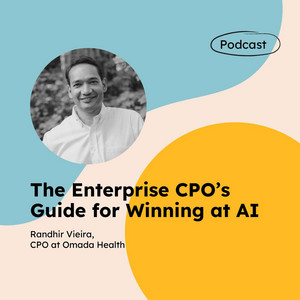
My guest today is Randir Veira, Chief Product Officer at Omata Health.
Omata has been operating since 2011 and is a mature company with established products, they're playing with an entirely different set of challenges and advantages compared to the new startups that have AI embedded in their DNA.
Randy, you're talking me through different approaches that enterprise leaders can take when implementing AI in both their product offerings and their internal culture and how those decisions can help establish companies navigate into new horizons.
Let's jump in. Oh, by the way, we hold conversations like this every week.
So if this sounds interesting to you, why not subscribe?
Okay, now let's jump in.
Welcome back to the Product Manager Podcast. I'm here today with Randy Viera, he's the CPO of Amata Health.
Ranjoo, thank you so much for coming and joining us today.
My pleasure. So we'll start with the way we always start the show.
Can you tell us a little bit about your background and how you've arrived at where you are today?
All right, I'll start at the end.
I am the chief product officer at Omada Health.
I've been here about five and a half years.
And prior to this, I was at Headspace.
But now, rewinding a little bit, I started at Yahoo!, where I joined a small group that went from zero to 300 million in about four years and was at Yahoo!, for about six and a half years.
but since I was based in Silicon Valley I decided I want to at least try the startup life and So I followed my passion which was photography and joined a photography related startup called Ify there was less than 20 employees at the time and one of the first or early Internet of Things combination of hardware and software and through that and through the VC Network met somebody at B2B learning management software called Mindflash and I was there for a few years, leading product, marketing, sales, and engineering had various points there.
Then I have a huge passion for meditation, and I had an opportunity to join Headspace to start their B2B product and eventually led product for all of Headspace.
That was my first foray into health and wellness, and then from there to Omada.
Wow, it's a good journey.
Today, we're going to be focusing on approaches for established companies like Amata to start integrating AI into their products and their culture, which was a big topic.
So we'll get started off with your thoughts on Horizon 1 and Horizon 2 when it comes to AI adoption.
So can you tell me a little bit about how you're thinking about these horizons and why you believe that companies kind of tend to get stuck optimizing their existing workflows rather than kind of thinking about that Horizon 2?
What's possible and what's next?
I think the Horizon 1 is what I describe as the incremental improvements or innovations that people can use with any new technology and in this case AI is that hot new technology that we're all excited about and so the usual place that we all go to are what are the things that we are currently doing that we maybe hate doing or believe that AI can do faster, better, cheaper and those are the things that we will use AI for.
So summarizing is a great example whether it's summarizing content, summarizing meetings those kind of things are great places to start and those are low hanging fruit.
Of course, we should absolutely take advantage of it.
The bigger opportunities though lie in the horizon to areas.
So what are the things that we could just not do before that this new tool or capability can unlock?
I think that's where what holds us back is the inertia.
It's the inertia of our thinking, of existing processes of our business model, of lots of different things that usually hold, especially large companies and successful companies, back from moving to that horizon to our revolutionary updates.
And I think that a lot of standard examples of, if we look at the last big tech shift that we had, which was around mobile and smartphones, there were a lot of companies that may have had an online presence, let's say for booking, or other things from the web that moved that content or that capability to the phone, because it was more convenient, etc. But the companies that really stood out were those that used the capability that in a way that just wasn't possible before.
The ride -share companies like Uber and Lyft, etc. would likely not have existed without a smartphone.
Those are the kinds of things that are more challenging for especially successful large companies to re -imagine versus being almost victims of their own success with their existing successful business model and process.
Yeah, that's a really succinct example.
And I'd like to, speaking of examples, explore some of the ways that you have seen that kind of transformative application of AI that goes kind of into that horizon two territory just to kind of give a contrast of like where does that exist in a space right now?
Are you seeing that happening?
Yeah, I think where companies go after some of the foundational constraints that might exist or go after new capabilities that are unlocked, that's where you see really exciting things.
I think we are still in the very, very early days of the AI transformation, especially for those horizon two kind of scenarios.
I'll give you a couple of examples that I've been fascinated with.
One is an example of currently, we have a lot of people applying for jobs and we've always had some algorithms that that were helping to screen people, right, at many companies that receive lots of applicants.
And some of the new wave tools that I've noticed, some of them do full -on synchronous, not just audio but also video interviews of candidates.
Now, what if instead of having those keyword -based scraping, et cetera, anyone who applies for a role is instantly offered the option due to interview with an AI agent?
Would we now have a much better selection criteria that is more objective versus just what people state in the application.
You could actually run a structured interview process completely AI based especially for that first year or second year interview.
So now you don't have the constraint that was forcing you to select a small group of people to put in front of a human interviewer.
So I'm fascinated with these kinds of companies that are just reimagining what's possible because of that constraint is removed of having to filter down to a smaller set of people.
Another example might be having a doctor on demand, or at least somebody that you can ask questions to all the time.
And there are many companies that are trying to do this in a way that is both safe and complies with regulatory guidelines, etc. But again, that was not something that was possible earlier because of cost and resourcing, etc. So fascinating things there around mental health and a lot of areas.
They definitely come with some risk and one has to be careful about that.
But it's certainly opens up access, affordability, etc, in a way that wasn't possible five years ago.
You've observed that even within the product and engineering teams, that AI adoption hasn't reached 100 % despite obviously the benefits that we've just discussed.
So why do you think that is?
One of the barriers that you're thinking are preventing full adoption into this kind of technology and how can we address that from a leadership perspective?
I think this observation comes up in many of the product and engineering leadership groups that I'm part of.
And I think all of us are surprised in some ways that how can we not have anything less than 100 % adoption of such an exciting technology?
And yet when you step back, you look at the technology adoption curve and it's standard. And I think no different in this case, but you're going to have some already adopters and then the the early majority and the late majority and the laggards, and it requires us, as leaders, to run our change management process.
And some of those things that may encourage this are experimentation, encouraging those early adopters to be the scouts and show the rest of the organization or to show the rest of the team what's possible, to invite the skeptics in and make them part of the team that is evaluating some of these solutions, none of these tools are perfect.
but the pace of change and improvement that we are seeing is something that we have not seen before.
And so for every criticism or concern that we have today, those quickly get reduced significantly, if not raised within a few months or a few quarters.
So it is incumbent on all of us to keep trying and may not be deployed ready just yet, but at least to keep playing with it and see what the current capabilities are and be aware of both the pros and the cons.
And not look for solutions to jam this technology in, but really see what kind of problems or opportunities would benefit from this amazing technology.
And it is a tool after all it's not a solution that's looking for a problem it should be a powerful tool that is deployed to the right problems or opportunities.
There are also some companies that I've seen that also use the stick, which is as an example, they might say that if your team does not have 100 % adoption of the AI tools that we provide.
We're not entertaining any request for additional headcount for your team.
So, that's certainly an interesting technique.
I haven't seen many companies adopt that.
But it's certainly one example of the stick to really push that adoption because we're not seeing the level of adoption that maybe we want.
Yeah, I don't think most people respond very well to the stick, especially if they're already set in their way that I don't want to do this.
I had a conversation with someone we'll be having on the show very soon.
She works in a startup that's really an enculturated AI curiosity into the atmosphere of the work culture, which I think is a really special way of going about it.
It just seems fostering that excitement.
It's the way to go, so it's interesting to hear that folks are going the other way.
I agree. I think it definitely you want to lead with the carrots and a lot more of this curiosity and excitement and maybe the stick is the last resort to bring the the laggards along.
Yeah exactly. If you really can't force curiosity then you can bring them to stick out.
So let's walk through the risk impact matrix that you use when you're evaluating AI initiatives.
When you think about helping teams moving past that low risk, low impact quadrant that we were talking about when we're talking about sort of a Horizon One and kind getting stuck in that phase.
How do you move past that as a leader?
I think like any typical brainstorm we want to encourage all the ideas that people have about where they see AI really making an impact.
And then usually product teams will have different frameworks that they use.
They might use Ice or any number of different frameworks around scope, impact, et cetera.
One that we found helpful, and I've seen a bunch of other companies use this, especially in regulated industries, is the impact and risk, and it just allows you to list all these different ideas that come up in brainstorms on this matrix.
And you can use ROI, etc., for the impact piece, and then there are elements of risk that come up.
So we certainly don't want to spend too much time in things that are low impact, regardless of the risk.
So low impact, low risk, still not impactful.
Also, we ignore that low -impact high -risk definitely want to stay away from that.
And so, the easy place to start is things that are high -impact and low -risk.
And typically, those are things that are around summarization, internal tooling, those kind of things.
And there are lots of projects that companies find where this kind of work can be super impactful and is a lower -risk great way to get the ball moving and get people playing with this kind of technology and see the real business impact of it internally.
But usually, the horizon two kind of things are in the high impact, but maybe higher risk.
And there are ways to try and mitigate the risk.
You do assumption testing, you can step your way into it, but at least being open to the fact that that's really where the price is and having things in place to move towards that.
One of the questions that could be helpful in trying to explore what those horizon two or high impact but higher risk items might be is, what if we started our company today?
We didn't have the legacy of the past. We start our company today with all the tools that are available, AI and non -AI tools that are available today, what would we do and how would we do it?
What would the company look like?
What would the offering look like?
What would the pricing look like?
It just gives people space to think about what could be, because you can be sure that there's some new companies who are starting with exactly that mindset, and without even having to do it as a thought exercise, it is their reality that they do not have the baggage of the past. And this is why this topic interest me so much. There's really some very clear pros and cons when you're in the startup position versus an established company when you're kind of dealing with this kind of the technology where there's a lot of opportunity and a lot of white space.
So when we think about retrofitting AI into established companies that have existing products, there is that kind of possibility that's undrawn and unmapped.
what advantages do organizations have over AI for startups and what unique challenges do they face in contrast?
I think the advantages that any big company has are the advantages of being a large successful company, which includes the brand.
Yeah, the resources, they have the revenue, they have people, they have the resources, they usually have strong distribution channels.
So there are a lot of benefits that they have. Similarly, the other side of that coin is because of those, they've been successful doing what they've done in the past and how they've done it.
They can also be risk -averse to changing the formula, messing with the machine and there can also be inertia about, here's what we've done, here's how we've done it, these are the customers, here's what they like, etc. The same reasons that they are successful, and so many of the benefits that they have, can also hold them back.
Of course, we explore ways to get past those barriers or friction points at least. Okay, I'm going to switch gears a little bit and talk a little bit more about internal change management.
I know we kind of talked a little bit about this with the carrot and the stick, but there's a lot more to it than just kind of incentives and, let's say, consequences.
So you mentioned the importance in the past of change management with implementing AI when we were talking previously.
But what specific strategies have you found effective in driving that cultural acceptance and enthusiasm around AI capabilities?
Have you really leaned into the carrot, you know, what are like the actual leadership tactics that you can implement?
I think finding and nurturing the early adopters in a company and on a team are really important.
There are usually always a few people who are very curious and just gravitate to new technologies and being able to find them and channel that enthusiasm and interest into something that is impactful.
And this is where the high impact, low risk kind of grid can help to steer those people and the projects.
Being able to find and celebrate some of these early wins, especially if they are impactful, can help generate some internal momentum and enthusiasm for the usual cautious skepticism for anything that is hyped.
And we've seen this in the past before, oh, we've seen this hype cycle before and there isn't anything real there.
So let's just wait for the cycle to pass.
And instead to be able to see that, sure there is a lot of hype but there may be something that is useful and impactful for us.
And let's see what we can get out of it.
So being able to celebrate those early wins can be helpful.
And the third one is co -development, which I think is super, super important, because rarely are we doing things just for ourselves.
So we might be building things for internal teams, we might be building things for members, but making sure that we are developing these solutions, especially because they're so new, in partnership with the customer, whether that customer is internal or external.
And that is what drives not just the success of the feature being shipped, but more importantly, the adoption and the impact of that feature, and the value of that co -development cannot be understated.
So, yes, it may make things feel like they're going a little bit slower during the development process, but usually the result and the adoption is way worth it.
Yeah, absolutely. It really seems like that's a really concrete way to mitigate some of the risks that you were talking about before.
Absolutely. Yes, having the subject matter experts, having the people from your legal team, regulatory, security, etc., involved early in co -developing the solution, helps to mitigate a lot of those risks.
I'd like to kind of zero in a little bit on AI in healthcare specifically, this is a really interesting field, I think that there's a ton of opportunity as I'm sure that the industry is well aware, but also a ton of risk kind of inherent in some of these solutions.
What are some of the unique considerations around ethics, privacy, and accuracy that you've encountered that might differ from other industries?
I've certainly seen this similar matrix being used of the higher risk, high impact area to try to guide how careful people should be with solutions.
This is heavily regulated, and it's the same for any other regulated industry, whether it's fintech, et cetera, of making sure that you're developing solutions that are within the bounds of the regulation, even as companies are maybe trying to shape regulation to accommodate this new technology, but making sure that the solutions that we're deploying are very much in line with the existing regulations.
There's obviously in healthcare, the do no harm and making sure that we really stick by that.
That can mean lots of different ways to mitigate some of the risks that may come with this.
Making sure that that's outlined upfront and center, many companies will create before they start creating solutions, will create a set of AI principles.
How do we want to make sure that we are developing solutions?
So examples might be to be very clear and transparent to customers and to members on when they're dealing with an agent and a virtual agent versus a human agent.
Maybe one example, if there's anything that an AI agent is unsure of that they will triage to a human person.
There are lots of ways to mitigate that, but I think starting with those principles for your company is super important and helpful before going down specific areas.
Being mindful of bias that may exist from the foundational models and ensuring that you're doing things to plug those gaps and make sure it's as unbiased as possible for your population can be helpful.
And ultimately, no matter what we do, we have to test a lot.
And it's not just testing before deployment, but it's continuously monitoring and course correcting based on user feedback, your own quality control process that is continuing post production is important.
So making sure that the guardrails that you set are working the way that you intend.
And there's no model drift or other things that are happening, even post -production.
I think all of those can help, but being aware and naming those challenges upfront, and then trying to mitigate them for the use techniques like pre -mortems or other ones can be helpful to name all the risks, and concerns, and how likely they are, and what the mitigations are for especially those that are high impact and even if they're at lower probability, they can still be important enough to know how we're gonna mitigate them.
Absolutely, yeah. Yeah I've heard it, this phrase tossed around in unknown healthcare industries or agency settings where oh you know we're not saving lives or we're not doing heart surgery here and in this case you actually might be so, I'm sure you have to have some very robust processes in place to ensure that some of that risk is really tightly regulated and mitigated.
So okay if we take off our Strictly CPO hat and we kind of look into our crystal ball here.
Just yourself, obviously you've done a lot of thinking about what's possible, where we're at right now.
What do you see happening in the next three to five years?
What are you excited about in terms of AI developments and from your perspective, in your professional experience, what do you think existing companies should be doing to prepare now to take advantage of that horizon too?
I don't think I'm well equipped at all to try and look ahead on what's happening and what will happen in three to five years.
The face of change is just so, so quick even for technology that in three to five years seems like an eternity.
However, I think what we do know is that things are changing a lot, that new capabilities are coming on way better, way faster than we've ever seen before.
Just in this last week, I've been amazed at the quality of the voice interfaces that we have just not the quality of the voice, but the inflections, the tonality, the size, I mean, it's just it's amazing what's happening and we will continue to see that evolution but not just voice but with this kind of technology.
So I think the ways for me to think about how we can take advantage of it is to continue to keep an eye on what problems are we solving, what opportunities are we trying to solve for and invest in people, in training, in creating space for these prototypes, in proof of concepts to be able to see what the current technology can unlock in terms of the problems or opportunities that we are interested in.
I think those can be helpful.
What constraints could this eliminate?
So asking those questions when you see some new capability or new technology come up, is it cost?
Is it time? Is it resources?
And we talked about the AI interviews as just one example.
Asking those kind of questions that are helpful in that creative thinking in the diverge phase of what might we do with this capability, what would we do if we didn't have this constraint can help unlock some of those opportunities.
So that no matter what the specific capability is that may be available in three years or five years, that we have people who are ready, available, and excited about bringing that and plugging it into that solution.
All really great points, and I think it's a really good idea to be kind of always be thinking about that criteria and I like to hear proponents of curiosity.
It sounds like you're a little bit more leaning towards a carrot.
Oh, absolutely. Big carrots, many of them.
We're both pro -carrot, it sounds like.
Well, thank you so much for joining us around here.
Where can folks connect with you online?
LinkedIn is the best place for just follow me on LinkedIn and you can keep track of what we're cooking up.
Sounds great. Well, thank you so much for being here.
Thank you. Thanks for listening in.
For more great insights, how -to guides, and tool reviews, subscribe to our newsletter at product manager .com slash subscribe.
You can hear more conversations like this by subscribing to the product manager wherever you get your podcasts.