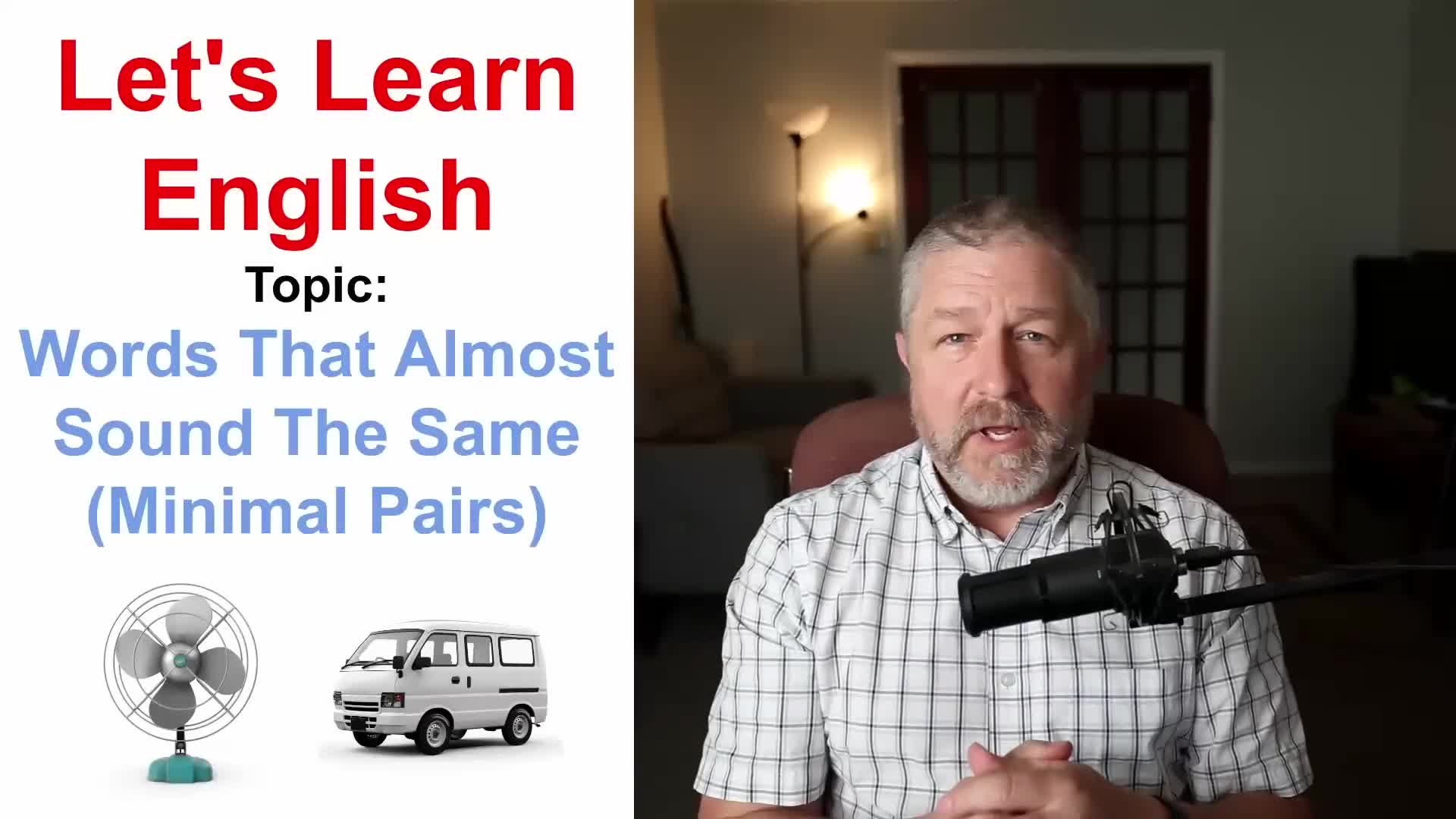
Well, hello and welcome to this English lesson about words that almost sound the same, like man and men, and there's a bunch of other ones.
And in English these are sometimes called minimal pairs.
They're words where they have one letter difference.
And the meaning is probably different or completely different.
Uh, and it is hard for people learning English to learn how to say them, and sometimes, when they hear these words, they're not sure which word is being said.
So we'll go through about 50 of these I think.
So welcome to this English lesson about minimal pairs.
This English lesson about words that almost sound the same.
Almost.
Ship and sheep.
So I tried to create slides where you have both words and a good image so that you can understand the meaning.
Now these are simple words.
Ship and sheep.
A ship goes on the ocean.
Sheep go in the pasture.
Um but I think it's important to understand and hear what I'm saying.
Ship has a short vowel.
Ship it's a very fast word.
Whereas sheep has a very long vowel.
In fact you wouldn't be able to say ship the same way like ship.
I guess you could.
But ship and sheep.
Um ship is huge.
A ship goes on the ocean.
In fact we also use this as a verb.
When I buy something from Amazon they will ship it to me.
It doesn't go on a boat.
It just goes in someone's car or van.
But a ship is a large boat.
The verb to ship means to send something somewhere.
And of course a sheep is simply an animal.
So you can see in this field there are several sheep.
That sheep are on pasture because they like to eat grass.
So once again ship and sheep.
Whenever I say the two words in this lesson, I'll always start with the word that's furthest that way and then end with the word that's closest to me.
Fan and van.
Should I say that a little more slowly?
Fan and van.
To me, these words sound very very similar.
Fan and van rhyme.
The only difference is how they start.
Of course, a fan is something that blows air on you when you're hot, and a van is something that you drive, and if you have lots of kids, you need a van so you can fit them all in.
Let me say both words a little more slowly.
Fan, fan.
And then now the second word van, van.
You can hear when i say van, there's like a vibrating sound.
As i said vibrating, you heard it as well whereas with fan it's more of a just the sound of air.
So a fan blows air and a van is something that you drive around.
Let me say both of them at normal speed.
I don't have a fan right now because Jen borrowed it and so I'm getting warm and our van has to go to the garage for an oil change next week and men
This is a common one.
Many English learners who are learning North American English complain that these sound very similar, especially when we speak quickly.
You can see that when there is only one male it is a man.
When there is more than one we say men.
So again the vowel sound changes.
Obviously from an A to an E, But.
But when we speak quickly you can have trouble understanding and sometimes you just have to use context.
Like if I say there was one man at the concert or if I say there were a lot of men at the concert, you can, because of the other words I'm using, you can determine which of the words I'm using.
But I will agree that man and men, when you say it very quickly, do sound very similar and feet.
So depending on your native language there may be certain sounds that are difficult for you.
That lady who is out hiking and who has stopped to have a coffee is very fit.
This means she's not overweight.
She probably has lots of muscle.
She is very fit.
My goal is to always walk a lot so I can be really fit.
When you're fit you're healthy you're in shape.
So of course are those things at the end of your legs.
Those are your feet.
So for some of you, depending on your native language, these may sound completely different and might be very easy to say.
The woman is very fit.
I have to put socks on my feet.
But for some of you they might sound very similar and might be hard to say.
So once again the two words are fit and feet.
So bit and beat.
So this is basically the same thing but with a different consonant at the front.
So sometimes at night a mosquito will land on me, and it's not nice when the mosquito decides to bite me.
So I don't like getting bit.
That's how we would use that word.
The mosquito bit me.
Not fun.
If you play the drums you will have the job in the band is to make the beat.
So you not a drummer, but I can make like the drummer phase, like So when you play the drums you want to have a beat.
So once again the first word bit the mosquito bit me.
Um the drummer is setting a good beat while he plays this song.
Live and leave. if you have a house or an apartment that's where you live.
If you decide to go somewhere else you leave.
So right now I live in Ontario Canada.
You live in your country.
Um I used to live in the town close to me about 30 years ago.
But Jen and I decided to leave that town so that we could come and live here on the farm.
And So again, these might sound very distinct and might be very easy for you, but depending on your native language, they might be a challenge.
So, where do you live?
I live in Canada.
Where did you used to live?
I used to live in France but I decided to leave. and can't.
So this is the one that inspired the lesson.
When you can do something it means you're able to do it.
When you can't do something it means you're unable to do it.
The problem with this is when we speak quickly in informal English, we kind of blend our words together.
So if I say I can do that tomorrow or I can't do that tomorrow.
I kind of overemphasize the can't.
Like I can do it tomorrow.
I can't do it tomorrow.
You really have to listen for the T. And then another thing would be this.
I might say oh I can do that tomorrow.
Or I might say hm I can't do that tomorrow.
So you sometimes need to watch the body language in order to understand what exactly is being said.
So can And can't.
So I can do it.
I can't do it.
And then, yeah, if you look at can, it says schwa vowel in fast speech.
So if you don't know what schwa is, it's when My description is always like the vowel kind of shows up.
Like it's not stressed.
It's not emphasized.
Like I can do it.
So I can do it or I can do it.
In the second instance I'm really mushing the vowel sound together.
I can do it.
I can do it.
I can do it and pull.
So if you have a rope and you're doing what this guy does, you have decided to pull on the rope.
Okay, you're going to pull.
Maybe let me see when do you maybe?
When do you pull on a rope?
You will more likely pull on a leash.
If you are walking a dog and you want to go a different direction, you might pull the dog leash.
If it's hot you're experiencing a heat wave, like we are right now.
You might wish that you had a pool.
A beautiful place to swim to cool off.
So pull and pool.
Let me say them one more time.
He's going to pull the leash.
He's going to go swimming in a pool.
Pool.
So you notice the long vowel sound with pool.
Cup and cop. found the picture that had my cup in it.
I think maybe my cup's not in there.
It's kind of maybe the colors are off.
This is the standard Ikea cup.
If you have little kids who you go to IKEA.
This is the this is the cup you buy.
The little plastic cup.
A long time ago they had this style of cup.
I have two here today.
But a cup of course is anything like this that holds something you can drink.
A cup.
Very fast short vowel cup.
If you drive too fast though might get pulled over by a cop.
So notice the difference.
You drink from a cup.
You get pulled over by a cop.
I haven't been pulled over by a cop for a year and a half.
I think I talked about that.
I got a ticket a year and a half ago for speeding.
And which is odd cuz I'm not someone who normally drives fast.
But you drink from a cup.
You get arrested by a cop. and bad.
So when you're tired you go to bed.
You go to bed so that you can sleep.
Um sleeping is a wonderful thing.
Um it's bad if you don't get a good night's sleep.
So you sleep in a bed and it's bad if you don't sleep well and you feel bad the next day.
You don't feel good.
Um so anyways you can also use bad as the opposite of good. cap and cab.
So the only real difference here is how the word ends.
So we say cap.
I went to a Blue Jays game the other day.
I don't think my baseball cap is in here.
Uh and I wore my baseball cap.
Um I can see how when we speak quickly like I wore my baseball cap to the baseball game.
The P at the end of cap does soften a bit.
Like I wore my cap to the game.
I it is there.
I am hitting it with my like cap cap.
But cab is a slightly different sound.
You can take a taxi cab if you are in the city.
You can get a cab to go somewhere.
Thankfully now most of you just use Ubers.
So if you're not sure how to say cab you can just get an Uber.
But you wear a cap on your head.
You take a cab if you want to go somewhere. and tree.
This comes from.
There are some people, when they are learning English, where the TH sound is very difficult.
So three and tree you have to look at what my mouth is doing.
It's kind of weird but you're going to see my tongue three when I say three.
One two three.
It's going to be right there.
Three.
When I say tree you don't see my tongue.
Sorry microphone. there are some nice trees on our property.
There's more than three.
There's definitely more than three.
Word and world.
This is also difficult to pronounce because for some people, when you cluster consonants together, it's hard to get the sounds out.
So word be fairly easy for you to say.
Word.
Word.
But world we've put an R and an L and a D beside each other with no vowel in between them.
So it becomes a little more challenging.
Scrabble is a game that where you make words.
You decide I'm going to make the word plan.
But get some points.
Words are what we use when we talk to each other.
The world is the planet we live on.
You all live somewhere in the world.
And honestly the more I say the word world see I just use them both in the same sentence.
The more I say the word world the weirder it sounds.
World.
And Um and world.
There's a lot of movement in my mouth at the end of world.
World.
Cuz you're making the RLD.
It's like your tongue.
Um your tongue's like a wave world.
It goes like this in my mouth.
I'm not gonna show you.
This isn't about Bob shows you what his tongue looks like while he's doing pronunciation lessons.
Walk and work.
Um walk is interesting because you don't really need the L. You can go for a walk with your friends.
Uh I like to go for a walk every day.
I like to go to work.
Uh in the fall and usually in the winter and not so much in the spring.
I get tired of work.
So the school year goes on but sometimes you're excited to go outside to go for a walk.
Sometimes you're excited to go to work because you like your job and you like to make money and look.
So I put a four leaf clover there.
Luck is something that we use to describe when good things happen to you.
Maybe you bought a lottery ticket and you won because you have good luck.
Maybe you're going somewhere and someone just says good luck.
That's a common thing to say.
But right now I'm going to look into the camera.
Sorry I looked away.
But look I can look into the camera and and I can wish you good luck.
Um, I'm not sure in your country or culture whether a four leaf clover is supposed to bring good luck.
But here in Canada I think it's from the Irish.
If you can find a four leaf clover it's supposed to be good luck.
Um, sometimes I go outside to look for four leaf clovers so that I will have good luck.
Cheap and jeep.
These might sound very similar to you.
They might not, but cheap starts the same way as cheese, like you can eat cheese, but cheap means that something is not expensive.
It's always nice to find something that is cheap in a store.
A jeep is a vehicle that is made by the jeep company which I think is owned by Dodge Chrysler now.
Every everybody's owned by everybody now but a jeep is a four wheel vehicle.
Four wheel drive vehicle.
Um that you can use to go off roading.
So if you like jeeps, you probably want to find a cheap jeep so that you don't have to pay a lot of money for it.
But unfortunately it's hard to find a cheap jeep because you Jeeps are usually quite expensive.
You want me to say that again?
Cheap Jeep.
He's looking for a cheap Jeep because he wants to go off-roading.
I hope he finds a cheap Jeep.
That's the funnest one so far, by the way. and vet.
So this comes from if you have trouble distinguishing between the W and the V sound.
That dog is wet.
So he had to go to the vet.
Vet is short for veterinarian.
A doctor for lack of a better word that takes care of animals.
Um we have two dogs.
Walter, our black dog, likes to go swimming in the river and sometimes he's wet and then he runs up and he shakes all the water off after he goes swimming and he gets wet.
Walter is also the dog that gets injured the most and has been to the vet many times because he's an expensive dog.
He runs into things.
Oscar does not like to get wet.
And Oscar only goes to the vet once a year when when he needs his regular yearly shot.
That's when he goes to face and phase.
So we're going to talk here a little bit about what's called a dip thong.
So a dip thong is when you sort of convert one vowel into another vowel as you say the word.
So if you look this is a person and we see her face.
This is the moon and there are different phases of the moon.
The current moon phase in this picture is full moon.
So let me explain what's happening here.
Phase It starts almost like an A and flips a little bit to an E. Face.
Face.
Face.
It's kind of weird.
Phase is very similar but the F and the S I'm trying to explain.
Let me it's the C and the S. So I'm getting this wrong.
So face is my face.
You can see my face.
When the live stream stops working you can't see my face.
Um when you look at the moon you you think what phase is the moon in.
So face and phase.
So little difference on how that ends.
But I
Yeah the vowel sort of transitions.
Let me give you the formal definition.
Um a diphthong is a sound formed by the combination of two vowels into a single syllable, in which the sound begins as one vowel and moves towards the other.
So an example is face.
So when I say it quickly, you can't quite hear it, but it is there.
It's like Faye and S face face.
That's how it becomes.
And phase just more of a Z sound at the end when you are saying it.
There you go.
Pen and pan.
You would use a pen to write.
You would use a pan to fry an egg.
Pen obviously rhymes with men.
Pan rhymes with man.
So again this is another thing where context works.
If someone said I need a pen I want to fry an egg that doesn't make sense.
So they must have said pan. someone says do you have a pan I want to write a letter to my sister.
That doesn't make sense.
You would use a pen to write a letter.
You would use a pan to fry an egg.
So pen and pan.
Duck and dog.
So there are birds that live in the water and they're called ducks.
So you might see a duck fly by.
And obviously the word duck is very hard with that K sound, a duck, okay?
It rhymes with, I don't, not gonna say it.
There's a swear word that rhymes with duck. gonna say it.
Dog is of course a pet.
Some people like dogs.
Some people like cats.
We have two dogs.
Our one dog is named Oscar.
Our other dog is named Walter.
So if you are by a pond you might see a duck.
When you go for a walk in the park you might see someone who is walking their dog. and think.
Again this is for people who have trouble with the TH sound.
So when I do the dishes I do the dishes in the sink.
At school before I eat lunch I'll wash my hands at the sink.
So because I want my hands clean before I eat.
So a sink is a place where water comes out and it has a drain in the bottom.
You can wash dishes, you can wash your hands, etcetera.
When you are trying to figure something out, you need to think.
You need to sit and think about it.
When I made this lesson yesterday, I had to think about what words am I going to put in the lesson.
So again, you wash your hands at the sink and you are trying to figure something out.
You need to think.
Again you do see the tongue with the TH sound.
Think.
I think it's a good idea to watch my mouth as awkward as that is when I say some of these words.
Sink and think.
It can really help to just physically form the mouth correctly. and cut.
Now, cot might not be familiar to you.
A cot is a type of bed that you can set up temporarily to sleep on.
Maybe when you go camping you set up a cot in your tent and it's pronounced the same way as the word cot.
So know, if you played Pokemon, maybe you went to the park Pokemon go and you caught some Pokemon in the park.
So that's the verb to catch caught like he caught them.
Um but a caught like in the picture is something you sleep on.
Um cut is what you do with the scissors.
You will cut the piece of paper.
So caught something to sleep on and cut when you make something in more than one piece with a scissors or a knife.
Full and fool.
That bucket is full.
That guy is a fool.
So, full.
So, when something is empty, there's nothing in it.
When it's filled to the brim, we would say it is full.
Full.
It's kind of like it's described as a full rounded sound.
Full.
Full.
But fool is more like zoo.
So that's the difference there.
Fool.
That's not how I say it in everyday life but this is a minor insult.
Usually we use it to describe ourselves.
Like I couldn't find my car keys and then I realized they were in my pocket.
I'm such a fool.
I'm such a fool.
Or they the other one full.
I ate so much food that I'm full.
Like I'm full.
I'm such a fool.
I ate too much food again and now I'm full.
There's a sentence with both words in it. and uncle.
To me these are not a minimal pair but these were on several lists as I was researching.
Your ankle of course is the part of the body where your leg joins your foot.
It's that bottom piece there.
The heel at the bottom and then right there is your ankle.
Ankle.
Ankle.
Did I talk about schwa already?
I think I did.
It's when the E is, or the, not just the E, but the vowel is super shortened, right?
So ankle. uncle is basically the brother of your father or the brother of your mother.
So if you have an uncle he's probably cool.
For some reason in the world uncles are usually really cool.
But you can play a sport and you could twist your ankle and then your ankle will be sore.
And then you can maybe go and visit your uncle.
So here's a funny story.
I broke my collarbone and and the other day, my uncle came to visit me.
So I didn't hurt my ankle, but my uncle did come to visit me.
And they end the same way one beard and beer.
So of course a beard is the hair that you grow on this part of your face.
This is a mustache.
This is a beard.
This guy is growing a better beard than I can grow.
I am over pronouncing it a little bit because I want you to hear the D. Beard.
Does he have a beard?
Yes he grew a beard. we speak quickly though you might not quite hear the D at the end.
Um sometimes we forget to pronounce it a little bit.
Beer is, of course, made from barley and hops, and it is a an alcoholic beverage that people will drink.
So the guy with the beard is drinking a beer.
There's your sentence.
The guy with the beard is drinking a beer.
Um yeah, that that D at the end is not always the.
And then an R colored vowel just means beer, beer.
Like the vowel is transitioning into the R sound as I say it beard beard, beard and beer.
Shirt and short.
So to me these are very distinct but again this was on a lot of lists.
I am wearing a shirt.
I am not short.
I
I'm not tall.
So obviously this is a shirt and short is used to describe someone who is not as tall as other people.
I'm actually average height for where I live in North America.
Um so I'm not short but I'm not tall but I am wearing a shirt.
Dad and dead. me these are very distinct.
The more I said them though it's very slight difference.
So a dad is of course a man who has had children.
He's a dad.
I'm a dad.
I have five kids.
I'm a dad.
Um sometimes though my phone goes dead.
When your phone is dead it means your phone isn't working anymore.
So it's not nice when your phone goes dead.
Um sometimes a dad, my phone has to work all the time just in case my children need to text me.
So, dad and debt. and zoo.
So sue is a, a name, a woman's name, but it's also a verb, which means to take legal action against someone.
Um if someone was in a car accident, they might sue the other party.
They might go to court and sue them to try and get money.
A zoo is of course a place where there are animals.
So again Sue, like her name is Sue, or he's going to sue his neighbor, or we went to the zoo to see animals.
So, like the whistly S sound Sue or like a vibrating Z sound. which the Americans call the zoo.
So again, think of a bee buzz zoo buzz.
So a bee will buzz.
And when you can make the sound, you can say zoo and then Sue soon.
Sue will be here to sue her neighbor.
There you go.
Rink and ring.
So a rink is a place that you can go skating.
You can go to an ice rink and it rhymes with sink.
So you can wash your hands in the sink and then you can go to the rink.
And it is a K. You can hear the K.
Ring though like I'm wearing my wedding ring.
It's the same as rink but there's no hard stop.
What they mean by that is rink.
It's like the word hits a wall.
Rink.
Like it stops.
Rink.
Whereas ring just kinda it's a little softer.
Ring.
Rink.
Rink.
Ring.
I don't do the little at the end.
So you can go skating at a rink.
You can get married and you can then wear a wedding ring. and choose.
So this comes from those of you that have trouble pronouncing the sh sound and the ch sound.
So I wear shoes.
Today I'm going to have to choose what to eat for breakfast.
So shoes are of course things you put on your feet.
And when you need to make a decision you need to choose.
So if you think about it shoes shoes.
It's a softer.
There's no hardness to that, right?
Like shoes.
But when I say choose, it's like choose.
Uh chosen.
Chuck.
Chuckle.
It's a sound like TCH.
I don't know how it is.
So, I wear shoes.
Sometimes, I have to choose what to do.