Okay, in real life, people are going to say something to you and you want to respond naturally.
How do you do that?
Well, let's practice some expressions that you can use.
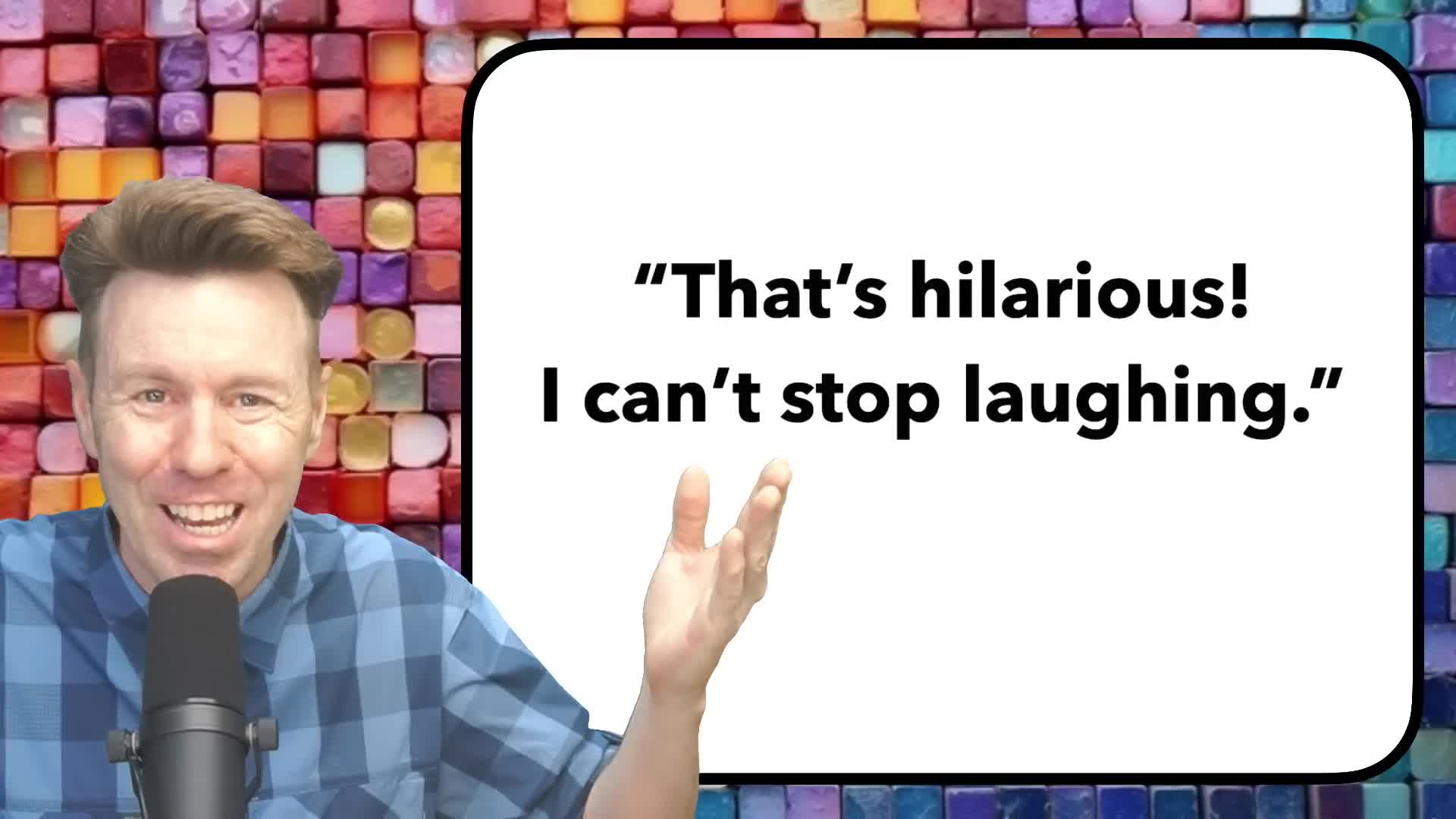
That's hilarious.
That's hilarious.
Now, in what situation would you use that?
Maybe your friend tells a funny story.
And then you respond.
How would you respond?
That's hilarious.
I can't stop laughing.
That's hilarious.
I can't stop laughing.
Try it.
Okay, good.
How about this?
I'm not sure.
Let me check.
I'm not sure.
Let me can become lemmy.
Let me check.
So maybe your friend asks you for directions but you're not quite certain about something, so you can respond.
I'm not sure.
Let me check.
Or maybe, I'm not sure, let me check my phone real quick.
I'm not sure, let me check my phone real quick.
I'm not sure, let me check my phone real quick.
Say it.
Give me a second.
Give me, give me, give me, give me, give me, give me a second.
Give me a second.
All right.
So when someone asks for something and you can't respond right away, you can say give me a second, I'll find it for you.
Oh, so they're asking for something and you're like, wait just a second.
Give me a second.
Give me a second.
I'll find it for you.
Give me a second.
I'll find it for you.
All right, take your time.
Take your time.
Your friend is apologizing for being slow.
Your friend is really slow and they say, oh, I'm so sorry.
I'm so slow.
And you respond, No rush.
Take your time.
No rush.
Take your time.
No rush.
Take your time.
Take your time.
Take your time.
All right.
Let me know when you're ready.
Let me know when you're up where we have.
Let me let me let me know when you're ready.
All right.
So you wait for your friend to finish getting ready before you're leaving and you say to your friend
Let me know when you're ready to go.
Let me know when you're ready to go.
Before we said no rush.
Take your time.
Take your time.
No rush.
Let me know when you're ready to go.
Okay, so that creates a relaxed atmosphere, right?
But maybe you're a little irritated and you are waiting.
So you would say it.
Let me know when you're ready to go.
I've been ready for five minutes now.
So you just go ahead and let me know when you're ready to go.
All right.
Just kidding.
Just kidding.
Sounds like a plan.
Sounds like a plan.
So you agree to meet up with somebody.
You're talking and you're saying, okay, let's, let's meet up at this time.
And then you respond.
Dinner at seven.
Sounds like a plan.
Dinner at 7 o'clock?
Sounds like a plan.
Sounds good to me.
Let's do it.
Sounds like a plan.
I'm down for that.
I'm down for that.
Do you know this one?
So your friend suggests going out for pizza.
They say, hey, how about we go get some pizza?
And then you respond, I'm down for that.
Count me in.
I love pizza.
I'm down for that.
Count me in.
Count me in.
Yes, I am one.
I want to go.
Count me also.
Do you want to grab some coffee?
Do you want to, wanna?
Do you want to grab some coffee?
So you invite someone to meet.
Let's meet up.
And you say, Do you want to grab some coffee later and catch up?
Catch up, talk about what's been happening, discuss our life.
Do you want to grab some coffee later and catch up?
Do you want to grab some coffee later and catch up?
Try it.
Yeah, let's catch up.
Let's grab a coffee.
Let's hang out soon.
Let's hang out soon.
So when you're parting from friends, you're going your own directions and maybe you say let's meet again soon.
What's another way to say it?
That was fun.
Let's hang out again soon.
That was fun.
Let's hang out again soon.
Let's hang out.
Let's hang out next weekend.
Last weekend when we were hanging out, that was so much fun, wasn't it?
All right, hit me up later.
Hit me up later.
You tell a friend to reach out to you if they want to talk.
Reach out to you is just communicate.
Maybe send a text message.
Maybe call.
Maybe even visit.
Just reach out to you if they want to talk.
And you say, hit me up later if you want to talk.
Hit me up later if you want to talk.
Hit me up.
So that just means text me, call me, visit me, contact me.
Hit me up later if you want to talk.
All right.
I need a break.
Do you need a break?
I need a break.
So after working for hours, you say, Say you want to go outside.
You've been inside for a long time.
I need a break.
Let's get some fresh air.
I added a word.
What did I add?
I added fresh.
Let's get some air.
I need a break.
Let's get some air.
So let's get some air.
That just could mean, you know, let's take a breath.
But if you say fresh air, that would mean let's go outside and take a walk, maybe.
I need a break.
Let's get some air.
I hear ya.
I hear you.
The you is often spoken ya.
I hear ya.
I hear ya.
Your friend complains about work.
They're like, oh, this job is so hard, so many hours, our boss is so demanding.
And then you say, I hear you.
It's been tough lately.
I hear you.
It's been tough lately.
I hear you.
It's been tough lately.
Totally agree with you.
Totally agree with you.
Kind of leaving off the, I totally agree with you.
Totally agree with you.
So during a discussion, you're talking to your friend about music and your friend says something like, oh, I love this song, blah, blah, blah, blah.
And then you say, totally agree with you.
This band is amazing.
Totally agree with you.
This band is amazing.
All right.
Same here.
Same here.
So your friend says they're hungry and you respond.
Same here.
Let's eat.
Same here.
I'm also hungry.
Same here.
Same with me.
Same here.
Let's eat.
Let's go grab something to eat.
I couldn't agree more.
Couldn't agree more.
So someone comments um, they make a comment and you think i feel the same way and you say oh, i'm sorry, i messed up.
So someone come, someone comments this place has the best pizza.
This place has the best pizza.
And then you reply I couldn't agree more.
I couldn't agree more.
Maybe you lost your train of thought because I messed up.
My flow wasn't good.
I'm sorry.
I couldn't agree more, Chad.
Your flow was not good on that one.
Couldn't agree more.
That means I feel the same way as you.
No worries.
It's fine.
Maybe you say to me now, oh, no worries, Chad.
It's fine.
It's fine.
All right, so a friend apologizes for being late.
They say, oh, I'm sorry I'm so late.
And you respond, no worries, it's fine.
No worries, it's fine.
That's all right, don't sweat it.
That's all right, don't sweat it.
So you reassure someone.
Now maybe your friend made a mistake and you want them to not feel bad.
You don't want them to feel bad, right?
You want to reassure them.
So you say to them, you remember?
That's all right.
Don't sweat it.
Don't sweat it.
That's all right.
Don't sweat it.
Everyone makes mistakes.
Don't sweat it.
Don't worry about it.
That's all right.
Everyone makes mistakes.
Even English coach Chad, he makes three or four mistakes every lesson.
So, you know, that's the way it goes.
Hey, don't make fun of me.
Boom.
Good workout, everyone.
Way to go.
Keep moving forward.
One step at a time.
Fall down seven times.
Get up eight times.
I know that doesn't make any sense.
It should be fall down seven times.
Get up seven times.
But the Japanese proverb is fall down seven times.
Get up eight times.
Anyways, moving on, I'll see you in the next video.