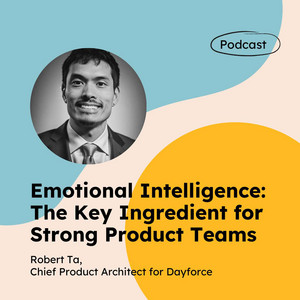
Usually when I introduce an episode, I like to frame the topic you're about to hear in my own words.
But this time, I think my guest actually summed it up best with this great quote, Work is just a bunch of humans getting together.
I think it's easy to lose sight of this simple truth, especially in the tech industry, where every interaction tends to take place between several layers of software and device displays.
But even when we do get that face -to -face time, high stakes and rising pressure sometimes tricks us into seeing people as their job titles and not who they are.
And that's why today's conversation is all about emotional intelligence, the skill set with the power to set amazing product managers, product leaders apart.
And if anyone is a perfect case study, it's my guest today, Robert Toth.
Robert's resume is not exactly easy to summarize.
He's a lead product architect at Seridian, he's a co -founder and CEO of a crypto gaming startup called Choose Your Meta, he's a founding member of a leadership program called Sidebar, and he counts himself as a professional dog -dad to his best pal, Nibbler.
Yet when we discussed what he'd want to share with you that would tie all of this together, he didn't hesitate.
It's the role that emotional intelligence has played in making all of this possible.
Let's jump in. Welcome back to the Product Manager podcast.
I'm here today with Robert Toth.
Robert, thank you so much for making time in your very busy schedule to talk to us today.
Awesome. Thanks so much for having me on.
I could tell you a bit about myself.
Studied chemical engineering in college.
Don't do that now. I work in technology.
I've launched several products starting my career at Workday and I had to lead a lot without direct authority influencing a lot.
I think a lot of PMs have to do that.
I launched my own company in crypto gaming and now I'm serving as chief product architect at Dayforce.
Awesome. I love the concise intro.
So today we're going to be talking about a topic that really fascinates me.
It's very close to my heart, which is the role of emotional intelligence in leadership.
Very underrated skill.
So to kick us off, can you tell us a little bit about how you came to recognize the value of EQ at work?
Yeah. So it's so important because it's fundamentally like work is just a bunch of humans getting together to do something together, make money, make a business, that kind of thing.
And you have a goal and you're organizing a bunch of humans together towards a goal.
And we're very relational.
You know, humans, we're very about community.
We want to belong. So it's really important.
I think it's also important to distinguish emotional intelligence from empathy.
So I'll just kind of define what I think of that.
I think EI or some people call it EQ, emotional intelligence is a broad set of skills that involves the ability to identify, understand, manage emotions in yourself and with others.
Empathy is one part of that EI puzzle.
It involves the ability to seek to understand some of these feelings and perspectives on something, see something from their lens, recognize, and respond appropriately when talking to them.
A story of how I learned the hard way that EI is really important was when I was in college doing a senior design project in chemical engineering, I had three other teammates and two of the teammates just weren't showing up to meetings.
They just weren't doing work.
And then it came to a head when we did presentation and then the two teammates just didn't show up.
So me and my other teammate were really fearful that we'll get a bad grade, we won't pass, we'll end up in college forever, you know, like bad feelings.
And I was a poor college kid.
I didn't want to have to pay for another year.
And so what I ended up doing, I highly regret and it taught me a lot.
But I ended up tattling to the professor and I told them I went to the professor before I went to those two teammates because I was a little afraid of confrontation and I thought it was obvious to be a good teammate to show up and stuff like that, right?
I didn't have the foresight then to maybe think about what might be going on their lives or just to get over that inertia to confront and just set boundaries.
And so I tattled to the professor and he did something I didn't expect, which was he pulled them aside and basically told them you need to work with Robert and stuff and get this project done.
You can imagine how bad the working relationship was after I tattled because I didn't expect the professor to do that.
I was more like, hey, professor, heads up, when you grade my stuff, just know that it's half capacity because we have half the team working.
I didn't expect him to go all the way to like reprimand my other teammates.
And so the working relationships were terrible.
I don't even remember what we delivered.
It was that bad. Like, I think everybody from that point was just like, let's just get this over with with as minimal communication and relationship building as possible.
So we obviously didn't deliver anything that great of value.
I ended up passing, you know, I graduated college.
That was really great.
But when I look back at that, I realize I had a low EI because I couldn't manage my own fear of just confronting somebody about an issue.
It led to me making the wrong working relationship move by tattling to the professor.
And then that broke all trust and psychological safety in our team.
I didn't have those words then.
So that taught me that I should figure out working relationships better because when you're rowing a boat, you're not generally doing it alone on any sort of endeavor, especially like starting a startup or launching a product.
Yeah, I think there's a very foundational example and probably a time when a lot of us kind of get this formative idea that managing relationships is more than just being nice to people.
You have to manage your own relationship with other people.
But I'm interested because you mentioned psychological safety, which is something we've discussed in the podcast before.
I think it's just hugely, hugely important to kind of get around that concept in any kind of team dynamic.
I'm wondering if you can kind of go a little bit further into some of the nuances of EI or EQ that you think are really important for leaders to lean into.
Psychological safety definitely being one of them.
Yeah, so I really subscribe to Daniel Goleman's definition of emotional intelligence.
And I'll just lay it out really quickly.
There are four domains of emotional intelligence.
I kind of think of them as higher level capabilities.
And within those domains are specific skills and empathy being one of the skills.
So the four domains are self -awareness, self -management, social awareness, relationship management.
I was an F minus in relationship management from that example.
Right. Within that, there's 12 competencies grouped by these.
And I could send you a little visual on this to add to the pod.
But there's emotional self -awareness, emotional self -control, adaptability, achievement orientation, positive outlook, empathy, organizational awareness, influence, coaching and mentoring, conflict management, teamwork and inspirational leadership.
So that's a bunch of buzzwords.
But for a leader, I really think their job, it comes down to a couple of things, but their job is really to cultivate an environment that promotes psychological safety, which is the basis of trust, so that you can give feedback to each other and know it's going to go well without a lot of defensiveness
so that you could then take that feedback, fix whatever's happening, focus, perform, do better.
Without that trust component, you'll never believe that I can give you feedback or whatever, right?
Like we see this in relationships, actually, like, like with my partner, if we were really bad with, hey, I give you feedback and then it was just a bunch of defensiveness, then I'm never going to be trained to believe that it's OK, that I bring you feedback and you care about my feedback and you care about my
experience and my partnership in this.
So it's the same with teams, but on a larger scale, it's not N equals two, it's N equals maybe thousands, hundreds, hundreds of thousands, millions if you look at the government.
So the way I think about it is leaders, their job is to architect an environment that promotes psychological safety and has a culture of that so that you can increase the amount of trust, increase the amount of feedback being given, increase the amount of accountability, then you ultimately get to performing
and delivering results.
One other way that I think about this is product leaders in particular, they will be responsible for the direction of product strategy.
Like, how are we going to make money?
What's the new vision for the customer experience?
These decisions have a lot of financial impact.
So the way I think about it is the ability to make good decisions is a function of your emotional intelligence.
So the ability to make good decisions.
Sure, there's the hard skills like let me do market research.
Let me do competitive intelligence.
But, you know, like you could probably relate to this when you're pissed at something.
Are you in the mood to make a good decision?
You're probably not because you have a lot of cortisol, adrenaline.
You've got a lot of things going on in the body.
You got to be able to calm yourself down to make a good decision that's rational.
When you have a lot of emotions firing up, they call it emotional flooding and something we can find in a bit, then your ability to make rational decisions is actually impeded.
Your ability to process information with which to make a judgment call or decision is impeded.
And so that's why I say the function of leadership, I think, is a function of how high a leader's EI is or emotional intelligence.
Back to that example, if we take a CEO or a CPO and they manage a billion dollar portfolio, we take two of them.
All else the same, let's say the EI is different, but one ends up with a 70 percent higher effective decision.
Maybe that returns 70 percent the next year.
They make 700 million the next year.
One person, the other person, couldn't as effectively emotionally regulate their down to 30 percent effectiveness in the decision for their portfolio.
So they only made only this relative 300 million the following year.
But that 400 million delta can be down to somebody getting emotional because they do a bunch of market research.
They're getting railed by the board of directors, whatever.
And they might just decide hastily to go a different way instead of collecting themselves, getting their self -management under control and then making a rational choice.
Those are some of my thoughts around trust, building psychological safety and also self -management to be able to make great decisions as we do in product leadership quite a bit.
I love that you're connecting this idea to business outcomes and like kind of what is like the more concrete value of kind of mastering EQ.
What you kind of touched on there with emotional flooding, I think, is a really interesting point to kind of dive a little bit deeper into.
So when we kind of think about the role of emotional flooding or even just like like you said, you're dealing with a lot of pressures in the leadership role.
And as your portfolio increases or the pressure increases on your role, it's, I guess, more challenging to separate your emotional reactivity with the decision making that you're responsible for.
So do you have any kind of like strategies that you've employed in order to kind of manage that kind of self -regulation and make better decisions in spite of those kinds of pressures on your on your well -being?
Yeah, totally. So I write a newsletter and in a recent newsletter I wrote one about how to respond and not react.
And in there I had, you know, Maslov's hierarchy of needs.
Yeah, I had like a little cheeky Robert's hierarchy of needs.
It's a two -step pyramid at the bottom.
It's your health at the top.
It's everything else.
And so I think your ability to do anything is going to be a function of your health.
And that health, I mean, physical health, I mean, spiritual health, I mean, mental health, emotional well -being.
Right. And so we're talking about emotional intelligence here.
And so let's go back to the question, what are the strategies to sort of manage emotional flooding?
I guess to define that first for people listening, emotional flooding, I believe, if I got this right, was found by the Gottmans.
They have the modern day couples therapy model and they've researched a lot of couples, but their work transcends just couples.
A couple is just intimate teammates, right?
So you could take those concepts and think about teamwork.
So emotional flooding actually occurs when you get some sort of trigger.
And I don't think anybody leaves childhood without a little bit of baggage.
And so you're triggered in certain ways, different ways, everybody is right.
And so I think about this in a couple of ways.
Once you reach a certain level of emotional flooding, some external stimulus, somebody says something, maybe your parents said something, everybody could relate to that.
And you're like, oh, parents, why?
And then you get emotional.
Maybe you're getting angry, maybe you're getting frustrated.
The higher you're flooded and they define flooding as your heartbeats going up in a certain amount of time and then cortisol and adrenaline kind of releasing in the system and then putting you in fight or flight state.
So to be flooded means that you can actually increase your heartbeats by up to 40 beats per minute in the span of one heartbeat, meaning I might get a trigger and then in the next instant, my heart is up 40 beats per minute.
Like that's a lot. Right.
And so the science says that you just don't have good judgment when you are flooded.
So then my question becomes how do you reduce the chances you'll be flooded and how do you minimize the recovery time to getting back to baseline?
That's how I would think about the strategy.
So how do you increase emotional resilience to flooding that basically comes down to doing meditation, honestly, and keeping yourself grounded in general.
So that's why I was saying, you know, earlier, earlier on, it's the two step pyramid, it's your health and then it's everything else.
So part of your health is not skipping the mental health gym, in my opinion.
And there's a reason for this.
You don't have to be like a Shaolin monk to get benefits from being mindful and meditation.
I think that's actually what a lot of people think is, oh, if I'm not meditating under a waterfall for years, I'm not going to become Buddha or whatever.
But actually, if you just meditate for a few minutes every day, like literally two minutes every day, your emotional resilience is going to be way higher than a normal person just by virtue of doing it.
So I'll say that's one thing.
The how do I minimize the recovery time?
Number one, I find that just naming the feeling it couldn't be out loud, it could be in my head is very useful.
There's a tool that I go back to at times, which is called the feelings wheel.
And when I have a feeling that's not just baseline, happiness, neutral, whatever, I'm frustrated, I'm angry, stakeholders are derailing my product roadmap again.
Oh, my gosh, I'm frustrated.
So I look at the feelings wheel, I'm like, name every feeling I might be feeling right now.
And then I find just that act of self -awareness to just take a step, breathe, pause, don't respond yet, name your feeling.
And naming it, I've learned over the years, I've kind of refined my craft here, but I name it as I am experiencing frustration in my body.
And this ties into another principle around emotional intelligence that I've learned, which is feelings are really just physiological symptoms.
Like these are things you feel in the body.
So I think a lot of people might think, Oh, I don't want to be known as an angry person or whatever.
And it's like, you can just put that away and realize anger is just a physiological symptom of your response to a situation.
And so that dissociating those things, I think really helps you manage what's in your control, which is like, okay, I named the feeling taking a breath, I'm chilling out, and that goes down back to your normal rate.
So those are the ways I think about it, minimizing recovery time, maximizing your emotion resilience, so you're just more resilient to being triggered.
I really think that those are helpful strategies.
And like, especially meditation, I think, is something that I personally was really resistant to initially, because I yeah, I definitely did kind of have this Buddha slash Shaolin monk imagery in my mind.
But I have a good friend who practices that she says, I can't go a day without it.
And for her, it's just a matter of being mindful of clearing the mind and then pushing away any feelings, just kind of having like this baseline to kind of almost like mental cleaning is kind of how I would best describe her approach with something that was a really, you know, as approachable way of thinking
about meditation and doing it for two minutes.
It's just like, it's such a manageable amount of time for most people to just integrate into their day.
Since you've done it, do you notice a difference?
Yeah, I do. And well, disclaimer to everybody, I have ADHD, I think a lot of folks in creative fields especially tend to have ADHD.
And if you are familiar with it, it tends to be I guess a state of being that integrates a lot of mental clutter into your life, whether you want it or not.
So yeah, I find that meditation, when I am more mindful of it, I almost kind of liken it to hydration.
It's like one of those things that, you know, if you're mindful of hydration, it's like one of those habits that can be hard to get into.
But once it becomes a part of your day, you do notice a difference in just your overall feeling of well being.
There's real science behind it.
It's not, you know, I think it kind of gets unfairly lumped into sort of like a new agey sort of mind, but it really is a real exercise.
It's good for your body.
Yeah, actually, all the latest research shows that meditation is really good for you.
So for the naysayers that might be listening, just literally Google meditation research, you'll find endless amounts of research on this.
Andrew Huberman did a podcast actually on meditation, the types of meditation, how helpful it is to even do 15 minutes a week.
Even people like Kobe Bryant are like what changed my game at one point in my career was meditating.
And so like all stars in every field do it.
So then you have to be asking, like, well, if literally everybody that is a high performance doing it, like why am I not right?
There's one thing that I wanted to add to what you said, in particular about the ADHD thing, because I find I don't have never been diagnosed with ADHD, but I do find that my attention wanders quite a bit.
And I tend to have a lot of anxiety and like have a lot of trains of thoughts kind of running all the time.
So to meditate is to kind of like you said clear the mental clutter and just get back to baseline.
So one interesting concept I learned from this book called search inside yourself.
It was such a great book, but it's this engineer at Google who stood up Google's mindfulness program and as a Google engineer does looked up every science -backed study on mindfulness and meditation.
Great book. So if you don't believe in it, go read that book, you'll believe in it after for sure.
And one concept he had in there relating to the my mind's wandering, you know, attention, he talks about two concepts that mindfulness and meditation really help with.
One is attention. So everybody knows like what it's like to be in flow, right?
When you're like, Oh, I'm, you know, I'm breaking down this user journey as a product manager.
Oh, cool. I'm really diving into the user research.
Or, Hey, like I'm really getting this workshop deck together for facilitating an awesome product kickoff, whatever, like whatever it might be.
Maybe you're coding, maybe you're doing art, whatever it might be.
Everybody has an experience of getting into flow and getting like a month's worth of work done in like two hours.
Like it's such a great feeling.
So one question I had early in my career was like, how do I get into flow on demand?
Oh, that's the golden question.
Yeah. So actually I have a hypothesis and there are frameworks for doing this that I've tried and I have some thoughts around this.
I won't say it's a silver bullet, but in this book I learned meditation is just basically mental health training, like mental health gym training.
Like it's like a muscle for your mind to focus your attention on whatever you want it to focus on.
And then he has this other concept called meta attention.
You know, when you sit there and you're doing something, maybe you're meditating, maybe you're focusing your breath and your mind wanders.
So meta attention is attention on how your attention is wandering.
So the muscle is how quickly can I come back?
How quickly can I recognize that my attention is wandering?
So the way I translate in this into getting into flow on demand is the better that I get at recognizing my attention, like improving the muscle of my meta attention, the better I could fully dedicate myself to a given thing, like calendar block, 30 minutes, going to do user research, boom, I'm in flow.
So I have found that the more I meditate have meditated over time, the greater my ability to get productive pretty quickly and like focus my attention.
So that's like a little side quest of meditation.
This episode is brought to you by Sprig.
What if your product team knew exactly what to build to achieve your toughest goals, like increasing conversions or boosting engagement?
Meet Sprig, a product experience platform that generates AI powered opportunities to continuously improve your product at scale.
First, Sprig captures your product experience in real time through heat maps, replays, surveys and feedback studies.
Then Sprig's industry leading AI instantly analyzes all of your product experience data to generate real time insights.
Sprig AI goes even further with actionable recommendations for driving revenue, retention and user satisfaction.
Join product teams at Figma and Notion by uncovering AI powered product opportunities at scale.
Visit Sprig .com slash the product manager to book a demo and get a $75 gift card.
I think that's a game changing kind of concept to wrap your head around.
And it like the the Pomodoro method is kind of along the similar kind of vein like kind of time blocking, very small chunks of time to you know, just kind of train yourself to yeah, I guess master that meta attention a little bit more.
And actually, this kind of calls to mind speaking of many trains of thought that I think one of the things that most people who are new to meditation will be very surprised by is how hard it is.
It sounds very easy to just sit there and think about nothing.
But even for two minutes, like you don't realize how many thought processes enter your mind and in like a 30 second period until you're forced to kind of sit down and try and think about nothing intentionally for two minutes.
It's an underrated skill.
And I think that that's probably where a lot of folks fall off the train, is trying it and recognizing how hard it is, and that that gets interpreted as this is boring.
But in fact, it's actually it's just challenging because you really haven't built that muscle before with intentionality.
That's so true. Thank you for sharing that Hannah.
What's interesting about that is that in this book Search Inside Yourself, the author talks about two easy ways of meditating for even people that don't believe they could be shallen monks or meditate or don't believe in it.
He calls number one the easy way and he calls number two the easier way.
So if I remember, right, the easy way is just sit there and focus on your breathing for two minutes.
If you think about other things, whatever.
When you notice that, just go back to your breath.
The easier way is just sit there for two minutes.
That's it. And then if you feel like it, do the easy way and just focus on your breath.
But if you don't, that's OK.
And so his whole thinking is let's erase the friction to even think about doing it because you're right.
Like sitting there for two minutes can be quote hard because you're going to especially if you don't do it much, you're going through lots of thoughts.
Your mind's going everywhere like, oh, my God, what am I making the family for dinner tonight or oh, I'm seeing the in -laws next week or I have this product deliverable.
It's just life is chaos.
Right. So there's lots going on.
There's lots that your mind will go to.
And he talks about how if you do have a lot and your mind is wandering a lot, that's just opportunity for improvement.
It's actually a sign that you're leaning into a growth edge because if you aren't, that means that then maybe you're not doing a challenging enough meditation.
If your mind's not wandering, if your attention is not being challenged, then it might be a sign that you're not on a growth edge of meditation practice.
Anyway, as an aside, those are some thoughts on how might somebody just start with the easy way, just sit there for two minutes and focus on breathing.
And if you focus on other things, totally fine.
You're still meditating.
Second way, the easier way.
Just sit there for two minutes.
And then if you feel like doing the easy way, do that.
I'm glad that we had this tangent because I think this sort of meditation is probably like the secret weapon that not enough people really lean into.
So I'm glad that we're putting it out in the open, giving people a new tool.
You had mentioned kind of leaning into personal growth and kind of that uncomfortable process of growing as an individual personally and professionally.
And that I think is a great segue into imposter syndrome, which I think we should really touch on if we're in this conversation.
And I think everybody has an imposter syndrome story or moment.
But what do you think that imposter syndrome can tell us about ourselves?
How can we use that as a tool to navigate our personal and professional growth?
Yeah, so I'll tell a bit of a story.
That's a really good question.
And my too long didn't read is everybody has it.
Every human experience is it.
It's a human thing.
It's normal. So my story on this was I moved up in product pretty fast.
And I actually attributed it to emotional intelligence.
And I started going to therapy like eight years ago.
And I definitely when I reflect back, I see that my career accelerated after I went to therapy.
But I started in product.
And within three years, I started working on C -suite level things.
This was at workday.
So I was in charge of a lot of different projects that had really high visibility, a lot of pressure to deliver, have to influence a lot of different teams like 100, 150 plus product teams would have to chip in by end of the vision, do work as teammates and collaborate for me to be successful.
So when I switched, I went from reporting to a director launching a product, I launched a SKU that went well, I had great teammates, then I switched to reporting to the SVP of platform engineering with 1500 teammates under them.
And so I was like supposed to be their principal staff level individual contributor product person.
And so that switch was like I remember it was like, oh, I was having normal meetings talking about scrum launcher products, then the next week, I was integrated in all these like staff meetings, like extended leadership team meetings.
And then I became known as the data and analytics and API guy.
And so in these meetings, you know, the head of product development, and engineering, like product and engineering would be like, so Robert, what do you think of this API issue that's affecting how we do implementations and potentially bogging down our time of value?
And I was like, I've heard about you.
I've seen you talk like this is interesting that I'm in a meeting with you.
And so I was kind of like a deer in headlights for my first view, when I started thinking like, am I the right person?
Why did they give me this?
Like, why am I the right person for this?
Why are they asking me questions like they're twice as old as I am?
Why are they asking me questions like shouldn't know this and, and after a lot of anxiety and then going to more therapy and like endlessly questioning myself, I had this inner critic that was super loud.
And I think a lot of people that I mentor and coach, like to tell me the same thing.
And so I've come to realize, like, actually, after I've talked to a lot of C -suite executives, entrepreneurs and founders that are successful, every single one of them has imposter syndrome.
And it is completely normal when you're doing something new and your inner critic is telling you things like, oh, maybe you shouldn't be here.
Maybe you'll be found out or that's how it manifests for me is a lot of anxiety.
And, you know, it leads me to perfectionism where I have the nitpick the crap out of my work before I show it to other people.
And so I had to learn to deal with that very quickly because of that quick come up at work day where I was responsible.
I had this, like, core desire to succeed and do well and be able to do good work for my teammates and my management.
It's always in my values to try to be the best teammate, best hire anybody's ever had.
So I was like, all right, I got to get it over this.
And so I started talking to other people about it.
And then I realized, like, wait a second, the head of product has imposter syndrome.
Like what? That person was mentoring me at the time.
And I realized, like, oh, after I researched it a bunch, it is completely normal.
It just means you're on a growth edge.
And if you're feeling that way, keep going.
It means you're about to level up.
That's how I've absorbed it into my philosophy in working and improving myself personally.
In general, as if I'm feeling a hint of imposter syndrome, it means that I'm going the right way.
And I'm probably going to grow if I stay the course and just lean into the discomfort.
So two tactics that I use that help because staying in an anxiety hole of imposter syndrome sucks.
So I had to learn how do I get out of this.
So two things. One is when it happens, similar to the emotional intelligence and self -management tactic of just being aware.
Number one, just be aware of, oh, that's imposter syndrome.
That's that feeling.
That's the little devil on my shoulder, whatever, whispering bad things.
That's my end of credit.
And then you reframe it.
So instead of in that meeting, this person, head of product engineering, asks me about APIs, instead of my inner critic being like, oh, my God.
Why are you even here?
You don't know enough about this topic.
These people have done it for decades.
Instead of thinking that way, I might reframe it in the moment to be like, he asked you because he is relying on your critical thinking and problem solving skills.
Obviously, you don't have the industry experience or whatever the history, but they're relying on you.
And so your voice does matter.
You're at the table for a reason.
And so just reframing that from like, oh, I shouldn't be here to like, well, I'm already here.
There's a reason I'm here.
And they're asking me a question because they believe I can answer it.
Or at the very least, I could look into it and I know how to work hard.
So I'll do that. So that's reframing.
That is very helpful every situation you're in where you encounter imposter syndrome.
Second tool that I got from a friend, she was really great.
She's like a chief customer officer, super awesome.
And she's had imposter syndrome.
So she told me, have a smile file.
And I was like, what's a smile file?
And she said, it is my file, my little folder where I keep screenshots or copy paste text.
And when I get good feedback or a customer win or a product win.
And I think a tendency of high achievers that I am aware of in myself and other people I know is that they will never look at their wins.
Like it's weird. I like look at your wins.
It's like, ah, I already won.
I'm going to keep going.
There's another one to be had.
There's another one to be had.
That's also a symptom of perfectionism when you keep moving the gold pose and you can't really smell the roses.
So when she said that I was like, wait a second, I have this problem.
I don't look at my wins.
And so I started tracking my wins.
And sure enough, when I had imposter syndrome, my thing would be reframe and then go to my smile file when I had time, look at my wins and be like, yeah, you should be here.
You've done all these things cool.
And then you can just keep adding to it over time.
It's like a personal little victory folder.
One shout out I'll give to my dog is I'm a very proud dog dad.
I raised him to be the best dog ever.
And his name is Nibbler and he is biasedly the best dog ever.
On my LinkedIn, I even have a KPI of he has inspired four dog adoptions I'm aware of because he was such a good boy and like people met him.
They were like, I want a dog like Nibbler.
They went to go adopt a dog.
And so actually one of those messages I had of somebody messaging me and saying, oh my God, like Nibbler was so cute and he's so good.
I went to adopt a dog.
I like kept that screenshot at the top of my smile file.
So nothing else bad can really happen, right?
Like that's something I want.
And I'm like, can't go bad if that was my big win of life.
Yeah. Oh, I love the idea of the smile file.
We actually have a very similar company policy of just trying to keep track of wins, good feedback and stuff like that, because yeah, it is encouraging, especially when things, you know, turn if there's like an economic situation beyond your control that puts pressure on situations that otherwise wouldn't
be there. Like there's so many ways that life can get away from you or you get kind of, you know, over invested into a project where you kind of lose that and don't see the forest for the trees.
So I love that idea as like even just like a personal tactic.
I think I'm actually going to integrate that and I really mean that I really like that idea.
Heck yeah. Let me know when you do.
But yeah, actually kind of speaking of I kind of touched on economic climate, which is kind of an overhanging factor.
I think kind of in any conversation we have about product or just in general right now, I do want to talk about change management a little bit because I think this is really an area where EQ and leadership strongly intersect is kind of how do we deal with change management as leaders?
And especially when economic climates can be uncertain, people feel a lot of pressure to maintain their jobs or find a new job or whatever.
Like there's just so many stressors now more than ever before.
And you know, you've been in like so many different roles.
You've been in ICU, you've been a leader, you've been a founder.
What do you see as some of the toughest challenges with respect to change management that people might not be consciously aware of and that there's like there's that EQ skill really to lean into that can really help you as a tool.
So first defining change management, I think of it as the skill set or set of activities slash organizational discipline to absorb and manage change.
So you could even think about this as change management for an individual like, hey, I need to lose weight.
I'm aware that I need to do that.
I had a health thing that made me aware that I should go to the gym or my doctor told me I should.
And then you go take action on it.
And then like awareness, then acceptance, and then you take action on it, you're going to the gym and then all of a sudden your identity is you're a fitness person.
And so then it becomes a regular habit.
Right. So change management in the individual is very similar to change management at scale.
It's just a number more complex because you have lots of humans to coordinate.
I like to think about I guess we can go a couple of ways about this, which is how do I absorb change as myself or how do I absorb change?
Like if I'm trying to put a new product out into market that's transformative, how do I manage that change?
Like I'm happy to go either way, but I'm curious which way would you kind of want to go with this?
An area where I see it being a huge opportunity is in shifting team dynamics.
So, for example, if a company has to endure a layoff and then that puts pressure on certain ICs more so than they had before, or, you know, even the situation of rapid scaling, that's I think a hugely challenging period for startups to master because oftentimes in a startup environment, you're dealing
with first time leaders or people who have minimal experience with that level of responsibility, trying to shift a company culture in a very drastic way and kind of steer a ship that's growing by the minute.
So, you know, when I think about shifting team dynamics and kind of managing that intelligently, managing the energies that are kind of on board, I think this is a very broad conversation.
We could probably do a whole other episode about this.
But, you know, if you think about your experience of the biggest challenges when it comes to managing a change, whether it's a growth or shrinkage, what are some of the skills that can be really key in managing that effectively?
Yeah, so there's a couple of examples that come to mind.
So one, as a founder, I learned a great entrepreneurial lesson, which is your first hires are key hires.
And you want missionaries, not mercenaries.
And so I had mistakenly realized, and this is totally my fault, I had hired the wrong person for the job and they were more of a mercenary.
Also, fortunately, unfortunately, this person got very emotionally connected to the rest of the team.
And so we had a small team at the time, as most startups do, and I realized like, this person is not up to the task, and it's going to hold back the whole team.
If I keep letting this go, it's going to be a very deep wound versus just taking the band aid off now.
So literally, like I started researching how to do this, I talked to some mentors on how it might be to let go of a teammate when they're really close to the team.
I'll first say it's always going to be slightly messy, you can never do this perfectly, letting go of somebody, and then managing that change so that the team still feels like performing and all that.
And that's okay, because we're human, right?
When somebody's gone, and you have relationships with them, and you have an emotional connection, like it's totally normal for that to be hard.
So while I'll say that I had tactics to do this, and it helped out, I've never seen or been in a position to see that this type of topic goes smoothly.
It's always hard, and I think that's part of being human, because it's emotional inherently.
So when I had to do this, I asked some of my mentors, here's my plan, this is what I'm thinking.
And so I had let most of the team know ahead of time, and this was a mistake in itself.
I should have let the entire team know, but I thought that maybe some of them were closer, and they would let the person know ahead of time.
And there was a bit of a risk on my side that this person might be emotionally volatile, turned out that was kind of true.
And so that was really, really hard to navigate.
What went well was just letting the team know ahead of time, hey, this is going to happen.
Here's the reason I made this decision.
Like here's the rationale behind it.
And I cited a bunch of evidence points towards my point of view and perspectives that led to the decision.
And I basically tried to over communicate with the teammates who I didn't think would leak the information out.
And then they didn't.
And then you know, I was able to coordinate, alright smoothly them handing off access and being access being revoked and handing off the artifacts and deliverables and had a little bit of a plan for what transition would look like.
And I even personally put in, you know, I will very happily work with you to mentor you, give you access to my network to land you somewhere else because I think you're great.
It's just not a good fit here.
So I tried to make it as easy as possible and then be as transparent as possible.
And it still didn't go perfect.
It still was very emotional.
I was emotional, because this was like a friend, you know, like we had become friends in the course of trying to conquer the world as a startup, as people do.
And it was it was hard.
And so it was hard on me.
And I had to go take care of myself and do things that recharge my batteries.
And I encouraged the team to do that to to look out for themselves and really focus on the human side of it and be okay with the fact that they're feeling sad or frustrated.
And then I had one on ones with everybody on the team shortly after that, and held just open space for the next two weeks.
Anytime anybody wanted to talk about it, they could come hit me up.
And I think that helped us ultimately move actually two weeks after that our velocity skyrocketed, we were even closer as a team because we went through a hard thing.
And also that person was actually providing a lot of friction.
Like I said, they weren't in the right role for them.
And that was my fault as a leader.
And I messed up in the hiring process.
I messed up in recruiting, I messed up with setting expectations.
And so doing all of this to be intentional about absorbing the change and understanding that there's a human side to it and kind of navigating it with some of the skills that I gained on the emotional intelligence side to make space for the grieving because grieving happens when you lose a teammate
at that level. It's basically like a little family, right?
Leaving space for that, making sure everybody understands my decision making process.
So no stones are left unturned.
There aren't questions of like, well, why did this or did he try this, or but literally everything that could be thought of, I had answers for.
And then two weeks later, we were skyrocketing like we ended up, if I remember correctly, launching a product a month later.
And we made tremendous progress and covered ground in those two weeks after.
But there was that two weeks of like, it impacted everybody, everybody was feeling a little down.
So that's one example of letting go of a teammate.
And at an early stage startup kind of level where everybody feels like they're part of the family, and it was hard, it was rough.
No way to do that perfectly.
I don't know if it's acknowledged, but I think any change in team dynamics is felt by the whole team.
It's not just the person who's impacted.
There's always a reaction, whether it's, well, you know, I'm glad that it wasn't me, or could that have been me?
Or you know, is there, you know, does this mean something else for the future of the company?
So I think that it's really great that you took the time to address those concerns with everybody individually.
I think that reassurance bit is really key to kind of closing the loop.
That kind of leads to scaling like that's kind of the new team members at a higher rate, your KPIs change, you know, your objectives change, the transfer of information changes.
And all of those, you know, they're individually challenging.
But I think there's kind of a mindset that you have to be in like a mindset shift that has to happen to even just kind of approach the aspect of scaling, like what you're in store for, what does that look like for you?
So on this one, I'll say like, I haven't had the experience of myself of being an entrepreneur and going into hyperscale mode.
So I can't answer from that perspective.
I have seen Workday grow from a few 1000s of people to 15 ,000 people in a few years.
So I have that perspective that I could share.
And I could ground it in the story of this product analytics framework that I helped to co invent, where we had this culture of product management at Workday where it wasn't very data driven.
Actually, when I became a product manager there, I was like, there's got to be a mission control dashboard, we're all looking at user adoption rates usage, you could look at user journeys, slice and dice, like any question that I want, any insight that I want, turns out, no, turns out, a lot of the culture
was talk to a few customers out of a few thousand, and then make decisions based on that, which isn't wrong, especially if you have the right sample sizes, you're talking into a diverse array of customers, that's the qualitative side, on the quantitative side, there were lots of things we could do better.
And in fact, one of the biggest bottlenecks to our revenue growth was our lack of ability to target upsells across cells to existing customers.
This is a common problem in b2b sass that I've heard of anyway, the growth really comes from maximizing customer lifetime value, you already have the customer acquiring them, you already spent that cost implementing them, we already spent that so sell them more stuff, right?
If they love your stuff, they'll buy more of your stuff.
In general, good products, like good product companies will lean that way.
And if your customer is happy with you, they'll buy more of your stuff.
We had a problem where our customer success team couldn't even see what features is customer XYZ using?
And did they get the value that was promised to them in the sales cycle, aka I bought Workday to improve recruiter efficiency, I bought Workday to minimize my time to hire, I bought Workday to minimize my payroll errors in my global payroll, that type of value driver, right?
And so some of that gets lost in the implementation cycle.
Fast forward, we had a few hundred product managers that were used to doing it, let me go for small sample sizes, ask questions, make features, and our definition of success was I ship the feature, not the customer loves the feature, not we're stickier, not we've retained them, not we've maximize CLV.
And so I was very dissatisfied with that.
And I started looking into it.
And I was like, Well, how do you be data driven here?
And turns out the data was a mess to look through.
But I did find ways of doing that and being scientific about my data driven product management practice there.
And in a hackathon project, I co invented this product analytics framework that would answer those two questions is, what customer is using what feature?
And what kind of value are they getting out of using our product?
I had a high level, we were able to quantify that.
And then I think we want second or third place the hackathon or something like that.
And the messy suite was like, we want this project to be alive.
And then I had to bootstrap internally a brand new product.
And I had no resources initially to do that.
So I had to go bag borrow steel from all these different product management teams that are already used to doing it another way.
Then, basically, imagine the guy that comes to you and you're a busy product manager as everybody is.
And he's asking you, Hey, could you help me with this thing that doesn't impact your bottom line directly, fill out the spreadsheet, get some dev work on your roadmap.
Generally speaking, people are going to say, hell no, like, what did no my manager didn't tell me to work on this, like, or I don't see the value of this.
And so I had to really flex my influence muscles from emotional intelligence.
And then the change management aspect was like, how do we build culture change?
Because I realized, even getting the PMS to think we don't have the data, we should be looking for the data, you know, that was a whole different habit for them to build.
So I crafted my pitch in a way where I told the story of how our stock will grow, if we do this, how your life will be better.
Because when you get a new bug, and you get 100 of them, it's hard to prioritize them.
But now, if we know how many bugs match what features match what usage from customers, way easier on your PM life, right?
So I made it a win for PMS.
I made it a win for like being an employee, stock goes up, if we're able to sell more, get more customers, retain them, maximize CLV.
And then I sold it as like a good story for our customers too, is they bought Workday and they trust us with maximizing payroll efficiency, like, well, do we even know we're doing a great job?
How do we know we'll retain them.
And so when I began looking at it from those perspectives, and pitching it that way, and then hitting all the different influence styles, there's five influence styles, you know, getting the data, getting people to believe it's teamwork, that's bridging inspiration, like what the world will look like after this is done.
And we've left our mark.
There's also negotiation.
So like, hey, you can't do the full ask right now.
Could you scope it in your roadmap later, like people like negotiating.
And then there was assertion too, which is like, hey, the C -suite wants this done.
I tend to lean on the other influence styles.
But after a time, all the PMS in the org started being more data driven, especially when we erased the buried entry to make it easy to be data driven.
Because what happened before was I had to go write SQL, I had to write Python to get data to answer that question.
Then what happened after was I click a button, I get the answer.
And so culture change, I realized comes from those things like even going to the gym, if you make it easy on yourself to go to the gym, way better than making it hard.
I have to pack my gym bag, I have to blah, blah, blah, I have to drive to this gym 20 miles away, it's like you'll never go to the gym.
Just like this, it's like if we make it frictionless to adopt the habit change we want, which is PMS asked the question of how do I be data driven here?
How do I maximize customer lifetime value here?
How do I maximize adoption and usage?
Then we just saw that behavior change happen.
So it took some time like I think the project, when I left it, it was a year going and we had pilot customers and early adopters of the tool.
And then I left the company.
And even a year ago, somebody at some party I was at, I was like, Oh, I used to be at work day.
Then they were like, Wait, are you Robert that like invented this adoption analytics framework?
And I was like, Oh, yeah, I did.
This is still going.
And they're like, Dude, we use it for everything now.
And it just made me really happy.
Because I think anybody that inculcates change or transformation at that scale, they want to know it lives on after them.
So I thought very intentionally about how to sell it, how to influence it, I even thought about things like, if we don't have it in the career framework that a senior PM needs to be data driven, nobody is going to economically be invested in being data driven.
So I influenced to get the PM career framework changed.
So you the higher your capability of data driven product management, the more you move up the pay scales, right.
And so I had all this intentionality that went behind my change management influence strategy, and it paid off.
And Workday ended up growing, I think, four or five years after the analytics framework was in place, we grew from 2 billion to four plus billion or something like that.
Last I looked at the numbers.
Anyway, it's a whole story on, like a cool framework that I built with a lot of great people and how we change culture, which is very hard.
Anybody that's listening to this that is at a big company, it's very hard to change culture.
So I think about those things very intentionally.
Yeah, okay, there's so much to that story.
It's very, very rich with examples of, you know, the value of storytelling, as a means to drive culture change, the value of shaping your culture as a means to kind of, you know, like making culture like a living breathing thing, which is very difficult, as you said, but you know, it's something that's
collaborative in nature, or can be if you make that part of your culture, and then just the importance of using data as a vessel for storytelling.
And we actually just did a great episode with Mo Halaba of Data Whisk, his whole platform is about making data more accessible for everybody and helping to make sure that everybody's kind of on the same page to pull the insights that are required in order to make those good decisions and tell great stories.
All this fits together so nicely.
Time is of the essence at this point.
We've covered a lot of ground.
But before we wrap up, I do curious, because obviously, there's so much more that we could be talking about.
We've already spent a great deal of time talking about the things we have.
What kinds of recommendations do you have in terms of resources that people can kind of approach if they're interested in learning more about emotional intelligence?
Do you know of any books or podcasts for product managers or anything that you think would be really helpful for folks wanting to prioritize your emotional intelligence and leadership skills?
Absolutely. I'll give you three tactics, like they're actionable.
And I'll give you like three resources.
So three tactics. Number one, go to therapy.
That's gonna make your life better.
If you don't want to do that, journal every day.
And meditation, do the easy way, do the easier way.
So those three, and also journaling, I like to start my day with, I write some gratitude in my journal.
I'm grateful for breathing grateful for my dog.
So important at night, I journal on like, What were the wins of the day?
And it could be small.
Like I had this great meal, I got this takeout from my favorite place, or me and my partner had this great conversation.
And something that I learned, because generally, you learn something every day, it might be small, it might be like, I learned this about my friend or whatever, they shared more with me.
And so I just do that.
And I really believe you fall to the floor of your system.
So I have a habit of like stacking gratitude.
So that's journaling meditation, and then the resources.
So emotional intelligence by Daniel Goldman, if you want to learn about some of the science behind it, he's the guy that actually coined the term emotional intelligence, the book came out in the 90s, he gave a refresh of it in the early 2000s.
Emotional intelligence by Daniel Goldman.
Second book I'll give is Search Inside Yourself by Chae -Meng Tan.
I believe I'm pronouncing that right.
That's the Google engineer that made a mindfulness program at Google is a lot of science backed research on EQ applied or EI applied.
The last one I'll give you is Dr.
Valerie Young, who is the imposter syndrome expert.
And she is a PhD, she gave a TED Talk on imposter syndrome that I draw some of my thinking on on how to manage it.
So if you just watch that, I think 1015 minute YouTube video, and you deal with monster syndrome, you'll probably have good tactics to deal with it after this.
Awesome. Well, and the last resource that I'm going to ask for you is your own where can people follow your work online?
I have a bunch of social accounts, LinkedIn, primarily I check that I have gotten on Instagram, threads, Facebook, Twitter and TikTok, just because I think you just have to be Omni channel nowadays, but I checked LinkedIn the most.
So yeah, this has been a fantastic chat.
Obviously, I feel like we covered a lot of ground.
And that's always a great sign.
So thank you so much for making so much time.
And yeah, really appreciate you coming on the pot.
Thanks a lot, Hannah.
And thanks, Becca, behind the scenes for making such a great podcast and for considering having me on and having me on this was a great time.
So thanks a lot. I appreciate you.
Yeah, likewise. Thanks for listening in.
For more great insights, how to guides and tool reviews, subscribe to our newsletter at the product manager .com slash subscribe.
You can hear more conversations like this by subscribing to the product manager wherever you get your podcasts.