Welcome to Spotlight Advanced.
I'm Bruce Gulland.
And I'm Megan Nolet.
Spotlight uses a special English method of broadcasting.
It is easier for people to understand, no matter where in the world they live.
We will begin today's program with a poem by Emily Dickinson.
It is called i heard a fly buzz when i died.
I heard a fly buzz when i died.
The stillness in the room was like the stillness in the air between the heaves of storm.
The eyes around had wrung them dry and breaths were gathering firm for that last onset, when the king be witnessed in the room.
I willed my keepsakes signed away what portion of me be assignable.
And then it was there, interposed a fly with blue uncertain, stumbling buzz between the light and me, and then the windows failed and then I could not see to see.
This poem looks out from the mind of a person who is dying.
It examines their final minutes of life.
Their death is not a beautiful one, but it is not ugly either.
Here, Dickinson speaks about death as a normal event.
There is no pain or joy.
The speaker just stops being able to see.
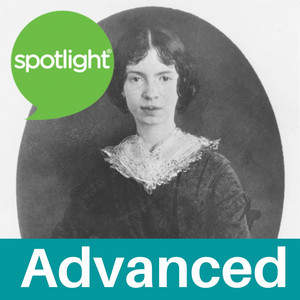
Today's Spotlight is about Emily Dickinson, a woman poet who lived in Amherst Massachusetts, in the 19th century.
Dickinson wrote hundreds of poems in her lifetime.
She often wrote about death and loneliness.
But she also wrote about the world around her.
She wrote about joy and friendship.
While she was alive, most people did not know that Dickinson was writing.
She avoided other people.
She wrote many letters to her friends.
But she did not often write poems for other people.
When she was alive, she only published ten.
Dickinson was not always such a private person.
She was born in 1830 in the United States.
For much of her early life, she seemed like a normal girl.
But when she was 14, something happened that would change her life forever.
Sophia Holland was Dickinson's second cousin.
In 1844, she got sick with a disease called typhus.
Typhus is a deadly disease spread by an insect called a louse.
It causes a lot of pain, fever and confusion.
Typhus may cause a person to not understand what is going on around them.
Today, many people recover from typhus.
But in the 1800s, doctors did not know how to treat it.
Holland died after getting typhus.
Holland's death changed to Dickinson.
She became very sad.
Her parents were so worried that they took her out of school.
She was very young, but she spent a long time thinking about death and loss.
Months later, Dickinson recovered enough to go back to school.
But death seemed to follow her.
In 1848, Dickinson met a man named Benjamin Franklin Newton.
Newton was a great influence on Dickinson.
He helped her find other writers that would shape Emily's writing and he quickly became her closest friend.
But then, only two years after they met, Newton died very suddenly.
Again, Dickinson fell into a deep sadness.
Dickinson went through a lot of loss in her life.
She did not have many friends.
The ones she did have, she loved deeply.
When she lost them, she also mourned deeply.
In 1854, she wrote to her sister-in-law named Susan Gilbert.
Dickinson was very close with Gilbert, but they had been in an argument and would no longer talk.
Dickinson wrote to Gilbert, You do not need to fear to leave me alone.
I often part with things I think I have loved.
Sometimes they are buried, sometimes they leave me.
My heart bleeds so often that I will not mind bleeding more.
I can only add another pain to several that have come before.
In the mid-1850s, Dickinson began to turn away from the world.
She started to refuse visitors.
She would speak to people only by letter.
Often she would not leave her home.
In 1874, her father died.
The family held a memorial in their home, but Dickinson would not leave her room to visit.
Instead, she watched through a small opening of her door.
As she grew older, people began to think Dickinson was very strange.
She hid away from everyone.
But people did not understand why.
But Dickinson's life was not all sadness.
She was alone for much of her life.
But she seemed to choose to live this way.
She spent most of her time taking care of plants and flowers.
Or she would spend long hours writing.
And often the poems she wrote were full of joy.
One poem that shares this joy is called Hope is the Thing with Feathers.
It reads Hope is the thing with feathers that perches in the soul, and sings the tune without the words and never stops at all.
And sweetest in the gale is heard, and sore must be the storm that could abash the little bird that kept so many warm.
I've heard it in the chillest land and on the strangest sea, yet never in extremity.
It asked a crumb of me.
In this poem, Dickinson compares hope to a songbird.
It seems beautiful and easy to break.
But even a storm cannot blow hope away.
Hope spreads its beauty even in the most difficult of times.
It never asks for anything in return.
Death finally came for Emily Dickinson in 1886.
She was 55 years old.
When she died, very few people knew she was a writer.
Even her family did not know.
Lavinia Dickinson was Emily Dickinson's sister.
She discovered Dickinson's poems in a locked box.
Reading through these, Lavinia saw how many poems her sister had written.
There were over eighteen hundred poems in the box.
Most of these no one had ever read.
In the years since, people have published all of Dickinson's poems.
She is one of the most well-known poets from the United States.
Dickinson did not ask for praise.
She did not need it.
This makes Dickinson even more special.
She wrote for the love of writing.
This love shines like a fire from every line.
Have you ever read anything by Emily Dickinson?
What did you think?
What about her poems is most interesting?
You can leave a comment on our website or email us at radio at radioenglish.net.
You can also comment on Facebook at facebook.com slash spotlight radio.
The writer and producer of this program was Dan Chrisman.
The voices you heard were from the United Kingdom and the United States.
All quotes were adapted for this program and voiced by Spotlight.
You can listen to this program again and read it on the Internet at www.radioenglish.net.
This program is called Emily Dickinson, American Poet.
You can also get our programs delivered directly to your Android or Apple device through our free official Spotlight English app.
We hope you can join us again for the next Spotlight program.
Goodbye.