

[Emily Dickinson: The Reclusive Soul Behind the Poetry]-[Emily Dickinson: American Poet]
📋 Summary
The Life and Legacy of Emily Dickinson: A Journey Through Solitude and Hope
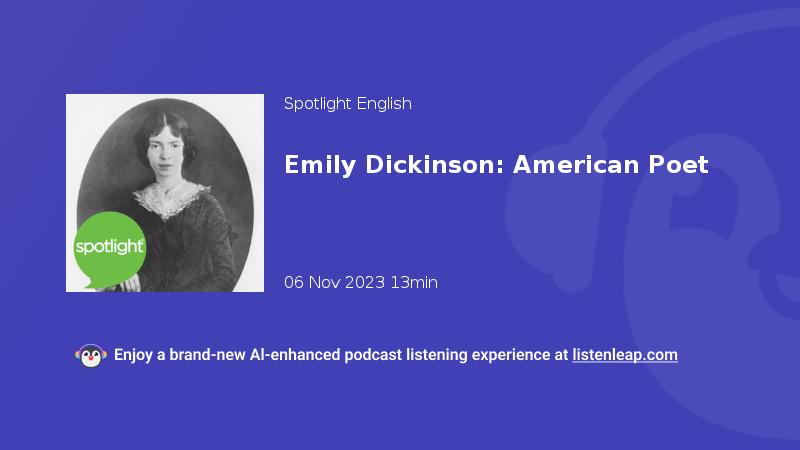
Emily Dickinson, a 19th-century poet from Amherst, Massachusetts, remains one of the most significant literary figures in American history. Despite her global recognition today, her life was defined by profound seclusion, intense personal loss, and a prolific private writing practice that remained largely hidden until after her death.
Encounters with Death and Early Influence
Dickinson’s preoccupation with mortality was not merely abstract; it was rooted in early trauma. At the age of 14, the death of her cousin, Sophia Holland, from typhus—a disease characterized by "pain, fever and confusion"—marked a turning point in her life. This loss triggered a period of deep sadness that necessitated her withdrawal from school.
This theme of loss continued in 1848 when she met Benjamin Franklin Newton, a mentor who guided her literary development. His sudden death just two years later reinforced her tendency to mourn deeply. As she articulated in a 1854 letter to her sister-in-law, Susan Gilbert, her life was marked by the sensation that "my heart bleeds so often," reflecting a vulnerability that would eventually lead her to retreat from the public sphere.
The Choice of Seclusion
By the mid-1850s, Dickinson began to intentionally turn away from the world. She became a "private person," refusing visitors and communicating primarily through letters. Her reclusive nature was so extreme that when her father passed away in 1874, she observed the memorial service from a small opening in her door rather than joining the mourners. While many contemporaries viewed her behavior as "very strange," her seclusion was a deliberate choice that allowed her to focus on her internal world, her garden, and her writing.
The Duality of Her Work: Death and Hope
Dickinson's poetry serves as a window into a complex mind. Her poem, I Heard a Fly Buzz When I Died, examines the final minutes of life with a clinical, almost detached perspective, describing death as a "normal event" devoid of excessive pain or joy.
Conversely, her work is equally defined by an enduring sense of optimism. In Hope is the Thing with Feathers, she characterizes hope as a resilient songbird, noting that "sore must be the storm that could abash the little bird." This metaphor highlights how hope remains persistent, even in the "chillest land" and "strangest sea," never asking for anything in return—a testament to the strength found within her solitude.
A Legacy Discovered
When Emily Dickinson died in 1886 at the age of 55, the world was unaware of her immense creative output. It was her sister, Lavinia, who discovered over eighteen hundred poems stored in a locked box. This discovery unveiled a lifetime of work written "for the love of writing."
Dickinson did not seek fame or public validation during her lifetime. Her refusal to conform to the social expectations of her era, combined with her raw, honest exploration of the human experience, makes her an enduring figure. As the program notes, the "love of writing" shines like a fire from every line she produced, cementing her status as a literary icon whose voice, though once hidden, now resonates across the globe.
Deep Learning with ListenLeap


