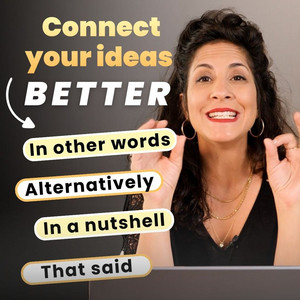
Linking words or connectors or transitional words are the little words or phrases that we use to connect ideas and make what we say or write flow better.
For example, however, so, but, nonetheless, besides, furthermore, alternatively, and so many more.
You're listening to the Influency Podcast.
I'm Hadar, your host, a pronunciation expert. fluency coach, and a proud non-native speaker.
With over 16 years of experience teaching, I am here to share with you all my secrets on how to show up in English clearly, with confidence and freedom.
On this podcast, I'll provide step by step strategies, lessons, stories and practical tips. to keep you inspired and motivated on your English journey.
Are you ready? Let's do it! Hey everyone, it's Hadar.
Today we are going to practice together linking words to help you sound more expressive and to help you organize your thoughts And also we'll practice connected speech, so this is also going to be a pronunciation lesson.
First, let's start by defining linking words.
Linking words or connectors or transitional words are the little words or phrases that we use to connect ideas and make what we say or write flow better.
For example, however, So, but, nonetheless, besides, furthermore, alternatively, and so many more.
So linking words are designed to help the other person follow our thoughts, especially when it's a longer sentence or a complex thought.
And it helps guide the other person to see whether we're adding something, showing contrast. explaining, giving examples, or wrapping things up.
Today, we're going to practice five linking words, we're going to practice the pronunciation.
And I deliberately chose longer phrases so we can practice connected speech.
And we're going to talk about the meaning and how we use them in context.
The most important thing is to always practice new words or new phrases or phrases that you don't Regularly use in context and repeat it again and again until you make it a habit, until you can use it spontaneously.
Because we all know that the worst thing is to learn something new or to hear something that you already know and to put it on the back shelf in the back of your brain and forget about it.
Okay? So this is why the intentional repetition, it's part of my method, the pronunciation confidence method.
This is why it helps you make these words that you'll learn more available and to use them regularly.
The linking words and phrases that we're going to practice today are In other words, that said, At the same time, alternatively, and in a nutshell.
Let's start with, in other words. So in terms of pronunciation, we want to connect this whole phrase together.
In other words, we have a TH and an R there, so we want to make sure that the transition is smooth.
Other, ther, ther, ther. other connected with the word in, in-other, n-other.
The N becomes the beginning of the word other.
Another. And then the word words, notice the pronunciation.
You don't pronounce the O here. Words. In other words, R to W might pose a difficulty for a lot of you.
Do it slowly first. In other words. If it's really, really difficult, just drop the R. Listen.
In other words. In other words. In other words.
No one will notice. No one will know. Okay.
In other words. Now, the definition In other words, it is used when you want to clarify or explain something in a different way.
When you said it and then you want to highlight it, emphasize it or... land an idea and you use other words to say it.
It's often used to simplify or rephrase a point.
In other words, for example, She's really good at managing her time.
In other words, she's always on top of things.
Again, she's really good at managing her time.
In other words, in other words, she's always on top of things.
Next sentence. He's really picky with food.
In other words, he won't eat anything unless it's perfect.
One more time, he's really picky with food.
In other words, notice the pronunciation, he won't eat anything unless it's perfect.
I'll be there at 10.15. In other words, I'm running late.
I'll be there at 10.15. In other words, I'm running late.
Now I want you to pause the video and think of at least one sentence with the phrase, in other words.
Okay, good. Next up, we have, that said.
I really like that phrase. I don't know why, but I really like it.
That said, I don't have a lot to say about this phrase except for the TH.
Make sure you stick the tongue out. And then the T is a held T that connects to an S.
That said so you don't really hear the T. It's like that said that said as in cat now that said is something you say when you want to add a different point or twist to what you just said so it's in a way A way to balance things out or soften what you said before.
You can also think of it as if you were to use the word however or still.
Okay? Let me give you an example, so it's going to be clear.
The hike was difficult. That said, the view from the top was absolutely worth it.
The hike was difficult, that said, the view from the top was worth it.
What does that mean? Like the hike was difficult, right?
I'm saying something that has a negative connotation, That said, I'm softening it or I have like another perspective to what I had just said.
The view from the top was worth it. Let's look at another example.
She's not great at math. That said, she's an excellent writer.
She's not great at math. I made a statement.
That said... And also think of it as, however, she's an excellent writer.
That said, that said. I've never been to Europe.
That said, I really want to visit someday.
Okay, now it's your turn. I want you to pause the video and think of a sentence or a phrase that you can say using that set.
The next phrase is at the same time. At the same time.
Here, we wanna connect the words together.
At the, at the, at the. The T and the TH connect.
To do that, place your tongue on the teeth for the T at And then it's already ready for the TH.
The. At. The. You don't have to pop the T. At.
No need. At. The. At the, at the schwa, same time.
That's easy to say, right? At the same time, at the same time.
Now, at the same time, it's used to show that two things are true simultaneously, even if they seem contradictory or a little surprising together, okay?
At the same time. At the same time. And if we want to think of alternative words, you can think of while or still.
I love spending time alone, but at the same time, I get lonely easily.
Does that make more sense now? So I love spending time alone, but at the same time, I get lonely easily, so it's kind of like conflicting and surprising that I say those two things, But the two things are true at the same time.
I love spending time alone. At the same time, I get lonely easily.
It's a great opportunity, but at the same time it's a big risk, but at the same time.
Pay attention to the pronunciation, but at the same time.
It's a great opportunity, but at the same time, you really have to consider it because it's a big risk at the same time.
She was tired but at the same time full of energy from the excitement.
She was tired but at the same time full of energy from the excitement.
So she was both tired and excited, okay?
Full of energy, I mean, and excited at the same time.
The two things were happening. At the same time.
Makes sense. Pause the video and think of at least now two sentences with the phrase at the same time.
The next one is alternatively, alternatively.
Pronunciation. You can either pronounce it with an AW as in daughter, it's a more rounded version of the open AH sound, or AH, alternatively.
Choose whatever you want. Now, this is a dark L, so the dark L affects the beginning vowel. alternatively.
A dark L appears before a consonant or at the end of words, and it sounds like this.
It's not alternatively, but alternatively. alternatively.
If that's difficult for you, pronounce whatever L you're used to pronouncing, it's still going to be clear.
Primary stress is on . Div-flap-ty-ly. Okay?
Alternatively. alternatively alternatively alternatively introduces another option or possibility an alternative option, an alternative possibility.
You can think of it as using the word or, or Another option is, or instead, right?
These are other phrases that could be used for the same situation.
You could fly to London. Alternatively, you can take the train from Paris.
You could fly to London. Alternatively, you can take the train from Paris.
So, I could have easily said you could fly to London or you can take the train from Paris.
But alternatively, it's got like a fancier way to say it.
I sound sophisticated. You could fly to London.
Alternatively, you can take the train from Paris.
Now, it's not fancy language, okay? You can use it daily.
It's however you want to use it. I'm just giving you the tools, you decide how to use them.
I can cook tonight. Alternatively, we could order in.
Order in is order food from a restaurant. to your house.
I can cook tonight. Alternatively, we could order in.
Let's look at another example. You can join the 5pm session.
Alternatively, there's another one at 7pm.
Again, you can join the 5pm session. Alternatively, there's another one at 7.
Good. To summarize this lovely video, we are going to practice the phrase in a nutshell.
In a, in a, in a. In a nutshell. T is held connected to the SH sound.
Nutshell. In a nutshell. In a nutshell.
In a nutshell is used when you want to summarize something in a clear way.
Okay, when you say something and then you just want to End it with a one-liner that summarizes the whole thing you'll use in a nutshell.
You can also, alternative phrases would be to sum up or basically.
In a nutshell. Okay, so let's look at a few examples.
The first one. The movie was too long, too slow and confusing.
In a nutshell, I didn't like it. The movie was too long, too slow and confusing.
In a nutshell, I didn't like it. Another one, he's lazy, unreliable, and never shows up on time.
In a nutshell, he's not a great teammate.
Okay, so I said a bunch of things and then to summarize or in short or let me put it in very basic words or simple words in a nutshell.
Bottom line, he's not a great teammate, okay?
Last one. The app kept crashing, the interface was confusing, and the support team didn't help.
In a nutshell, it was a frustrating experience. in a nutshell, in a nutshell.
Now pause the video and create at least two sentences with the phrase in a nutshell.
All right, that's it. I hope you enjoyed the episode about linking words where we talked about literally linking the words and also using linking words in a sentence and how to use them.
Remember that if you want to add a new phrase or new word into your vocabulary, and I bet that you've all heard these phrases or these words before.
And I bet that you don't regularly use these phrases as well.
So this is called passive vocabulary. When you know a word and a phrase, if you were to hear it, but you don't use it regularly and for you to be able to express You don't need to keep on learning more and more words, right?
You keep learning and more linking words and more words you don't know.
But what about all these beautiful words that you know, but you don't use, like the ones we practiced in this video.
In this case, my best advice is to just become more confident in using these phrases.
And I believe that the best way is A. to say these phrases out loud again and again, building pronunciation confidence.
So your mouth is used to saying them, feel like you're owning these phrases or these words.
And then you want to use them in context.
You can Google phrases with these words, or you can use chat GPT to use these words. and you can say them again and again and again, these phrases.
And then you want to create your own sentences with these words or phrases, and then you want to start being mindful about using these words, that's intentional practice, when you speak freely.
And then you want to maybe use these words intentionally in a conversation with someone or in a meeting.
Because that's how you make these words more available, and that's how you use new vocabulary or passive vocabulary spontaneously.
All right, if you enjoyed this episode, like and share and you can comment, tell me what you think.
And if you want to find out more about my lessons and get all the free resources that I have for you, then go check out my website, HadarShemesh.com.
You'll have a lot of fun. Have a beautiful, beautiful rest of the day and I'll see you next week in the next video.
Bye.