This is Round Table.
You're listening to Round Table with myself, Ha Young.
I'm joined by Steve Hatherly and Yu Shen in the studio.
Coming up, it's easy to think of a warm tone and simple words as respectful, but when the same style is used with both children and older adults, it blurs an important line.
In English, this way of speaking, known as Elderspeak, is raising concern.
It's not what you say, but how you say it.
That can leave older people feeling talked down to.
Let's explore how cultural norms, tone and intention come together in the way we speak to elders and how we can do better together.
And life's best moments, from the soundtrack of your heart to little things that make you smile.
Join us at Round Table's Happy Place.
Our podcast listeners can find us at Roundtable China on your favorite podcast platform.
Have a question worth exploring?
We are game! Send it to Roundtable Podcast at QQ .com.
Emails are fine, but bonus points for voice memos.
They are a listener's favorite.
And now on Roundtable, let's move on to this topic discussion.
We often think of showing respect as using polite phrases, such as saying thank you after you.
or can I give you a hand?
But what about how we say it?
In the US, researchers are raising alarms about elder speak.
A way of speaking to older adults that's well -meaning but can come off as patronizing.
Is marked by slow speech, simple vocabulary, exaggerated tones.
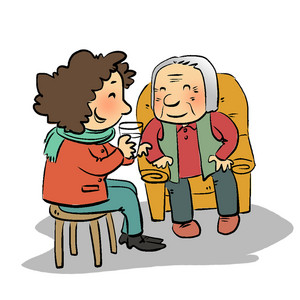
Think of how you'd speak to a child or a pet.
When it's often meant to show affection or concern, it can unintentionally reinforce the idea that older people are fragile or helpless.
And what about in Chinese speaking cultures?
Our language already comes with built in honorifics and family -based respect terms. So are we off the hook?
Or are there subtler ways we might also talk down, even as we try to lift up.
So Steve, let's go to you first. Could you explain in a thumbnail what's elder speak.
Yeah, sure. You said that this research was taking place in the States, and Clarissa Shaw, she's a dementia care researcher at the University of Iowa College of Nursing.
She's also the co -author of a recent article that helps researchers document elder speak, and this is how it's defined.
It's what you just said.
It's communication to older adults that sounds like baby talk, and it arises from an ageist assumption of frailty, perhaps incompetence, and also dependence.
And the focus here was on how caregivers specifically talk to the elderly who are under their care.
So we're talking about working professionals, right?
But this can apply to anyone, of course.
So elders speak a little more on that, it can be controlling, it can be a little bit bossy so to soften the tone, if you think about how a care worker would speak to an elderly person in a nursing home.
It can sound a little bossy because they're often telling them what to do, right?
So to soften that tone, people will often use words like honey or deary or sweetie, for example, these terms of endearment that couples would normally use.
home care workers were using these, they found.
And these people, not everyone of course, who use these, they can have negative stereotypes of older adults so that the way we talk to them sometimes is not like we are talking to another adult.
It's like we're talking to a baby or a child or a pet.
Yeah, so it's like baby talking but to a elder in this case.
And you mentioned that it's specifically more commonly seen among working professionals who have a job to take care of elders.
Mm -hmm. So it's not just I randomly bump into an elder in the supermarket and I call him or her sweetie.
No, no, no, no, no. Something like...
Okay good. Not like that.
Yeah. Oh my goodness.
So is that all using terms of endearment like what you mentioned?
Uh yeah, no, no, it's not just that.
According to the author, caregivers may resort to plural pronouns as well.
For example, instead of asking the person, asking the elderly person, are you ready to take a bath?
They might use plural pronouns.
Are we ready to take our bath?
Now, go with the baby talk, are we ready to take our bath?
Right? And so, you can hear that tone difference, and that's what they say is where it becomes condescending.
and the implication there is that the person is not able to act as an individual when you say are we ready to take our bath it doesn't mean that you're going to take a bath with them it means that you are implying that they cannot act on their own sometimes the volume can get louder sometimes sentences can get shorter or they may developed a kind of a sing -song kind of tone when speaking to them.
And all of these things together, along with certain vocabulary, vocabulary that you might use with a child.
For example, the bathroom, a slang term for a child for the bathroom is the potty, or pajamas would be jammies.
So sometimes caregivers, they found, would use that vocabulary when speaking to the elderly patients.
I find that so fascinating, because not all of the elders that's being cared in this scenario has cognitive function impairment.
Let's say they're still grown ups.
They live their 60, 70 years of life, and in the caregiving house, they're being treated as babies.
But you have to understand that this isn't being done with the intention of being patronizing.
These care workers, these care workers are not trying to be condescending.
When a parent or grandparent speaks to a baby they're not trying to make the baby feel like less of a human being, right?
That's a show of love.
That's a show of care and attention, so therefore these care workers will use that tone with that same intention.
Love, care, attention, but they've discovered that it's not received very well.
So, just to clarify again with this American study are we talking about care home?
That's what they're talking about specifically here but it's not just there you can find this kind of speak or behavior in a place where you can find high -functioning elderly people for example in a grocery store or a doctor's office or or anywhere for that matter It's kind of a way that people will sometimes—not everybody, not all the time—but sometimes speak to elderly people as a sign of taking care.
This is fascinating.
This word came up a bit too often, but bear with me.
I'm thinking the last time I heard something similar to this in China was in a bank.
I saw this older gentleman who seems well -dressed, lucid, silver -haired and I overheard the teller or the financial advisor was trying to sell him some very expensive insurance policy packages.
And she was using, and here's, in Chinese linguistics, when honorifics have been built into our everyday language, the lady immediately went with...
Shou Shou, so uncle.
Like in English you don't do that, you always refer to, oh, Mr. Hatherly.
Like nobody would come to you, like a younger professional wouldn't come to you, calling you big brother or uncle.
Too casual, yeah. And it's weird. And you just don't do that in a professional setting.
But I overheard that, and the gentleman very warmly received it.
And she was speaking in definitely, I mean, the financial advisor was speaking in a very warm and slower tone as she would be speaking to me, a regular working person.
So, but it seemed like it went well.
I don't know if they inked the deal in the end or not.
But to me, that was a very normal and common social setting.
And I think the older gentleman felt like he was taken care of and he wanted that extra attention out with him as well.
Yeah, and that's a great point to make.
Remember, this is done this is English.
This is the English language and not only the English language.
This is a study conducted in the United States.
So this is North America.
This is North American culture with the English language, right?
And if you applied this to maybe even Spanish or some South American -Latin cultures, maybe this wouldn't apply here.
So it is culturally specific I would say.
Well, do you think this occurs in China in some shape of form at all?
I would say what you mentioned, He Yang, is very common here in China because when we switch our zoomed in lenses into China, then with our culture that's deeply rooted into respecting elders, following the Confucianism teaching, and all that.
It's very natural for the elders, especially those that have a higher social status.
It's even natural for youngsters to just simply pay respect in a way that's from the gesture, from the verbal communication, in whichever way you can offer it's just natural and just like day -to -day talk for us to refer to them with a say a referring word such as uncle or grandpa or grandma so by saying that we're not saying oh you're old enough to be my uncle or old enough to be my grandpa or grandma but rather it's just a say a way of referring for the Chinese people to pay respect to the elders And also, that being said, here in China there are similar, say elders speak, happening, but under a different
context. So these scientists, Shen Zhaohui and Jing Xiaoping of Nanjing University of Science and Technology, they conducted a study, and according to their study, they quoted from a fascinating study published in 2023, which looked at how young people in China talked to older adults with cognitive impairments, in the cases like Alzheimer's, on a reality show called Forget Me Not Cafe.
So the researchers found that these young caregivers often used what's called elderly directed speech, kind of like how we might soften our tone with children, but also adapted for dignity and support.
There are some patterns, like using a affectionate nicknames, asking tag questions like, is that okay, or blah blah blah, right?
So that's repeating themselves gently and using all of these features in their talking as a way of softening their commands.
So this is also used in China but in, say, a more special, specific case.
Yeah, the tag question is something they found from this research, as well, for example, or the home care worker might say to the patient, it's time for you to eat lunch now, right?
So they say the problem with that is that you're asking them a question, but you're not letting them respond, you're telling them how to respond.
So why is this considered negative?
Well, so what they did was they looked at nursing homes to find out how commonplace this ElderSpeak was.
And when they analyzed video recordings of 80 interactions between staff and residents with dementia they found that 84 % had involved some form of ElderSpeak.
So this is really taking place almost all of the time you could argue.
Again, it's not just nursing homes but that's what they were looking at here.
Why is it considered so negative?
Well, among the nursing home residents with dementia, the studies found there is a relationship between exposure to elder speak and behavior collectively known as resistance to care.
Resistance to care might mean if they're trying to give them their medicine the patient will turn away, turn their face away, or if they're trying to give them food they'll clench their mouth closed or sometimes they found they would even push or strike their caregiver.
That's from that then there was another one from the University of Kansas.
This is a paper from 2022 where they talk about Elderspeak and the fact that it implies that an older person is not competent.
And the miscommunication that's occurring is the fault of the patient, not the fault of the younger person or caregiver who's speaking to them.
And this may reinforce negative stereotypes about aging.
It could also erode the older adult self -esteem.
Many aspects of Elderspeak they actually decrease comprehension, they found and it's confusing when a word gets exaggerated for a person who's older and they could also have a hard time understanding statements that sound like a question.
They did another, just very quickly, they did another one, another bit of research where they had younger people give directions on a map to elderly patients and they didn't instruct the younger people how to speak at all.
They didn't say, use baby talk.
They didn't say anything.
They just said, give them instructions on how to follow this map.
And the elderly patients were not given any instructions on how to respond.
What they found was that the younger people, just almost like an instinct, they just use that baby talk because they're trying to show love and care.
But the elderly people didn't have any problem comprehending the directions on the map.
map, but they did say, what did I make a mistake in there?
Why? Why are you treating me like that?
Why are you talking to me like this?
So it can lead to the elderly person questioning their self esteem, questioning their intelligence, questioning their competence when they hear talk like this.
See, here it can get a little bit tricky because you have a very capable older adults.
Maybe they're not moving physically as fast as they used to but they're perfectly lucid and they're perfectly well in making decisions for themselves.
But we know not all older folks are on it like that anymore.
So, I mean, out of love and concern that's very nice of people.
But if you overdo it when people don't need it, that's bad.
Yes. But also we need to be considerate that in Chinese we sometimes say that an older person becomes a laoshauhar, an older kid, and well that term was meant to be endearing, but there are a chunk of the elderly population, who needs an extra little bit of I don't know what it is, is it coziness or something, it's not like everybody's still young and can function like when you're 30 anymore.
I know exactly what you mean.
and that's why the experts say they know that there are changes in thinking and communicating as a person ages.
So science has established that older adults, they do have changes in their working memory, and this affects the way that they hear and understand what is said to them.
Because of this, we know that seniors will have better comprehension if you do repeat or paraphrase what you are saying or be explicit simplify your sentences don't make them too complicated yeah you're absolutely right there there wasn't so much of an issue with that it was just all focused on this kind of baby talk and how condescending it may sound and how it made the elderly person feel about themselves so what did the researchers say to do to try to change the way caretakers talk to the elderly?
Well actually, they developed such a system called or program called CHAT Chat for changing talk.
So that's a three hour long sessions that include videos of communication between the staff and patients, intended to reduce how the staff will be using elder speak or their baby talk tones, and it actually worked.
So before the training in 13 nursing homes in Kansas and Missouri, almost 35 % of the time spent in interactions consisted of elder speak.
And that number was dropped to around 20 % after the training.
And there's also data proving that on the recipient side, on the elder side, once they sense the different tone and vocabulary through their caregivers, Their resistant behavior is also lowered as well through their training.
Yeah, it dropped by 16%.
So they proved that it works.
What are some final good tips to give people to keep a mind when speaking to the elderly?
Yeah, I mean this isn't to say don't speak with respect to the elderly, of course.
And also using a kind of a rich and varied vocabulary makes any conversation more interesting.
and adults never stop learning, right?
You can learn new words over the course of a lifetime, but just try to avoid making the other person feel just simply speaking bad about themselves by using a condescending tone.
And people with hearing loss, of course they need amplification, but maybe avoid raising the pitch so that it distorts the words.
Language doesn't just reflect how we see others, it actively shapes those relationships.
Elderspeak, whether in English or Chinese, reminds us that even gentle words can carry heavy meanings.
A kind tone, when misplaced, can quietly take away agency.
As speakers, we hold a kind of power.
Our tone, our choice of words, our respect or assumptions.
The challenge isn't just about speaking with care, but to listen deeply and let our elders lead the way in how they want to be seen and spoken to.
Coming up next, welcome to the happiest corner on the airwaves, Roundtables happy place.
and Steve I know you have something special to share with us.
Well I just wanted to share with our listeners that I'll be away from the show for a couple of weeks my wife and I are going to sun hopefully sunny beach location in Southeast Asia for for a good couple of weeks.
So we'll be off to relax and enjoy some great food and do a little bit of swimming and some sightseeing and some Sun tanning, I hope.
Yeah so I just wanted to share that in case the audience was wondering where I disappeared to for the next couple of weeks or so.
We're excited to see Steve getting a tan in a week's time.
I better have a tan when I come back.
You ever heard that before?
You go to a sunny beach location and then it rains all the time.
So when you come back to work your coworkers say, You're not even tanned.
We wouldn't do that to you.
Oh, I hope I don't get to hear that.
Yeah, my very quick, very quick Swift, happy places that I recently just moved to my apartment, which is such a big changing for me.
It took me only within a week to decide that I want to move, to pick the house I want to move in and to actually move.
So yeah, that's a very, very exciting, big news for me.
But Yep. Happy place for today.
No wonder she's been very happy.
Oh yeah. yeah and also next, well, for the next two weeks Steve wouldn't be on the show and that explains why and we hope you have a very happy holiday and lots of new things to share with us when you come back.
I hope so yeah. You can be tan or without a tan.
Thanks for the well wishes and I will see you in a couple of weeks.
Yes and that brings us to the end of today's Roundtable.
Thank you so much Steve Hatherly and Yushan for joining the discussion.
You can always find us on Apple podcast at round table China.
And if you're so kind and feeling inclined and you have something that you might not be bothered to look up on the internet, or it doesn't give you a good answer.
Send it over to us roundtablepodcastatqq .com.
We'll discuss it on the show and what's even better.
You can send us a voice memo so we can play your voice on the show as well.
And that brings us to the end of today's show.
I'm Ho Young, we'll see you next time.