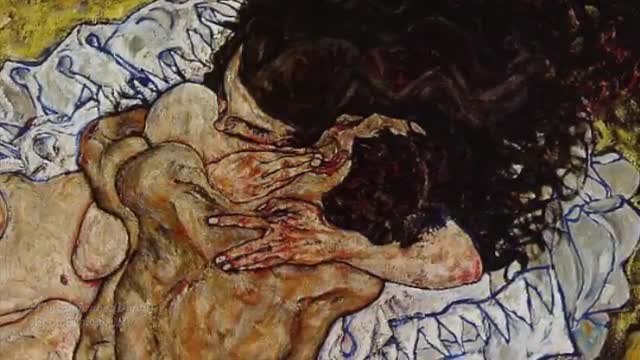
There are many images I could not use making this video.
You can find the full uncensored adult version on my Patreon link in the description below.
Egon Schiele was one of the most intense and controversial artists of the early 20th century.
A shy, reserved child turned rebellious visionary.
He scandalized Vienna with raw, often unsettling depictions of the human body.
His work is filled with twisted forms and existential angst, reflecting an obsession with mortality, sexuality and identity, especially his own.
His self-portraits are unlike anything that came before them emaciated, contorted and confrontational.
With sunken eyes and twisted limbs, they were not intended to flatter, but to disturb.
So what drove this young artist to depict himself so mercilessly?
In this film we'll explore how Schiele's extraordinary self-portraits reflect not just his own inner world but the last throes of empire, a fascination with medical patients, the artistic ferment of fin de siècle Vienna, including the influence of Gustav Klimt, and even the unlikely effect of Javanese puppet theatre on his work.
And we'll ask, why do these haunting images still grip us over a century later?
As a child, Egon Schiele watched his father Adolf, slowly disintegrate as hallucinations and seizures took hold of him, his body jerking convulsively into contorted shapes.
It would have a profound effect on the young Schiele.
Born in 1890 in the small Austrian town of Thuln, just outside Vienna, his childhood was shaped by three things.
Trains, an early obsession with drawing, and the long shadow cast by his father's health.
Schiele's father, his grandfather, even his older sister worked on the trains, and it was assumed Egon would follow the same path.
As a child, he spent hours sketching locomotives with incredible detail.
But it wasn't so much the trains that drove his fascination, it was drawing itself.
The act of making images quickly became a refuge and an obsession.
His father's humiliating mental and physical decline was due to the neurological effects of late-stage syphilis, a disease he had contracted from a prostitute on the night of his wedding.
He would die when Egon was just 14.
While Schiele never directly painted his father's death, it haunted his subjects the frail body, the thin line between beauty and suffering and the inescapable presence of death in life.
The shame of his father's illness almost certainly contributed to Schiele's complicated attitudes towards sexuality.
His work often connects eroticism and suffering, and there is a persistent undercurrent of desire, danger and transgression in his work.
For Sheila, the loss of his father was devastating, and he retreated further into drawing and painting, and even began to use his own self as a subject, as if he were trying to catch something hidden just beneath his own skin.
This remarkable photograph of him as a teenage boy shows us the intense psychological world he was already constructing around his image.
It seems as if it's a visual rehearsal for the role he would play in his paintings, as if he was sculpting a persona.
Schiele was a boy shaped early on by death, intensity and inward obsession, traits that would define both his art and his short, haunted life.
At just 16, Schiele was accepted into the prestigious Vienna Academy of Fine Arts, and at 17, he sought out and met his idol, Gustav Klimt who, already established and 28 years older, would become his mentor.
This early drawing by Schiele records their meeting.
As we shall see, elements of Klimt's style can be found in many of Schiele's early works and drawings.
In 1911, when Schiele was 21, Klimt introduced him to 17-year-old Wally Neusel, a working-class model.
The two quickly became inseparable.
Wally was both his partner and muse, posing for many of his most intimate and expressive works.
And she became an essential part of the emotional and aesthetic core of Schiele's most radical work.
What is most striking about her portraits is the look in her eyes.
Volley's direct gaze showed her to be comfortable with herself and her sexuality as she looks calmly and intimately at Schiele.
This is one of the most famous paintings of Volley, showing her with unsentimental honesty, staring directly at the viewer.
It was painted as a counterpoint to Schiele's own self-portrait of the same year, one of his most celebrated works.
Both of them are confident, even defiant.
But the paintings also reveal something fragile beneath the surface.
The two paintings are a powerful pair and a statement of their bond and a relationship that would last four years.
That was until he abruptly ended it to marry Edith Harms, a bourgeois woman he considered more respectable.
His many portraits of his wife were altogether more modest than Schiele's usual depiction of women.
He asked Vali to stay on as his mistress, but she refused.
In response to the end of their relationship, Sheila created one of his greatest paintings, which anyone who has been through the end of a love affair can connect with.
They never saw each other again.
When an artist is making a self-portrait, they are looking into a mirror asking, who am I?
Over his short lifetime, Schiele would go on to produce at least 170 self-portraits.
And while many external influences and other artists shaped Schiele's work, it is significant that he and Sigmund Freud were working in Vienna at the same time.
Schiele's art emerged from the same cultural and intellectual climate that produced Freud's psychoanalysis, an era defined by a deep fascination with self-examination.
Schiele's self-portraits can almost be read as Freudian case histories in visual form.
They strip away social masks, expose taboo desires, and make the unconscious visible in the body.
His close friend and mentor, Gustav Klimt, didn't paint any works that he called self-portraits.
So why did Schiele paint so many?
And what makes them so different from those of his predecessors?
One of the central reasons artists create self-portraits is to explore questions of identity and status.
Many artists use self-portraits to elevate their social standing.
In the Renaissance, Albrecht Durer famously painted himself in the image of Christ, raising the status of the artist to something approaching the divine.
And art saw a rise of self-portraits included in commissions another comment on the artist's status in society.
Then there's the technical aspect.
Repeatedly observing the same face allows for artistic experimentation and refinement.
For others, it was about legacy.
Painted in 1780.
Sir Joshua Reynolds' self-portrait is a deliberate nod to Rembrandt, a calculated exercise in personal branding.
Artemisia Gentileschi meanwhile, painted herself as the embodiment of painting, boldly asserting her place in an art world that barely acknowledged women.
But while this self-portrait by Vincent van Gogh is looking for our empathy or our understanding, this self-portrait by Schiele demands you face something raw and uncomfortable.
It is a challenge.
Sheila doesn't seem interested in sympathy, status or legacy.
Some have suggested it is down to narcissism.
A fair point.
His letters to his mother reveal a startling sense of entitlement, and his treatment of those closest to him, including his partner Vali, show a marked lack of empathy.
But despite this, Sheila didn't use self-portraiture to celebrate himself, but to expose an inner truth.
And whilst it emerged from the personal, it explored something much wider.
He certainly wasn't flattering himself in either subject or aesthetic.
It is precisely his distorted use of line and composition that make his self-portraits so compelling.
That and the proliferation of male nudes, a rarity in art.
Schiele was academically trained and was a master draftsman.
I think his line work is why his images still feel alive and immediate over a century later.
Schiele's line is unmistakable.
Even a fragment, a wrist, a cheek, a fold of cloth is recognisably his.
That's because his line has a particular rhythm, angular, tense, and economically placed.
It's not just a means of describing form, it's a voice.
When people describe Schiele's sureness of line, they don't necessarily mean smooth or conventionally graceful.
In fact, many of his lines are jagged, angular, or abruptly broken.
But they feel decisive.
Any discussion of Sheila must start with the naked body.
He used his own body repeatedly, showing it more emaciated than it actually was, radically distorted and twisted, sometimes faceless or limbless, sometimes in abject terror, not to flatter but to expose vulnerability, anxiety and sexuality.
These are not likenesses, they are psychological portraits, a search for the self or the ego, a preoccupation of the time.
They are often in an intersection between suffering and sex, as if he is disgusted with his own body.
Outlined in black crayon, the brushstrokes visible, the technique as exposed as his inner, being eliminating everything except the body, often floating untethered on a blank background, frequently using white paint to emphasise the outline.
No indication of social standing, profession or character of which we learn nothing, discarding centuries of ideas centred around portraiture.
Isolated figures focus our gaze, and these stark, fragmented compositions suggest a search for control over a body and psyche that had witnessed disintegration firsthand, with the slow, painful death of his father from a sexually transmitted disease.
It has been suggested that by portraying male nudes, Schiele was levelling up the male-female nude ratio.
But many models of this period and before were poverty-stricken prostitutes and didn't have a choice.
Schiele did.
He controls how he is seen.
In contrast to his distorted self-portraits, in his unposed photographs we see a more relaxed, handsome and fashionably dressed man.
In this drawing, Schiele presents himself in a deliberately awkward pose.
The elbow juts outward, his chin tucks behind his shoulder, his ribs protrude.
The line is confident, almost aggressive.
And as was often the case, he avoided lush palettes.
Instead, using ochres, browns, greens and pallid skin tones, suggestive of decay.
This is not a natural pose.
It's bordering on discomfort.
His hands often take on as much psychological weight as the faces in his portraits, sometimes exaggerated angular, claw-like or elongated to the point of distortion.
They become the most expressive elements in his self-portraits, mostly in this peculiar V-shape, a pose he practiced in photos and one we see time and time again in his works, in a gesture conveying tension, or visual expressions of something internal, deliberately and carefully choreographed.
One of the last oil paintings Schiele did included one of his last self-portraits.
His wife Edith, was pregnant at the time with her first child, and they were comfortable, happy and settled, unaware of the tragedy yet to come.
Schiele's body wasn't just a subject.
It was a vehicle for expressing the tension and fragmentation of his time.
His raw style was shaped by more than personal pain.
He came of age in the final years of the Austro-Hungarian Empire, a sprawling multi-ethnic state struggling with nationalist tensions, political fragmentation and looming war.
Politically, Vienna was caught between the old imperial order and modern democratic movements.
Culturally, it was a laboratory for psychoanalysis, radical art, music and taboo-breaking literature.
Modern ideas in technology, medicine and the arts clashed with deep-rooted traditions.
The self became a key site of exploration in both culture and science.
Out of this chaos, the Vienna Secession was formed in 1897 by a group of artists led by Gustav Klimt, who broke away from the dominant conservative style.
Schiele immediately gravitated to Klimt's expressive works and the secession motto to the age it's art, to art is freedom reflected the modernism he would go on to embrace.
You can clearly see Klimt's influence in Schiele's early works, particularly in his use of pattern and decoration.
But the younger artist quickly found his own artistic voice.
Artists, writers and others were coming of age at a turning point where everything morals politics, empires felt unstable.
And Schiele's new sparse figures often embody this instability.
Twisted poses, tense gestures, bodies that seem in flux or under strain.
They evoke not just personal discomfort but something larger the sickness and fragility of an entire society.
But this physical imagery of illness and disintegration wasn't just metaphorical.
They were symptoms of a deeper obsession gripping Vienna.
Medical science.
Sigmund Freud, father of psychoanalysis, reshaped ideas about the unconscious repression, dreams and sexuality, challenging the belief that humans were ruled only by reason.
In a society uneasy about sex and morality, his view of sexuality as central to life was met with repression.
Artists turned inward.
For Schiele, the erotic, pathological, intimate and grotesque often overlapped.
But psychiatry wasn't the only innovative field in medicine at the time.
The discoveries made in neurology were just as important.
The medical journal Nouvelle Iconographie de la Sorpetrière was intended as a visual reference for neurological diagnosis.
It was cutting edge.
Medical photography was still new, and the images it published of neurological patients were unusually vivid, detailed and staged.
It became a curiosity collected by those outside the medical profession and eventually, an iconographic source for artists in their search for new ways of representing the body.
Schiele's likely exposure to the journal came through Viennese medical networks, notably Dr Erwin von Graf, a gynecologist who allowed Schiele to sketch patients at Vienna's women's clinic, and also through his studio mate Erwin Ossen, who sketched at medical lectures.
Having seen his father die of syphilis, Schiele's interest was personal.
His work blurs the line between sickness and health, seeing the body in all forms as his truest subject.
And this fascination with bodily expression, gesture and identity would lead Schiele into new territory, one influenced not by medicine but by movement masks and the performance traditions of distant cultures.
One of the more surprising influences on Schiele came from the painted puppets of Javanese shadow theatre.
His friend and patron, Arthur Roessler, collected these stylised figures, prized in the Viennese Avogad for their ritualistic, mystical quality.
At the time, Austrian artist Richard Teschner was also adapting Javanese traditions for Viennese audiences, reinforcing their influence.
Rossler recalled showing his collection of puppets to Sheila who, he said, played with them for hours.
It's hard not to see the connection between Sheila's work and the bent limbs and angular and flattened silhouette shapes of these puppets, set against empty or negative space.
In some early self-portraits, Schiele's hands seem to manipulate himself like a puppet, creating a tension between control and collapse and mirroring the theatricality of the Javanese performances.
Any film about Schiele must confront controversy.
As he pushed artistic boundaries, he pushed social ones too.
Schiele lived with his partner Wally for four years, but they weren't married, which in early 20th century society was considered deeply scandalous.
Struggling financially, they left Vienna and moved to the small town of Neulenbach.
But the conservative community soon clashed with his eccentric behavior and provocative art, alarming locals and feeding suspicion.
In 1912, tensions reached a breaking point.
Sheila was arrested and charged with allegedly seducing a minor.
Though he was acquitted of that serious charge, he was convicted of displaying indecent drawings where children could see them.
He served 24 days in jail.
Whether his motives were purely artistic or something more sinister remains debated, but his behavior caused real unease.
Acknowledging this uncomfortable dimension is essential, not to justify it, but to understand both the radical nature of his art and the moral complexities it raises for us as viewers today, not least the debate between art and exploitation.
During his imprisonment, Volley stood by him, visiting regularly and offering her support.
Her loyalty was not repaid.
On July 28, 1914, the world was swept into a vicious war.
Then, in June 1915, Schiele ended the relationship with Wally and married the respectable middle class Edith Harms, just days before being conscripted for the war.
He avoided frontline combat and by 1917 was transferred to a barracks near Vienna where he mainly did clerical work, which left him time to draw these extraordinary portraits of prisoners, officers and fellow soldiers.
His close friend and mentor, Gustav Klimt, died in February 1918 after a stroke and pneumonia, nine months before the end of the war.
Then, just as the war was drawing to a close, another deadly force would claim at least 50 million lives across Europe.
In October 1918, the Spanish flu swept through Vienna, and within days, Edith was dead.
She was six months pregnant.
Three days later, Schiele followed her.
He was only 28 years old.
Egon Schiele created some of the most psychologically charged and emotionally intense works of the early 20th century.
In his self-portraits, themes of eroticism, mortality and the fragility of the human condition are laid bare with unflinching honesty.
His distorted figures and expressive lines still provoke outrage and fascination because they strip away comfort and force us to confront what lies beneath.
For Schiele, the body was never just a subject, it was a vessel for emotional truth.
By turning his own image into a kind of allegory, he spoke not only of himself, but of the anxieties, desires and wounds of the world around him, around us.
Sheila unsettles us, and perhaps that is his greatest skill.
To be unsettled is to question, and to question is to feel alive.
I'd like to read you an extract from my introduction, because I think it says everything I want to say about what this book is.
Art doesn't exist in a vacuum.
Monet's water lilies can be seen on a purely aesthetic level.
But we can also go beyond their surface beauty to consider whether these works created during the First World War can also be viewed as profound meditations on the power of art in the face of human conflict.
We can appreciate Michelangelo's Pietà for its Christian symbolism and its mastery of marble, but we can also view it in more universal terms, as an exploration of motherhood and grief.
Frida Kahlo's self-portraits are not just personal expressions.
They are lenses into Mexican culture, identity, and the artist's own complex relationships.
Every great work of art carries with it its echoes of its time the politics, the religion, the economy, the social norms and the individual struggle that shaped his creation.
This book looks at those contexts, available now for pre-order.
Thank you.