N .P .R. This is The Indicator from Planet Money, I own Tyrion Woods.
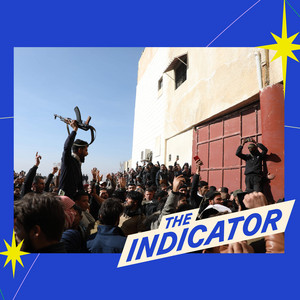
On Sunday, half a century of the Assad family ruling Syria came to an end.
Syria's brutal 13 year civil war that led to this moment had many players.
And today we want to put a spotlight on one of them, an economist.
It's like a dream, honestly.
It's like a dream. Today on the show, the story of one Syrian exile who made a real contribution to the resistance while on the other side of the world.
He tells us how lines of computer code and spreadsheets can help bring down a long -standing dictatorship.
This is Eric Glass.
On This American Life we're like stories that surprise you.
For instance, imagine finding a new hobby and realizing.
To do this hobby right, according to the ways of the masters.
There's a pretty good chance that you're going to have to bend the law to get the materials that you need.
If not break it. Yeah, to break international laws.
Your life story is really good ones, This American Life.
On the Ted Radio Hour, don't you hate it when leftover cilantro rots in your fridge?
I have to tell you cilantro is like my nemesis.
Food waste expert Dana Gunders says that's just a hint of a massive global problem.
Food waste has about five times the greenhouse gas footprint of the entire aviation industry.
Ideas about wasting less food.
That's on the Ted Radio Hour podcast from NPR.
It's been a great year for TV, movies, and music, and we are highlighting the best of the best.
We're talking about our favorite moments of the year, including some of the best pop culture you might have missed.
Listen now to the Pop Culture Happy Hour podcast from NPR.
Karam Shah is an old economist friend of mine.
Well, hello, hello.
Karam, it's so nice to see you.
Karam and I met while we were colleagues about eight years ago in New Zealand.
And when you were here at the New Zealand Treasury.
Yes, but now we meet professionally again, but this time to talk about the Syrian economy, which is all over the news right now because of what's just happened.
Indeed, exactly. I mean, the past 10 days or so have been insane, very momentous.
We chatted about all the events that led Karam to where he is today, on the front lines of Syrian research and advocacy.
Karam grew up in Aleppo, which is one of Syria's two big cities.
And after studying his economics degree, he got involved in anti -government protests.
This was in 2011, when the Arab Spring was awakening pro -democracy movements all over the Arab world.
Karam didn't tell his family, though.
We try to avoid and tell our loved ones about these protests.
And also, I mean, mainly to ensure their safety.
So I remember actually in one of the protests in Aleppo, we were shouting, people demand the downfall of the regime, the most liberating moment, I think, in my life.
The feeling is so exceptional.
It's liberating. And I remember actually someone tapping me on the shoulder and saying, hey, Abu Adib, as in like, that's my nickname.
And I turned my head and then I saw it was my brother.
So it turns out he was also protesting, but we were not telling each other.
My sister was also protesting.
I came to realize this later on.
The protests were met with heavy crackdowns by the Assad government.
And as rebel groups gained a foothold, Syria descended into civil war.
In 2012, Karam's father told him he should leave the country for his safety, especially given his activism.
Karam flew to Malaysia, then to New Zealand, where he studied for his economics PhD and was granted asylum.
That's about the same time that I met you when you were working at the New Zealand Treasury, working on the economic policy problems of a high income, peaceful country.
How was that for you?
Yeah, it was like working on another planet.
You know, it's a completely different context.
But after working there for like three and a half years, I just couldn't deal with the guilt, you know, with the guilt that I can do something for Syria and I should do it.
So how could a young economist on the other side of the planet possibly make a difference in one of the bloodiest conflicts of recent memory?
Karam put all his time into working on Syrian issues.
He hired analysts and open source intelligence experts to help out.
He started looking into how countries were using economic tools to pressure Syria, and he found some pretty major flaws, like in how humanitarian aid money was leaking to the Assad regime.
Like a lot of troubled economies, Syria has two exchange rates, the official exchange rate, according to the government, and the black market exchange rate, which is basically determined by supply and demand.
In Syria, the government was claiming the Syrian pound was worth more than it actually was.
So anyone wanting to buy Syrian pounds would need to pay the central bank more than those pounds were actually worth.
And in 2021, when Karam was looking at the Syrian central bank's website, he saw a footnote that said that this inflated exchange rate was used for foreign aid.
And I was like, this is unbelievable.
I mean, the level of stealing is just mind boggling.
Yeah, so let's break down how this played out.
Let's say I'm a UN agency working in Syria and I want to rebuild a school.
I need to pay a local construction company in Syrian pounds.
And to do that legally, I need to use the official exchange rate.
I exchange a million dollars at a bank for Syrian pounds, but I get weighed less Syrian pounds than I would have if I'd used the black market exchange rate.
And by Karam's calculations, maybe five hundred thousand dollars of that million would have been eaten up through that money exchange.
Who gets to keep all that extra money?
The Assad government.
So basically, it's a kind of levy on humanitarian aid.
And that is the aid that is paid by Assad's enemies.
Basically, it's predominantly western countries.
Karam wrote a report.
The problem got picked up by the Guardian newspaper.
And from there, it snowballed.
It just went viral, you know, all over.
We got members of US Congress to sign a letter to President Biden to put pressure.
There were parliamentary questions in Europe.
The US, Germany, the UK and some other countries put pressure on the UN telling them, look, we are providing these funds.
You talk to the central bank.
They either accept it or it will be withheld.
And yeah, the central bank of Syria reached a point after resisting for so long.
You know, they agreed to close the gap.
Did you and your team celebrate at all?
Actually, we did celebrate.
You can go on Twitter and see I was over the moon when it happened.
Of course, a lot of remote work requires digital celebrations.
Karam estimates this action stopped about sixty five million dollars a year going into Assad's coffers and funding its army.
Which in the context of the tens of billions of dollars in aid or military support given by countries like Iran is small.
But it was one victory over a range of fronts trying to bring down Assad.
Other economic analysis that Karam worked on involved reviewing who the aid agencies were contracting with.
He was horrified to learn a lot of people who had committed some grave crimes were receiving these contracts.
In one case, a militia group tied to Iran that had destroyed a city was allegedly being paid to rebuild it.
We just showed that thirty one percent of your and procurements from Syria actually come from sanctioned individuals.
You know, so that is basically Western governments funding the Syrian government with one hand and sanctioning it with the other simultaneously.
His analysis led to more scrutiny of these contracts.
But not all of Karam's efforts have had happy results.
To support his accountability work, he relied on people inside Syria.
About seven months ago, he learned two of them had been arrested, one of them on some pretty serious charges related to his work with Karam.
I mean, I think that was truly the ugliest nightmare in my entire life, you know, when when he was arrested and I couldn't sleep.
This man was kept in the notorious Saydneya prison where tens of thousands of people have been tortured and executed.
He was sentenced to death.
His execution date was set for the end of this month.
And so that meant that with the downfall of the Assad regime, Karam was relieved to learn this man was among the people leaving Saydneya prison just a few days ago.
It feels like it's magic, you know, I mean.
We've been waiting for 54 years, you know, for this regime and it just collapsed at exactly the right moment.
The right moment that saved his contact from death.
Karam spoke to him soon after.
When he was out and we had a call on what's up, I just started crying immediately.
I couldn't believe my eyes, you know, that that he's out.
And while Karam is overjoyed, he's reserving his judgment about whatever government gets formed next.
In the meantime, he will keep writing reports.
He will keep scrutinizing the numbers because who knows what impact that might have.
This episode was produced by Cooper Katz -McKim with engineering by Neil Teevolt.
It was fact checked by Ciro Juarez.
Cake and Canon edits the show and The Indicator is a production of NPR.
It's cuffing season, the cold months where we might look for a warm somebody to cuddle up to.
But dating isn't always warm and fuzzy.
And this year there were so many big debates about how we love.
On It's Been a Minute, our cuffing season series will help you answer some big questions.
Like what is the ick really about?
Or is it okay to date for money?
To find out, listen now to The It's Been a Minute podcast from NPR.
Lately on the NPR Politics podcast, we're talking about a big question.
How much can one guy change?
What will change look like?
Or energy? Schools.
Take the Department of Education closer.
Healthcare. Better and less expensive.
Follow coverage of a changing country.
Promises made, promises kept.
We're gonna keep our promise.
On the NPR Politics podcast.
This message comes from the Kresge Foundation.
Established 100 years ago, the Kresge Foundation works to expand equity and opportunity in cities across America.
A century of impact.
A future of opportunity.
More at Kresge .org.