You know, Waylon, we turn to economists all the time on the indicator for their expertise and their insights on so many topics, right, from interest rates to international trade.
That's right, Adrian.
So we thought, why not turn to economists for their love advice?
It is love week on the indicator.
Yes, and our co -host, Darian Woods, recently went to an economist's get -together at a bowling alley in Pennsylvania.
True story, he asked attendees for their tips on love.
Ara Karazian, I'm an economist at Square.
A key principle of economics is that people make the best decisions with the best information.
And I've found that to be true in love, too.
Daryl Fairweather, Chief Economist at Redfin.
So there's this great movie, I highly recommend it, called Who Can Play That Game starring Vivica A.
Fox and Morris Chestnut.
And in the movie, Morris Chestnut starts, you know, stepping out, flirting with other women.
And Vivica A. Fox, instead of getting in a fight, she uses game theory.
She starts, you know, flirting with other men, throwing that in her guy's face.
And that's what wins him back.
So I think economics can really help you kind of understand how power works in relationships that way and the power of outside options.
Card of Garcia, editorial director of the Economic Innovation Group and former co -host of The Indicator from Planet Money.
It's a great podcast I hear.
Yeah, it's alright.
It's alright. It's alright.
What's one thing that economics has taught you about love?
About love. Oh, God.
How much time do you have?
This is The Indicator from Planet Money.
I'm Adrian Ma. And I'm Waylon Wong.
On our final installment of Love Week, we asked listeners to send us their most pressing relationship questions to pose to an economist.
After the break, a friend of the show, Tim Harford, answers your questions with sage economic wisdom.
This message comes from Wwise, the app for doing things in other currencies.
Send, spend, or receive money internationally and always get the real -time mid -market exchange rate with no hidden fees.
Download the Wwise app today, or visit Wwise .com, tease and seize apply.
This message comes from Indiana University.
Indiana University drives discovery, innovation, and creative endeavors to solve some of society's greatest challenges.
Groundbreaking investments in neuroscience, climate change, Alzheimer's research, and cybersecurity mean IU sets new standards to move the world forward, unlocking cures and solutions that lead to a better future for all.
More at iu .edu slash forward.
This election season, you can expect to hear a lot of news, some of it meaningful, much of it not.
Give the Up First podcast 15 minutes, sometimes a little less, and we'll help you sort it out what's going on around the world and at home.
Three stories, 15 minutes, Up First every day.
Listen every morning wherever you get your podcasts.
Tim Harford is host of the Cautionary Tales podcast and he also writes a column for the Financial Times called Undercover Economist.
Tim, you ready to answer some relationship questions?
Yeah, I was born ready and, you know, I'm 51, I have three children, I haven't dated since the 1990's, so yeah, knock me out.
Okay, our first question comes from Bob.
Dear Economist, what do I do if she doesn't love me as much as I love her?
So is there anything we can do here, Tim?
To kind of reassure Bob?
I mean, we could just sort of shed a little tear.
That was so sad. But well, okay, if she doesn't love him as much as he loves her, but she's still perfectly happy to be with him, then that's great.
He's actually getting the best half of this deal.
You're the one who should be happy.
We economists call this surplus.
Of all the surplus from that deal, you're getting what?
95 % of the surplus.
So you win. So really the situation Bob is describing is a situation where he is totally winning at this relationship.
So actually, why am I feeling sorry for Bob at all?
We should be giving Bob a high five.
He's in a great situation.
He just needs to reframe it.
I hope that makes you feel a little better, Bob.
Our next one comes from Anita in California, and she writes, Dear Economist, my partner of a decade makes a significantly less amount of money than I do.
We have a young child now, and it's made the burden even more disproportional on me because there is a lot that I have to shoulder financially and also in terms of actual care.
How do people deal with disproportional income and responsibility?
When I heard Anita's problem, it made me think of Gary Becker.
So Gary Becker is a great economist, won the Nobel Memorial Prize for applying economic ideas to other non -economic parts of life.
So discrimination, crime, but also to the family.
And Becker had this big idea that families might specialize.
So you'd have one partner who would work really hard and get really good at their job and get paid a lot of money.
So you're maximizing the family income and the other partner would work really hard on unpaid labor and get really good at cooking and cleaning and childcare.
And it sort of makes sense if you're living in say 1970.
But now in the 21st century, what we have is quite a lot of women in Anita's situation where they're the ones who have got the high -paying job, they're working really hard, they've got really valuable, marketable skills, and they're earning most of the family income.
And yet somehow, despite the predictions of Gary Becker's theory, they're also doing a disproportionate amount of the childcare and the housework because it turns out there's more going on here.
Than just economics.
There's all kinds of social pressures and traditions and we still live in a sexist society.
So it sounds like it might just require Anita to sort of communicate directly and even negotiate these responsibilities with her partner.
Yeah. Which is not going to be easy, right?
Because sometimes advocating for yourself in that way is it disrupts this kind of lovey romantic equilibrium that we like to imagine that we live in, but sometimes life is difficult.
Sadly, yes. Okay, let's move on to the next question, which comes from Caroline.
She writes, I, a heterosexual female, always used to reach for my wallet at the end of a first date, though admittedly mostly to give my date the opportunity to look chivalrous.
But in the past several years, I've noticed more and more of my dates actually take me up on my offer to pay half of the date to the point that I've actually stopped reaching for my wallet altogether.
Is it rude for me not to offer to pay for half of a first date?
This is such a fantastic question.
So I'd like to think about this in terms of game theory.
So game theory is the study of basically how you're interacting with people, you're trying to make an optimal choice, but they also have a choice.
And so you're trying to anticipate what their choice will be and they're trying to anticipate what your choice will be.
So that's game theory.
So there's a little mini game here, which is who pays for the first date.
And what she's trying to do is signal that she's willing to pay for half, but she doesn't actually want the signal to be picked up.
She wants the guy to pay for everything.
Of course she does.
She's thinking like an economist, like, why would you want to pay for stuff that you could have for free?
So the question I think she really faces is, does she want to kind of win the date so to speak and get the guy to pay for the food?
Or does she want to generate valuable information, to discover whether this is the kind of person who is going to insist on paying or not?
And which is the more valuable?
It really all depends on how often you expect your first date to turn into second date to 10 to third dates and so on.
Here's another question from our listener, Hannah.
Hannah writes, I've been with my lovely partner for almost six years now.
Having been together so long, the words, I love you, are a bit less impactful than when we first started dating.
It's taken the place of saying, good morning or see you later.
How do I express how much I love them in a novel way?
Economists are all about judging people by their actions rather than by their words.
I mean, in economics, we have this concept of cheap talk.
You can say whatever you like, but what actually matters is what you do and what you do signals the kind of person you are, signals your preferences, signals everything that matters.
So I think it's very clear that Hannah needs to demonstrate her love for her partner through her actions.
Far be it from me to explain what those actions might be, but I mean, just to throw an idea out there, something my wife and I do every month or so is to arrange a surprise for each other.
But however you do it, it can't be with words.
It's got to be with actions.
There you go, Hannah, straight from an economist.
I love it. Well, you say that, Adrian, but who cares what you say?
What I care is what you do.
Well, what I'm doing is thanking you, Tim, for providing your economic insights.
Tim Harford, thank you so much for coming on Love Week on The Indicator.
Always a pleasure. Thank you.
Waylon, I cannot believe that Love Week is over.
I know it's bittersweet, but cuffing season has only just begun.
You know what? You're right.
Let's play our theme song one more time to get people in the mood.
Love Week was produced by Julia Richie with engineering by Kwesi Lee.
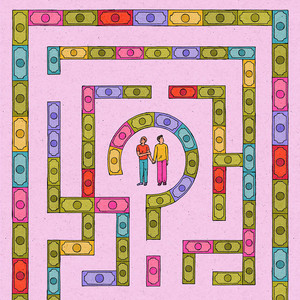
It was fact -checked by Sierra Juarez and edited by Kakin Cannon thanks to Grant Lee Phillips for our theme song and Caitlin Brico for episode artwork.
The Indicator is a production of NPR.
It's Love Week on the Indicator.
It's Love Week. It's Love Week.
It's Love Week. It's Love Week.
This message comes from Organic Valley, a farmer -owned dairy cooperative of small organic family farms dedicated to protecting where food comes from.
Learn more at ov .coop.
This message comes from Indiana University.
Indiana University is committed to moving the world forward, working to tackle some of society's biggest challenges, nine campuses, one purpose, creating tomorrow, today.
More at iu .edu. This message comes from Grammarly.
The work week can be fast -paced and it's hard to focus on getting everything done.
Ninety -three percent of professionals report that Grammarly helps them get more work done.
Download Grammarly for free at Grammarly .com slash podcast.